
8 Best Paint For Basement Cement Walls in 2026
This post contains affiliate links. As an Amazon Associate, we earn from qualifying purchases.
The best paint for basement cement walls is KILZ Basement and Masonry Waterproofing Paint, which blocks up to 12 PSI water pressure and resists alkali buildup in high-moisture areas. For maximum mold and mildew resistance, the Zinsser WaterTite Mold & Mildew White Waterproofing Paint offers a 10-year guarantee. Homeowners with actively damp walls will appreciate the Zinsser WaterTite General Purpose formula, which applies to wet masonry.
The real challenge with basement walls isn’t just appearance, it’s managing moisture, preventing mold, and ensuring the coating lasts. A paint that peels or fails under hydrostatic pressure wastes time and money, and can lead to bigger problems like structural damage.
This guide is based on manufacturer specifications, expert round-ups, and patterns in owner feedback. We evaluated each product for waterproofing ability, moisture resistance, ease of application, and durability to help you choose with confidence.
Top 8 Paints For Basement Cement Walls in the Market
Certain content that appears on this site comes from Amazon. This content is provided "as is" and is subject to change or removal at any time.
The Best Paints For Basement Cement Walls, Reviewed
KILZ Basement and Masonry Waterproofing Paint

What We Like
- Blocks up to 12 PSI water pressure
- Low-odor formula for indoor use
- Dries in 1 hour, recoat in 4
- Resists alkali buildup in high-moisture areas
Trade-offs
- Requires filling cracks with hydraulic cement first
- Full cure takes 7-14 days before washable
Blocking up to 12 PSI of water pressure, this paint tackles the kind of hydrostatic push that seeps through basement walls after heavy rain. That nanotechnology barrier means it’s built for below-grade concrete and masonry where lesser paints would blister or peel. It suits anyone finishing a damp basement who wants a durable, decorative finish that stands up to moisture and alkali buildup, all with a low-odor formula that makes indoor application comfortable. The quick dry time, touch in an hour, recoat in four, keeps the project moving without long delays between coats.
Compared to the Zinsser WaterTite General Purpose paint, which stops 10 PSI, this KILZ offers a higher pressure rating for more demanding walls. The seven-to-fourteen-day cure before the surface becomes washable means you can’t scrub scuffs right away, but that’s standard for serious waterproofing paints. For basement walls that see real water pressure, this is the one to reach for.
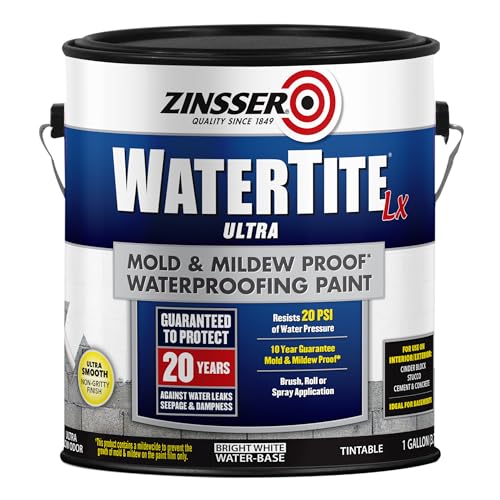
Zinsser WaterTite Mold & Mildew White Waterproofing Paint
What We Like
- 15-year waterproof guarantee on paint film
- 10-year mold & mildew-proof guarantee
- Ultra low odor with soap-and-water cleanup
Trade-offs
- Requires dry walls before application
- Only for interior masonry surfaces
A water-pressure resistance rating of up to 20 lbs. means this paint can handle serious hydrostatic pressure against basement walls, not just dampness. That backing comes with a 15-year waterproof guarantee and a separate 10-year mold and mildew guarantee on the paint film. That gives you long-term peace of mind in a space prone to moisture. The latex formula stays low odor and cleans up with soap and water, so you don’t need harsh solvents or a respirator for a weekend project. It lays down a smooth, bright white finish that feels more like a proper wall coating than a gritty block filler, which makes it a strong pick if your basement doubles as a living or workshop area.
The trade-off is that this paint works only on dry masonry surfaces, it’s a waterproofing coating, not a leak stopper for actively seeping cracks. If you’re dealing with a wet wall before you start, you’ll need to solve that first. For a basement where mold and mildew are the primary worry and the walls can be dried before painting, this is the most specialized protection in the guide.
Product photos
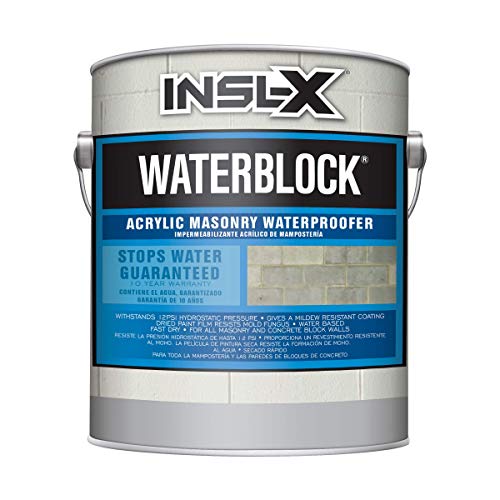
INSL-X WaterBlock Acrylic Masonry Waterproofer Paint
What We Like
- Fast-drying waterproof formula
- Withstands up to 12 psi hydrostatic pressure
- High alkali resistance up to pH 13
- Suitable for interior and exterior masonry
Trade-offs
- Only for vertical surfaces, not floors
- Requires 50-90°F temperature range to apply
With a hydrostatic pressure rating of 12 psi, this paint stands up to serious water pressure against basement walls, making it a strong choice for below-grade concrete that sees damp soil on the other side. Its fast-drying acrylic formula means you can recoat or move furniture back sooner than with slower-curing alternatives. That is a real advantage when you’re working on a tight schedule or in a basement you need to use quickly. It also handles high alkalinity up to pH 13, so fresh concrete or block walls won’t eat through the coating as they cure.
This paint is designed strictly for vertical surfaces, so it won’t work on basement floors or poured slabs where water seeps up from below. Against the KILZ waterproofing paint for basements and masonry, the INSL-X can handle higher hydrostatic pressure, up to 12 psi, and dries faster. But the KILZ comes in a heavier can at 12.5 pounds, which may be less convenient to handle on a ladder. For a basement wall project where speed and pressure resistance matter most, this is the one to reach for.
Product photos
Zinsser WaterTite General Purpose Waterproofing Paint

What We Like
- Resists 10 PSI water pressure
- Applies to wet or dry masonry
- Low odor water-based formula
- Bright white non-gritty finish
Trade-offs
- Covers only 250 sq. ft. per gallon
- Not for mold or mildew resistance
A 10 PSI water pressure rating means this paint actively stops dampness from seeping through basement cement walls, even under moderate hydrostatic pressure. That makes it a strong choice for homeowners dealing with chronically wet walls or occasional water intrusion. It can be brushed or rolled directly onto damp masonry without waiting for the surface to dry completely. The low-odor water-based formula also keeps the workspace more comfortable than solvent-based alternatives.
Coverage is a factor here: at up to 250 square feet per gallon, you may need more paint for a typical basement than some competitors, though actual coverage depends on surface porosity and application method. This version is not labeled for mold or mildew resistance, so if that is a concern, you would need to look for a product that specifically offers it. For walls that already feel wet to the touch, the ability to paint on a damp surface and stop up to 10 PSI of water pressure makes this a practical option.
Product photos
KILZ Self-Priming Masonry, Stucco and Brick Paint

What We Like
- Self-priming on masonry and stucco
- Alkali-resistant up to pH 12.0
- Works on smooth and rough textures
- Cleans up with soap and water
Trade-offs
- Flat finish shows stains more easily
- Coverage varies widely by texture
A single gallon of this acrylic latex paint covers between 250 and 400 square feet, with the actual number depending heavily on the roughness of the surface. On a typical textured basement wall, you should expect coverage closer to the lower end of that range. That’s enough for a modest-sized wall section or a small patio area. The paint is self-priming, so you can skip a separate primer coat on properly prepared masonry, stucco, or brick. It resists alkali up to pH 12.0, which helps it hold up on fresh concrete or mortar without peeling. Application is straightforward with a brush, roller, or sprayer, and cleanup requires only soap and water.
Keep in mind that this is a flat acrylic latex, not a waterproofing paint. If your basement has active moisture seepage or you need a barrier against water, you’re better off with a product like the KILZ Basement and Masonry Waterproofing Paint, which is heavier (12.5 lb per gallon) and formulated for waterproofing. But for a dry basement with masonry or stucco walls that just need a clean finish without extra prep steps, this self-priming formula gives you a natural look that accentuates the surface texture.
Product photos
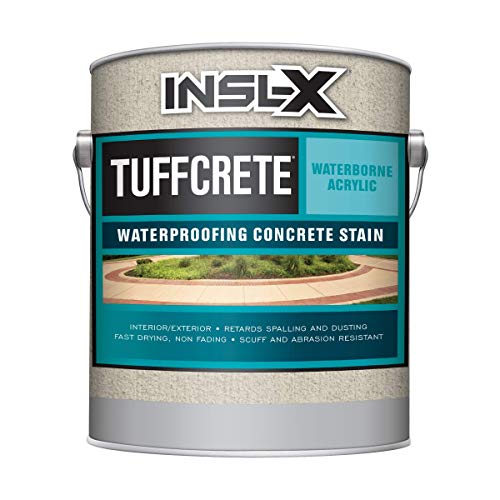
INSL-X TuffCrete Waterborne Acrylic Concrete Stain Paint
What We Like
- Non-fading, fast-drying formula
- Resists detergents, oils, and grease
- Works on interior or exterior masonry
- One-coat stain or two-coat opaque finish
Trade-offs
- Not a waterproofing paint, no water-seepage protection
- Requires surface temperature below 90°F for application
With 300 to 400 square feet of coverage per gallon, this stain paint can cover a typical basement wall in one or two coats depending on the finish you choose. Its acrylic formula bonds to concrete, stucco, and brick while resisting detergents, oils, and grease, making it a good fit for spaces that see occasional spills or heavy scrubbing. If you want a tough, stain-like finish that won’t fade quickly and dries fast enough for a same-day second coat, this is a durable option for homeowners.
This product is designed as a stain and finish, not a waterproofing barrier. Unlike the KILZ Basement and Masonry Waterproofing Paint, which stops water seepage, TuffCrete focuses on surface toughness and appearance. For basements with active moisture issues, pair this with a proper sealer underneath; for dry walls where you want a stain that holds up to traffic and cleaning, it’s a smart choice.
Product photos
MasterSeal 583 Formerly Super Thoroseal

What We Like
- Harder than the wall itself
- Made in the United States
Trade-offs
- At 39 lb, very heavy to carry
- Large 22-inch bucket hard to maneuver
- Designed as coating, not decorative paint
MasterSeal 583 claims a finish harder than the wall itself. For a basement where cement walls take bumps from storage, tools, or kids, that means a surface that resists chipping and scuffing far better than standard masonry paint.
Handling is the main consideration. At 39 pounds in a 22-inch bucket, this is not a quick weekend grab. It is heavy and bulky, so you will need a sturdy work surface and some muscle to mix and apply. Compared to the lighter KILZ Basement and Masonry Waterproofing Paint at 12.5 pounds, the MasterSeal demands more effort upfront but delivers a far denser, harder final coat. If your priority is maximum durability over convenience, this is the right call.
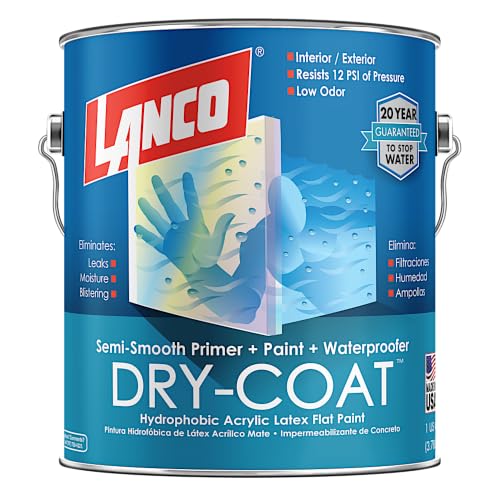
LANCO Dry-Coat Waterproofing Paint
What We Like
- Acts as primer, paint, and sealant
- Resists up to 12 PSI water pressure
- UV and chalk resistant
- Free of heavy metals and lead
Trade-offs
- White only, no color options listed
- Semi-smooth finish won't hide deep surface pitting
Resisting up to 12 PSI of hydrostatic pressure means this paint can handle serious water intrusion on basement walls, not just dampness. It also pulls triple duty as a primer, textured finish, and sealant, so you save time and money by skipping separate products. This makes it a strong fit for anyone wanting a single-coat solution that preps and protects in one step, especially on rough concrete or foundation walls where adhesion and waterproofing matter most.
One limitation is that this paint is available only in white, so if you need a colored finish, you will have to topcoat it. For a single-coat solution that primes, seals, and waterproofs in one step, the LANCO formula covers more ground with less effort.
Product photos
How We Evaluated Paints For Basement Cement Walls
Our evaluation focused on technical specifications from manufacturer documentation, expert round-ups, and common themes in owner feedback. Basement wall paint must perform under conditions that would ruin standard interior paint, so we prioritized real-world moisture resistance and longevity.
The four criteria that mattered most were hydrostatic pressure resistance (measured in PSI), mold and mildew protection, application requirements (dry vs. Wet walls, cure times), and finish durability. A paint that blocks 12 PSI is fundamentally different from one rated at 10 PSI, and knowing whether a wall must be dry before painting is critical.
A research-led evaluation has limits: we cannot replicate decades of moisture exposure in a lab. Instead, we rely on published guarantees (like 15-year waterproof warranties) and consistent owner reports to identify products that perform as claimed.
What To Look For In Paints For Basement Cement Walls
Choosing the right paint means matching the product to your wall’s moisture level and your project goals. Here are the key factors to consider.
Look for a paint that matches your wall’s moisture level: dry, damp, or wet. Check the PSI rating for water pressure resistance, and confirm whether the paint offers mold and mildew protection or just waterproofing.
Hydrostatic Pressure Resistance
This number tells you how much water pressure the coating can withstand. A rating of 10 to 12 PSI is ideal for below-grade basement walls. Paints with no PSI rating are not designed for waterproofing and will likely fail in a damp basement.
Moisture Condition at Application
Some paints require completely dry walls, while others can be applied to damp or even wet masonry. If you have an actively leaking wall, you need a product rated for wet application, but remember, no paint can stop an active leak; that requires structural repair first.
Mold and Mildew Resistance
Not all waterproofing paints include antimicrobial protection. If your basement is prone to musty smells or visible mold, look for a paint with a specific mold and mildew guarantee. These paints contain additives that prevent fungal growth on the coating itself.
Finish and Coverage
- Check the coverage rate per gallon (e.g., 250 sq. Ft. Vs. 400 sq. Ft.) to estimate how much paint you need.
- Consider the finish: flat hides imperfections but stains easily; semi-gloss is more washable.
- Verify if the paint is self-priming or requires a separate primer coat.
A gallon of basement wall paint typically covers 250-400 square feet, but rough or porous surfaces will use more.
Paints For Basement Cement Walls Compared
The table below compares all eight paints side by side, highlighting their waterproofing ratings, application conditions, and key features.
| Product | Coverage | Water Pressure Resistance | Surface Compatibility |
|---|---|---|---|
| KILZ Basement and Masonry Waterproofing Paint | N/A | Up to 12 PSI | Concrete, brick, cinder block |
| Zinsser WaterTite Mold & Mildew White Waterproofing Paint | N/A | Up to 20 lbs. | Interior Masonry Surfaces |
| INSL-X WaterBlock Acrylic Masonry Waterproofer Paint | N/A | Up to 12 psi | interior and exterior concrete walls |
| Zinsser WaterTite General Purpose Waterproofing Paint | 250 sq. ft. per gallon | 10 PSI | Wet or dry masonry |
| KILZ Self-Priming Masonry, Stucco and Brick Paint | 250-400 sq ft/gal | N/A | Masonry, stucco, brick |
| INSL-X TuffCrete Waterborne Acrylic Concrete Stain Paint | 300-400 sq ft/gal | N/A | Concrete, stucco, brick |
| MasterSeal 583 Formerly Super Thoroseal | N/A | N/A | N/A |
| LANCO Dry-Coat Waterproofing Paint | N/A | Up to 12 PSI | Basement, Concrete & Foundation Walls |
Frequently Asked Questions
Can I paint basement walls that are damp?
Yes, but only with a paint specifically formulated for damp or wet masonry, like the Zinsser WaterTite General Purpose formula. Most waterproofing paints require completely dry walls before application.
What is the best paint to stop water seepage in a basement?
The KILZ Basement and Masonry Waterproofing Paint is the best overall choice, blocking up to 12 PSI of water pressure. For maximum protection, the MasterSeal 583 offers a finish harder than the wall itself.
How long does basement waterproofing paint last?
Many quality paints carry a 15-year warranty on the paint film. The actual lifespan depends on the wall’s moisture condition, proper surface preparation, and whether the paint includes UV protection if exposed to sunlight.
Do I need a primer before painting basement walls?
Some paints, like the KILZ Self-Priming Masonry paint, include a primer and can be applied directly to clean masonry. Others recommend or require a separate primer for best adhesion and coverage.
What is the hardest finish for basement concrete walls?
The MasterSeal 583 (formerly Super Thoroseal) is designed to create a finish that is harder than the concrete wall itself. It is a heavy-duty coating, not a decorative paint, and comes in a large 39-pound bucket.
The Bottom Line
For most homeowners finishing a damp basement, the KILZ Basement and Masonry Waterproofing Paint is the best overall choice. It balances strong waterproofing, low odor, and fast drying with reliable alkali resistance. If mold is your primary concern, choose the Zinsser WaterTite Mold & Mildew formula for its 10-year guarantee.
For those with actively wet walls, the Zinsser WaterTite General Purpose paint applies directly to moist masonry. DIYers who want a single product that primes, seals, and waterproofs should consider the LANCO Dry-Coat.
The single most important factor is matching the paint to your wall’s moisture condition. A paint rated for dry walls will fail on damp masonry, and no paint can fix an active leak. Prepare the surface properly, and your basement walls will stay dry for years.
