
9 Best Engine Bay Paint in 2026
This post contains affiliate links. As an Amazon Associate, we earn from qualifying purchases.
For protecting and restoring your engine compartment, the Rust-Oleum Automotive High Heat Spray Paint is the best overall choice, offering extreme heat resistance up to 2000°F and a clear, rust-fighting finish. For those needing color options, the VHT Engine Metallic Spray Paint delivers a durable metallic gold, while the Eastwood Underhood Black Matte Acrylic Lacquer provides an authentic factory-correct look for classic restorations.
The challenge with painting an engine bay is finding a coating that can withstand extreme temperatures, resist oil and gasoline, and still look great after years of use. Not all paints are created equal, and using the wrong one can lead to peeling, discoloration, or failure under the hood.
This guide is based on a thorough analysis of manufacturer specifications, expert recommendations, and patterns in owner feedback. We have evaluated nine top options across key criteria like heat tolerance, chemical resistance, and application ease to help you choose with confidence.
Top 9 Engine Bay Paints in the Market
Certain content that appears on this site comes from Amazon. This content is provided "as is" and is subject to change or removal at any time.
The Best Engine Bay Paints, Reviewed
Rust-Oleum Automotive High Heat Spray Paint

What We Like
- Withstands heat up to 2000°F
- Resists oil, gas, and grease
- Stops Rust formula for corrosion protection
- Any-angle spray reaches tight engine spots
Trade-offs
- Clear finish only, no color options
- Requires multiple coats for best results
A 2000°F heat resistance rating means this paint can handle the hottest engine surfaces without bubbling or peeling, even near exhaust manifolds or turbochargers. That extreme tolerance, paired with the Stops Rust formula and resistance to oil, gas, grease, and solvents, makes it a complete protective layer for any engine bay. It is ideal for enthusiasts who want a clear, durable shield that preserves the natural look of their components while defending against the harsh chemicals and heat under the hood. The any-angle spray with a comfort tip helps you reach tight spots around hoses and brackets without needing to flip the can.
The trade-off is that this is a clear finish only, so it won’t change the color of your engine block or valve covers. If you are after a specific shade like the metallic gold flake of the VHT Engine Metallic Spray Paint, you will need to look elsewhere. Still, for pure protection and heat resistance in a straightforward clear coat, this paint delivers exactly what it promises with no fuss.
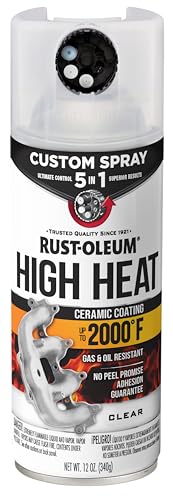
Rust-Oleum High Heat 5-in-1 Spray Paint
What We Like
- Five spray patterns for precise control
- Heat resistant up to 2000°F
- Gas and oil resistant ceramic coating
- Sprays from any angle
Trade-offs
- Limited to clear coating only, no color options
- Clear gloss only, no color options
This spray paint resists intermittent heat up to 2000°F, which makes it suitable for automotive parts that get hot, like exhaust manifolds. The 5-in-1 dial lets you choose from five spray patterns: high output, standard, low output, vertical fan, and horizontal fan. That gives you control over how the paint lays down, whether you need broad coverage or a narrower stream. The any-angle spray technology means you can spray from any orientation, so reaching tight spots is easier. It dries to the touch in 30 minutes and covers up to 10 square feet per can. The ceramic formula resists gas and oil, and the manufacturer promises no peeling.
This is a clear gloss finish, so it works as a topcoat over your existing color rather than a standalone paint. If you want a colored finish, other products like Dupli-Color Ford Semi-Gloss Black Engine Enamel or Dupli-Color Pontiac Blue Engine Paint offer those shades. But if you already have the color you want and need a clear, heat-resistant layer that stands up to gas and oil, this spray gives you flexible application options.
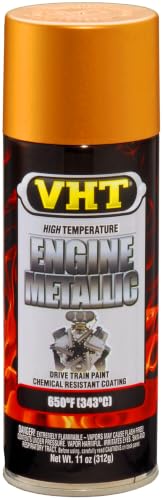
VHT Engine Metallic Spray Paint
What We Like
- Chemical resistant coating
- Drive train paint formulation
Trade-offs
- 650°F rating is lower than some 2000°F alternatives
- Gold flake limits color options for subtle builds
The chemical resistant coating protects against oil and coolant spills, so a quick wipe keeps the finish clean after a leak. With an intermittent temperature rating up to 650°F, the paint stays intact on parts that get hot during normal driving. The drive train paint formulation is built for components that face both heat and grime under the hood.
Product photos
Dupli-Color Ford Engine Enamel with Ceramic

What We Like
- Resistant to oil and automotive fluids
- EZ Touch Conical Nozzle for controlled spray
Trade-offs
- Heat limit of 500°F is lower than some competitors
- Semi-gloss black only, limited color choice
This makes it a strong fit for restorers or daily drivers who want a durable, factory-looking coat under the hood without worrying about fluid leaks ruining the paint.
Compared to Rust-Oleum Automotive High Heat Spray Paint, which is rated to 2000°F, this Dupli-Color enamel covers lower-temperature engine bay surfaces. For the block, inner fenders, and other parts that stay under 500°F, the fluid resistance and quick dry time make it a practical everyday choice.
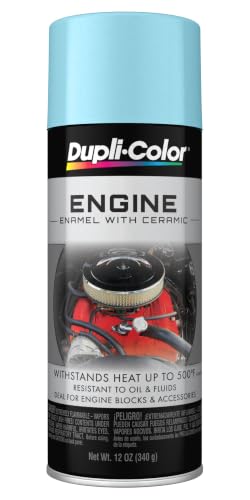
Dupli-Color Engine Paint with CERAMIC
What We Like
- EZ Touch Conical Nozzle included
Trade-offs
- 500°F limit is lower than 2000°F options
- Single color limits matching versatility
For someone restoring a classic Pontiac or just wanting a factory-correct blue with a metallic sheen, this is a clean, durable option that also shrugs off oil and fluid spills.
The heat ceiling is 500°F, which is lower than the 2000°F offered by the Rust-Oleum Automotive High Heat Spray Paint. Dupli-Color’s metallic blue is a single color, so if you need a different shade, you would need another product. But for a ceramic-protected finish with high gloss retention and chemical resistance, this paint matches its stated features.
Product photos
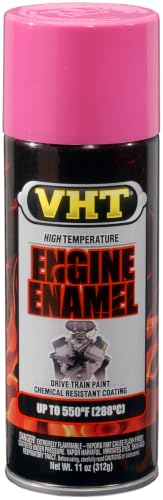
VHT Engine Enamel Spray Paint
What We Like
- Formulated to resist corrosion and rust
- Excellent heat and chemical resistance
- Withstands salt spray and additives
- Gloss finish for a clean look
Trade-offs
- Gloss finish shows dirt and grease more than flat
- No stated maximum heat rating like some competitors
VHT Engine Enamel is built to fight corrosion, rust, salt spray, and additives, four enemies that attack an engine bay from day one. That targeted protection makes it a natural fit for anyone restoring a daily driver or building a show car that needs to stay clean underhood for years. The gloss finish adds a polished look that complements a well-kept engine, and the enamel holds up against the heat and chemicals an engine sees regularly.
The gloss finish adds a polished look that complements a well-kept engine, but it will show oil smudges and dust more readily than a flat or matte finish. For a builder who prioritizes long-term corrosion resistance, this VHT enamel delivers exactly what the label promises.
Product photos
Seymour Hi-Tech Engine Spray Paint

What We Like
- Dries to touch in 5 minutes
- Heat resistant up to 300°F
- Chemical and gas resistant
- Restores factory color to engines
Trade-offs
- Only one color available: Universal Gold
- Not suitable for exhaust components over 300°F.
A five-minute dry-to-touch time means you can move from one coat to the next without waiting around, which is a real advantage when you are painting an engine bay in a single afternoon. The chemical and gas resistance helps protect the finish from exposure to oil or fuel, and the 300°F heat rating covers valve covers, blocks, and most underhood components comfortably.
The 300°F heat resistance means this paint won’t survive on exhaust headers or turbo housings, where Rust-Oleum’s High Heat spray paint reaches 2000°F. For engine bays and transmissions away from those extreme spots, the 15 square feet of coverage per can handles a full refresh. The Universal Gold color is the only one listed in the product details, so matching a specific OEM shade isn’t possible here.
Product photos
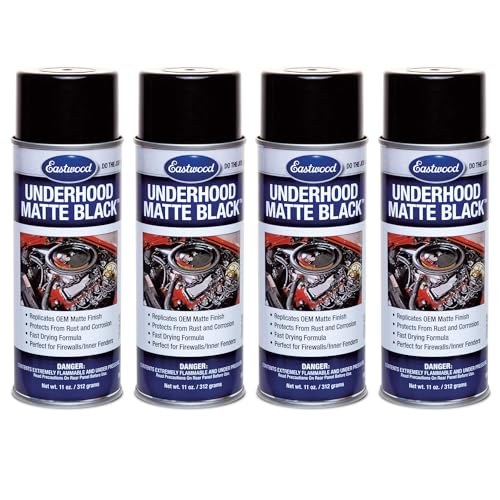
Eastwood Underhood Black Matte Acrylic Lacquer
What We Like
- Reproduces authentic factory-correct matte black
- Thin formula preserves stampings and surface details
Trade-offs
- Only 250°F heat resistance limits high-heat areas
Restorers aiming for a factory-correct matte black engine compartment will appreciate how this thin acrylic lacquer formula preserves original stampings and surface details. That means the subtle textures and markings from the assembly line remain visible, not buried under a thick coating. The aerosol delivers approximately six square feet of coverage per can, so a typical underhood job needs just a few cans. It handles heat up to 250°F, which is sufficient for radiator supports, firewalls, inner fenders, and brackets. The matte finish reproduces the look found on classic vehicle engine compartments, making it a practical choice for authenticity-focused projects.
Eastwood Underhood Black Matte Acrylic Lacquer reproduces the factory-correct matte black finish used on classic engine compartments. Its heat ceiling is 250°F, so it won’t stand up to exhaust manifolds or turbo housings the way Rust-Oleum Automotive High Heat Spray Paint’s 2000°F rating can. For the bulk of the engine compartment, firewalls, inner fenders, and brackets, this lacquer delivers a finish that looks period-correct and goes on without hiding the subtle contours of original sheet metal.
Sherwin-Williams Company DE1618-6PK Engine Bay Paint

What We Like
- EZ Touch Conical Nozzle for precise spray
- Dries to touch in 30 minutes
- Universal fit for any engine bay
Trade-offs
- Only available in Detroit Diesel Alpine Green color
- No stated maximum temperature rating in specs
A 30-minute dry-to-touch time means you can move on to reassembly or a second coat faster than with many engine enamels that take hours. The EZ Touch Conical Nozzle gives you control over application in tight engine compartments without overspray. This six-pack covers multiple components or a full bay, making it a practical choice for restorers who want a fast-drying finish that handles in one hour.
Sherwin-Williams Company DE1618-6PK Engine Bay Paint locks you into Detroit Diesel Alpine Green, which is perfect for vintage GM or military-style builds but not for anyone wanting a black, red, or silver engine bay. Compared to Rust-Oleum’s High Heat line, which offers heat resistance to 2000 degrees F, this option sacrifices versatility for a specific vintage look. If you’re matching a factory green engine block, this is the one.
How We Evaluated Engine Bay Paints
To build this guide, we conducted research-based evaluation by studying manufacturer datasheets, reviewing expert round-ups from restoration and automotive communities, and analyzing common patterns in owner feedback. This approach allows us to highlight the strengths and trade-offs of each product without relying on personal testing.
The four criteria that mattered most were heat resistance, chemical resistance, application quality, and finish accuracy. Heat resistance determines whether a paint can survive on exhaust manifolds or engine blocks, while chemical resistance ensures protection against oil, gas, and grease. Application quality covers spray patterns, nozzle design, and drying time. Finish accuracy matters for restorers seeking a factory-correct look.
It is important to note that this is a research-led evaluation, not a hands-on test. This means we can identify which paints are most likely to perform well for specific use cases, but we cannot guarantee performance in every unique environment.
What To Look For In Engine Bay Paints
Choosing the right engine bay paint means balancing heat tolerance, chemical resistance, and the finish you want for your build.
Look for a paint that matches the temperature of the part you are coating, resists oil and gasoline, and applies easily with a controlled spray pattern. Higher heat ratings (up to 2000°F) are essential for exhaust components, while 500°F is sufficient for engine blocks and valve covers.
Heat Resistance Rating
The most critical factor is the paint’s maximum temperature rating. Exhaust manifolds and turbo housings can exceed very high temperatures, requiring a paint rated for 2000°F like the Rust-Oleum High Heat options. Engine blocks and valve covers typically stay under 500°F, so a paint like the Dupli-Color Ford Engine Enamel with Ceramic (500°F) works well there. Always match the paint’s rating to the hottest part of the component you are coating.
Chemical and Corrosion Resistance
Engine bays are exposed to oil, gasoline, grease, and road salts. A paint that resists these chemicals will last longer and protect the metal underneath. Look for formulations that specifically mention resistance to oil, gas, and automotive fluids. Paints with ceramic additives, like the Dupli-Color Engine Paint with CERAMIC, offer enhanced heat dissipation and chemical protection. For maximum corrosion protection, consider the VHT Engine Enamel Spray Paint, which is formulated to resist rust and salt spray.
Application and Finish
The ease of application affects the final result. Look for spray paints with adjustable nozzles or “any-angle” spray technology to reach tight engine spots. Drying time matters too: the Seymour Hi-Tech Engine Spray Paint dries to touch in just 5 minutes, while others may take 30 minutes. The finish type, gloss, matte, or metallic, should match your restoration goals. For a factory-correct look, the Eastwood Underhood Black Matte Acrylic Lacquer preserves original surface details.
- Check the maximum temperature rating against the hottest part you are painting.
- Verify chemical resistance to oil, gasoline, and grease.
- Consider the drying time and nozzle design for your workspace.
- Match the finish type (gloss, matte, metallic) to your build’s aesthetic.
- For restorations, choose a paint that reproduces the original factory color and sheen.
A good rule of thumb: use 2000°F-rated paint for exhaust parts and 500°F-rated paint for blocks and valve covers.
Engine Bay Paints Compared
The table below compares the heat resistance, finish type, and key strengths of each engine bay paint in our lineup.
| Product | Heat Resistance | Finish/Type | Size |
|---|---|---|---|
| Rust-Oleum Automotive High Heat Spray Paint | 2000°F | Clear | 0.8 pounds |
| Rust-Oleum High Heat 5-in-1 Spray Paint | 2000°F | Gloss Clear | N/A |
| VHT Engine Metallic Spray Paint | 650°F | Flat, Gold Flake | 11 oz |
| Dupli-Color Ford Engine Enamel with Ceramic | 500°F | Semi-Gloss Black | 12 oz |
| Dupli-Color Engine Paint with CERAMIC | 500°F | Metallic, Pontiac Blue | 12 oz |
| VHT Engine Enamel Spray Paint | Excellent | Gloss, Hot Pink | 11 oz |
| Seymour Hi-Tech Engine Spray Paint | 300°F | Universal Gold | 12 Ounce |
| Eastwood Underhood Black Matte Acrylic Lacquer | 250°F | Matte black | 1.0 pounds |
| Sherwin-Williams Company DE1618-6PK Engine Bay Paint | N/A | N/A | 12 Ounces |
Frequently Asked Questions
What is the best engine bay paint for high heat?
The Rust-Oleum Automotive High Heat Spray Paint and the Rust-Oleum High Heat 5-in-1 Spray Paint both withstand temperatures up to 2000°F, making them ideal for exhaust manifolds, turbo housings, and other high-heat components. For parts that stay below 500°F, the Dupli-Color Ford Engine Enamel with Ceramic is a reasonable choice.
Can I paint over an existing engine bay color?
Yes, but you need to choose the right paint. The Rust-Oleum High Heat 5-in-1 Spray Paint is a clear topcoat designed to go over an existing color. For a colored finish, you can use a paint like the VHT Engine Metallic Spray Paint or the Dupli-Color Engine Paint with CERAMIC, but ensure the surface is properly cleaned and prepared.
How long does engine bay paint take to dry?
Drying times vary by product. The Seymour Hi-Tech Engine Spray Paint dries to the touch in 5 minutes, while the Sherwin-Williams Company DE1618-6PK Engine Bay Paint takes about 30 minutes. Most other paints recommend waiting before handling or exposing to heat.
What engine bay paint is best for a factory-correct restoration?
For a factory-correct matte black finish, the Eastwood Underhood Black Matte Acrylic Lacquer is the top choice. It reproduces the authentic look of original engine compartments and preserves surface details like stampings. For a Detroit Diesel or vintage GM build, the Sherwin-Williams Company DE1618-6PK Engine Bay Paint offers a factory-correct Alpine Green.
Do I need a clear coat over engine bay paint?
Not necessarily. Many engine paints, like the Rust-Oleum Automotive High Heat Spray Paint and the VHT Engine Enamel Spray Paint, are designed as complete finishes. However, if you want to protect an existing color or add extra gloss, a clear topcoat like the Rust-Oleum High Heat 5-in-1 Spray Paint can be applied.
The Bottom Line
For most engine builders and restorers, the Rust-Oleum Automotive High Heat Spray Paint is the best overall pick. Its 2000°F heat resistance, corrosion protection, and ability to spray at any angle make it a versatile choice for protecting engine parts without altering their original color.
If you need a colored finish, the VHT Engine Metallic Spray Paint delivers a durable metallic gold for moderate heat areas. The Eastwood Underhood Black Matte Acrylic Lacquer is perfect for achieving an authentic factory-correct look on classic cars. Budget-conscious restorers working on blocks and valve covers will find good value in the Dupli-Color Ford Engine Enamel with Ceramic.
The single most important factor in choosing engine bay paint is matching the heat rating to the component you are painting. Get that right, and you are well on your way to a durable, great-looking engine compartment.
