
10 Best Basement Waterproof Paint in 2026
This post contains affiliate links. As an Amazon Associate, we earn from qualifying purchases.
The KILZ Basement and Masonry Waterproofing Paint is the Best Overall pick. It blocks up to 12 PSI of water pressure, dries to the touch in one hour, and works on both interior and exterior masonry. For those needing mold resistance, the Zinsser WaterTite Mold & Mildew Waterproofing Paint offers a 15-year guarantee. If you are on a budget, the UGL Drylok Latex Masonry Waterproofer is a reasonable choice.
The real challenge with basement waterproofing paint is that not all products handle the same level of moisture. Some are designed for damp walls, while others can withstand active hydrostatic pressure from groundwater. Choosing the wrong one means you might end up with peeling paint and a wet basement anyway.
This guide is based on a thorough review of manufacturer specifications, expert round-ups, and patterns in owner feedback. We focused on the features that matter most for keeping a basement dry and livable. We will help you match the right paint to your specific moisture problem.
Top 10 Basement Waterproof Paints in the Market
Certain content that appears on this site comes from Amazon. This content is provided "as is" and is subject to change or removal at any time.
The Best Basement Waterproof Paints, Reviewed
KILZ Basement and Masonry Waterproofing Paint

What We Like
- Blocks up to 12 PSI water pressure
- Low-odor formula for easy application
- Dries to touch in 1 hour
- Suitable for interior and exterior masonry
Trade-offs
- Fully cures in 7-14 days
- Requires hydraulic cement for below-grade cracks
This paint blocks up to 12 PSI of water pressure, which means it can handle the kind of hydrostatic pressure that pushes moisture through concrete and cinder block walls. That makes it a strong choice for anyone finishing a below-grade space or sealing an outdoor retaining wall, especially since the low-odor formula lets you work indoors without needing heavy ventilation. KILZ has over 50 years of experience in surface coatings, and the nanotechnology barrier is designed to create a powerful water barrier that resists alkali buildup for a long-lasting finish.
The trade-off is patience: you can recoat in four hours. But the paint takes a full week or two to cure into a washable, durable finish, so don’t lean anything against the wall or hose it down too soon.
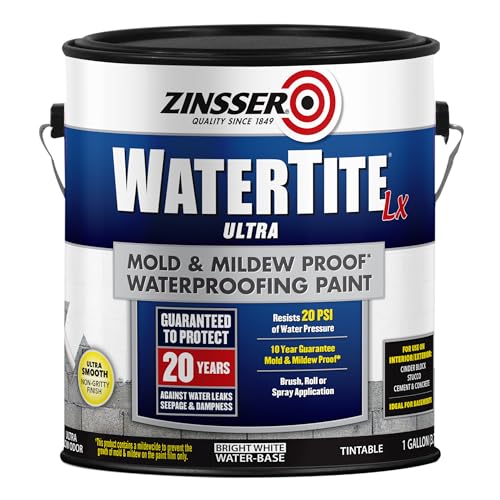
Zinsser WaterTite Mold & Mildew Waterproofing Paint
What We Like
- Ultra low odor during application
- Smooth, bright white finish
- 15-year waterproof guarantee
Trade-offs
- Requires dry wall before application
- No primer included for porous masonry
The catch is that the wall has to be completely dry before you roll it on, so an actively leaking wall will need to be stopped first. Compared to the KILZ Basement and Masonry Waterproofing Paint, which also gives a smooth finish, this Zinsser product demands more prep but offers a higher water-pressure resistance rating. For a basement where moisture is a constant threat, that extra effort buys real peace of mind.
Product photos
Zinsser WaterTite General Purpose Waterproofing Paint

What We Like
- Resists up to 10 PSI water pressure
- Applies to wet or dry masonry
- Bright white non-gritty finish
- Low odor water-based formula
Trade-offs
- Coverage limited to 250 sq ft per gallon
- Only for masonry surfaces, not wood or drywall
With a rating that resists up to 10 PSI of water pressure, this paint is designed to handle significant moisture on basement walls, not just surface dampness. It covers 250 square feet per gallon, making it a focused option for a single wall or a smaller cellar rather than an entire foundation. The bright white, non-gritty finish leaves a clean look that won’t feel rough under a brush or roller, and it goes on over wet or dry masonry without waiting for the surface to fully cure. That makes it a practical pick for a homeowner tackling a damp basement wall who wants reliable waterproofing without the fuss of pre-drying the surface.
Coverage runs 250 square feet per gallon, so you’ll need more paint for a full basement than some other products. That can mean more paint to buy for large areas. But if your project is a single wall or a small space, the 10 PSI resistance and easy application on wet masonry make this a straightforward, low-odor choice that gets the job done without lingering fumes.
Product photos
LANCO Dry-Coat Waterproofing Paint
What We Like
- Resists up to 12 PSI hydrostatic pressure
- Acts as primer, paint, and sealant
- UV-resistant and chalk-resistant
- Free of heavy metals and lead
Trade-offs
- Only available in white
- No mold or mildew resistance listed
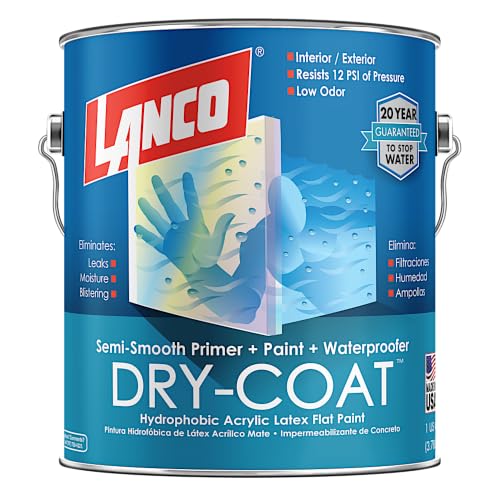
This paint resists up to 12 PSI of hydrostatic pressure, which means it can handle water pushing from behind the wall, the kind that seeps through foundation cracks after heavy rain. It also pulls triple duty as a primer, paint, and sealant, so you save time and money on extra coats or separate products. The UV and chalk resistance are listed features, and the lead-free formula is a responsible choice for indoor spaces.
LANCO Dry-Coat resists up to 12 PSI of hydrostatic pressure, which means it can handle typical below-grade water seepage in most basements. It comes only in white with a semi-smooth finish. The Zinsser WaterTite Mold & Mildew paint offers mold and mildew resistance, but LANCO does not list that feature. The YKF Masonry Pro resists up to 15 PSI, so if you face higher water pressure, that product may be a better fit.
Product photos
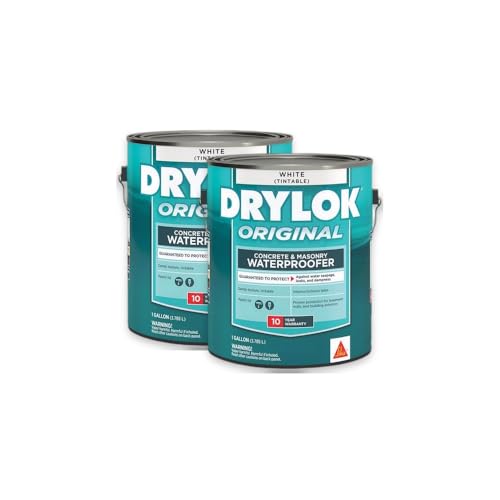
UGL Drylok Latex Masonry Waterproofer

What We Like
- Low-odor, water-based formula
- Easy cleanup with soap and water
- Brightens dark masonry surfaces
- Tintable with universal colorants
Trade-offs
- Coverage depends on surface porosity
- Not rated for surfaces under constant hydrostatic pressure
A water-based latex formula makes this one of the lowest-odor options for basement waterproofing, so you can work in a confined space without the headache of strong solvents. The white finish brightens dingy concrete or brick walls, and because it accepts universal colorants, you can tweak the shade without buying a separate tinted product. For a straightforward, budget-friendly way to seal interior masonry that doesn’t see standing water pressure, this is a practical choice that keeps application and cleanup simple.
That means it works well for damp walls and above-grade block, but if you are dealing with active seepage from below, the Zinsser WaterTite General Purpose Waterproofing Paint is built for that higher-pressure scenario. For the buyer whose basement is dry except for occasional moisture, this gallon keeps the job affordable without overcomplicating the process.
UGL Drylok Extreme Concrete Waterproofer

What We Like
- Withstands up to 15 psi hydrostatic pressure
- Penetrates deeply into masonry pores
- Bright white finish, tintable to match décor
- Easy application with brush, roller, or sprayer
Trade-offs
- At 24 lb, heavy for one-person handling
- Not tintable to match all existing wall colors
A 15 psi hydrostatic pressure rating means this coating can stand up to a 33-foot column of water pressing against your wall, making it a serious choice for basements that see real groundwater force. The formula is designed to penetrate deep into masonry pores rather than just sit on the surface, which suits anyone dealing with below-grade walls or retaining walls where water pressure is a known problem. The bright white finish gives you a clean look that can be tinted later if you want color.
At 24 pounds per gallon, this is noticeably heavier than the KILZ Basement and Masonry Waterproofing Paint at 12.5 pounds, so carrying a couple of gallons down basement stairs takes some effort. That heft comes from a thicker, more concentrated formula built to handle extreme conditions rather than just light dampness. For walls that need to stop real water force, the Drylok Extreme is built for that.
INSL-X WaterBlock Acrylic Masonry Waterproofer
What We Like
- Dries quickly for fast project turnaround
- Withstands up to 12 psi hydrostatic pressure
- High alkali resistance up to pH-13
- Works on concrete, cinder block, stucco, brick
Trade-offs
- Requires surface and air temps between 50-90°F
- Only for vertical walls, not horizontal surfaces
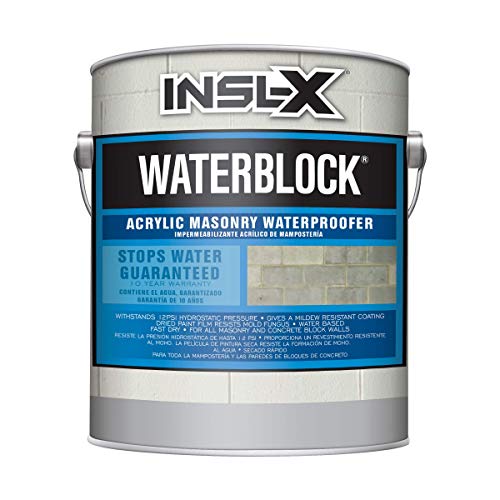
With a hydrostatic pressure rating up to 12 psi, this paint is designed to resist water penetration on basement walls, which is useful for areas prone to dampness. Its fast-drying acrylic formula means you can apply a second coat sooner than with some slower-drying alternatives, helping you finish the job faster. For DIYers looking to seal vertical masonry surfaces, this offers a practical balance of speed and pressure resistance.
The INSL-X WaterBlock withstands up to 12 psi hydrostatic pressure, which is more than the Zinsser WaterTite General Purpose’s 10 psi, but you can only use it on vertical walls, so no basement floors. You also have to paint when the temperature is between 50 and 90°F, which rules out freezing or scorching days. For a vertical masonry wall that needs waterproofing and dries fast, this is a practical option.
Product photos
YKF Masonry Pro Foundation Waterproofing Sealer
What We Like
- 15 PSI hydrostatic pressure resistance
- Water-based polyurethane high-solids formula
- Smooth white finish conceals minor imperfections
- Works on dry or slightly damp surfaces
Trade-offs
- Only 100 sq ft per gallon, less coverage than some
- Requires prep: repair cracks and leaks first
- Needs two coats for full coverage
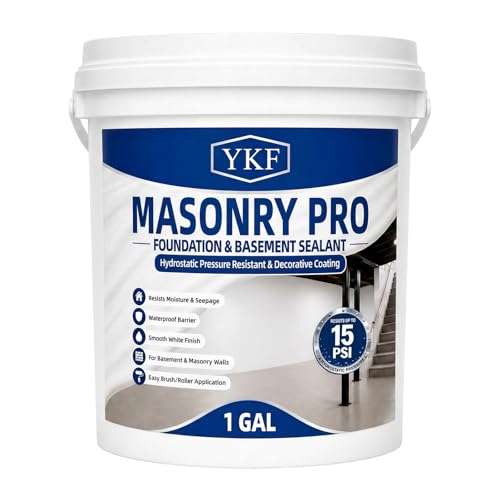
With a 15 PSI hydrostatic pressure resistance rating, this coating is engineered for below-grade wall conditions where water pressure is a concern. The water-based polyurethane formula bonds to both dry and slightly damp masonry, so you don’t have to wait for perfect conditions, and the smooth white finish hides small surface flaws as it seals.
Coverage is roughly 100 square feet per gallon, so a gallon covers less area than some alternatives. The manufacturer says to repair active leaks and cracks before applying. If your walls are already prepped and you need that 15 PSI resistance, this is a strong option. For larger areas with less demanding moisture conditions, a higher-coverage product might be more economical.
Product photos
MasterSeal 583 Waterproof Coating

What We Like
- Formerly Super Thoroseal formula
- Made in the United States
- Manufactured in the United States
Trade-offs
- At 39 lb, very heavy to carry
- Large 22-inch bucket needs floor space
This coating is a cement-based waterproofing product manufactured in the United States. Its dense formula is designed to create a hard, durable surface that resists water penetration. For homeowners or masons working on masonry walls that need a tough, long-lasting barrier, this product offers a level of hardness that typical paints cannot match. It is best suited for projects where maximum durability is the priority, not for quick cosmetic fixes.
At 39 pounds, this bucket is more than three times heavier than a gallon of KILZ Basement and Masonry Waterproofing Paint. Carrying it up stairs or mixing on-site demands real effort.
GROVE Flat White Latex Masonry Waterproofer
What We Like
- Tintable with universal colorants
- Low odor, low VOC formula
- Primer and sealer in one coat
- Works above and below grade
Trade-offs
- Covers only 100 sq ft per gallon
- 27.3 lb 2-pack is heavy to carry
The GROVE Flat White Latex Masonry Waterproofer covers 100 square feet per gallon, which is a fixed coverage rate stated by the manufacturer. Its flat white base can be tinted with universal colorants, so you are not stuck with plain white if you want a custom color. The water-based, low-VOC formula keeps odor down during application, and cleanup is with soap and water. It also combines primer and sealer in one coat, saving a step on basement or garage walls. No pre-mixing or pre-wetting is needed, so you can start painting sooner.
The two-pack weighs 27.3 pounds, which is heavier than single-gallon cans of comparable products, so carrying it down stairs requires a bit more effort. The 100-square-foot-per-gallon coverage means you will need to calculate your wall area carefully to avoid running short on larger projects. If your project is modest in size and you want a tintable finish that doubles as a primer and sealer, this pack offers two gallons at once. Just measure your walls before buying to ensure you have enough.
Product photos
How We Evaluated Basement Waterproof Paints
Our evaluation is research-based. We analyzed manufacturer data sheets for each product, looking for specific claims about hydrostatic pressure resistance, coverage rates, drying times, and application requirements. We also consulted expert round-ups from professional painters and masonry contractors to understand which products perform best in real-world conditions.
The four criteria that mattered most were hydrostatic pressure resistance (measured in PSI), coverage per gallon, drying and curing time, and the paint’s ability to resist mold and mildew. For a basement, the single most important factor is how much water pressure the coating can handle. A paint rated at 15 PSI is very different from one with no PSI rating at all.
A research-based evaluation has honest limits. Our conclusions come from what the manufacturer states, what industry experts report, and the patterns we see in thousands of owner reviews. This approach gives you a reliable starting point for your own purchase.
What To Look For In Basement Waterproof Paints
Choosing the right waterproof paint starts with understanding your basement’s moisture level. Here are the key criteria to consider before you buy.
Look for a paint rated for hydrostatic pressure (PSI) that matches your wall’s moisture exposure. Check coverage per gallon and drying time. Choose a low-odor, water-based formula for indoor use. Confirm the paint works on your specific surface (concrete, cinder block, brick).
Hydrostatic Pressure Resistance (PSI)
This is the most critical spec. PSI (pounds per square inch) measures how much water pressure the dried paint film can resist. A rating of 10 PSI is good for damp walls, while 12 to 15 PSI is needed for walls with active seepage or below-grade foundations. Products like the LANCO Dry-Coat and INSL-X WaterBlock handle up to 12 PSI, while the UGL Drylok Extreme and YKF Masonry Pro handle up to 15 PSI.
Coverage Per Gallon
Coverage determines how much paint you need and how many coats. Most products cover between 100 and 250 square feet per gallon. The Zinsser WaterTite General Purpose covers 250 sq ft, which is good for a single wall. The YKF Masonry Pro and GROVE Flat White cover only 100 sq ft per gallon, meaning you will need more product for large areas. Always measure your wall area and plan for two coats.
Drying and Curing Time
Drying to the touch is not the same as fully curing. The KILZ Basement paint dries in one hour but takes 7 to 14 days to cure. Fast-drying options like the INSL-X WaterBlock let you apply a second coat sooner. If you are painting a basement you use regularly, a fast-drying formula is more convenient. For a storage area, a longer cure time is acceptable.
Mold and Mildew Resistance
Basements are naturally damp, so mold resistance is a valuable feature. The Zinsser WaterTite Mold & Mildew line is specifically formulated for this. Some paints, like the LANCO Dry-Coat, do not list mold resistance. If your basement has a history of mold, prioritize a product with built-in protection.
- Check the PSI rating against your wall’s moisture level (damp vs. Actively seeping).
- Measure your wall area and divide by the paint’s coverage per gallon to estimate how many gallons you need.
- Look for a low-odor, water-based formula if you are painting in a living space.
- Confirm the paint is for vertical walls, not floors, unless you need both.
A good rule of thumb: if you see water beads on your wall, choose a paint rated at 12 PSI or higher.
Basement Waterproof Paints Compared
The table below compares the key specs of our top picks side by side, making it easy to see which paint fits your basement’s needs.
| Product | Coverage Type | Hydrostatic Pressure | Base Type |
|---|---|---|---|
| KILZ Basement and Masonry Waterproofing Paint | Interior & Exterior | N/A | N/A |
| Zinsser WaterTite Mold & Mildew Waterproofing Paint | Interior | 20 lbs. of water pressure | Latex |
| Zinsser WaterTite General Purpose Waterproofing Paint | N/A | 10 PSI | Water-based |
| LANCO Dry-Coat Waterproofing Paint | N/A | 12 PSI | N/A |
| UGL Drylok Latex Masonry Waterproofer | Interior/exterior | N/A | Water-based latex |
| UGL Drylok Extreme Concrete Waterproofer | N/A | Up to 15 psi | N/A |
| INSL-X WaterBlock Acrylic Masonry Waterproofer | Interior/exterior | 12 psi | Water-based acrylic |
| YKF Masonry Pro Foundation Waterproofing Sealer | Indoor and outdoor | 15 PSI | Water-based polyurethane |
| MasterSeal 583 Waterproof Coating | N/A | N/A | N/A |
| GROVE Flat White Latex Masonry Waterproofer | Interior and exterior | N/A | Latex |
Frequently Asked Questions
Can I apply basement waterproof paint over existing paint?
It depends on the existing paint’s condition and type. If the old paint is peeling or chalking, you must remove it first. Most waterproof paints, like the KILZ Basement and Masonry paint, work best on bare masonry or surfaces prepared with a primer. Always test a small area first.
How many coats of basement waterproof paint do I need?
Most manufacturers recommend two coats for full protection. Products like the YKF Masonry Pro require two coats for their full 15 PSI rating. The GROVE Flat White is a one-coat primer and sealer, but a second coat is still advisable for high-moisture areas. Always follow the label instructions.
What is the difference between waterproof paint and water-resistant paint?
Waterproof paint is designed to resist hydrostatic pressure from groundwater, meaning it can stop water from seeping through the wall. Water-resistant paint only repels surface moisture. For basements, you need a true waterproof paint with a PSI rating, not just a water-resistant masonry paint.
Can I use basement waterproof paint on the floor?
Most basement waterproof paints, including the INSL-X WaterBlock, are designed for vertical walls only. Using them on a floor where water pools or where you walk will cause them to fail. For basement floors, look for a specific epoxy or concrete floor paint rated for horizontal surfaces.
How do I prepare my basement wall before painting?
Preparation is critical. Fill any cracks or holes with hydraulic cement. Clean the wall of dirt, efflorescence, and loose paint. The Zinsser WaterTite Mold & Mildew paint requires a dry wall before application. For the best adhesion, many products recommend a light acid etch or a masonry primer on very porous surfaces.
The Bottom Line
For most homeowners, the KILZ Basement and Masonry Waterproofing Paint is the best all-around choice. It balances a strong 12 PSI rating, a fast dry time, and a low-odor formula that makes indoor application pleasant. It is ideal for dry to moderately damp basement walls where you want reliable protection without a complex application process.
If your budget is tighter, the UGL Drylok Latex Masonry Waterproofer offers a low-odor, tintable finish that brightens dark masonry. For basements with a history of mold, the Zinsser WaterTite Mold & Mildew line is worth paying more for. And if you face active water seepage, choose a high-PSI option like the UGL Drylok Extreme or YKF Masonry Pro.
The single most important factor in your choice is the hydrostatic pressure rating. Match the PSI to your wall’s moisture level, and you will have a dry, healthy basement for years to come.
