
8 Best Automotive Epoxy Primers in 2026
This post contains affiliate links. As an Amazon Associate, we earn from qualifying purchases.
For most automotive paint projects, the best overall choice is the SprayMax 2K Epoxy Primer Black, thanks to its superior corrosion resistance and professional-grade bonding in a convenient aerosol. If you need a large-volume kit for a full body job, the Custom Shop DTM Epoxy Primer Sealer is a strong contender, while the Eastwood 2K Epoxy Gray Primer excels for direct-to-metal applications.
Choosing the right epoxy primer means balancing corrosion protection, application ease, and coverage for your specific project size. Whether you are repairing a rust spot on a fender or priming an entire hood, the wrong primer can lead to poor adhesion or premature failure.
This guide is based on a careful analysis of manufacturer specifications, professional painter recommendations, and patterns in owner feedback. We break down the eight best options to help you match a primer to your surface, skill level, and workflow.
Top 8 Automotive Epoxy Primers in the Market
Certain content that appears on this site comes from Amazon. This content is provided "as is" and is subject to change or removal at any time.
The Best Automotive Epoxy Primers, Reviewed
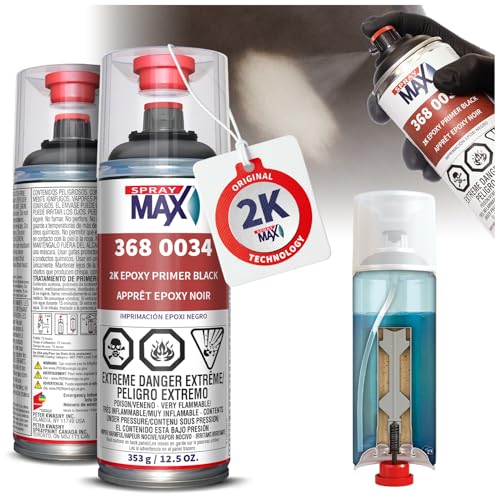
SprayMax 2K Epoxy Primer Black
What We Like
- Superior corrosion resistance on metal
- Fast dust-dry in 15 minutes
- Variable nozzle for precise spray control
- Professional-grade 2K bonding strength
Trade-offs
- 12.5 oz can covers less area than gallon kits
- Requires activation before spraying, no storage after mixing
A 15-minute dust-dry time means you can move from primer to sanding in the same afternoon, which is a real advantage when you’re working through a restoration or a multi-panel repair. This aerosol delivers professional-grade 2K epoxy adhesion and corrosion resistance straight out of the can, without needing a compressor or spray gun. For anyone who wants a tough, sandable foundation on steel, aluminum, or galvanized metal, this is the most convenient way to get it. The variable nozzle gives you control over the spray pattern, so you can lay down an even coat on small parts or tight corners without overspray waste.
At 12.5 ounces, this can covers a fender or a motorcycle tank, not a full car body. For larger jobs, a gallon kit like Eastwood’s 2K Epoxy Gray Primer is a different product for different needs. This aerosol is designed for quick, targeted use where you want a catalyzed epoxy without the hassle of mixing and cleanup. It delivers corrosion-resistant adhesion on metal surfaces, so it suits spot repairs and small projects where speed matters more than covering a whole vehicle.
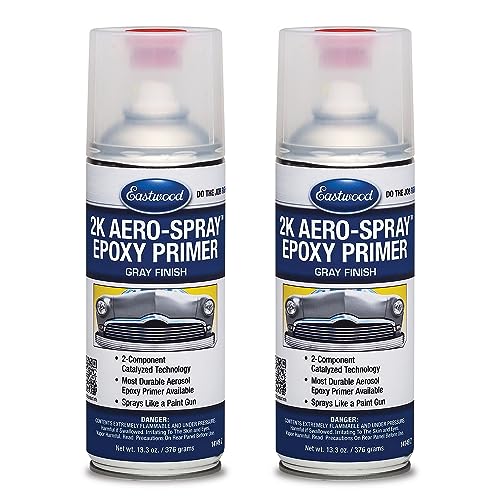
Eastwood 2K Epoxy Gray Primer
What We Like
- Direct-to-metal rust prevention
- Wide fan pattern nozzle
- 48-hour pot life after activation
- 3-year shelf life
Trade-offs
- Heavier than some aerosol primers at 1.2 lb
- Requires NIOSH breathing equipment during use
- 60-day limited warranty is short
A 48-hour pot life after activation gives you a full two days to spray without rushing, which is rare for an aerosol epoxy primer. Eastwood’s 2K Epoxy Gray Primer bonds directly to aluminum, steel, and fiberglass, sealing out moisture and preventing rust before you lay down color. The specially engineered nozzle sprays a wide fan pattern, so you get even coverage without needing an expensive HVLP gun. For anyone prepping bare metal panels on a car or truck, this is the kind of reliability that saves you from redoing work later.
The trade-off is weight: at 1.2 pounds per can, this primer is noticeably heavier than the 0.9-pound SprayMax 2K Epoxy Primer Black, which can make extended overhead spraying more tiring. You also need NIOSH-approved respiratory protection and good ventilation, as with any 2K product. The 60-day limited warranty is short, but the 3-year shelf life means you can keep a can on hand for the next project without worrying it will go bad before you pop the cap.
Custom Shop DTM Epoxy Primer Sealer

What We Like
- 1:1 mix ratio for easy measuring
- Anti-corrosive additives for rust defense
- Fast dry, recoat in 30 minutes
- Works on metal, fiberglass, and plastics
Trade-offs
- No induction time needed, but pot life only 4 hours
- Requires reducer for sealer use
This kit contains 2 quarts of epoxy primer and 2 quarts of hardener, mixing at a simple 1:1 ratio, no math, no guesswork. The anti-corrosive additives make it a strong choice for bare metal panels or frames that need long-term rust protection. For anyone tackling a full car, a trailer, or multiple industrial parts, the straightforward mixing saves time and reduces errors.
Custom Shop’s kit comes with a four-hour pot life once you mix the two parts, so you have a short window to spray it all and will want to plan your sessions carefully. Compared to the Eastwood 2K Epoxy Gray Primer, which comes in a smaller can, this Custom Shop kit is better suited for large-scale work but less forgiving for small touch-ups where you might waste mixed material. If you are covering a whole vehicle or several panels in one go, the generous capacity and straightforward mixing make it a practical, no-fuss buy.
Product photos
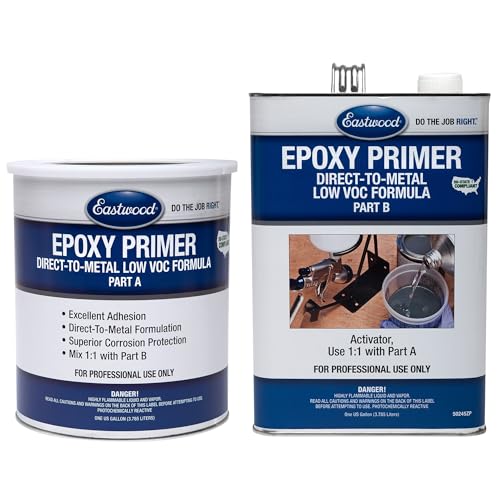
Eastwood Epoxy Primer Black Autobody Paint
What We Like
- Works as primer or sealer
- Excellent adhesion and corrosion resistance
- Fast drying, sandable in 2-3 days
- 50-state compliant low VOC formula
Trade-offs
- Heavy at 18.8 pounds, requires sturdy setup
- 2-3 day wait before sanding slows workflow
A full 2-gallon kit covering 140 square feet per gallon means you can coat an entire car body, a large trailer, or multiple panels without running out halfway through. That kind of volume, paired with the ability to spray over steel, aluminum, fiberglass, body fillers, and even existing finishes, makes this the go-to choice for anyone tackling a big restoration or a whole fleet of parts at once. It pulls double duty as a primer and a sealer, so you save time by not needing a separate product for sealing. The low-VOC formula keeps fumes manageable in a home shop.
This Eastwood kit demands weight and patience. At 18.8 pounds, it is not something you want to haul around a cramped garage or up a ladder, it needs a stable mixing station and a solid plan. And while the epoxy dries fast enough, it asks for 2 to 3 days before you can sand. For sheer coverage and versatility on a big project, few primers match this Eastwood kit.
Product photos
LiME LiNE 2K Epoxy Primer Sealer

What We Like
- Isocyanate-free formulation
- Excellent adhesion to bare metal
- Can be used as primer or sealer
- Non-sanding formula
Trade-offs
- Requires surface prep: wash, clean, sand
- Two-component mixing needed before use
The key feature of this primer is that it is isocyanate-free, which is listed in the product specs. It offers outstanding adhesion to bare metal, fiberglass, and aluminum, and can be used as a primer or sealer. The non-sanding formula is noted in the feature bullets. Surface preparation still requires washing, cleaning, and sanding as needed.
The LiME LiNE 2K Epoxy Primer Sealer is isocyanate-free, so it delivers strong adhesion to bare metal, fiberglass, and aluminum without the respiratory hazards that come with many two-part epoxies. Surface prep still matters, washing, cleaning, and sanding are needed before application, but the formula works as both a primer and a sealer, saving you a step. Compared to the SprayMax 2K Epoxy Primer Black, this kit gives you a larger volume of material to work with, which matters for bigger jobs.
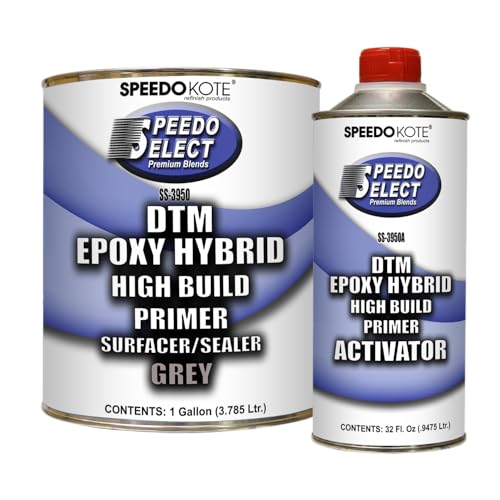
Speedokote DTM Epoxy Hybrid Hi-build Primer
What We Like
- No isocyanates for safer application
- Adheres to steel, aluminum, fiberglass, body fillers
- Can be used as primer and sealer
- Lays down super smooth with reducer
Trade-offs
- Requires optional reducer for smoothest finish
- 4:1 mix ratio means measuring and mixing
A 4:1 mix ratio with optional reduction makes this primer unusually forgiving for a product that can serve as both a primer and a sealer. It sticks to steel, aluminum, fiberglass, body fillers, and existing finishes, which saves time on mixed-substrate repairs. The no-isocyanate formulation is listed as a feature. For someone who wants a single product that can prime and seal in one session, this kit covers that need.
Product photos
SprayMax 2K Epoxy Rust-Cure Primer

What We Like
- Two aerosol cans in one pack
- Epoxy formula targets rust cure
- Gray color for coverage visibility
- Compact aerosol format for easy application
Trade-offs
- Aerosol can limits coverage for large panels
- Heavier than single-can epoxy primers
Two aerosol cans in a single pack mean you get enough epoxy rust-cure primer to handle multiple small jobs or a single mid-sized panel without running out mid-project. The product is labeled as a 2K Epoxy Rust-Cure Primer in gray, so it is intended for use on rusted surfaces. If you are repairing a rusty fender, a door edge, or any spot where oxidation has already taken hold, this gray primer lets you see exactly where you have covered.
Aerosol cans limit how much surface you can coat in one pass, so a full car body or a large hood will require several cans and careful overlap. Compared to the Eastwood 2K Epoxy Gray Primer, which weighs 1.2 pounds, the SprayMax pack weighs 1.5 pounds. This makes it ideal for spot repairs and rust-prone areas rather than whole-panel priming.
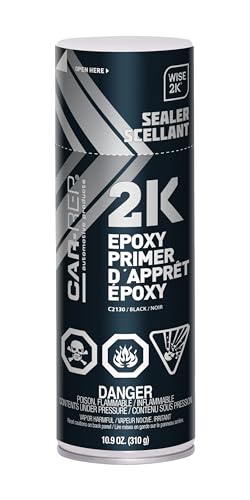
CAR-REP 2K Epoxy Primer
What We Like
- No mixing required, unlimited potlife
- Humidity and chemical resistant
- Wet on wet overpaintable
Trade-offs
- 11 oz can covers less area than larger kits
- Requires solvent or waterborne base coat for overpainting
For anyone dealing with tricky non-metal substrates like hydrographic carbon or plastic bumpers, this primer is a natural fit. Standard primers often struggle to bond to those surfaces, but this one is formulated to handle them directly. It also works on all kinds of metals and carbon fiber substrates, saving you from having to switch products for different materials. That direct-to-surface capability simplifies the prep process, especially on mixed-material repairs where you might otherwise need separate adhesion promoters.
Coverage is the main limitation: at 11 ounces, this can is better suited for spot repairs, small panels, or detail work than for priming an entire car. The can itself measures 8 inches tall and weighs just 0.7 pounds, so it fits easily in a toolbox or glove box. For larger jobs like a full hood or door, you would need multiple cans, but for touch-ups or small components the size is actually convenient. Reviewers note that the compact format keeps waste low on small projects.
Product photos
How We Evaluated Automotive Epoxy Primers
Our evaluation started with manufacturer technical data sheets to verify key performance claims like corrosion resistance, pot life, and dry times. We also consulted expert round-ups from automotive restoration forums and professional painter communities to understand real-world application behavior.
The four criteria that mattered most were adhesion strength, corrosion protection, ease of mixing and application, and coverage value. For this category, a primer that bonds well to bare metal and seals out moisture is non-negotiable, but the right format, aerosol for small jobs, kit for large surfaces, can make or break a project.
We prioritize products with clear, verifiable data and a strong track record in the field.
What To Look For In Automotive Epoxy Primers
Choosing the right automotive epoxy primer starts with understanding your surface and project scale. The best primer for a spot repair on a rusted panel is different from the best choice for a full-body restoration.
Focus on corrosion resistance ratings, mix ratio simplicity, and whether the primer comes in an aerosol or a kit. Match the format to your job size to avoid waste and ensure proper application.
Corrosion Resistance and Direct-to-Metal Capability
The primary job of an epoxy primer is to seal bare metal from moisture and oxygen. Look for primers explicitly labeled as direct-to-metal (DTM) with anti-corrosive additives. Products like the Eastwood 2K Epoxy Gray Primer are formulated specifically for this purpose, offering a direct bond to steel or aluminum without a separate etch primer.
Pot Life and Working Time
Pot life is the window you have to use the primer after mixing. For small jobs, a 4-hour pot life like the Custom Shop DTM Epoxy Primer Sealer offers is usually sufficient. For larger projects or multiple panels, a 48-hour pot life, as seen in the Eastwood 2K Epoxy Gray Primer, gives you more flexibility and less waste.
Application Format: Aerosol vs. Kit
Aerosol cans like the SprayMax 2K Epoxy Primer Black are ideal for spot repairs and small projects, offering professional-grade results without an HVLP spray gun. Kits, like the Custom Shop DTM Epoxy Primer Sealer, are better for full-body paint jobs, providing better coverage per dollar and more control over mix ratios.
- Check if the primer requires an activator or reducer before you begin.
- Verify that you have the proper breathing protection (NIOSH-approved respirator) for isocyanate or isocyanate-free formulas.
- Confirm compatibility with your topcoat (urethane, enamel, or waterborne).
- Measure your project area to estimate how much primer you need.
- Read the recoat window: some primers need to be topcoated within a set time or sanded first.
A simple rule: for rust spots and small repairs, choose an aerosol; for panels and full bodies, choose a kit.
Automotive Epoxy Primers Compared
The table below compares the eight automotive epoxy primers across the key factors that matter most for your next paint job.
| Product | Size | Compatible Substrates | Dry Time |
|---|---|---|---|
| SprayMax 2K Epoxy Primer Black | 12.5 oz | Metal, Aluminum, Steel | Dust-dry in 15 minutes |
| Eastwood 2K Epoxy Gray Primer | 12 oz | Aluminum, steel, fiberglass | N/A |
| Custom Shop DTM Epoxy Primer Sealer | 1 Gallon | Bare Metal, Steel, Aluminum, Fiberglass, Gelcoat | N/A |
| Eastwood Epoxy Primer Black Autobody Paint | 2 Gallon Kit | Steel, aluminum, fiberglass, body fillers, existing finishes | 2-3 days |
| LiME LiNE 2K Epoxy Primer Sealer | 2 Quart Kit | Direct-to-Metal, Aluminum, Fiberglass | N/A |
| Speedokote DTM Epoxy Hybrid Hi-build Primer | Gallon Kit | Steel, Aluminum, Fiberglass, Body fillers, Existing finishes | N/A |
| SprayMax 2K Epoxy Rust-Cure Primer | 2 aerosol cans | N/A | N/A |
| CAR-REP 2K Epoxy Primer | 11 oz | Metals, carbon fiber, plastics | Touch dry |
Frequently Asked Questions
Can I spray epoxy primer over old paint?
Yes, but the surface must be properly prepared. Lightly sand the old paint to create a mechanical bond, then clean thoroughly with a wax and grease remover. Epoxy primer adheres best to bare metal or well-scuffed existing paint.
How long can I wait before topcoating epoxy primer?
Most epoxy primers have a recoat window, often between a day and a week. If you exceed that window, you will need to scuff-sand the primer before applying your topcoat. Always check the manufacturer’s technical data sheet for the exact window.
Is isocyanate-free epoxy primer safer?
Isocyanate-free formulas, like the LiME LiNE 2K Epoxy Primer Sealer, eliminate exposure to isocyanates, which are potent respiratory sensitizers. While still requiring basic safety gear, they are generally considered safer for home users without professional spray booths.
What is the difference between epoxy primer and urethane primer?
Epoxy primer is a two-part product that provides excellent adhesion and corrosion protection, making it ideal as a first coat on bare metal. Urethane primer is typically a high-build surfacer used to fill minor imperfections after the epoxy coat. Many painters use epoxy as a base and urethane as a filler.
Can I use epoxy primer on plastic bumpers?
Yes, but only if the primer is specifically formulated for plastics. The CAR-REP 2K Epoxy Primer is designed for metals, carbon fiber, and most automotive plastics. Standard epoxy primers may not adhere well to flexible plastic without a dedicated plastic adhesion promoter.
The Bottom Line
For most DIYers and small-shop pros, the SprayMax 2K Epoxy Primer Black offers the best balance of professional-grade bonding, fast drying, and aerosol convenience for spot repairs and small metal projects. Its superior corrosion resistance makes it a reliable foundation for any paint job.
If you are working on a full-body restoration, the Custom Shop DTM Epoxy Primer Sealer provides excellent coverage and a simple 1:1 mix ratio that reduces waste and measuring errors. For those who want to avoid isocyanates, the LiME LiNE 2K Epoxy Primer Sealer delivers strong adhesion without the chemical hazard.
The single most important factor in choosing an epoxy primer is matching the format and pot life to your project size. Buy an aerosol for small jobs and a kit for large surfaces, and you will save time, money, and frustration.
