
10 Best Airbrushes For Models in 2026
This post contains affiliate links. As an Amazon Associate, we earn from qualifying purchases.
For modelers who need both fine detail and broad coverage, the Iwata Eclipse HP-CS Airbrush is our best overall pick. Its compression-fit nozzle and break-resistant needle make it a versatile, easy-to-clean workhorse. For tool-free convenience, the Harder & Steenbeck Ultra 2024 offers a self-centering nozzle, while the Master Airbrush G233 Performance Pro Kit provides three nozzle sets for maximum versatility.
Choosing the right airbrush for models means balancing precision, ease of cleaning, and the ability to handle everything from tiny cockpit dials to large camouflage patterns. A brush that excels at one often struggles at the other. This guide is research-based, drawing on manufacturer specifications and patterns in owner feedback to help you find the right fit for your workbench.
Top 10 Airbrushes For Models in the Market
Certain content that appears on this site comes from Amazon. This content is provided "as is" and is subject to change or removal at any time.
The Best Airbrushes For Models, Reviewed
Iwata Eclipse HP-CS Airbrush

What We Like
- Ultra-fine lines to broad sprays
- Compression-fit E3 nozzle for easy cleaning
- Break-resistant spring-steel needle
- Solvent-resistant needle packings
Trade-offs
- Small 0.24 oz cup requires frequent refills
- Gravity feed limits use with thick paints requiring thinning
A compression-fit E3 nozzle with no threads means you can swap tips without worrying about cross-threading, a real time-saver when switching between paint types. The dual-action trigger lets you control air and paint independently, so moving from a hairline to a wide spray is a simple finger adjustment. A spring-steel needle resists bending if you accidentally knock the tip, and the solvent-resistant packings hold up against acrylics, enamels, and lacquers without drying out.
The 0.24 oz gravity cup is small, so you will need to refill it often when painting large surfaces. If you prefer fewer interruptions, the Harder & Steenbeck Ultra 2024 offers a 5ml cup and a 0.45mm self-centering nozzle, but its larger nozzle may not match the Eclipse’s ability to produce very fine lines. For most modelers, the Iwata’s balance of precision, durability, and quick maintenance justifies the extra cost over budget kits.
Harder & Steenbeck Ultra 2024 Airbrush

What We Like
- Self-centering nozzle for consistent atomization
- 5ml cup plus built-in micro-cup socket
- Fully backward compatible with H&S systems
- Tool-free disassembly for easy cleaning
Trade-offs
- Single 0.45mm nozzle only; no smaller tip included
- Weighs 0.6 pounds, which is heavier than some compact airbrushes
A 0.45mm self-centering nozzle means the needle and nozzle align automatically every time you reassemble the airbrush, so you get repeatable atomization without fiddling with tiny adjustments. That alone makes this a strong pick for modelers who want consistent spray patterns from one session to the next. The 5ml cup handles extended work, and the built-in micro-cup socket lets you paint with just a drop of color while keeping your line of sight clear for fine details. It suits anyone who values precision and easy maintenance over raw speed.
The trade-off is weight: at 0.6 pounds, the Ultra 2024 is heavier than a compact option like the Iwata Eclipse HP-CS, which sits at 0.1 pounds. That extra heft can tire your hand during long sessions, though the balanced German engineering helps. For modelers who want a durable, upgradeable airbrush with a hassle-free nozzle setup, this is a smart investment.
Master Airbrush G233 Performance Pro Kit
What We Like
- Three nozzle sets for fine to wide spray
- Quick-disconnect coupler with airflow control
- Cutaway handle for easy cleaning
- Works with most paint types
Trade-offs
- 1/3 oz cup is small for large coverage work
- Heavier than some rival airbrushes at 0.2 pounds
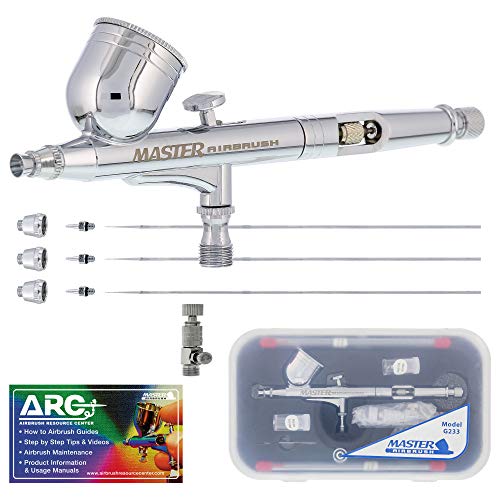
Three interchangeable nozzle sets, 0.2, 0.3, and 0.5 mm, let you switch from ultra-fine detail lines to two-inch-wide background sprays without buying a second airbrush. That range makes this kit a natural fit for modelers who paint everything from tiny cockpit dials to large camouflage patterns. The gravity-feed dual-action trigger gives you direct control over paint flow, and the included quick-disconnect coupler with a built-in airflow valve means you can adjust pressure right at the brush. Beginners will appreciate having all three sizes ready to go, while experienced artists can grab the right nozzle for each stage of a project.
The 1/3-ounce fluid cup is small, fine for detail work, but you will need to refill often when spraying larger surfaces. Compared to the Iwata model, which uses a single 0.24 oz cup and a fixed 0.3 mm nozzle, this Master set gives you more flexibility but less continuous spray time per fill. Overall, this is a practical all-in-one kit that covers the most common model painting tasks without requiring extra purchases.
Paasche TG-3AS Airbrush Set
What We Like
- Three nozzle sets for extreme fine detail
- Fan aircap for wider coverage when needed
- Needle stop for consistent paint release
- Highest-end Paasche model for precision
Trade-offs
- No compressor or hose included in set
- Heavier than many competing airbrushes at 0.0 pounds
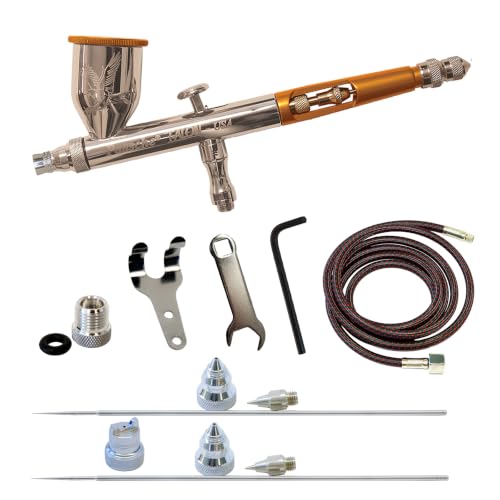
The TG is Paasche’s highest end airbrush, delivering the finest detail of all their models, so you can trust it for precision work. It includes .25mm, .38mm, and .66mm heads plus a fan aircap, letting you switch between fine lines and broader coverage without buying extra parts. Made in the USA, this double action gravity feed tool suits anyone who needs consistent paint release from a single, versatile airbrush.
You get the airbrush alone, no compressor, hose, or cleaning kit, so you’ll need to supply your own air source and accessories. Compared to the Iwata model, which is a gravity-feed dual-action airbrush with a 0.24 oz cup, the Paasche offers more nozzle size options but requires you to invest in supporting gear separately. If you already own a compressor and focus on fine detail work, this set gives you the versatility to handle both small and larger areas.
Badger Sotar 2020-2F Airbrush

What We Like
- Fine needle/nozzle for hairline detail
- 1/12 oz cup for extended painting sessions
- Micrometer preset for repeatable spray patterns
Trade-offs
- 2 ml cup holds less paint than larger-cup models
- 2 ml cup is too small for large coverage jobs
The fine needle and nozzle combination delivers a spray pattern that goes from a hairline up to 3/4 inch. That gives you precise control for the most delicate model details like cockpit instruments or tiny panel lines. Designed by professional illustrators, the Sotar 2020-2F suits modelers who spend hours on intricate work and need an airbrush that can hold enough paint to avoid constant refills. Its micrometer lets you lock in a repeatable spray width, so you can focus on technique rather than dialing in settings between sessions.
Size and weight are the trade-offs here. At 8.8 inches long and half a pound, this airbrush is longer and heavier than the compact Iwata model, which is 2.4 inches long and weighs 0.1 pounds. That extra size and weight may be noticeable during long painting sessions, and the 2 ml cup, while allowing extended use before refills, still holds less paint than some larger-cup models. For modelers who prize pinpoint accuracy over portability, though, the Sotar’s precision engineering makes it worth the extra mass.
Product photos
Master Airbrush Cool Runner II Kit
What We Like
- Three airbrushes cover detail to broad coverage
- Dual cooling fans for longer run time
- Includes paints, reducer, cleaner, and brushes
- Quick Start Guide and resource access card
Trade-offs
- Single-piston compressor can vibrate during use
- 9.0-pound unit is heavy for frequent relocation
- Siphon-feed brush uses larger 0.8mm tip only
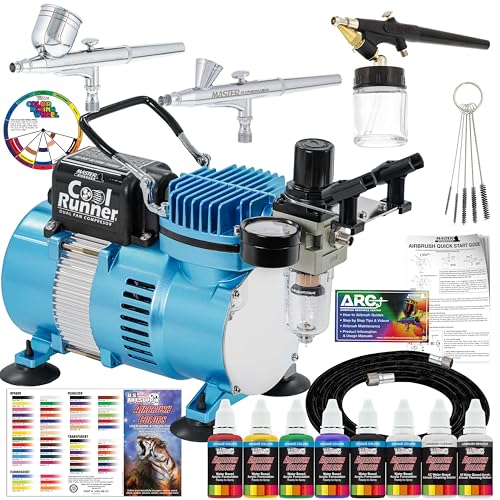
A 1/5 hp compressor with two cooling fans lets this system run continuously longer than most single-piston units. That matters when you’re laying down base coats or working through a batch of models without waiting for the compressor to cool. The kit includes three airbrushes: a 0.3mm dual-action for general work, a 0.2mm dual-action for fine lines and details, and a 0.8mm single-action siphon-feed for spraying larger areas or thicker paints like primers. With six acrylic paints, reducer, cleaner, and a cleaning brush set included, you have everything needed to start painting right out of the box.
The compressor in this kit is a single-piston design, so it vibrates more on a desk than quieter oil-less or twin-piston models. At nine pounds it is not something you want to move between workstations daily. Compared to the standalone Iwata model, which weighs only 0.1 pounds, the Master kit gives you a complete system but with a heavier compressor. The siphon-feed brush’s 0.8mm tip is best for thick paints and large coverage; it is not ideal for the ultra-fine detail work that the 0.2mm brush handles well.
Product photos
Gocheer Airbrush Kit With Compressor

What We Like
- Three selectable pressure settings
- Three matched needle/nozzle sets included
- Metal airbrush gun with ergonomic grip
- Complete cleaning and maintenance kit
Trade-offs
- At 1.5 lbs, heavier than standalone airbrush guns
- Compressor limits portability for field use
The compressor in this kit delivers up to 48 PSI with three selectable settings, so you can choose the pressure that fits your task without swapping tools. The needle and nozzle sets in three sizes let you switch between fine lines, everyday coloring, and broader coverage with the same gun. The dual-action trigger controls both airflow and paint flow, and the rear limit knob lets you preset the maximum paint output to help avoid overspray and wasted pigment. For someone who wants one setup that handles a range of airbrush work, this kit provides the flexibility without needing separate purchases.
At 1.5 pounds, this kit is heavier than a standalone airbrush like the Iwata model, which weighs 0.1 pounds. That extra weight means it is better suited for a stationary workspace than for moving around a workbench. The compressor is part of the kit, so you have a complete air supply in one package, but it limits how freely you can reposition during a session. For someone setting up a dedicated workspace who wants a complete air supply and three nozzle options, the convenience of having everything in one package may outweigh the bulk. The metal gun body wipes clean easily, and the included cleaning tools help prevent clogs, so maintenance is straightforward.
Product photos
Gaahleri GHAD-39 Airbrush Gun
What We Like
- Quick self-centering drop-in nozzle for easy cleaning
- Includes 0.35mm and 0.5mm needle sets
- Two replaceable gravity-feed fluid cups
- 8 Micro-Air-Channel system for fine detail
Trade-offs
- Two cup sizes but no tiny cup for micro-detail
- Heavier than some competitors at 0.9 pounds
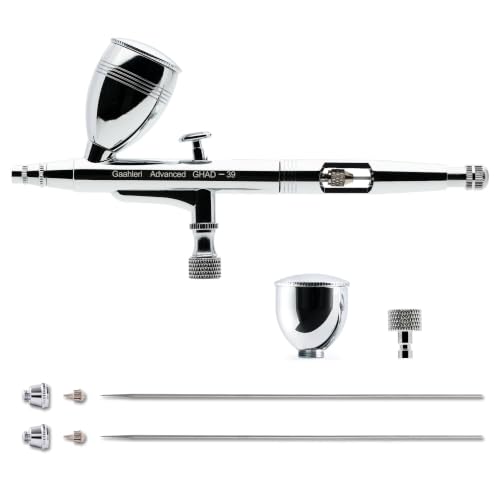
The quick self-centering drop-in nozzle structure is the key feature here, letting you disassemble and clean the airbrush far more easily than traditional threaded nozzles. With both 0.35mm and 0.5mm needle sets included, plus two cup sizes, this kit covers everything from fine model details to broader base coats without needing extra purchases.
Weighing 0.9 pounds and measuring 5.9 inches long, this airbrush is heavier than some competitors like the Iwata model that weighs 0.1 pounds. That extra heft can be noticeable during long sessions, but if you value the quick self-centering nozzle and the flexibility of two needle sizes, this is a practical choice that brings self-centering convenience to a wider range of users.
Iwata NEO CN Dual Action Airbrush
What We Like
- Dual action trigger for fine detail
- Two included fluid cups for versatility
- Smooth main lever for easier control
- Low air pressure design for beginners
Trade-offs
- Too light for users wanting a heavier metal-bodied brush
- Plastic body feels less durable than metal alternatives.
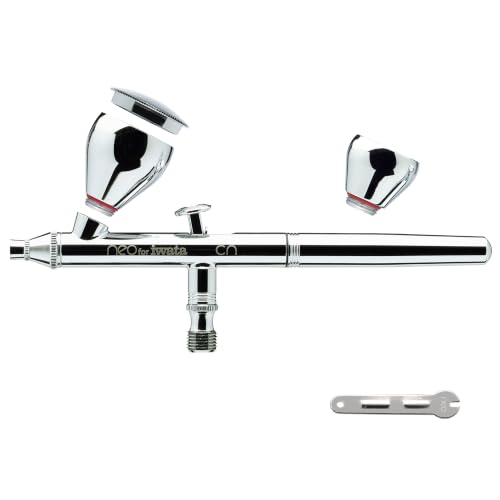
The Iwata NEO CN uses a dual action trigger that gives you full command over paint flow and air, so you can switch from a broad spray to a fine line without stopping. It comes with two detachable cups, a 0.24 oz for larger mixes and a 0.10 oz for small batches, which means you can work on a base coat and then swap to a tiny detail color without cleaning in between. This is the airbrush for someone who wants to learn on a tool that forgives mistakes and still rewards careful control. The smooth main lever action makes it easier to feather the trigger, and the low air pressure design means you don’t need a heavy-duty compressor to get good atomization. If you are picking up an airbrush for the first time and want something approachable that won’t fight you, this is a natural place to start.
At half a pound, this brush is light enough to handle for hours without fatigue, though some modelers accustomed to a heavier tool like the Harder & Steenbeck Ultra 2024 may find it lacks the heft they prefer. The N3 nozzle delivers smooth, even coverage at low air pressures, making it forgiving for beginners learning dual-action control. With two detachable cups, 0.24 oz for larger mixes and 0.10 oz for small projects, and a smooth main lever, the NEO CN keeps the learning curve gentle without sacrificing the control needed for detail work.
Product photos
Roizefar Airbrush Kit With Compressor

What We Like
- 18 paints plus 2 thinners included
- 3 nozzle sizes for detail to coverage
- 55 PSI compressor with adjustable airflow
- 4 large cleaners and cleaning brush set
Trade-offs
- Bulky kit at 7.1 x 5.0 x 9.4 inches
- Paints require shaking before each use
Eighteen paint colors and two thinners come right in the box, so you can start spraying models without a separate shopping trip. The 55 PSI compressor gives you three airflow settings between 14 and 23 L/min, letting you switch from fine lines to broader coverage by pressing a button. Three nozzle sizes help you tackle everything from tiny cockpit details to larger body panels. For a modeler who wants a complete setup with plenty of color options from day one, this kit saves time and guesswork.
Product photos
How We Evaluated Airbrushes For Models
Our evaluation is based on research. We examined manufacturer specifications, reviewed expert round-ups from modeling communities, and analyzed patterns in verified owner feedback to understand what makes an airbrush perform for modelers.
We focused on four key criteria. First, nozzle and needle precision determines how fine a line the brush can spray, essential for panel lines and stencils. Second, cleaning and maintenance is critical; a brush that clogs easily or is difficult to disassemble wastes painting time. Third, versatility, whether the brush can swap needle/nozzle sets or adjust spray patterns, matters for modelers who switch between detail and coverage. Finally, build quality and ergonomics affect comfort during long sessions and long-term durability.
The honest limit of this research-led evaluation is that we cannot report on real-world longevity or how a specific brush feels in the hand over months of use. We rely on consistent owner reports and technical specs to guide our recommendations.
What To Look For In Airbrushes For Models
Choosing the right airbrush for models comes down to understanding how its action, nozzle, and cup size match your typical project.
A dual-action gravity-feed airbrush with a 0.3mm to 0.5mm nozzle offers the best balance for most modelers. Look for easy cleaning, a consistent spray pattern, and a cup size that matches your painting sessions.
Action Type: Single vs. Dual
A dual-action airbrush lets you control both air and paint flow with one trigger. Pressing down gives air, pulling back releases paint. This allows you to vary line width and opacity mid-stroke, which is essential for fades, highlights, and precise detail work. Single-action brushes are simpler and often cheaper, but they lack this fine control. For model painting, a dual-action brush is the standard recommendation.
Nozzle and Needle Size
The nozzle and needle size determines the minimum line width and the types of paint you can spray. A 0.2mm to 0.3mm nozzle is ideal for fine detail like cockpit instruments and panel lines. A 0.4mm to 0.5mm nozzle handles primers, thicker paints, and broader coverage. Some airbrushes come with interchangeable nozzle sets, allowing you to swap between sizes within one brush body, offering the best of both worlds.
Feed Type: Gravity vs. Siphon
Gravity-feed airbrushes have a cup on top, using gravity to pull paint into the nozzle. They require less air pressure and waste less paint, making them the favorite for detail work. Siphon-feed brushes draw paint from a jar attached below, allowing larger paint volumes, but they need higher pressure and are harder to clean. For modelers, a gravity-feed brush is almost always the better choice for precision and efficiency.
Ease of Cleaning
Cleaning is the most frequent maintenance task for an airbrush. Look for features like a tool-free nozzle removal, a cutaway handle, or a self-centering drop-in nozzle. A brush that is quick to disassemble and clean will encourage you to maintain it properly, preventing clogs and extending its life. Needle packings that resist solvents also reduce wear from cleaning agents.
- Does the airbrush have a tool-free nozzle or a compression-fit seal for easy cleaning?
- Are replacement needles and nozzles readily available from the manufacturer?
- Does the cup size match your typical paint volume to avoid constant refills?
- Is the brush body comfortable to hold for extended periods without fatigue?
A brush that is easy to clean is a brush you will actually use.
Airbrushes For Models Compared
The table below compares the key specs and best-use cases for our ten picks, from the best overall to budget-friendly starter kits.
| Product | Feed Type | Action | Nozzle Size(s) |
|---|---|---|---|
| Iwata Eclipse HP-CS Airbrush | Gravity feed | Dual action | E3 compression-fit |
| Harder & Steenbeck Ultra 2024 Airbrush | Gravity feed | Dual action gravity feed | 0.45mm self-centering |
| Master Airbrush G233 Performance Pro Kit | Gravity dual-action | Dual-action | 0.2, 0.3 & 0.5 mm |
| Paasche TG-3AS Airbrush Set | Double action gravity feed | Double action gravity feed | .25mm, .38mm & .66mm |
| Badger Sotar 2020-2F Airbrush | Gravity feed | Gravity feed, dual action, internal mix | Fine (black) |
| Master Airbrush Cool Runner II Kit | Gravity feed | Dual-action | 0.3mm, 0.2mm, 0.8mm |
| Gocheer Airbrush Kit With Compressor | N/A | Dual-action trigger | 0.2 / 0.3 / 0.5 mm |
| Gaahleri GHAD-39 Airbrush Gun | Gravity feed | Dual-action gravity feed | 0.35mm & 0.5mm |
| Iwata NEO CN Dual Action Airbrush | N/A | Dual action | N3 nozzle |
| Roizefar Airbrush Kit With Compressor | N/A | Dual-action | 0.2 / 0.3 / 0.5 mm |
Frequently Asked Questions
What size airbrush nozzle is best for model painting?
A 0.3mm to 0.4mm nozzle is the most versatile for general model painting. It can handle fine detail like panel lines and camouflage, while still being able to spray primers and base coats with proper thinning. For extreme detail, a 0.2mm nozzle is better; for large surfaces and thicker paints, a 0.5mm nozzle is ideal.
Is a dual-action airbrush better than single-action for models?
Yes, a dual-action airbrush is strongly recommended for modelers. It gives you independent control over air and paint flow, allowing you to vary line width, create fades, and apply precise highlights in a single pass. Single-action brushes are simpler but lack this control, making them less suitable for detailed work.
What is the difference between gravity feed and siphon feed airbrushes?
Gravity-feed airbrushes have a paint cup on top, using gravity to feed paint into the nozzle. They require less air pressure, waste less paint, and are easier to clean, making them ideal for detail work. Siphon-feed brushes draw paint from a jar below, allowing larger volumes but needing higher pressure and more cleaning effort.
How do I clean an airbrush after painting models?
Clean the airbrush immediately after use. Flush the cup and nozzle with a compatible cleaner, then disassemble the needle and nozzle for a thorough soak. Use a soft brush to clean the nozzle interior without damaging it. A brush with tool-free disassembly or a self-centering nozzle makes this process much faster.
What air pressure should I use for model painting?
A typical range is around 15 to 25 PSI for most model paints, depending on the paint viscosity and nozzle size. Thinner paints and smaller nozzles require lower pressure; thicker paints and larger nozzles need higher pressure. A compressor with adjustable pressure and a moisture trap is recommended for consistent results.
The Bottom Line
For most modelers, the Iwata Eclipse HP-CS Airbrush is the best overall choice. Its combination of fine detail capability, easy cleaning, and durable construction makes it a reliable workhorse for everything from scale aircraft to sci-fi kits. It is the pick for modelers who want one brush that does it all without fuss.
If you are just starting out, the Iwata NEO CN Dual Action Airbrush offers an affordable, easy-to-learn entry point. For those who want a complete system with multiple brushes and supplies, the Master Airbrush Cool Runner II Kit or the Roizefar Airbrush Kit With Compressor provide everything you need in one box.
The single most important factor in choosing an airbrush is matching the nozzle size and action type to the level of detail your models demand. A brush that is too fine will frustrate you with coverage, while one too broad will frustrate you with detail.
