
Anti-Graffiti Coating Guide: Coats, Cure, and Dew Point
This post contains affiliate links. As an Amazon Associate, we earn from qualifying purchases.
An anti-graffiti coating guide lives or dies on three numbers: dry film thickness, recoat window, and the temperature floor. The sources disagree on all three, and the answer changes with the product.
The dew point rule is the one anti-graffiti coating guide that trips up first-time applicators. CFI’s Urethabond guide says not to apply within 10°F of the dew point, but it also says the product cures at temperatures as low as 25°F. A crew working at 30°F on a damp morning can satisfy one rule and break the other.
What follows is a walk through the actual spec language: how many coats the sources require, what the recoat windows are, where the temperature and humidity limits land, and why ASTM D6578 warns that a smooth-surface rating doesn’t transfer to textured concrete.
Key Takeaways
- Coat count varies by product: Urethabond 111 needs three coats at 2 mils dry film each, while NYSDOT 634.90010010 calls for one coat with a second only on porous surfaces.
- Recoat windows are not interchangeable: CFI says a minimum of 5 hours between Urethabond 111 coats; NYC HPD 9E-1 says 2 hours at 75°F for its finish coat.
- The temperature floor splits at 25°F vs 40°F: CFI prohibits application below 25°F, while NYSDOT 634.90010010 sets a 40°F minimum surface temperature.
- ASTM D6578 does not transfer to rough surfaces: the standard states graffiti resistance on textured concrete may be lower than the smooth-surface rating.
- New concrete needs 28 days: CFI requires a 28-day cure before coating unless the concrete is accelerated.
What an Anti-Graffiti Coating Actually Does
An anti-graffiti coating is a sacrificial or permanent film that stops paint from bonding to the surface underneath.
An anti-graffiti coating forms a barrier film on concrete, masonry, or steel. Sacrificial coatings peel away with the graffiti; non-sacrificial coatings stay in place and release the paint under pressure washing or solvent cleaning. The film thickness and cure schedule determine which removal methods the coating can survive.
CFI’s Urethabond 111 is a two-component urethane. Mix Part B into Part A with a mechanical stirrer and it’s ready to apply. CFI describes the cured film as resistant to commercial removers, lacquer thinners, janitorial cleaners and detergents, and to high-pressure water jetting and steam cleaning. That’s why it tolerates removers that would strip a weaker coating.
CFI’s guide also has a warning about clear coats on natural concrete. The clear film brings out the color variations in the concrete and gives it a mottled look. As a painter, I’d rather see a pigmented system on a natural wall. CFI recommends the same.
If you’re dealing with the aftermath rather than prevention, the process to paint over graffiti starts with cleaning, not coating.
How Many Coats Does an Anti-Graffiti Coating Need?
How many coats does an anti-graffiti coating need? The answer depends on which spec you’re reading, and the three major sources don’t agree.
CFI’s Urethabond 111 guide calls for three coats at a minimum dry film thickness of 2 mils per coat, while NYSDOT 634.90010010 calls for a single coat with a second only on extremely textured or porous surfaces. The recoat window is at least 5 hours for Urethabond 111, while NYC HPD 9E-1 sets its finish coat for an additional coat in 2 hours at 75°F.
The NYC HPD 9E-1 specification also calls for a three-coat system, but it’s one primer coat plus two finish coats.
NYSDOT 634.90010010 goes the other way: a single coat generally, with a second coat only on extremely textured or porous surfaces.
| Question | CFI Urethabond 111 | NYC HPD 9E-1 | NYSDOT 634.90010010 |
|---|---|---|---|
| Coat count | 3 coats | 3 coats (1 primer + 2 finish) | 1 coat, 2nd on textured |
| Dry film per coat | 2 mils minimum | not stated | not stated |
| Recoat window | 5 hours minimum | 2 hours at 75°F | not stated |
| Coverage | not stated | ~250 sq ft/gal/coat | manufacturer + Engineer |
A crew that reads only the anti-graffiti coating guide will plan for three coats and a 5-hour recoat window. A crew that reads only the NYSDOT spec will plan for one coat and no recoat window at all. Both are correct for their product class.
The coat count on the can is the coat count for that can. Borrow a number from a different spec sheet and you’re guessing.
Layering coats works like building a soup. You add a little at a time and taste between additions. Dumping all three coats on in one afternoon is the coating equivalent of throwing every spice in the pot at once.
Try one coating system at a time on a scrap panel. That’s the same advice I’d give anyone staring at a wall of specialty paints.
What Temperature, Humidity, and Dew Point Window Do You Need?
Three numbers from CFI’s Urethabond guide define the window: 25°F, 88% relative humidity, and 10°F from the dew point.
CFI says not to apply below 25°F, not above 88% relative humidity, and not within 10°F of the dew point, while NYSDOT 634.90010010 sets a 40°F minimum surface temperature. The same guide says not to apply within 6 hours of expected rain. And it says the product cures at temperatures as low as 25°F, which is the same number as the application floor.
| Limit | CFI Urethabond | NYSDOT 634.90010010 |
|---|---|---|
| Minimum temperature | 25°F | 40°F surface |
| Maximum humidity | 88% RH | not stated |
| Dew point buffer | 10°F | not stated |
| Rain window | 6 hours | not stated |
| Cure floor | 25°F | not stated |
The 25°F vs 40°F split is the one that catches crews in late fall: CFI prohibits application below 25°F, while NYSDOT 634.90010010 requires a 40°F minimum surface temperature, so a job at 32°F satisfies CFI’s floor but violates NYSDOT’s. If your project is specified to NYSDOT 634.90010010, the 40°F number wins.
Before you start: NYC HPD 9E-1 requires eye protection when applying the coating. Mix in a ventilated area, keep the batch away from open flame, and remember the pot life clock starts the moment Part B hits Part A.
Apply within 6 hours of expected rain and the coat can wash off before it sets, which is why CFI says not to apply within six hours of expected rain. If the coating fails, a paint stripper may be the only way to get back to bare concrete.
Sacrificial vs. Non-Sacrificial: Which One Fits Your Project?
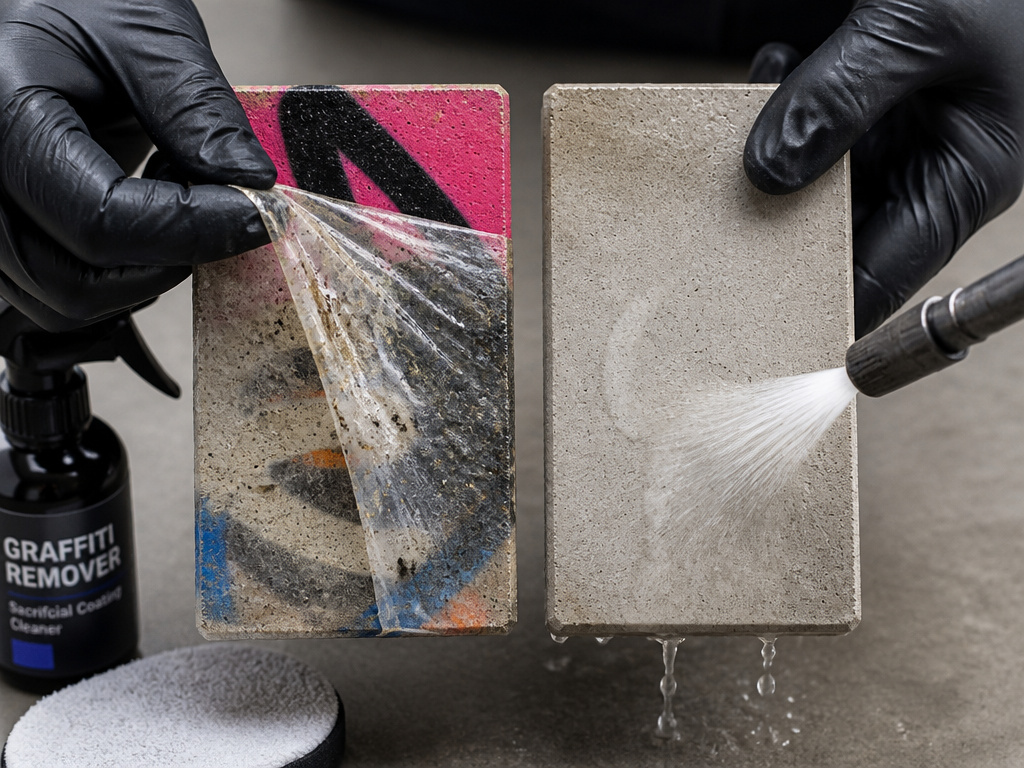
The two coating types are not interchangeable, and the spec that governs your project may only cover one of them.
The Iowa DOT IM 491.23 specification covers only non-sacrificial (permanent) coatings. Florida FM 5-580 tests both sacrificial and non-sacrificial water-cleanable coatings. A spec written to one standard excludes half the market the other addresses.
- Sacrificial: peels off with the graffiti and gets reapplied.
- Non-sacrificial: stays in place and releases paint under pressure washing or solvent cleaning.
- Pigmented vs clear: CFI recommends pigmented on natural concrete because clear brings out color variations and gives a mottled look.
Metrolinx DGL-03 recommends clear anti-graffiti coatings with silicone-based slip additives. The additive is what stops paint from adhering in the first place.
I’ve learned to read the scope section first. Iowa DOT IM 491.23 says “only non-sacrificial” in the second paragraph, and that one word changes the whole shopping list.
If you’re dealing with the aftermath rather than the prevention, the process to remove spray paint from concrete follows its own rules.
Field Application vs. Factory Application: Where the Spec Splits
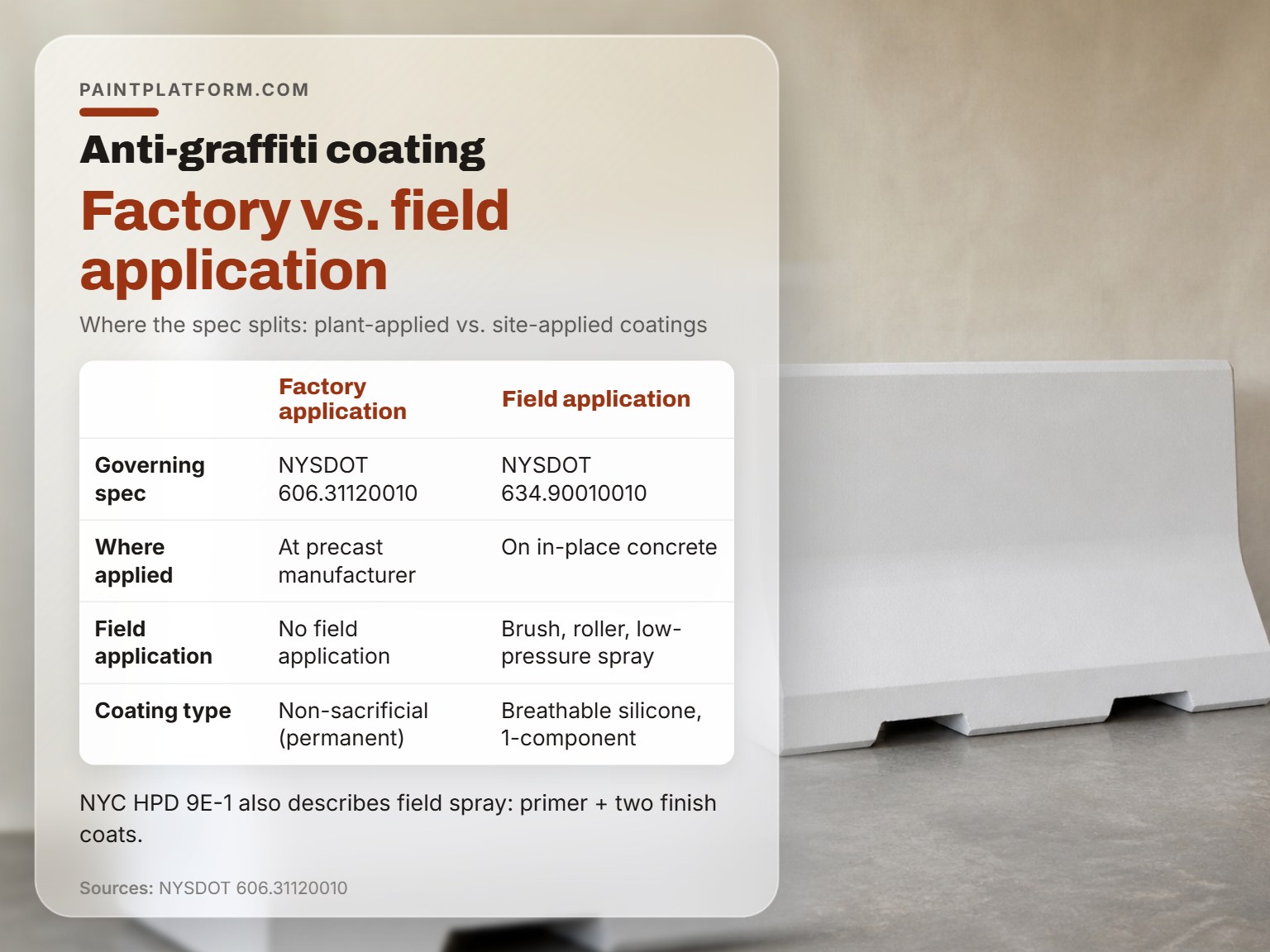
A precast barrier arrives at the job site already coated. A cast-in-place wall gets its coating sprayed on after the forms come off. The same agency can require both, and the specs read like they were written by different departments.
The NYSDOT anti-graffiti coating test practice requires the coating to be applied at the precast manufacturer, with no field application. NYSDOT 634.90010010 describes field application by brush, roller, or low-pressure spray on in-place concrete. NYC HPD 9E-1 describes field spray application of primer and two finish coats.
The difference is product class. A precast barrier with a factory-applied permanent coating is a different animal from a cast-in-place wall that gets a breathable silicone coating in the field.
- Factory application: required by NYSDOT 606.31120010 for precast barriers.
- Field application: described by NYSDOT 634.90010010 for in-place concrete.
- Field spray: described by NYC HPD 9E-1 for primer and finish coats.
Where this goes sideways: Specifying a field-applied coating on a precast barrier that’s already coated at the plant. The second coat may not bond to the first, and the spec that governs the plant may prohibit field application entirely.
For the field-applied side, the surface prep matters as much as the coating. A concrete paint types breakdown helps you match the coating to the substrate.
What Do ASTM D6578 and D7089 Actually Measure?
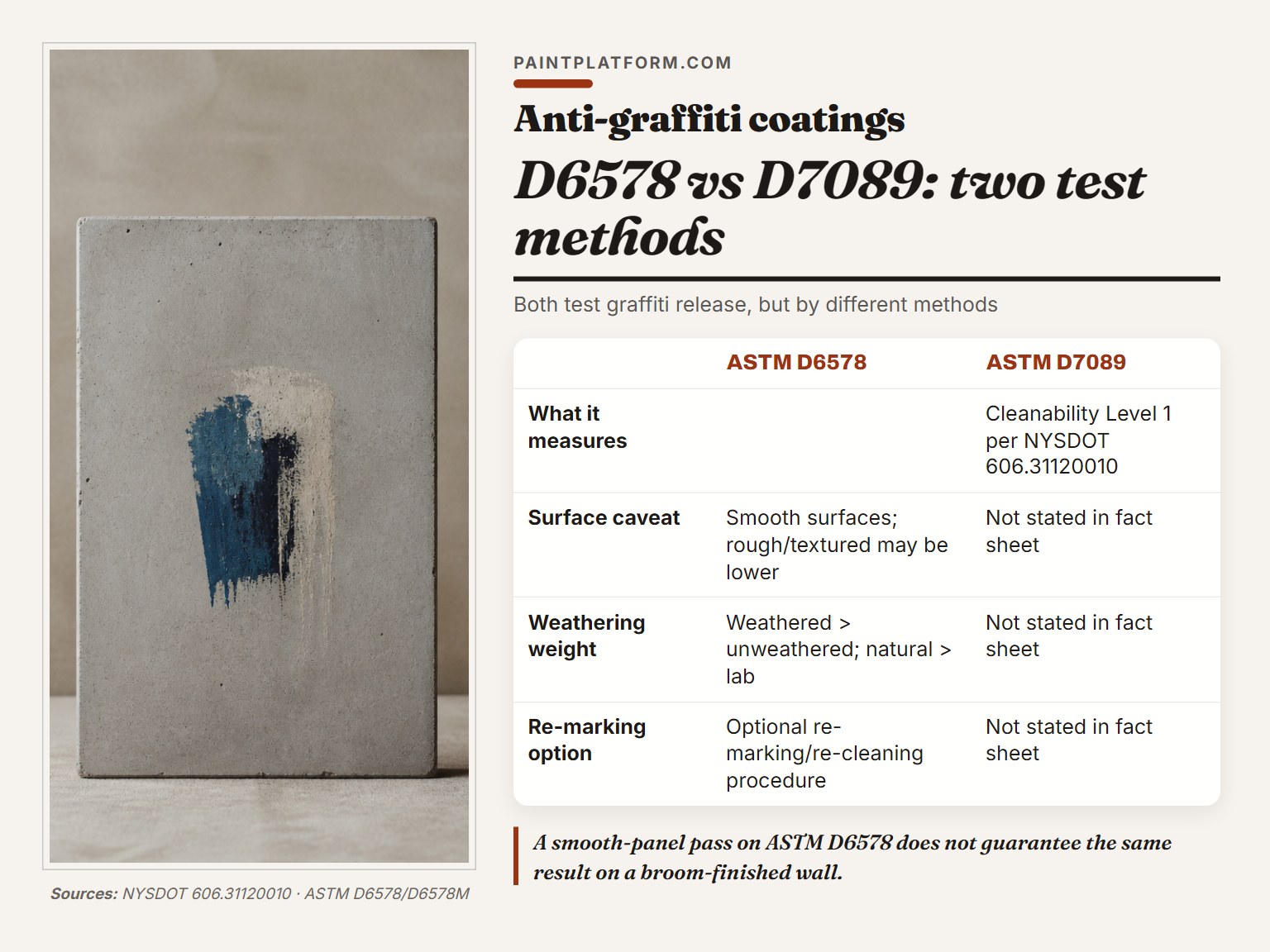
What do ASTM D6578 and ASTM D7089 actually measure? Both standards test how well a coating releases graffiti, but they use different methods.
The ASTM D6578 graffiti resistance standard evaluates resistance by how a defined set of markings is removed by a defined set of cleaning agents. It applies to smooth surfaces, and it states that resistance on rough or textured surfaces may be lower. That’s a critical caveat for concrete.
NYSDOT 606.31120010 requires the coating to hit “Cleanability Level 1” per ASTM D7089 after cleaning.
ASTM D6578 also says weathered results carry more weight than unweathered results, and natural weathering carries more weight than lab-accelerated weathering. Iowa DOT IM 491.23 accepts lab-accelerated weathering (ASTM D4587 or similar) as an alternative pass gate to outdoor exposure. ASTM ranks the two; Iowa treats them as equivalent.
A smooth-panel pass on ASTM D6578 does not guarantee the same result on a broom-finished wall. The standard says so in plain language.
If you’re sealing a painted surface rather than coating raw concrete, the same weathering logic applies to paint sealant selection.
Concrete Prep and the 28-Day Cure Rule
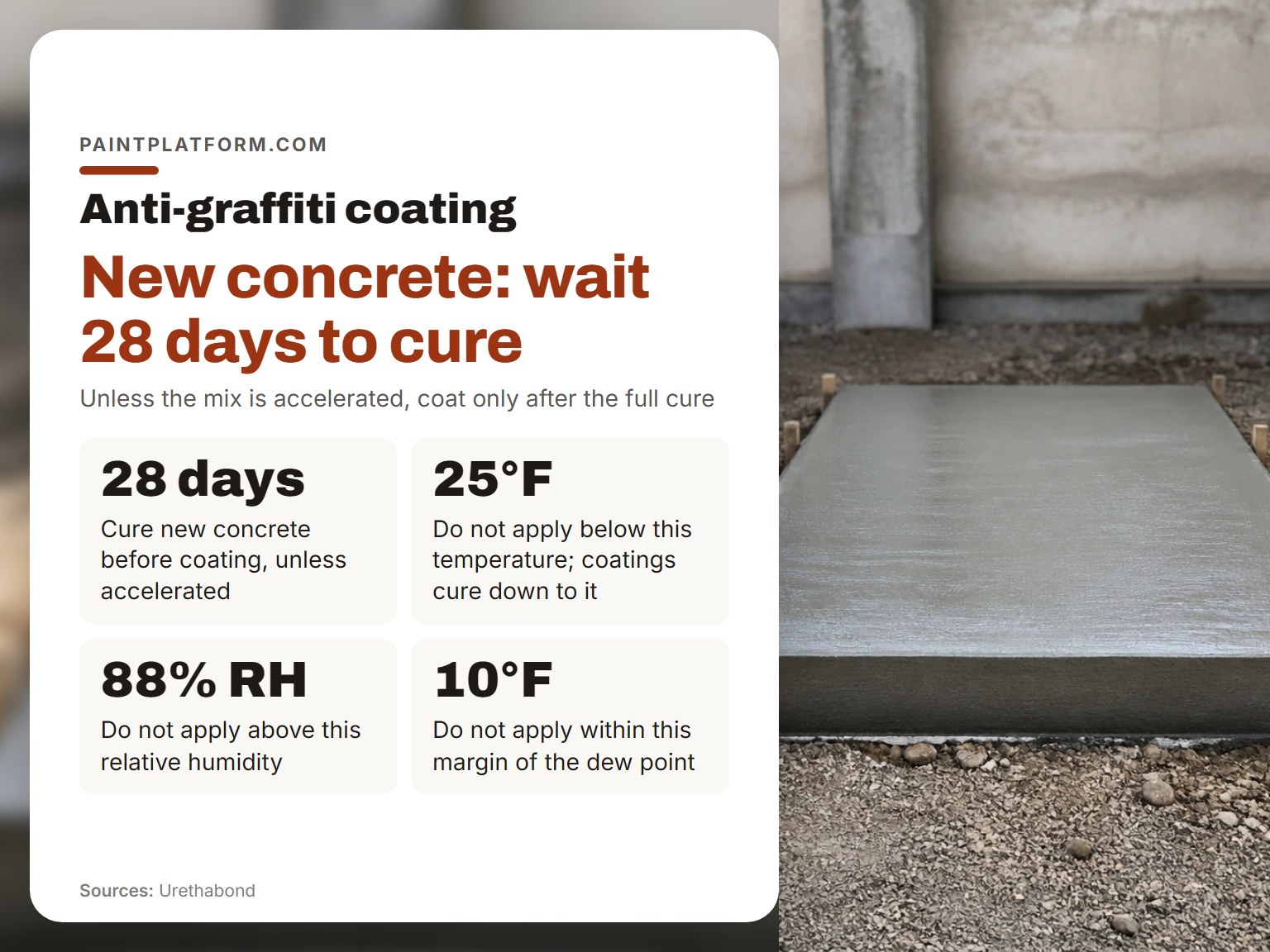
New concrete needs 28 days to cure before you coat it, unless the mix is accelerated.
CFI’s guide is explicit: new concrete, unless accelerated, must be cured for 28 days. Coat a slab too early and you’re fighting moisture the whole way. The coating may not bond to the surface.
Surface prep method is another split: NYSDOT 634.90010010 prohibits sandblasting, while CFI’s guide allows sandblasting on steel surfaces. CFI’s guide allows sandblasting on steel surfaces, along with hydroblasting, solvent cleaning, or detergent cleaning. The substrate decides which methods are allowed.
The part nobody mentions: A 28-day cure is the minimum for standard concrete. Accelerated mixes can shorten it, but the spec sheet has to say so. Don’t guess from the calendar.
If the concrete is already painted, a clear coat over the top can add a layer of protection without changing the color.
The Part Nobody Mentions: Coverage Rate
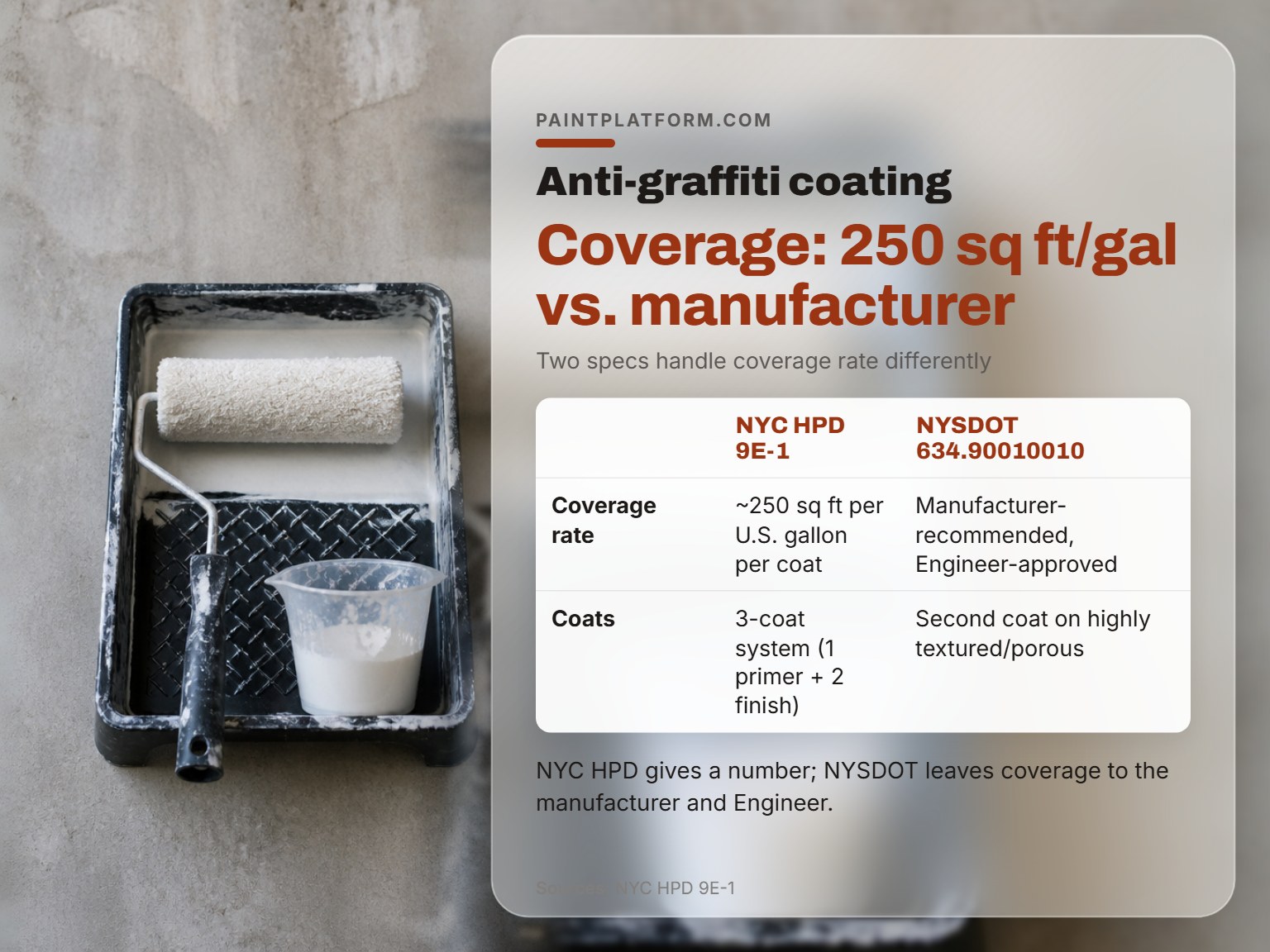
Coverage rate is where the estimate meets reality, and the sources handle it two different ways.
NYC HPD
Frequently Asked Questions
Can an anti-graffiti coating be applied over previously painted concrete?
Usually yes, but only after the existing coating is confirmed sound and compatible with the new product. A test patch is the fastest way to catch a solvent reaction or lifting before you commit to the whole wall. If the old film is chalky, peeling, or a different resin family, strip it first rather than coating over a weak bond.
Does a clear anti-graffiti coating change the appearance of the substrate?
It can, especially on bare concrete where the wet film darkens the surface and locks in color variation. Pigmented systems hide that mottling and are generally the safer choice on natural or patchy walls. Always apply a small sample panel and let it cure fully before judging the final look.
How soon can graffiti be cleaned off after the coating cures?
Wait until the film has reached its full cure, not just its recoat time, before any pressure washing or solvent work. Cleaning a green film can soften it or drive remover into the pores underneath. Check the product data sheet for the return-to-service interval and err on the longer side in cool weather.
What surface preparation does a bare concrete wall need first?
The wall must be clean, dry, and free of form release agents, curing compounds, and loose material before any coating goes down. Acid etching or mechanical profiling opens the pores so the film can anchor properly. Skipping this step is the most common reason a coating fails early, regardless of which product you choose.
