
How to Paint Over Nicotine Stains: Step-by-Step
This post contains affiliate links. As an Amazon Associate, we earn from qualifying purchases.
To paint over nicotine stains, wash the surface, then seal it with a shellac-based stain-blocking primer before any topcoat. Zinsser B-I-N blocks nicotine with one coat, though some stains need a second. Skip the sealer and the yellow-brown stain bleeds back through the fresh paint.
Zinsser UK’s own guide is blunt about the failure mode: most paints cover nicotine stains temporarily, and over time the stains reappear, seeping through the paintwork. The fix is a sealer built for stain blocking, applied over a surface that is genuinely clean, which is the core of how to paint over nicotine stains.
What follows is the sequence I use: which primer to buy, the prep that decides whether it holds, the six steps in order, and the temperature and coat-count rules the data sheets actually specify.
Key Takeaways
- Shellac is the blocker. Zinsser B-I-N is listed for sealing nicotine stains and odors, and one coat handles most of them.
- Prep decides the result. A degreaser wipe and a clean-water rinse come before the primer, every time.
- 45 minutes is the recoat window on B-I-N at 70 F and 50% relative humidity. Tikkurila’s AkroStop wants 24 hours between coats.
- Substrate moisture has two ceilings in Zinsser’s own documents: 12% in the US data sheet and the UK guide, 18% on the Europe page.
Why Nicotine Stains Come Back Through Ordinary Paint
Tobacco residue settles as a yellowish-brown film on ceilings, walls, floors, ventilation systems and appliances, per Tikkurila’s stain FAQ. Brewers makes the same point from the trade counter: on plaster or rendered surfaces, nicotine bleeds through unsealed paintwork if it isn’t treated first.
So the stain isn’t sitting on the surface waiting for a wipe, which is why how to paint over nicotine stains starts below the surface. It’s in the substrate and in the old paint film, and a fresh coat of emulsion gives it a new route out.
Zinsser UK says it plainly. You repaint, it looks clean for a season, then the ceiling goes yellow again and you’re back at the shop.
Zinsser B-I-N Shellac-Base Primer is a shellac-base primer-sealer. At 70 degrees F and 50 percent relative humidity the film is touch-dry in 20 minutes and ready for a recoat in 45. Full cure takes 1 to 3 days. Recommended dry film thickness is 0.75 to 0.9 mils per coat, wet 2.5 to 3 mils.
A shellac film works because it closes the surface. The technical data sheet describes B-I-N as a primer-sealer, stain killer and bond coat that seals porous surfaces so the topcoat sits on a closed film instead of soaking in. Nicotine stays underneath.
I’ve watched the difference on a bad wall. A water-based primer and the smoke smell still came back.
Fire residue is a different animal, and painting over smoke damage needs its own sequence. Cigarette residue is the narrower problem: one film, one job.
Primer Options That Actually Block Nicotine
Three products come up for this job, and the three makers don’t agree on method.
For nicotine specifically, Zinsser B-I-N Shellac-Base Primer is the one I’d buy. The data sheet lists it as recommended for sealing nicotine stains and odors from tobacco, and one coat does the blocking in most cases. On heavy stains or very porous substrates the same sheet allows a second coat and warns that coverage drops.
Zinsser’s UK guide takes a different road. It uses Zinsser AllCoat Interior SB as a single all-in-one product, with no B-I-N step anywhere in the method. Same brand, different region, opposite primer recommendation for the identical problem.
Tikkurila’s answer is AkroStop Sealing Paint, applied in two coats with 24 hours to fully cure between them. Tikkurila says the product encapsulates the stain so it can’t reach the topcoat.
| Source | Product | Coats specified | Interval between coats |
|---|---|---|---|
| Zinsser B-I-N data sheet | B-I-N Shellac-Base Primer | One; second for heavy stains | 45 minutes |
| Zinsser Europe guide | B-I-N plus Perma-White topcoat | One primer, two topcoats | 45 min, then 2 hours |
| Zinsser UK guide | AllCoat Interior SB | All-in-one, no B-I-N step | Not stated |
| Tikkurila | AkroStop Sealing Paint | Two | 24 hours |
| Brewers | Unnamed sealer | Two | Same method as the first |
Where this goes sideways: Picking the primer before you check the wall’s moisture. Both Zinsser documents cap substrate moisture, and no sealer holds over a damp wall. You’ll get blistering and blame the product.
If the stain you’re chasing came from a leak rather than a cigarette, water stains behave differently and the source has to be fixed first.
The Prep Step That Decides Whether the Seal Holds
My sponge came away tan after wiping a yellowed kitchen wall. That was a warm-water wipe with a degreaser, nothing aggressive, and it pulled off a sticky film I hadn’t known was there. My first attempt at that wall skipped the wash and looked blotchy under the primer.
The manufacturers split on what to clean with. Zinsser’s B-I-N data sheet says to wash with a household ammonia and water solution if you’re unsure of cleanliness, and adds a hard warning: do not use TSP as a cleaner. Zinsser Europe’s method calls for a methylated spirits wipe with the cloths changed regularly. Zinsser UK uses Universal Degreaser & Cleaner followed by a clean-water rinse.
Three routes, one goal. Get the grease and the surface film off so the primer can bond.
The general routine for washing walls before painting applies here, with one addition: nicotine needs a degreaser, not just soap.
Here’s what the prep actually involves:
- Wash the whole wall, not the visible stain. Nicotine travels, and the patch you can see is only the part that got the most smoke.
- Rinse with clean water and let it dry. Cleaner residue is its own adhesion problem.
- Scrape loose material back to a sound edge, then feather the edge with fine abrasive paper.
- Treat mildew separately.
- Check moisture before you prime. More on the numbers below.
Nicotine is one of several residues that survive a plain wash. Pet stains and cooking grease both need their own chemistry before any sealer will hold.
I won’t prime a wall I haven’t wiped, even when it looks clean. The yellow patch is the part you can see; the film that ruins the bond is the part you can’t. (I learned that one the expensive way.)
How to Paint Over Nicotine Stains, Step by Step
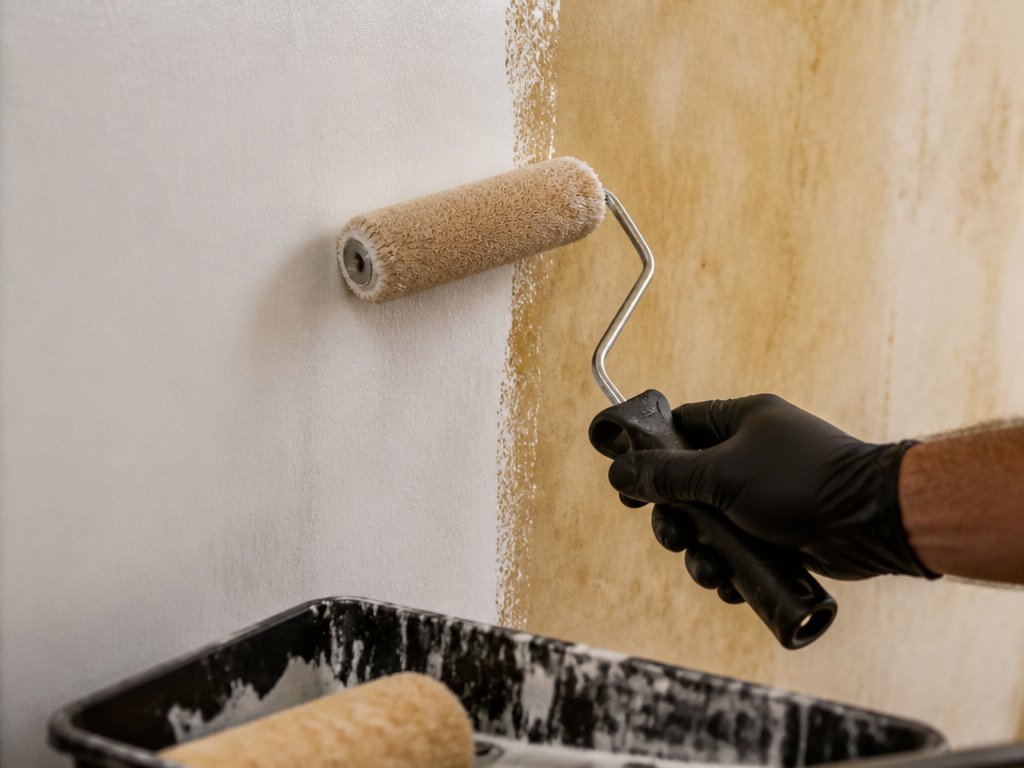
Work top to bottom, and let each stage dry before the next one starts.
Before you start: Scraping or sanding old paint can release lead dust, so wear a NIOSH-approved respirator and clean up with a HEPA vacuum and a wet mop. Shellac primer is flammable, so keep it clear of pilot lights and heaters. If you use bleach on mildew, wear goggles and never add ammonia to that bucket.
- Clear and protect the room. Move furniture out, tape the trim, and drop sheets over the floor.
- Wash with the cleaner you chose, then rinse with clean water and let the wall dry completely. Skipping the rinse leaves a film that stops the primer bonding.
- Scrape and feather any loose paint. A sound edge matters more than a smooth patch; primer bridges small steps but not flaking.
- Spot-treat mildew with the bleach solution if you found any, and let it dry. Sealing over live mildew traps the problem under the film.
- Prime with Zinsser B-I-N, rolling or brushing to the dry film thickness on the sheet. Do not thin it. Thinning drops the film below blocking thickness and the stain comes through.
- Recoat after 45 minutes at 70 F and 50% relative humidity, or wait longer in a cold room. A second coat is the fix for heavy stains and porous plaster.
- Topcoat with two full coats, allowing the interval the topcoat’s own instructions specify.
Not every stain-blocking primer behaves the same on a porous wall, so match the product to the substrate rather than to the label.
What Temperature and Humidity Does the Primer Need?
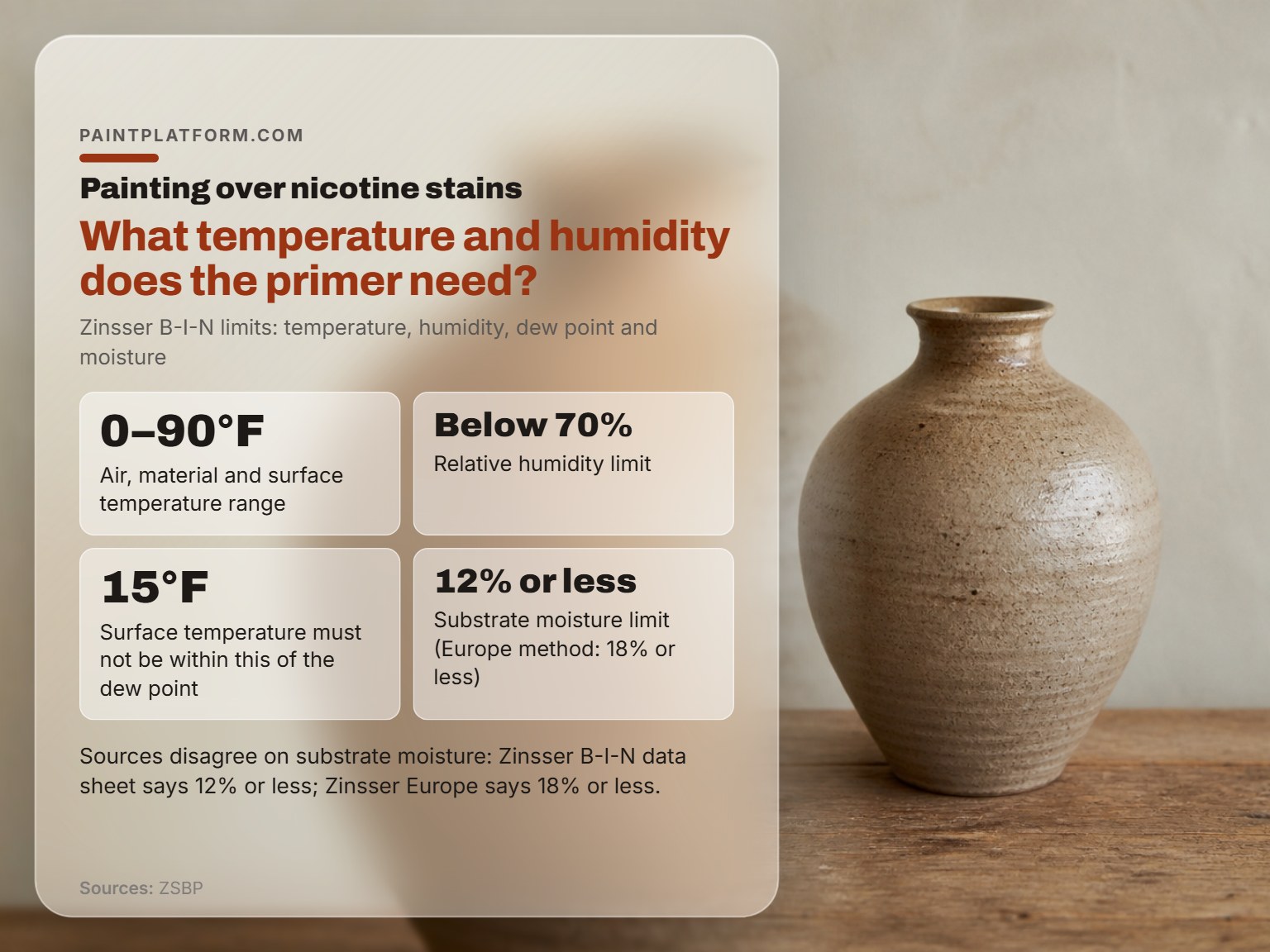
Zinsser’s data sheet sets a narrow window, and most of the failures I’ve seen came from ignoring it.
| Condition | Limit | Source |
|---|---|---|
| Air, material and surface temperature | 0 to 90 F (-18 to 32 C) | Zinsser B-I-N data sheet |
| Relative humidity | Below 70% | Zinsser B-I-N data sheet |
| Surface temperature vs dew point | Not within 15 F (9.5 C) | Zinsser B-I-N data sheet |
| Substrate moisture | 12% or less | Zinsser B-I-N data sheet |
| Substrate moisture, Europe method | 18% or less | Zinsser Europe |
The dew point rule catches people. A cold garage in a damp week is exactly the wrong room.
Substrate moisture is where the sources genuinely disagree. Zinsser Europe’s nicotine method says 18%. Same brand, same task, two thresholds. I’d work to the lower number and give the wall more drying time, because the cost of being wrong is a film you have to strip.
How Many Coats Do You Actually Need?
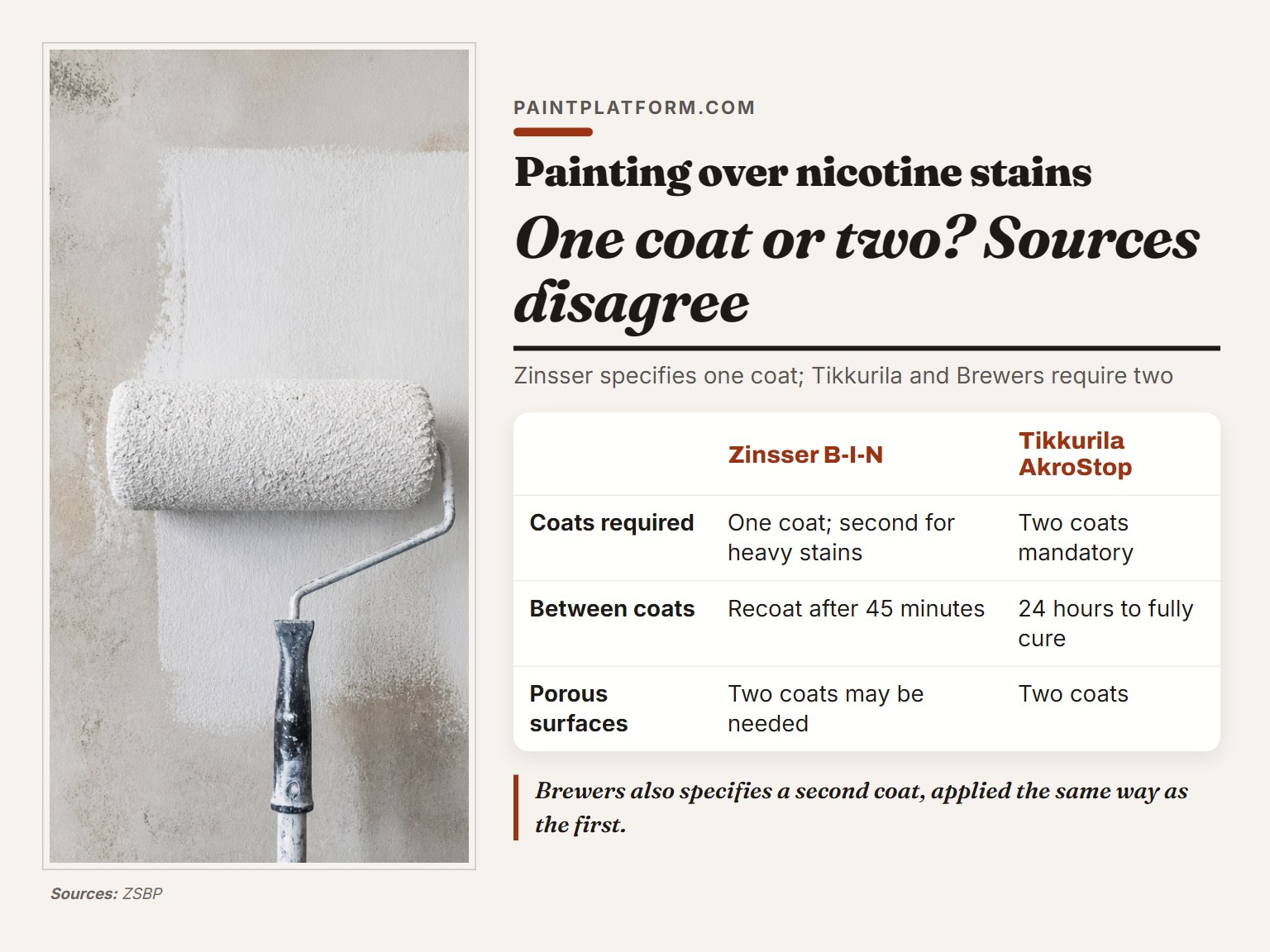
Zinsser’s data sheet specifies one coat, with a second only for heavy stains or very porous substrates, while Tikkurila requires two coats of AkroStop and Brewers specifies a second coat.
Not everyone agrees. Brewers says to apply a second coat in the same way as the first when treating nicotine. Tikkurila makes two coats of AkroStop mandatory, with 24 hours to fully cure between them.
My rule: one coat on a light stain over sealed paint, two on plaster, bare board, or anything that has been smoked in for years.
Rule of thumb: If you can still see a shadow through the first coat while it’s wet, plan the second coat now. Waiting to find out whether it bleeds costs you a whole topcoat cycle.
I knew better and I still had to start again. Primer works the same way: the recoat window is a floor, not a suggestion.
Where the smell is a bigger problem than the color, an odor-blocking primer carries more of the load.
Which Topcoat Goes Over the Sealer?
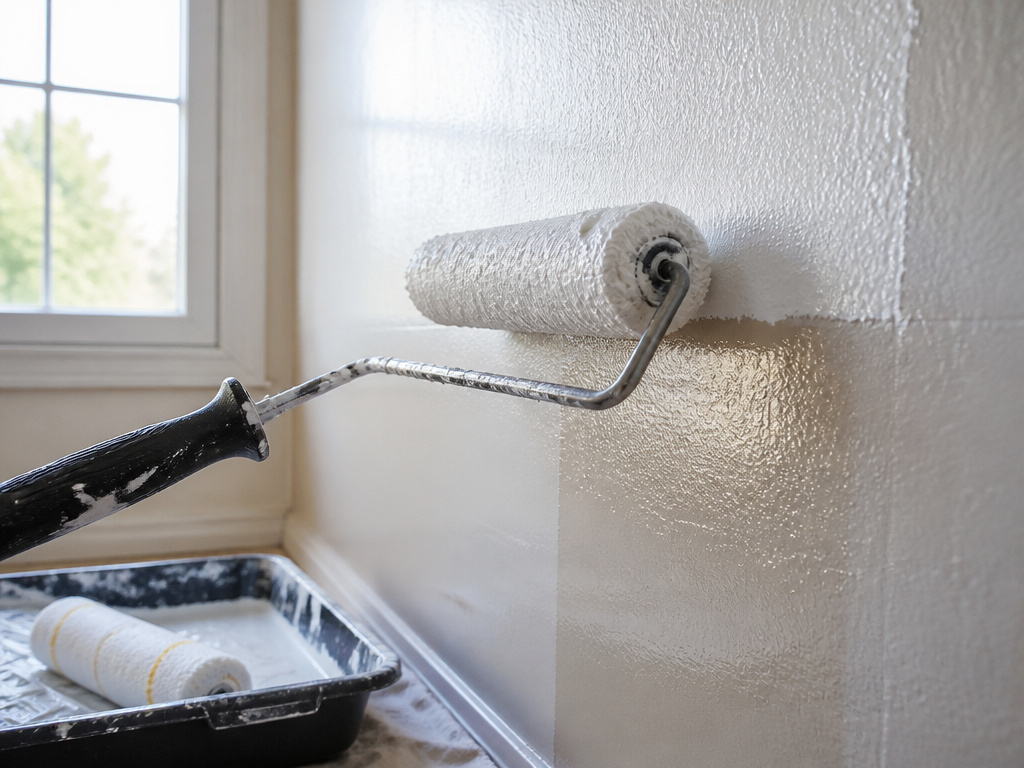
Two topcoats, two hours apart, is the schedule Zinsser Europe publishes for nicotine work, while Tikkurila’s AkroStop calls for 24 hours between coats.
That method names Perma-White Interior Matt or Satin as the topcoat, applied in two full coats with a minimum of two hours between them. It’s a brand-specific recommendation from one regional guide, so treat it as a starting point rather than a rule.
What matters generally: the topcoat goes on over a film that has set.
Fair warning: shellac smells like a distillery until it flashes off. Open the windows and let the room air out before you judge it.
Cleanup matters more than people expect.
A nicotine-stained porch ceiling isn’t the same job as a kitchen wall.
Frequently Asked Questions
Can I just paint over nicotine stains with ordinary paint?
Ordinary emulsion covers the color for a while. Zinsser UK’s guide notes that most paints cover nicotine stains temporarily and the stains often reappear, seeping through the paintwork. A stain-blocking sealer is the step that stops the migration.
Does the yellow come back after painting?
Without a sealer it does. The residue sits under the new film and works its way up. With one coat of B-I-N the data sheet says the stain is blocked from bleeding into the topcoat, and heavy stains get a second coat.
Can I use a water-based primer instead?
Zinsser’s UK guide does exactly that, using AllCoat Interior SB as an all-in-one with no B-I-N step. The US data sheet and the Europe method both specify shellac-base B-I-N for nicotine. Where odor is part of the problem, B-I-N is listed for sealing nicotine odors as well as stains.
How long before I can topcoat?
45 minutes minimum at 70 F and 50% relative humidity, per the B-I-N data sheet. Full cure takes 1 to 3 days. Tikkurila’s AkroStop wants 24 hours between its two coats, so check which product you’re holding before you start counting.
Do I have to wash the walls first?
Yes. Zinsser’s data sheet, the Europe method and the UK guide all put a cleaning stage before the primer, though they name different cleaners: ammonia and water, methylated spirits, or Universal Degreaser & Cleaner. Any of the three beats priming over a greasy film.
The Bottom Line
If the wall has been smoked in for years, budget for two coats of sealer before you open the topcoat. One coat is the manufacturer’s default, not a promise, and the second coat costs you 45 minutes rather than a day.
None of this helps if the wall is damp. If your moisture reading is above the ceiling, stop and find the leak first. Sealer over a wet substrate is money you’ll spend twice.
Before you buy anything, take a damp white cloth and rub the worst patch of ceiling. If it comes away clean, you’re repainting a wall that doesn’t have this problem, and you can put the money toward a better brush instead.
