
9 Best Waterproof Paint For Concrete Basement Walls in 2026
This post contains affiliate links. As an Amazon Associate, we earn from qualifying purchases.
For dry interior basement walls that need serious waterproofing, the Zinsser WaterTite Mold & Mildew Waterproofing Paint is the best overall choice. It resists up to 20 lbs. Of water pressure and is backed by a 15-year guarantee. If you need to paint a damp wall without waiting for it to dry, the Zinsser WaterTite General Purpose paint is your pick. For those on a budget, the Rust-Oleum Watertite Latex formula delivers impressive 20 PSI resistance at a lower cost.
The biggest challenge with basement walls is moisture. Hydrostatic pressure can force water through concrete, and standard paint won’t stop it. You need a specialized coating that bonds to masonry and blocks water under pressure.
This guide is based on a careful review of manufacturer specifications, expert advice, and patterns in owner feedback. We focus on the key factors that matter most: hydrostatic pressure resistance, application conditions, and coverage, so you can choose with confidence.
Top 9 Waterproof Paints For Concrete Basement Walls in the Market
Certain content that appears on this site comes from Amazon. This content is provided "as is" and is subject to change or removal at any time.
The Best Waterproof Paints For Concrete Basement Walls, Reviewed
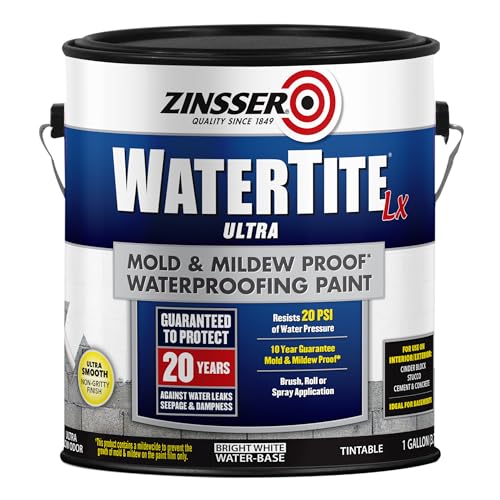
Zinsser WaterTite Mold & Mildew Waterproofing Paint
What We Like
- Resists up to 20 lbs. water pressure
- 15-year waterproof guarantee
- 10-year mold & mildew-proof paint film
- Ultra low odor, easy soap cleanup
Trade-offs
- Requires dry walls for application
- Heavy 12.2 pounds per gallon
A 20-pound hydrostatic pressure rating means this paint can stop serious water seepage through concrete basement walls, handling more force than many alternatives. The latex base keeps odor low and cleanup simple with soap and water, so you don’t need harsh solvents in a confined space. That combination of heavy-duty waterproofing and user-friendly application makes it the go-to choice for homeowners who want reliable protection without the hassle of a complex system. The bright white, smooth finish also gives walls a clean, finished look that feels more like a room than a cellar.
The bright white, smooth finish gives walls a clean, finished look that feels more like a room than a cellar. If your basement walls are already dry and you want maximum peace of mind against leaks and mildew, this is a strong option in the lineup.
Product photos
KILZ Basement and Masonry Waterproofing Paint

What We Like
- Blocks up to 12 PSI water pressure
- Nanotechnology creates powerful water barrier
- Low-odor formula for easy application
- Resists alkali buildup in high-moisture areas
Trade-offs
- Fully cures in 7-14 days before washable
- Requires hydraulic cement for below-grade cracks
12 PSI of water-pressure resistance means this paint stops serious moisture intrusion on basement walls, not just surface dampness. The nanotechnology barrier is designed for concrete, brick, and cinder block, making it a strong fit for below-grade spaces where hydrostatic pressure is a real concern. It works indoors or out, dries to the touch in an hour, and resists alkali buildup that can ruin lesser paints in damp conditions. For homeowners who need reliable protection against groundwater seepage, this is the one to reach for.
The trade-off is patience: the paint cures fully only after 7-14 days, so you cannot scrub or wash the wall until then. Compared to the Zinsser WaterTite Mold & Mildew option, which stops 10 PSI, this KILZ gives you a higher pressure rating for tougher basement conditions. If your walls are dry but you worry about future water, the extra headroom is worth the wait.
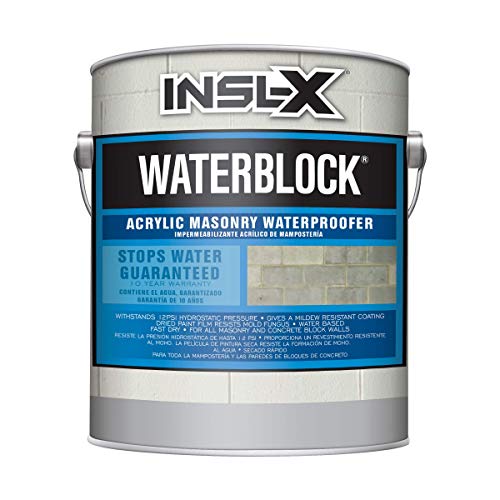
INSL-X WaterBlock Acrylic Masonry Waterproofer
What We Like
- Fast drying for quick project turnaround
- Withstands up to 12 psi hydrostatic pressure
- Resists alkali up to pH-13
- Works on interior and exterior masonry
Trade-offs
- Only for vertical walls, not horizontal surfaces
- Requires surface and air temperature between 50-90°F
With a fast-drying acrylic formula that handles up to 12 psi of hydrostatic pressure, this paint gets your basement walls sealed and looking clean in less time than traditional waterproofers. The high alkali resistance (up to pH-13) means it stands up to fresh concrete or block without breaking down, so you can apply it soon after the pour. It’s a solid fit for DIYers who want a weekend project done by Sunday night, no long waits between coats or before moving furniture back against the wall.
Withstands up to 12 psi hydrostatic pressure, which handles typical damp basement walls but may not stop heavy below-grade water flow, the YKF Masonry Pro resists 15 psi if you need more. This coating is designed only for vertical concrete, masonry, cinder block, stucco, and brick surfaces, so skip it for floors or patios. For interior basement walls with moderate moisture, the fast drying and reliable waterproofing make it a straightforward choice.
Product photos
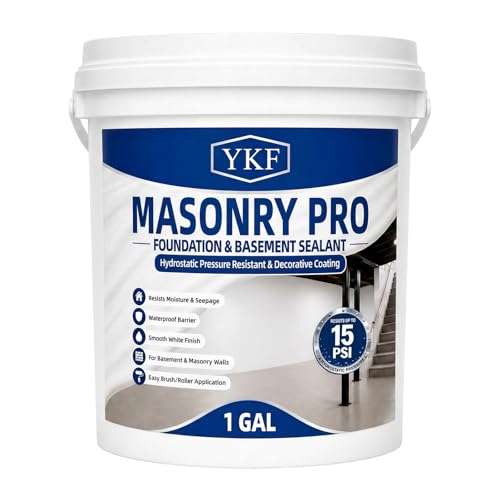
YKF Masonry Pro Foundation Waterproofing Sealer
What We Like
- 15 PSI hydrostatic pressure resistance
- Water-based polyurethane high-solids formula
- Bonds to dry or slightly damp surfaces
- Conceals minor surface imperfections
Trade-offs
- Only 100 sq ft coverage per gallon
- Requires surface prep and leak repair first
- Two-hour handling time between coats
With 15 PSI hydrostatic pressure resistance, this coating can handle demanding below-grade conditions when applied to properly prepared masonry. That makes it a strong option for basement and foundation walls where moisture intrusion is a concern. The water-based polyurethane formula bonds to dry or slightly damp concrete, and its high-solids content helps hide minor surface flaws while leaving a clean white finish. For anyone looking to protect porous concrete and masonry walls from water seepage, this sealer offers a rated barrier that matches the job.
Coverage is limited: at roughly 100 square feet per gallon, you’ll need more product than some other options in this guide, such as the Zinsser WaterTite General Purpose paint, which covers 250 square feet per gallon. That means a higher total cost for larger walls. The prep work is also non-negotiable: you have to remove loose paint, repair cracks, and stop active leaks before applying. But if your basement wall needs a coating that resists up to 15 PSI of hydrostatic pressure, the extra effort and lower coverage are part of the deal for that level of protection.
Product photos
Zinsser WaterTite General Purpose Waterproofing Paint

What We Like
- Applies to wet or dry masonry
- Resists 10 PSI water pressure
- Low odor water-based formula
- Bright white non-gritty finish
Trade-offs
- Coverage limited to 250 sq ft per gallon
- Single gallon size only in specs
Zinsser WaterTite General Purpose stops up to 10 PSI of water pressure, which means it can handle the kind of hydrostatic pressure that pushes moisture through basement walls after heavy rain. It delivers that pressure resistance in a low-odor water-based formula that goes on easily with a brush or roller. It also covers wet masonry without waiting for the wall to dry out completely, a practical advantage when you are dealing with a damp basement that never quite dries. For anyone who needs to seal a leaky cellar wall fast and wants a bright white finish that does not feel gritty, this is a straightforward choice.
Coverage is limited: one gallon spreads only 250 square feet, so a typical basement wall will take two or three gallons. The can size means you have to buy multiple units for larger projects. Compared to the YKF Masonry Pro, which resists 15 PSI, the Zinsser has a lower pressure rating, but it compensates with a finish that is easier to apply on surfaces that are already damp. If your basement wall is actively weeping or you need to paint over a wet patch without waiting days for it to dry, this paint solves that problem directly.
Product photos
Rust-Oleum Watertite Latex Waterproofing Paint

What We Like
- Resists up to 20 PSI water pressure
- Ultra low odor for indoor use
- Easy soap-and-water cleanup
- 15-year waterproof guarantee
Trade-offs
- Requires dry walls before application
- Only a quart, so covers less area than gallon competitors
A 20-PSI hydrostatic pressure rating means this paint can handle the kind of persistent dampness that seeps through basement walls without breaking a sweat. The smooth white finish goes on with a brush or roller, and the ultra low odor means you can work in a closed basement without gasping for fresh air. Cleanup is just soap and water, so you won’t need harsh solvents or special thinners.
The Rust-Oleum Watertite Latex Waterproofing Paint resists up to 20 pounds of water pressure, which means it can handle serious hydrostatic pressure on basement walls. That guarantee is backed by a 15-year waterproof warranty, giving you long-term peace of mind. Just remember this is a water-based latex, so it only sticks to dry surfaces, if your walls are actively leaking, you’ll need to stop the moisture first or let them dry completely.
AMES Blue Max Liquid Rubber Waterproofer

What We Like
- 900% elongation resists cracking
- Non-toxic and eco-friendly formula
- Works on concrete, wood, and metal
- Can be brushed, rolled, or sprayed
Trade-offs
- 24-hour wait between coats
- 11.3-pound pail is heavy for overhead application
A 900% elongation rating means this liquid rubber membrane can stretch nearly ten times its original length without tearing, making it an ideal choice for basement walls that shift or settle over time. Because it bonds to concrete, wood, and metal alike, you can seal cracks around window frames or utility penetrations with the same material. The non-toxic, low-VOC formula also keeps the air safer while you work, which matters in a confined below-grade space.
Patience is required: each coat needs a full 24 hours to cure before you can apply the next, so a two-coat job takes at least two days. For flexibility that moves with the wall, this rubber coating is hard to beat.
Product photos
AMES Block & Wall Liquid Rubber Waterproofer

What We Like
- Fills cracks up to ⅛ inch
- 1800% elongation resists re-cracking
- Low odor, non-toxic formula
- Applies with sprayer, roller, or brush
Trade-offs
- Requires two coats for full protection
- Heavy 47 lb pail is hard to maneuver
- White finish shows dirt on basement walls
This coating can fill cracks up to ⅛ inch and stretch up to 1800% of its original size, which means it handles movement without tearing. It goes on thick with a brush, roller, or sprayer, and the low-odor, non-toxic formula lets you work in a basement without strong fumes. For anyone waterproofing a foundation wall that already has hairline cracks, this rubberized membrane provides a durable seal.
Weight and finish are the trade-offs here. At 47 pounds per pail, hauling a full five-gallon bucket down basement stairs is a two-person job, and the white coating will show every splash of mud or dust on a basement wall. The AMES requires a second coat for full coverage, but if your wall has cracks up to ⅛ inch, this liquid rubber fills them rather than just painting over them.
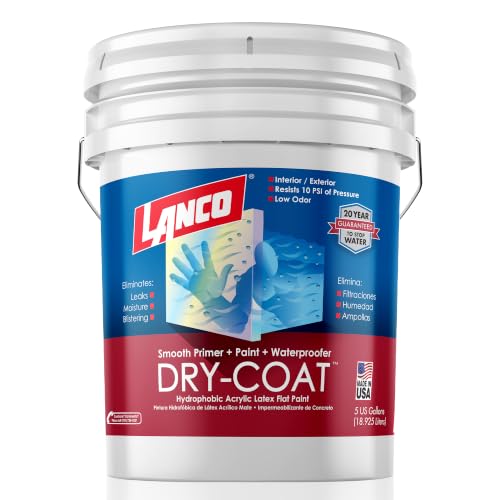
LANCO Dry-Coat Waterproofing Paint
What We Like
- 5-gallon bucket covers large areas
- Smooth white finish for clean look
- Great tools at a great price
Trade-offs
- Not rated for high hydrostatic pressure
- Only available in 5-gallon size
Five gallons of paint is a lot, enough to cover a large basement wall in one go, so you won’t run out mid-project. LANCO’s Dry-Coat Waterproofing Paint comes in a smooth white finish that leaves a clean look on concrete or foundation walls. It’s a straightforward product for anyone who just needs waterproofing paint without extra frills.
Product photos
How We Evaluated Waterproof Paints For Concrete Basement Walls
Our evaluation is research-based, drawing from manufacturer data sheets, technical specifications, and expert round-ups on basement waterproofing. We also analyzed common themes from owner experiences to understand what works in real-world conditions.
The most critical criteria were hydrostatic pressure resistance (measured in PSI), application requirements (dry vs. Wet walls, temperature ranges), and coverage per gallon. We also considered the warranty period, odor level, and whether the paint resists mold and mildew.
No research-based guide can substitute for a site inspection of your own basement. We do not claim to have tested these products.
What To Look For In Waterproof Paints For Concrete Basement Walls
Choosing the right paint starts with understanding your wall’s condition. The most important factor is whether your wall is dry or actively leaking, which determines the type of paint you need.
Look for a paint rated for the hydrostatic pressure in your basement. Check if your walls are dry or damp, and choose a formula that matches. Consider coverage per gallon and the warranty offered.
Hydrostatic Pressure Resistance
This is the most important spec. Hydrostatic pressure is the force of water pushing against your basement wall from the outside. Paints are rated in PSI (pounds per square inch). A rating of 10 PSI handles moderate dampness, while 20 PSI is for heavy water pressure. If your basement has visible seepage, choose a paint with at least 12 PSI.
Application Conditions: Dry vs. Wet Walls
Some paints require completely dry concrete before application. Others, like the Zinsser WaterTite General Purpose, can be applied to damp or even wet surfaces. Check your wall’s moisture level before buying. If you cannot dry your wall, you need a wet-surface formula. Also check the required temperature range; most need 50-90°F.
Coverage and Number of Coats
Coverage varies widely, from 100 to 250 square feet per gallon. A 5-gallon bucket covers a large area but may not be needed for a small basement. Some paints require two coats for full protection, which doubles your material cost and labor time. Factor this into your project planning.
- Measure your wall area and compare it to the coverage per gallon.
- Check if the paint requires one or two coats for full warranty protection.
- For large projects, consider a 5-gallon bucket to save money.
- Verify the recoat time; some paints need 24 hours between coats.
A good rule: always buy 10-15% more paint than your area calculation to account for waste and texture.
Waterproof Paints For Concrete Basement Walls Compared
The table below compares the nine top waterproof paints for concrete basement walls, highlighting their key specs and best use cases.
| Product | Water Pressure Resistance | Base/Type | Finish |
|---|---|---|---|
| Zinsser WaterTite Mold & Mildew Waterproofing Paint | 20 lbs. | Latex | Smooth, bright white |
| KILZ Basement and Masonry Waterproofing Paint | 12 PSI | N/A | N/A |
| INSL-X WaterBlock Acrylic Masonry Waterproofer | Up to 12 psi | Water Based Acrylic | N/A |
| YKF Masonry Pro Foundation Waterproofing Sealer | 15 PSI | Water-based polyurethane | Smooth white |
| Zinsser WaterTite General Purpose Waterproofing Paint | 10 PSI | Low odor water-based | Bright white, non-gritty |
| Rust-Oleum Watertite Latex Waterproofing Paint | up to 20 PSI | water-based base | Smooth, bright white, non-gritty |
| AMES Blue Max Liquid Rubber Waterproofer | N/A | N/A | N/A |
| AMES Block & Wall Liquid Rubber Waterproofer | N/A | N/A | N/A |
| LANCO Dry-Coat Waterproofing Paint | N/A | N/A | Smooth |
Frequently Asked Questions
What is the best waterproof paint for concrete basement walls?
The Zinsser WaterTite Mold & Mildew Waterproofing Paint is the best overall choice for dry interior walls. It resists up to 20 PSI of water pressure and comes with a 15-year waterproof guarantee and a 10-year mold and mildew resistant film.
Can you paint a damp basement wall?
Yes, but you need a paint specifically designed for wet surfaces. The Zinsser WaterTite General Purpose Waterproofing Paint can be applied directly to damp or wet masonry and resists up to 10 PSI of water pressure.
How much PSI do I need for basement waterproofing?
For moderate dampness, a paint rated for 10 PSI is sufficient. For active seepage or walls below grade, look for 12 PSI or higher. The Rust-Oleum Watertite and Zinsser WaterTite Mold & Mildew both resist up to 20 PSI.
Should I use a waterproofing paint or a sealant?
Waterproofing paint is a coating that bonds to the wall and blocks moisture. A sealant is typically a clear liquid that penetrates the concrete. For finished basement walls, paint is usually the better choice because it also provides a clean finish.
How long does waterproofing paint cures?
Drying time varies. The INSL-X WaterBlock dries fast, while the KILZ Basement and Masonry paint fully cures in 7-14 days before it can be washed.
The Bottom Line
If your basement walls are dry and you want the strongest protection, the Zinsser WaterTite Mold & Mildew Waterproofing Paint is the clear choice. Its 20 PSI resistance, 15-year guarantee, and low-odor formula make it ideal for most homeowners.
For damp walls you cannot dry, choose the Zinsser WaterTite General Purpose paint. If you are on a budget, the Rust-Oleum Watertite offers the same 20 PSI resistance in a smaller, more affordable quart.
The single most important factor is matching the paint to your wall’s moisture condition. Buy the wrong type, and you will be painting again next year. Get it right, and your basement stays dry for years.
