
Rust Inhibiting Paint Guide: Prep, Mils, Recoat Windows
This post contains affiliate links. As an Amazon Associate, we earn from qualifying purchases.
A rust inhibiting paint guide starts with surface prep: strip loose rust and flaking paint, wash off salt and grease, then let the metal dry completely. Only then does the coating matter, and Rust-Oleum 2-IN-1 Rust Reform & Seal covers 85-175 sq ft per quart at its rated 1-2 mils dry film per coat.
The 1-2 mils figure in this rust inhibiting paint guide is the whole ballgame.
What follows covers the prep that decides the outcome, the coating types all sold under the same name, the film and recoat numbers from the Rust-Oleum sheet, and the places where GM, ISO and Rust-Oleum contradict each other in print.
Key Takeaways
- Prep decides the outcome. Loose scale, road salt, and grease beat every coating covered here, including the expensive ones.
- The Rust-Oleum rating is 1-2 mils dry film per coat, which takes 2-4 mils of wet film to hit.
- Recoat before 2 hours or after 48 hours. Fall into that gap and you wait out the full 7-10 day cure.
- GM requires a phosphate treatment before DTM primer. Rust-Oleum’s sheet allows direct application to rusted metal. Both are in print.
- ISO 12944-5 leaves out corrosivity categories CX and Im4, so extreme environments need a different specification entirely.
What Does Rust Inhibiting Paint Actually Do?
Ever scraped a panel painted last spring and found rust already creeping under the film? That’s a coating that lost one of its three jobs.
Rust inhibiting coatings work by one of three mechanisms: barrier exclusion, where the film blocks water and oxygen; active inhibition, where a pigment such as zinc phosphate passivates the steel surface; or conversion, where the product reacts with iron oxide and locks it in place as a stable, paintable layer.
Most of what gets sold as rust preventative paint in this rust inhibiting paint guide leans on the first mechanism and adds a little of the second.
Rust-Oleum 2-IN-1 Rust Reform & Seal is a good example. Solids run 67.6% by weight and 51.3% by volume.
Here’s what each mechanism is bad at:
- Barrier films block water and oxygen until a stone chip breaches them, and then corrosion starts at the breach.
- Active inhibitors keep working at scratches, which is why zinc phosphate shows up in primer specs like AS 4089 Type 2.
- Converters only handle rust that’s already there.
That last point is where a lot of quick-fix advice falls apart. A converter doesn’t put back steel that’s gone.
The Prep Steps That Decide Whether the Coating Holds
The prep sequence is short, and every step in it is load-bearing.
Before you start: Scraping or sanding old paint can release lead dust, which is toxic and especially dangerous to children and pregnant women. Wear a NIOSH approved respirator, clean up with a HEPA vacuum and a wet mop, and keep the area closed to anyone not doing the work. Solvent-borne coatings carry a flash point of 84°F (29°C), so keep cans and rags clear of pilot lights and water heaters.
- Wash first, not last. Rust-Oleum’s sheet calls for a commercial detergent wash, names Krud Kutter Original Cleaner/Degreaser as an example, then a fresh water rinse and a thorough dry. Skip it and you’re sealing road salt under the film.
- Take off the loose material. A wire brush or sandpaper removes flaking paint and loose rust. What’s left should be tight to the metal.
- Decide whether you’re doing a phosphate step. GM’s refinish procedure requires a phosphate metal treatment on the cleaned, dried surface before any direct-to-metal primer. Rust-Oleum’s sheet doesn’t ask for one. More on that below.
- Let it dry completely. Both the Rust-Oleum sheet and the NZ Department of Conservation handbook specify a dry surface, so don’t rush this one.
Sandblasting is allowed but not required. GM’s document says blasting can be used for corrosion removal while noting it isn’t necessary for these products to work properly. Useful permission slip if you don’t own a compressor.
I reach for a wire brush before I reach for any chemical stripper on metal.
Where the Sources Flatly Disagree About Prep
Two documents covering the same substrate, both from major manufacturers, and they don’t agree on the minimum prep.
| Question | One position | The other position |
|---|---|---|
| Bare-metal prep | GM: phosphate treatment must precede DTM primer | Rust-Oleum: apply direct to rusted metal after wire-brushing |
| C1 environments | ISO 12944-5: no protection required in principle | Rust-Oleum: markets the coating for underbody use regardless |
| Extreme corrosivity | ISO 12944-5 excludes category CX and Im4 | AS 2312.1 is a separate national guide, not interchangeable |
| Minimum application temp | NZ DOC: above 10°C on dry surfaces | Rust-Oleum: 50-90°F (10-32°C), humidity under 65% |
| Coat count | NZ DOC: 2 spray or 3 heavy brush coats of epoxy mastic | Rust-Oleum: 1-2 mils DFT per coat with a recoat window |
None of this is a scandal. The documents are written for different jobs. GM’s procedure covers warranty repair on a vehicle, where a shop has to defend the work years later. Rust-Oleum’s sheet covers a person with a can and a Saturday.
The practical read: on a warranty or insurance repair, follow the OEM document. On a twelve-year-old truck’s wheel well, the can’s instructions are printed for exactly that use.
Where this goes sideways: Treating a hardware-store can as if it were an OEM procedure. GM’s document requires a phosphate step that Rust-Oleum’s does not, and a shop following only the can will be out of compliance with the OEM spec on a warranty repair.
Rust Converter, Encapsulator, or DTM Primer: Which Wins Where?
Three products get sold as rust inhibiting paint, and they do three different jobs.
Rust Converter Paint: Fast, Cheap, and Finicky
A rust converter paint reacts with iron oxide and turns it into a paintable layer.
Rust Encapsulating Paint: Sealing It In
A rust encapsulating paint seals the surface and starves it of oxygen. Rust-Oleum 2-IN-1 Rust Reform & Seal sits here, and its 1-2 mils per coat is the number that decides whether the seal is real.
Direct to Metal Paint: The Middle Path
A direct to metal paint bonds to bare steel without a separate primer coat. GM’s Kryptonite Solvent Based Chassis Coating, stock numbers 36500 or 36502, is the OEM example, and the same document puts Pure Prep Phosphate Metal Treatment under it as stock number 25418.
Here’s the head-to-head, committed:
I’d skip a converter as a first move on anything structural. It’s genuinely useful on a sound panel with flash rust, and it’s also how people postpone a repair they’ll still have to make.
How Thick Is 1-2 Mils, and Why Does the Recoat Window Bite?
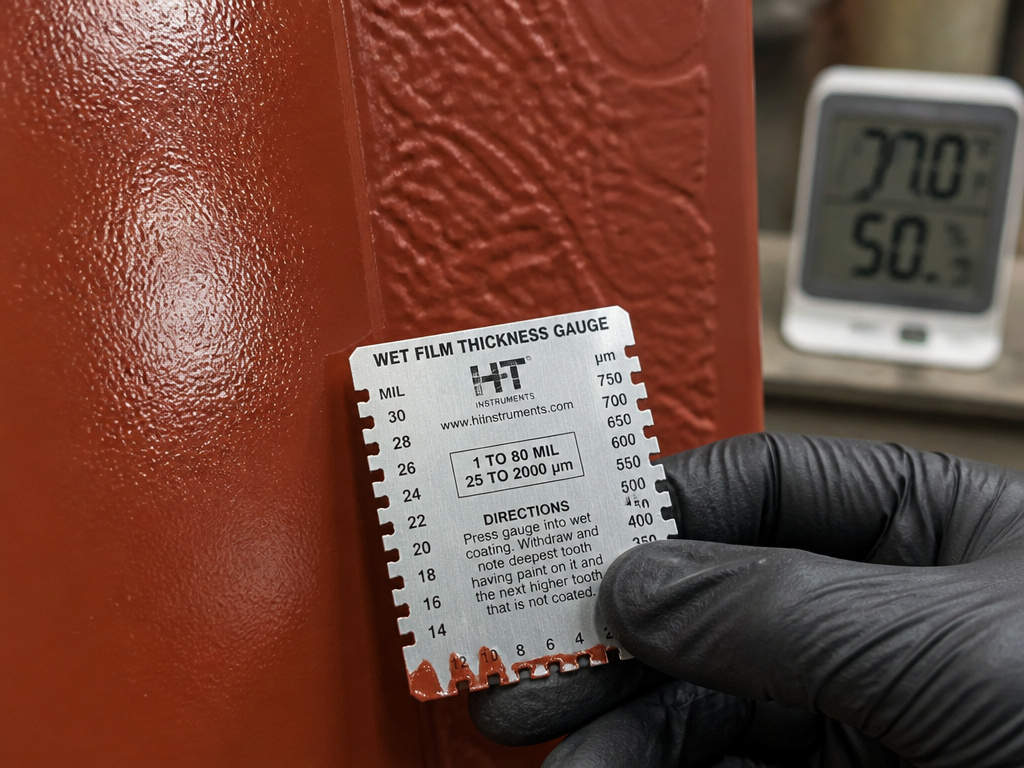
It wasn’t the can. The air was heavy, the film was still soft, and the second coat went on too early and wrinkled.
Rust-Oleum’s sheet puts numbers on that. Dry times are quoted at 77°F (25°C) and 50% relative humidity: touch in 1-2 hours, handle in 3. The recoat window closes at 2 hours and doesn’t reopen until 48.
| Spec | Value |
|---|---|
| Dry film thickness per coat | 1-2 mils |
| Wet film to reach that DFT | 2-4 mils |
| Coverage at rated DFT | 85-175 sq ft/quart |
| Recoat window | Before 2 hours or after 48 hours |
| Full cure | 7-10 days |
| VOC content | 430 g/l max |
If the can says recoat before 2 hours or after 48, plan the whole job around that one sentence. One coat applied inside the window beats three coats fighting each other.
Application conditions are just as tight. The sheet specifies 50-90°F (10-32°C) with humidity below 65%, and a spray gun held 10-12 inches from the surface and kept moving.
Cavity Wax, Skin Coat, and the OEM Process Nobody Copies
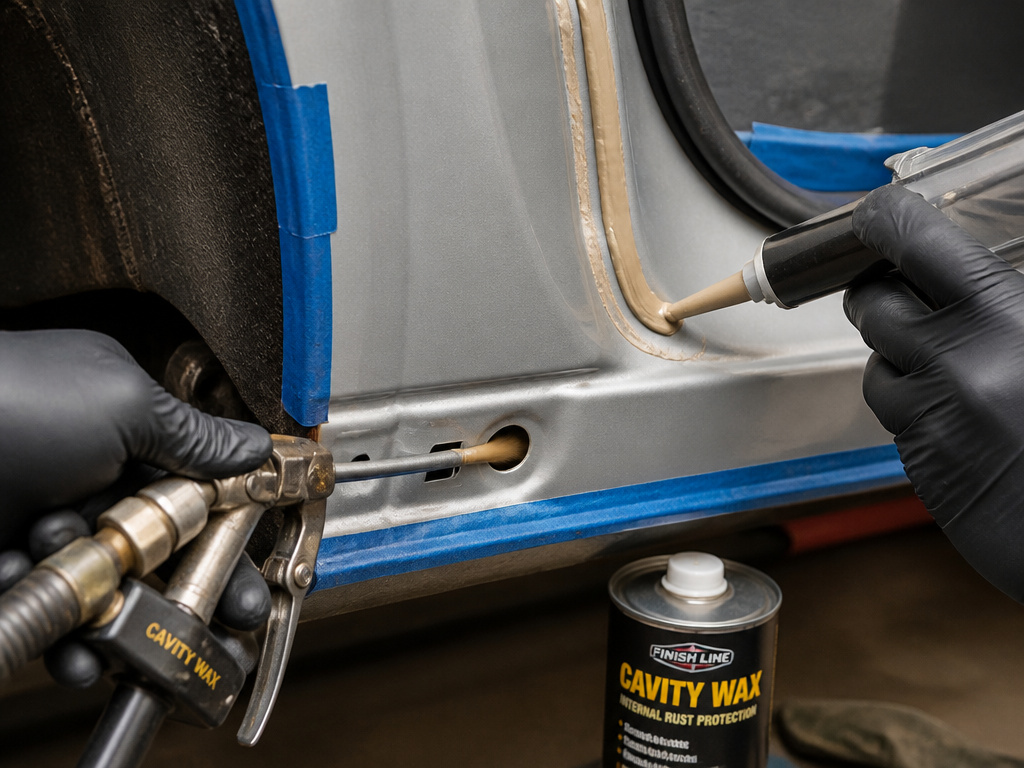
Toyota’s AIM 005 205-3 manual splits anti-rust work into a 2K process and a 1K process, and it calls the 2K route the preferred protection.
What Toyota Specifies for 2K vs 1K
The 2K route names DuPont 2K Etching Primer with DuPont 2K Activator 636R, or Standox Etching Adhesion Primer 020 16167 with Activator 020 16168. Toyota marks it mandatory on drilled chrome. The 1K route lists Nova Power Paint, Novatio Skin Coat, cavity wax spray, and Teroson Wachs USB Spray, reference 794867.
The process sheet is specific in a way consumer guides never are. It lists a 5-minute interval at 21°C at one stage and a 30-minute interval at 21°C at another, a minimum 2 mm skin coat, and a maximum 10 mm reach for cavity wax. Cleaner and degreaser steps come first, using Safety Clean 01 and Multi Foam 02.
Hyundai ran the same idea as a service campaign. Under the NHTSA Service Campaign 9A3 bulletin, the fix is cavity wax on internal surfaces plus undercoating spray on exterior surfaces. The earlier NHTSA technical service bulletin for Service Campaign 9A0 logs 1.0 M/H for the inspection and preventive service, reimbursing one can of undercoat spray and one can of cavity wax.
GM’s document explains why the cavity side matters more than the visible side. Closed cavity coatings stay sticky to the touch and seep into seams over extended periods, which is what makes them the best protection inside rocker panel, pillar, and frame sections.
The part nobody mentions: Cavity coatings stay tacky on purpose. Spray one into a door lock or a window regulator and you’ve traded a rust problem for a mechanism problem.
Keep these clear:
- Door locks and latch assemblies.
- Window run channels and regulators, which gum up and slow the glass.
- Seat belt retractors.
- The parking brake cable and any other moving or rotating part under the car, where a sticky film changes how the part behaves.
GM also requires that all body drain holes stay open after application. Plug one and you’ve built a bathtub inside the rocker.
What ISO 12944 Durability Grades Actually Promise
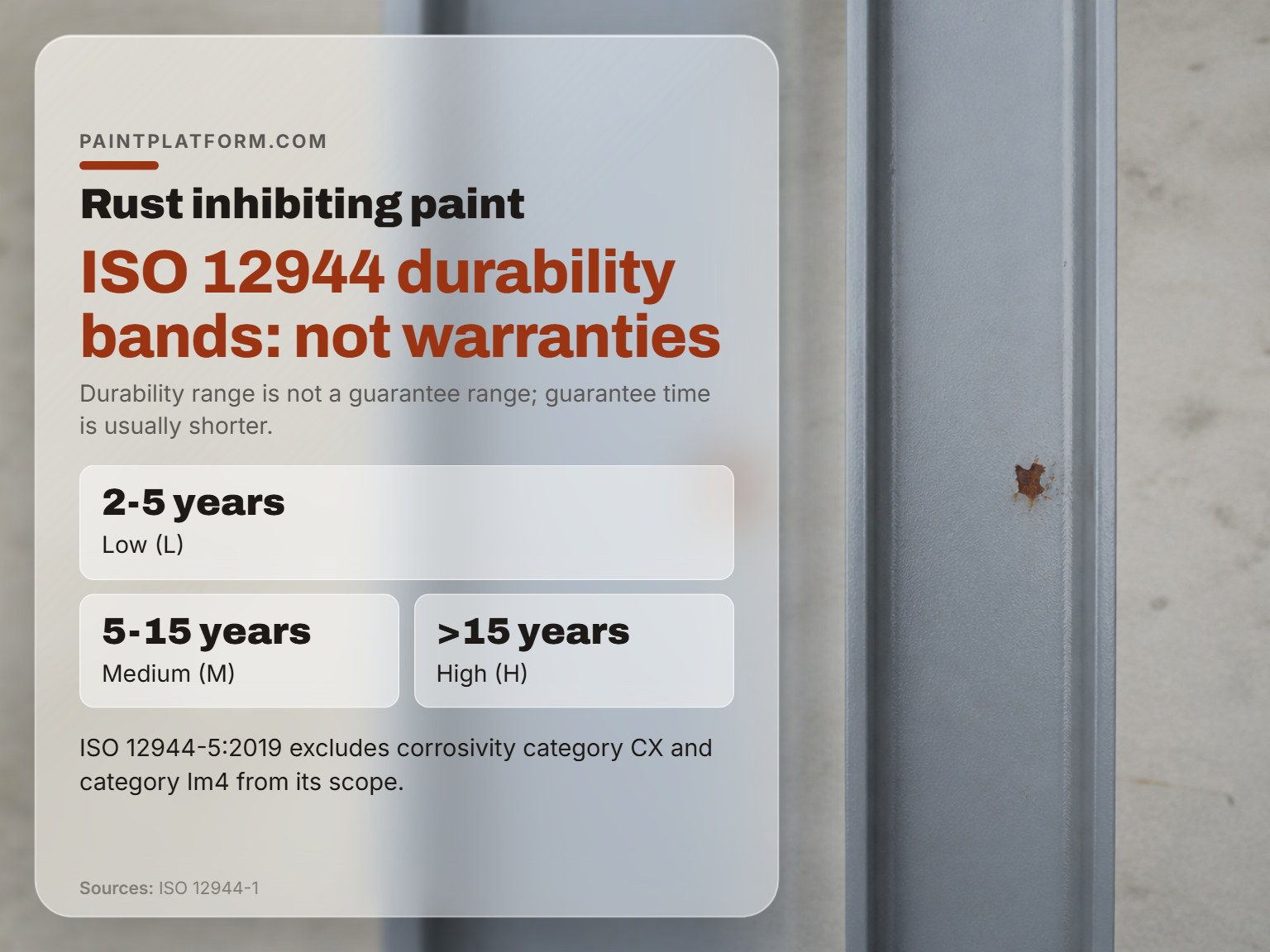
Three durability bands exist, and none of them is a warranty.
- Low (L): 2 to 5 years. Typical of a light-duty system in a mild environment.
- Medium (M): 5 to 15 years. The band most industrial specs aim at, and the one that requires real surface preparation to hit.
- High (H): more than 15 years. Achievable, but only with a documented system and inspection.
Teknos, summarizing ISO 12944-1, is blunt that the durability range is not a guarantee range. Guarantee time is usually shorter than the durability range, and no rules link the two. That distinction matters when someone quotes a fifteen-year number at you.
ISO 12944-5:2019 itself gives guidelines for selecting paint systems for different environments, surface preparation grades, and the durability grade to expect. Two limits are worth knowing. The standard explicitly excludes corrosivity category CX and category Im4 from its scope. Rust grade D, the pitted stuff, needs a thicker schedule and a call to the manufacturer.
AS 2312.1:2014 is a separate Australian guide with its own selection tables, currently marked [Pending Revision] and sitting in the NCC Primary References Set. It references field conductometric determination of water-soluble salts under ISO 8502-9 and extraction by the Bresle method under ISO 8502-6. It is not a drop-in substitute for ISO 12944-5 in extreme corrosivity, and treating it as one is how specifications go wrong.
For heritage or structural work, the NZ Department of Conservation handbook lays out two full systems with named products. The epoxy mastic route needs at least two spray coats or three heavy brush coats, and names Altex Bar Rust 236, Ameron Amerlock 2, Carboline Carbomastic 15, and Resene Alumastic, all conforming to AS 3750.1. The alkyd route runs one penetrating coat, two primer coats, then two finish coats, with Altex RIPO or Wattyl Killrust Fishoilene as the penetrating liquid and a zinc phosphate primer to AS 4089 Type 2 such as Altex High Build Rust Barrier, Wattyl Killrust Metal Primer, or Resene Rust-Arrest.
If you’re working outdoors rather than on a chassis, the same logic applies to exterior metal paint: pick the system for the environment first, then the colour. And when a spec sheet and a can disagree about coat count, the rust stopping paint that actually lasts is the one applied to the preparation grade the system was written for.
One more check Teknos flags: pre-fabrication primers vary in formulation, so confirm compatibility with the paint manufacturer before you assume a system stacks.
Frequently Asked Questions
Does rust inhibiting paint need a primer?
It depends which document you’re following. Rust-Oleum 2-IN-1 Rust Reform & Seal is specified for bare, primed, or rusted metal, so no separate primer is required. GM’s refinish procedure is stricter and requires a phosphate metal treatment before any direct-to-metal primer. Pick the procedure that matches the job.
Can you paint straight over rust?
Over tight surface rust, yes, after removing loose paint and scale with a wire brush or sandpaper and washing the surface. Over flaking or pitted rust, no. ISO 12944-5 gives guidelines for selecting paint systems for different environments and surface preparation grades.
How long before a second coat?
With Rust-Oleum 2-IN-1, recoat before 2 hours or after 48 hours. Dry times are quoted at 77°F and 50% relative humidity, so cooler or damper conditions push you toward the 48-hour side. Full cure runs 7-10 days.
Does rust inhibiting paint work on aluminum?
Yes. GM’s document states that the phosphate prep works well on both aluminum and steel, and lists its Kryptonite Solvent Based Chassis Coating for under-vehicle corrosion protection on both metals.
What temperature can you apply it at?
Rust-Oleum specifies 50-90°F (10-32°C) with humidity below 65%. The NZ Department of Conservation handbook requires dry surfaces above 10°C. Below those thresholds, cure slows and the recoat window stops behaving the way the sheet says.
The Bottom Line
The decision tree is shorter than the shelf suggests. If the metal is sound and the rust is surface-level, clean it, dry it, and put down 1-2 mils of a barrier product like Rust-Oleum 2-IN-1 Rust Reform & Seal. If a magnet won’t sit flat because the panel is pitted through, no coating covered here fixes that.
Here’s the concession. It isn’t a suggestion. Two hours or forty-eight, and if you miss both, you wait out the seven to ten days and start again.
Your first step this week: buy a wire brush and a cheap hygrometer before you buy any coating.
