
How to Choose Paint for High-Traffic Areas: Spec First
This post contains affiliate links. As an Amazon Associate, we earn from qualifying purchases.
To answer how to choose paint for high-traffic areas, read the spec sheet instead of the resin name. Dry film thickness of 1.5 to 2.0 mils per coat, practical coverage of 170 to 270 square feet per gallon, and dry times measured at 70-80 F predict wear better than the word “urethane” on the label.
Those three numbers come from the same place: the how to choose paint for high-traffic areas question of how much solid material actually lands on the floor after the water and propylene glycol flash off. Dry film thickness controls wear resistance. Coverage tells you how far the film will stretch. Dry time tells you how long the film stays soft enough to fail.
What follows is how to read a spec sheet line by line, how to test the concrete before you buy the can, and where the manufacturer’s window and the government spec part ways on humidity.
Key Takeaways
- Read the dry film thickness first. 1.5 to 2.0 mils per coat is the target for a high-traffic acrylic urethane, not the wet film number on the can.
- Test the concrete before you buy. A 4 mil plastic sheet taped 18 by 18 inches for 24 hours tells you more than any product label.
- Two coats on new concrete. The 5600 System TDS mandates it, and skipping the second coat is the most common field shortcut.
- Wait 72 hours for full use, 7 days before washing. Light foot traffic at 24 hours does not mean the film has cured.
- Rust-Oleum’s 5600 System TDS allows application at RH under 85%, while UFC 3-190-06 treats humid zones as corrosion-prone and calls for upgraded systems. UFC 3-190-06 treats humid zones as corrosion-prone and calls for upgraded systems.
How to Choose Paint for High-Traffic Areas: Start With the Spec Sheet
The floors I’ve seen fail most often skipped the second coat. The premium brand didn’t save them. The resin name on the can predicts less about wear life than the number printed next to dry film thickness.
An acrylic urethane floor coating is specified by measured performance, not resin chemistry alone. The 5600 System’s MPI #127 certification, its dry film thickness of 1.5 to 2.0 mils per coat, and its 170 to 270 square feet per gallon practical coverage are the numbers that predict wear.
A 1937 road-wear study by the National Bureau of Standards found that several commercial paints gave different wear results on the same road. All of them passed the same composition-based specification.
Paint near the car tracks and the curb lasted several times as long as center-lane paint, which is the first hint that traffic load, not weather, drives failure.
What the 1937 NBS Road Test Actually Measured
The study’s author, E.F. Hickson, concluded that a traffic paint specification should be based on physical and performance tests, not on a formula describing composition. That was 1937. The industry still largely specifies by resin type.
That’s the whole point. The word “epoxy” on a can tells you the chemistry. It tells you nothing about how the film will wear under a rolling chair or a rubber-wheeled handcart.
Rust-Oleum’s 5600 System is a single-component urethane-modified acrylic, and it’s MPI #127 certified. The certification is the performance claim. The resin type is the marketing.
The TDS warns against letting the coating puddle. Field practice often floods the floor for coverage. Flooding builds uneven film, and the puddles stay soft for days.
If you want the sheen side of the same conversation, the paint sheen guide covers how gloss and satin hold up under scrubbing. The short version: higher gloss cleans easier, lower gloss hides scratches.
What Do the Numbers on a Spec Sheet Actually Mean?
Which number on the technical data sheet actually predicts how long a floor paint will last? The dry film thickness and the practical coverage, in that order.
Dry film thickness (DFT) is what’s left after the water and solvent evaporate. Wet film thickness (WFT) is what you lay down with the roller. For the 5600 System, the TDS calls for 1.5 to 2.0 mils DFT, which means 5.0 to 8.0 mils WFT at application. The gap is the solids content: 25 to 30 percent by volume.
Practical coverage at the recommended DFT is 170 to 270 square feet per gallon, assuming 15 percent material loss. Theoretical coverage at 1 mil DFT is 400 to 480 square feet per gallon. The difference between those two numbers is the real world.
VOC content is under 100 grams per liter. That matters for indoor air quality and for whether you can apply the coating in an occupied building.
Reading Dry Film vs Wet Film Thickness
A properly applied coat goes on looking milky and dries to a hard, even sheen. A coat that’s too thin looks chalky and scuffs with a fingernail. A coat that’s too thick stays soft in the middle and wrinkles at the edges.
Use a wet film gauge at application. The cheap plastic comb-style gauge is fine. You’re checking that the roller is laying down 5 to 8 mils, not 3 and not 12.
The most common mistake is rolling the first coat too thin because the concrete soaks it up. The second coat is where the film build actually lands.
Hardness numbers on a spec sheet are a starting point, not the answer. The 1937 NBS study found that the hardest paint doesn’t always wear best. Film toughness matters more than hardness.
If you’re weighing washable paint against a dedicated floor coating, the floor coating wins on film build every time.
How Do You Test Concrete Before Painting It?
The plastic sheet test from ASTM D4263 is the first thing to run before you buy the can. Tape a 4 mil sheet 18 by 18 inches to the bare concrete, seal all four sides, and check under it after 24 hours.
Before you start: Krud Kutter and any bleach solution can splash. Wear protective eyewear and waterproof gloves, and keep fresh water within reach. A slab that’s still damp from cleaning will trap moisture under the film for months.
If the concrete under the sheet is darker, it’s damp. Wait 10 to 14 days and repeat the test. If repeated tests keep showing moisture, call the coating manufacturer’s technical service before you do anything else.
The water-drop test is the second check. Pour a small amount of water on the concrete. If it soaks in, the surface is porous and suitable for coating. If it beads up, the surface has a curing compound or sealer on it, and you need a test patch before you commit.
Common mistake: Painting over a damp slab. The film will bubble and peel, and no amount of topcoat will fix it.
The Plastic Sheet Test vs the Calcium Chloride Test
The plastic sheet method (ASTM D4263) is qualitative. It tells you moisture is present or absent. The anhydrous calcium chloride test (ASTM F1869) is quantitative. It measures the Moisture Vapor Emission Rate at a specific point and time.
| Test | Method | Pass Result | Fail Action |
|---|---|---|---|
| Plastic sheet (ASTM D4263) | 4 mil sheet, 18×18, 24 hours | Sheet interior dry | Wait 10-14 days, retest |
| Water drop | Small pour on bare concrete | Soaks in | Test patch first |
| Calcium chloride (ASTM F1869) | Quantitative MVER reading | Within coating tolerance | Consult engineer |
For a garage or a basement floor, the plastic sheet test is usually enough. For a commercial kitchen or a locker room, the calcium chloride test gives you a number you can compare against the coating’s tolerance.
UFC 3-190-06 requires a moisture vapor emission test at a representative location before installing any coating or flooring system. That’s the DoD standard, and it’s stricter than most residential practice.
The general washable paint guide covers the wall side of moisture problems. Floors are less forgiving because the moisture comes up from below, not down from a leak.
Where Single-Component Acrylic Urethane Stops Being Enough
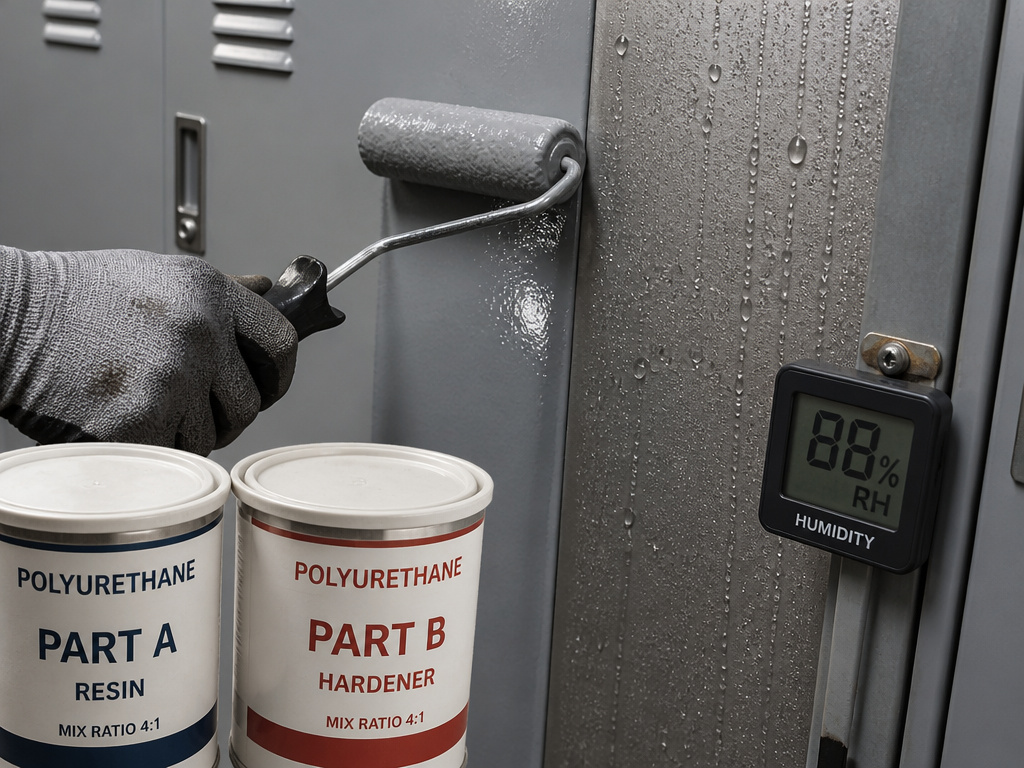
A single-component acrylic urethane is the wrong coating for a humid locker room. The UFC protective paints and coatings standard treats those spaces as corrosion-prone and calls for an upgraded system, even though the 5600 System’s own data sheet allows application at 85% relative humidity.
This is where the manufacturer’s window and the government spec disagree.
| Source | Humidity Position | Practical Effect |
|---|---|---|
| Rust-Oleum 5600 TDS | Applies up to 85% RH, 50-90 F | Single-component acrylic urethane is fine |
| UFC 3-190-06 | Humid zones 0A-5C are corrosion-prone | Requires ESC C3-C5 rated system |
| AS/NZS 2311:2017 | Humid environments need upgraded systems | Standard acrylic-urethane falls short |
The DoD standard lists ASHRAE climate zones 0A, 1A, 2A, 3A, 3C, 4C, and 5C as corrosion-prone. It also names high-humidity interior areas directly: bathrooms, locker rooms, laundry rooms, pools, and trainers.
If the floor you’re painting sits in one of those spaces, the single-component acrylic urethane is the wrong tool. Step up to a two-package system like Axalta Imron 2.1 HG, which is a 2.1 lbs/gal VOC polyurethane with chemical and abrasion resistance built for industrial service.
When Humid Zones Change the Spec
Microenvironmental factors can override the climate zone rating. Prevailing winds, ventilation, waterfront exposure, industrial emissions, deicing salt, chemical splash, flooding, and wind-driven rain all create a locally corrosive environment regardless of the ESC rating.
For a residential hallway, none of that applies. For a commercial entryway or a pool deck, it does. The kitchen paint question is the closest residential analog, because grease and steam do the same thing to a film that salt air does.
I’d rather spec a two-package system in a humid zone and overpay than repaint in two years. The interior wall brands that get recommended for walls aren’t built for this load.
Fair warning: the 85% RH number on the TDS describes the application window. The service window is a different number. A film that goes down at 84% RH and then lives at 90% RH for a decade is outside the durability envelope the government spec describes.
The Application Window That Ruins More Floors Than Bad Paint
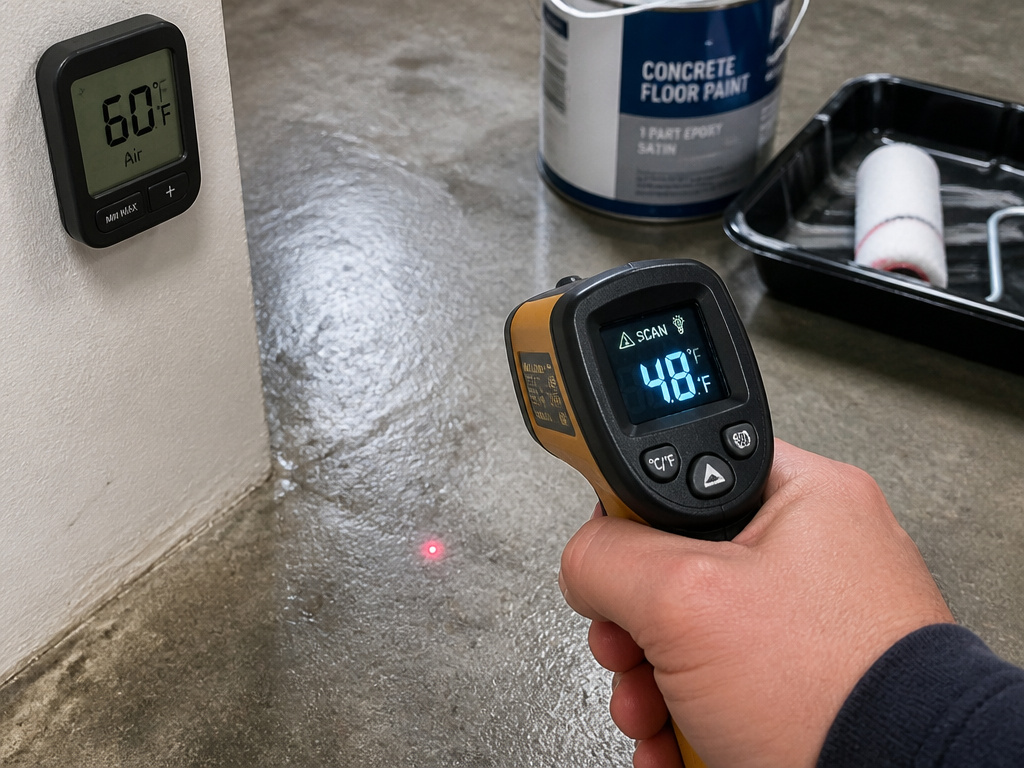
Apply outside the 50 to 90 F window, or when the slab sits less than 5 F above dew point, and the film will blush, wrinkle, or fail to bond. The paint doesn’t care how much you paid for it.
The 5600 System TDS lists 50 to 90 F (10 to 32 C) as the application window, with the surface at least 5 F above dew point and relative humidity under 85% during and after application. Sherwin-Williams’ exterior schedule is stricter on the cold end: no exterior painting below 50 F unless the product is designed for it, and low-temperature products still need air, surface, and material at 50 F or higher on metal siding.
A cold slab will pull the water out of the film too fast, and the surface goes from glossy to hazy. That haze is blushing, and it doesn’t buff out.
The dew point margin is the part people skip. A 55 F morning with a 52 F dew point is inside the temperature window and outside the dew point margin. Condensation forms on the slab before the film can cure, and the water gets trapped under the coating.
Where this goes sideways: Painting a slab that’s still cold from winter. The air temperature reads 60 F, the slab reads 48 F, and the film skins over before it bonds. You’ll see the first blister.
Dry Times at 70-80 F and 50% RH
The TDS dry times are measured at 70 to 80 F and 50% relative humidity. Tack-free in 1 to 2 hours. Recoat in 4 to 6 hours. Light foot traffic at 24 hours. Full use at 72 hours. No washing for 7 days.
Those times stretch in cool or humid conditions. Those times stretch in cool or humid conditions. Plan the job around the slowest condition, not the fastest.
Do you actually know what your slab moisture reads right now? The plastic sheet test answers it in 24 hours. Simple. Test first.
Two Coats, Not One: The Rule That Gets Skipped
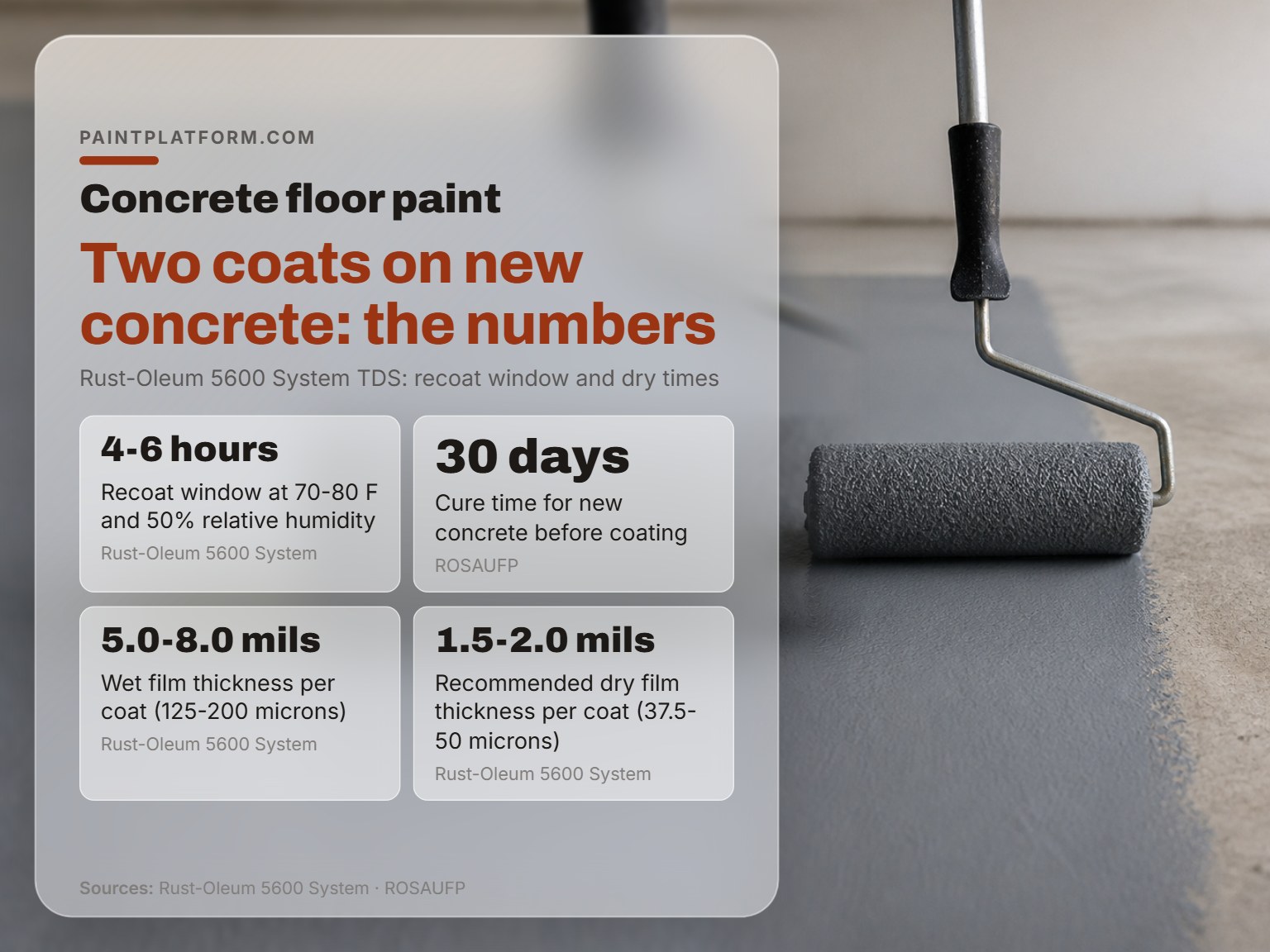
One coat on new concrete is a wasted can. The first coat soaks into the concrete’s pores and leaves bare patches where the surface is denser. The second coat builds film over those patches.
The 5600 System TDS mandates two coats on new or uncoated concrete. Field practice skips the second coat more often than any other step, usually because the first coat looks like it covered.
It didn’t. Concrete is not uniform. The troweled edges are denser than the field, and the first coat flashes off unevenly across both.
Easy to miss: The recoat window. The TDS says 4 to 6 hours. If you wait beyond the recoat window, the first coat is too hard for the second coat to bite into, and you’ll get intercoat adhesion failure.
Surface Prep Before the First Coat
Prep is where the two-coat rule actually starts. Skip it and the second coat won’t save you.
- Let new concrete cure for 30 days before any coating goes down.
- Remove grease, oil, dirt, and contaminants with Krud Kutter Cleaner Degreaser, detergent, or another suitable cleaner, then rinse with fresh water.
- Scrub with a standard floor scrubber or polisher fitted with a heavy-duty stripping pad such as 3M 7300. A thorough rinse is required if the concrete has been acid stained or acid etched.
- Vacuum to remove fine dust and debris. The floor should be dry and dust-free before application.
- Apply the first coat at 5 to 8
Frequently Asked Questions
Can I apply a high-traffic floor coating over a sealed or previously painted slab?
Only if the existing film is sound and bonded, and even then you must confirm compatibility with the new product’s data sheet. A sealer blocks the new coating from penetrating the concrete, so adhesion depends entirely on the old layer. When in doubt, grind back to bare concrete rather than gamble on a bond you cannot see.
Does a higher price per gallon mean longer wear life?
Not reliably. Price often tracks brand, distribution, and marketing rather than film performance. Two cans at very different prices can deliver the same dry film thickness and coverage, which are the numbers that actually govern wear. Compare spec sheets side by side before you compare receipts.
How do temperature and humidity on application day change the outcome?
Most manufacturers publish a window, often 50 to 90 F with relative humidity below a stated ceiling, and stepping outside it risks poor cure, blushing, or adhesion loss. Cool or damp conditions slow the film’s hardening, so it stays soft and vulnerable longer. Track the forecast for the full cure period, not just the hours you plan to roll.
Is one heavy coat better than two thinner ones?
Usually not. A single thick pass traps solvent, cures unevenly, and tends to fail at the edges where the film thins out. Two controlled coats at the specified thickness build a more uniform film and let each layer set before the next lands. Follow the can’s recoat window so the layers bond instead of sitting on top of each other.
