
9 Best Faded Paint Restorers in 2026
This post contains affiliate links. As an Amazon Associate, we earn from qualifying purchases.
For faded, oxidized paint, the Veksis Paint Deepoxidation Remover is the best overall pick because its non-abrasive formula safely restores gloss without damaging your clear coat. For clear coat safety with scratch removal, the Meguiar’s Ultimate Compound is a top choice, while the 3D One Car Scratch & Swirl Remover offers excellent one-step correction for light to moderate defects.
Faded paint happens when oxidation strips the color and gloss from your car’s clear coat. The right restorer removes that dead layer without sanding through the remaining finish, but choosing wrong can mean more work or worse, permanent damage to your paint.
This guide is based on manufacturer specifications, expert recommendations, and patterns in owner feedback. We evaluated each product for its formula safety, ease of use, and suitability for different levels of paint damage, so you can match the right restorer to your car’s condition.
Top 9 Faded Paint Restorers in the Market
Certain content that appears on this site comes from Amazon. This content is provided "as is" and is subject to change or removal at any time.
The Best Faded Paint Restorers, Reviewed
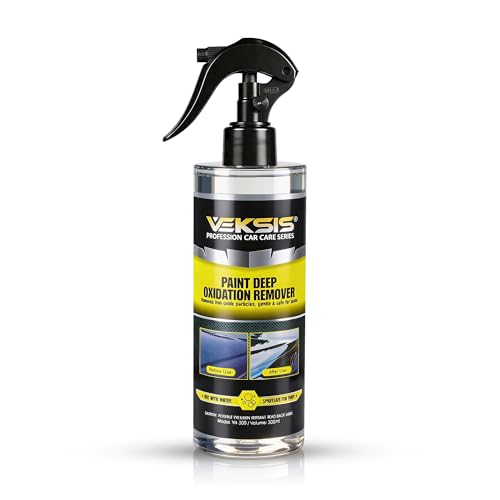
Veksis Paint Deepoxidation Remover
What We Like
- Non-abrasive formula protects clear coat
- Removes oxidation, water spots, swirl marks
- Concentrated: 6-8 full vehicle applications
- Easy DIY application without buffer
Trade-offs
- 300ml bottle covers fewer vehicles than larger options
- Requires manual circular motion application
A 300ml bottle covers 6-8 full vehicle paint corrections, which means you can restore a family car and still have enough for touch-ups on a second vehicle. This non-abrasive, pH-balanced formula lifts oxidation, water spots, and swirl marks without damaging clear coat, ceramic coatings, or PPF. It suits anyone who wants professional-grade results at home without buying a buffer or learning complex techniques. The concentrated liquid works into paint with simple circular motions and buffs off with a microfiber towel, making faded paint look deep and glossy in under an hour.
The trade-off is that 300ml is a moderate size for a dedicated restorer. If you regularly work on multiple cars or larger vehicles like trucks, you will need to buy more bottles sooner than you would with a gallon-sized compound. Meguiar’s Ultimate Compound comes in a 15.2 oz container and also removes defects, but the Veksis formula is non-abrasive and pH-balanced, which makes it safe for clear coats and coated surfaces without the risk of damage from harsher compounds.
Product photos
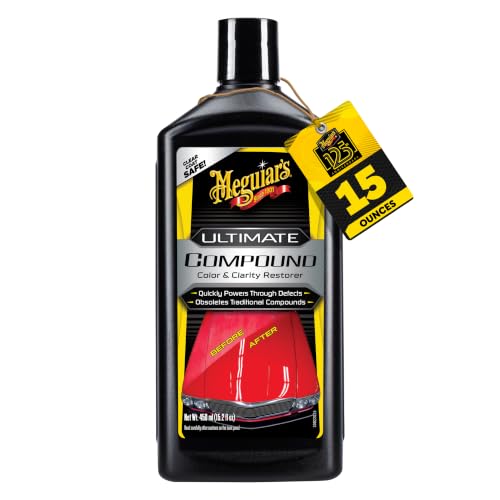
Meguiar's Ultimate Compound
What We Like
- Clear coat safe formula
- Removes scratches, swirls, oxidation
- Works by hand or DA polisher
- Micro-abrasive technology for fast cut
Trade-offs
- Single-stage compound: no built-in protection
- Requires a separate wax or sealant for protection
Meguiar’s Ultimate Compound uses micro-abrasive technology to remove scratches, swirls, and oxidation without hazing clear coats, making it safe for clear coats and all gloss paints. The 15.2-ounce bottle works by hand or with a dual-action polisher, so it suits anyone looking for a DIY fix that delivers a pro-detailer finish. If you’re working on a clear-coated car and need to correct surface defects, this compound cuts fast while keeping the clear coat intact.
Ultimate Compound is a pure cutting stage that leaves no wax or sealant behind, so you’ll need to follow up with a polish and protection step for long-term gloss. Compared to 3D One’s single-step compound-and-polish product, Meguiar’s requires an extra step but is designed for deeper defect removal. For clear-coated cars with scratches and oxidation, this is a safe option; for heavily oxidized single-stage paint, a dedicated restorer like Veksis may be a better fit.
Product photos
3D One Car Scratch & Swirl Remover

What We Like
- Hybrid cutting compound and finishing polish in one
- Zero-dust formula for clean finish
- Works by hand or DA polisher
- Pro-grade quality from 25+ years experience
Trade-offs
- Requires a polisher for best results on large panels
A single bottle that combines a cutting compound and finishing polish means you can remove swirls, light scratches, and oxidation without switching products mid-job. That hybrid formula makes it ideal for anyone who wants true paint correction in less time, whether you are spot-fixing by hand or polishing an entire panel with a DA polisher. Enthusiasts and detailers alike will appreciate the zero-dust finish and the mirror-like gloss it leaves behind, all from a brand trusted by pros for over 25 years.
A one-step product, no matter how capable, can’t match the deep cut of a dedicated heavy compound on severely faded or heavily oxidized paint. If your car’s clear coat is truly baked or peeling, a multi-step system like Meguiar’s Professional M105 Ultra Cut Compound followed by a polish will give you more aggressive correction. But for most daily drivers and show cars with typical swirls and light fading, this bottle simplifies the process without sacrificing results.
Product photos
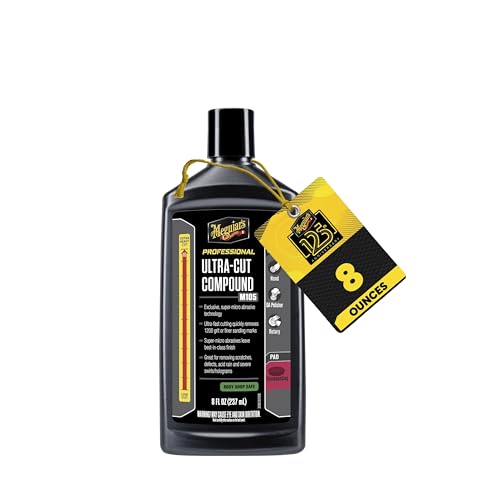
Meguiar's Professional M105 Ultra Cut Compound
What We Like
- Removes heavy defects like 1200 grit marks
- Super micro-abrasives boost gloss and shine
- Works by hand, DA polisher, or rotary buffer
- Clear coat safe for all glossy paints
Trade-offs
- Heavy cut requires skill to avoid overworking paint
- Not a one-step product; needs follow-up polishing
Meguiar’s Professional M105 Ultra Cut Compound removes moderate to heavy paint defects like scratches, oxidation, and swirls, and it cuts through up to 1200 grit sanding marks. Its super micro-abrasives minimize further swirling while boosting gloss and shine, so you get a high-gloss finish even after heavy correction. The formula is safe on clear coats and all glossy paint finishes, and it can be applied by hand, dual-action polisher, or rotary buffer, giving experienced users the flexibility they need for demanding work. Because this is a heavy cut compound, it typically requires a follow-up polishing step to perfect the surface.
Meguiar’s Professional M105 Ultra Cut Compound is a heavy-cut abrasive that removes scratches and swirls down to 1200 grit sanding marks. It’s the choice when you need serious defect removal rather than a light polish. The 8-ounce bottle weighs just 0.6 pounds, so it’s easy to handle by hand, with a DA polisher, or with a rotary buffer. Because it cuts aggressively, you’ll typically follow up with a finer polish to bring out maximum gloss.
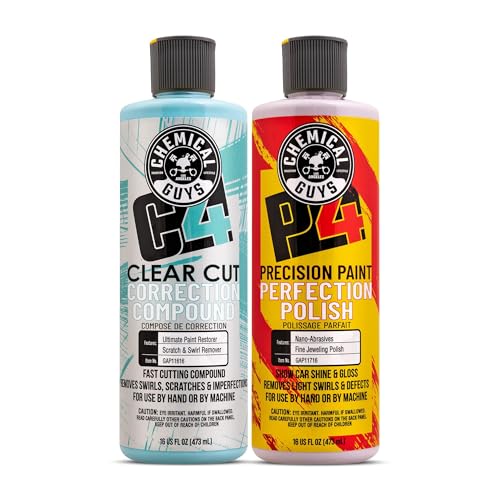
Chemical Guys C4 & P4 Paint Correction Kit
What We Like
- Two-step system for defect removal and gloss
- Safe on clear coat, single-stage, and ceramic paint
- Works with DA, rotary, or hand application
- Professional-grade correction at home
Trade-offs
- Two-step process takes more time than all-in-ones
- Heavier at 2.3 lb than single-bottle alternatives
- Requires both steps for full results
Two 16-ounce bottles deliver a complete two-step correction workflow: a heavy-cut compound for defect removal and a finishing polish for gloss refinement. The C4 Clear Cut Compound cuts through scratches, swirls, oxidation, towel marks, and etching, restoring clarity and leveling the paint surface. After compounding, the P4 Precision Polish refines the finish by removing micro-marring and enhancing depth, gloss, and color vibrancy for a show-quality result. This kit works on clear coat, single-stage, and ceramic-coated vehicles, and is compatible with dual-action, rotary, or hand application methods. Reviewers note it offers body shop–quality correction in a user-friendly format suitable for both enthusiasts and professional detailers.
Time is the trade-off: a two-step process takes longer than a one-step product like Meguiar’s Ultimate Compound, which combines cut and polish in a single pass. At 2.3 pounds, it’s also noticeably heavier than single-bottle options, so if you’re working on a whole car by hand, your arm will feel it. But if you’re after defect removal followed by show-car gloss, and you don’t mind the extra steps, this kit delivers exactly that sequence in a coordinated pair of formulas.
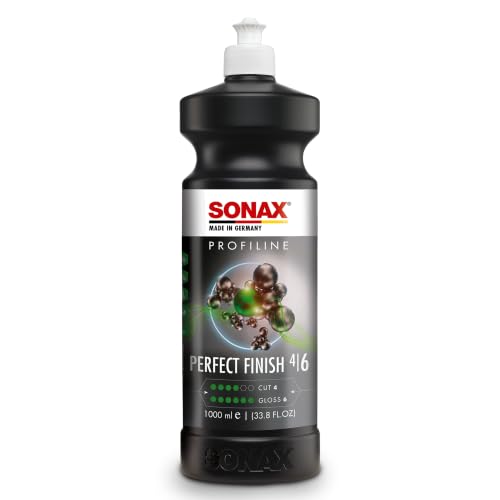
SONAX Perfect Finish Scratch Remover
What We Like
- Diminishing abrasives refine for high-gloss finish
- Works on soft and hard clear coats
- Silicone-free, water-based for low dust
- Combines medium-cut correction with fine finishing
Trade-offs
- Requires rotary or dual-action polisher, not hand-applied
A 1-liter bottle with diminishing abrasives that refine as you polish means this product can correct moderate clear-coat defects and finish with strong gloss in a single step. It removes P2000 sanding marks, swirls, water spots, and oxidation while leaving low haze. It suits detailers and experienced enthusiasts who want to save time by reducing the need for a separate finishing stage, especially across soft and hard clear coats including scratch-resistant ones.
Perfect Finish is designed for machine polishing with a rotary or dual-action polisher, so it won’t work for someone who prefers hand application. For deeper defects, you may need to adjust pad choice or consider a more aggressive product, but for moderate defects and a glossy result in one go, this is a balanced choice.
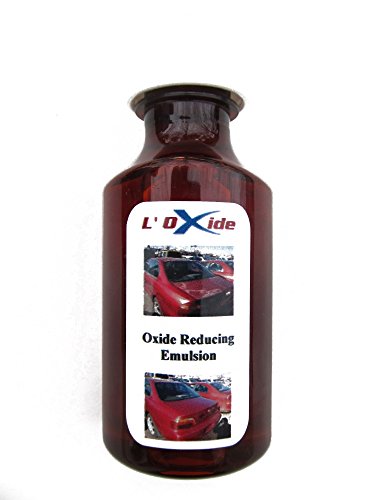
OxideOff Oxide Reducing Emulsion
What We Like
- No hard rubbing or sanding required
- Works on paint, clear coat, headlights, trim
- Simple DIY operation, easier than wax
Trade-offs
- Does not include polishing step for deep scratches
- Only addresses oxidation, not heavy swirl marks
OxideOff Oxide Reducing Emulsion needs no polishing and no hard rubbing, just a wipe-on, wipe-off routine that is easier than waxing. The nearly one million YouTube views indicate broad interest in the product. It targets faded paint, peeling clear coat, and dull headlights, making it a simple DIY option for bringing back color without learning compound techniques.
OxideOff Oxide Reducing Emulsion is designed to restore faded, oxidized, or sun-damaged car paint and peeling clear coat, not to fix deep scratches or swirl marks. For heavy defects, a product like Meguiar’s Ultimate Compound is a dedicated scratch remover, but OxideOff targets the white, chalky oxidation and converts it back to the underlying paint color. It needs no polishing or hard rubbing, so it’s a simple DIY operation for that specific job.
Product photos
Collinite 415 Color Up Cleaner Compound

What We Like
- Clear coat safe on all colors
- Removes oxidation, stains, and tar
- Works by hand or DA polisher
- Preps surface for wax protection
Trade-offs
- Cannot be used on glass, rubber, or trim
- Not for removing deep scratches
The Collinite 415 Color Up Cleaner Compound is a light-duty pre-wax cleanser that safely removes film, mild oxidation, brake dust, and stains from clear coats, single-stage paint, and fiberglass. Because it works by hand or with a dual-action polisher, it fits both casual weekend detailers and those who want a fast surface prep before applying wax. This makes it an ideal choice for anyone whose faded paint still has good clear coat integrity and just needs a gentle lift before protection.
This compound is not designed for heavy correction. Collinite 415 also requires care around trim, rubber, and glass, as it is not safe on those surfaces. For a simple, effective step between washing and waxing on lightly faded paint, it delivers exactly what the label promises.
Product photos
Lithium Seal and Squeal Paint Restorer

What We Like
- SiO2 ceramic protection lasts up to 12 months
- One-step polish and sealant application
- Hydrophobic water-beading repels dirt and grime
- Mild polishing improves light oxidation and haze
Trade-offs
- Mild polishing only addresses light oxidation, not heavy defects
- Requires clean painted surface before application for best bond
Up to 12 months of protection is possible from this product, so you can restore faded paint and then avoid re-coating for nearly a year. The SiO2 ceramic fused with Amino Polymers bonds to the surface, adding slickness and deep gloss while creating a hydrophobic barrier that makes water bead up and slide off, carrying dirt and grime with it. This makes it ideal for someone who wants a durable, low-maintenance finish on a daily driver or weekend cruiser without the complicated prep and cure times of a full ceramic coating.
The mild polishing agents are designed for light oxidation and surface haze, not deep scratches or heavy swirl marks. If your paint needs serious correction, something like Meguiar’s Ultimate Compound would be a better first step before applying a sealer. But for faded, chalky paint that just needs its pop back and a long-lasting shield, this one-step product delivers ceramic-style results without the drama.
Product photos
How We Evaluated Faded Paint Restorers
Our evaluation is research-based, drawing from manufacturer product data, professional detailing guides, and the collective experience of car owners who have used these restorers on real faded paint. We focused on the criteria that matter most for bringing back color and gloss without compromising the clear coat.
The first and most important criterion is clear coat safety. A restorer that is too abrasive can haze or burn through the thin protective layer, making the problem worse. We prioritized products with non-abrasive or micro-abrasive formulas designed for modern clear coats. The second criterion is effectiveness on oxidation, which determines how well a product actually removes the faded, chalky layer to reveal fresh paint underneath.
Third, we considered application method and ease of use, because not every owner has a dual-action polisher. Products that work by hand are more accessible for DIYers, while pro-grade compounds often need a machine for best results. Finally, we looked at versatility, whether a product can also handle swirl marks, water spots, or light scratches, saving you from buying multiple bottles.
What To Look For In Faded Paint Restorers
Choosing the right restorer means matching the product’s abrasive level to your paint’s condition. A mild polish won’t fix heavy oxidation, and an aggressive compound will damage a lightly faded clear coat.
Look for a clear-coat-safe formula that matches the severity of your paint fade. Non-abrasive emulsions work for light oxidation, micro-abrasive compounds handle moderate defects, and heavy-cut compounds are for deep scratches and sanding marks.
Abrasive Level and Cut
The “cut” of a compound refers to how aggressively it removes paint material. For light oxidation and haze, a non-abrasive chemical restorer or a fine polish is sufficient. Medium-cut compounds with micro-abrasives remove swirls and moderate oxidation while still finishing clear. Heavy-cut compounds can remove deep scratches and 1200-grit sanding marks but require follow-up polishing to restore gloss.
Clear Coat Compatibility
Modern automotive paint uses a clear coat as the top layer. A restorer that is too aggressive can haze or completely remove this layer. Look for products explicitly labeled “clear coat safe” or designed for clear-coated paints. For single-stage paints (older cars without a clear coat), use a product formulated for that finish.
Application Method
Some restorers are designed for hand application with a microfiber towel, making them ideal for quick DIY jobs. Others require a dual-action (DA) polisher or rotary buffer to work effectively. If you don’t own a machine, stick with products that work by hand. If you have a polisher, you can use a wider range of compounds.
Built-in Protection or Separate Steps
Some restorers include wax, sealant, or ceramic protection in a single step. Others are purely abrasive compounds that leave bare paint, which then needs a separate wax or sealant to protect the finish. A one-step product saves time, but a two-step system often gives better correction and longer-lasting results.
- Check the product label for “clear coat safe” before buying.
- Match the abrasive level to your paint’s condition: fine for light, medium for moderate, heavy for deep defects.
- Decide if you want to apply by hand or with a polisher before choosing a product.
- Consider whether you prefer an all-in-one restorer with protection or a separate compound and wax system.
A mild restorer is always safer than an aggressive one if you are unsure about your paint’s thickness.
Faded Paint Restorers Compared
The table below compares the key features of each product at a glance, helping you see which restorer matches your paint condition and application method.
| Product | Volume/Size | Formula Type | Application |
|---|---|---|---|
| Veksis Paint Deepoxidation Remover | 300ml | Non-abrasive, pH-balanced | Hand |
| Meguiar's Ultimate Compound | 15.2 oz | Pro-Grade Compound | Hand or DA Polisher |
| 3D One Car Scratch & Swirl Remover | 16 oz | Hybrid Rubbing Compound & Polish | Hand or DA polisher |
| Meguiar's Professional M105 Ultra Cut Compound | 8oz | Ultra-Cut Compound | Hand, DA polisher, or rotary buffer |
| Chemical Guys C4 & P4 Paint Correction Kit | 2 x 16 oz | 2-step compound & polish kit | Dual action, rotary, or hand |
| SONAX Perfect Finish Scratch Remover | 1 Liter | Diminishing | Rotary or dual-action polisher |
| OxideOff Oxide Reducing Emulsion | N/A | N/A | No polishing needed |
| Collinite 415 Color Up Cleaner Compound | 16 fl oz | Light-duty paint-cleansing pre-wax compound | Hand & DA polisher |
| Lithium Seal and Squeal Paint Restorer | 16 oz | SiO2 ceramic + Amino Polymers | Hand or dual-action polisher |
Frequently Asked Questions
Can I use a faded paint restorer on matte paint?
No, most paint restorers are designed for glossy clear coats and will leave shiny patches on matte finishes. Use a product specifically formulated for matte paint to avoid altering the sheen.
How often should I use a paint restorer?
Only use a paint restorer when oxidation or swirls are visible, typically once or twice a year. Overuse can thin the clear coat, so it is best to maintain the finish with a gentle wax or sealant between restorations.
Will a paint restorer remove deep scratches?
No, a paint restorer is designed for surface-level oxidation, swirl marks, and light scratches. Deep scratches that expose the primer or metal require touch-up paint or professional repair.
Can I apply a paint restorer by hand without a machine?
Yes, many restorers are formulated for hand application using a microfiber cloth. Check the product description, some heavy-cut compounds require a dual-action polisher or rotary buffer for best results.
Do I need to wax after using a paint restorer?
It depends on the product. Some restorers include built-in wax or sealant protection, while others leave bare paint that needs a separate wax or sealant to protect the finish and maintain gloss.
The Bottom Line
For most car owners dealing with faded, oxidized paint, the Veksis Paint Deepoxidation Remover is the best choice. Its non-abrasive formula is safe for clear coats, easy to apply by hand, and concentrated enough for multiple applications. It is ideal for home users who want to restore gloss without risking paint damage.
If your paint has deeper scratches or swirls along with fading, the Meguiar’s Ultimate Compound offers clear-coat-safe micro-abrasive correction that works by hand or polisher. For a complete two-step restoration with professional-grade results, the Chemical Guys C4 & P4 Paint Correction Kit gives you both defect removal and gloss enhancement.
The single most important factor is matching the restorer’s abrasive level to your paint’s condition. Start with the gentlest option that addresses your problem, and you will preserve your clear coat while bringing back the shine.
