
7 Best Antifouling Paint For Fiberglass Boats in 2026
This post contains affiliate links. As an Amazon Associate, we earn from qualifying purchases.
For fiberglass boat owners seeking reliable bottom protection, the TotalBoat JD Select Water-Based Antifouling Paint stands out as the best overall pick for its low-VOC water-based formula that cleans up with soap and water. For multi-season durability, the TotalBoat Spartan offers long-term protection, while the Pettit Trinidad Pro is the choice for severe fouling waters.
Keeping a fiberglass hull free of barnacles, algae, and slime is essential for performance and fuel efficiency. The challenge is choosing between water-based and solvent-based formulas, ablative and hard paints, and matching the protection level to your local waters and how often you use the boat.
This guide is built from manufacturer specifications, expert recommendations, and patterns in owner feedback. We break down the key differences between paint types, application requirements, and what to consider for your specific boating habits and water conditions.
Top 7 Antifouling Paints For Fiberglass Boats in the Market
Certain content that appears on this site comes from Amazon. This content is provided "as is" and is subject to change or removal at any time.
The Best Antifouling Paints For Fiberglass Boats, Reviewed
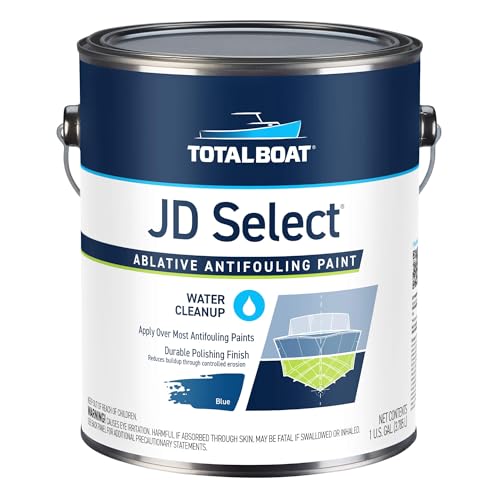
TotalBoat JD Select Water-Based Antifouling Paint
What We Like
- Low-VOC water-based formula
- Cleans up with soap and water
- Ablative coating reduces paint buildup
- Compatible with most existing bottom paints
Trade-offs
- Single-season protection only
- Requires 1-2 thin coats
With 25.5% copper biocide in a water-based, low-VOC formula, you get effective antifouling protection without the harsh solvents and fumes of traditional bottom paints. The ablative coating wears away gradually as the boat moves, exposing fresh biocide all season while reducing paint build-up for easier prep next season. It applies smoothly with a brush, roller, or sprayer, dries in as little as two hours, and cleans up with soap and water, ideal for DIYers working in marinas with VOC restrictions. For a single season of protection on fiberglass, wood, or steel hulls, this is a user-friendly option.
The trade-off is that protection lasts only one season, so you will need to repaint each year. That makes it less convenient than a multi-year formula like TotalBoat Spartan, which offers a higher 38% copper content. But for boaters who prefer the simplicity of annual maintenance, minimal solvent exposure, and easy cleanup, JD Select delivers exactly what it promises without the extra cost of a multi-season paint you might not need.
TotalBoat Spartan Multi-Season Antifouling Paint

What We Like
- 38% cuprous oxide for long-term protection
- Ablative layer reduces paint buildup
- No maximum dry time for flexible launch
- Works in salt, fresh, and brackish water
Trade-offs
- Needs scuff-sanding if dry over 2 weeks
- Requires scuff-sanding if boat sits over 2 weeks.
With 38% cuprous oxide, this ablative paint packs enough copper to fend off barnacles, slime, and weeds across multiple seasons in any water type. That high biocide load means you can leave the boat in high-fouling waters without worrying about mid-season haulouts. It gradually wears away as you move, so you won’t end up with a thick crust of old paint after a few years. The lack of a maximum dry time is a real bonus: you can paint the bottom weeks before launch and not stress about the clock.
Compared to the single-season TotalBoat JD Select, this one costs more upfront but saves the labor of repainting every year. It’s a premium choice for owners of fiberglass, wood, or steel boats who want to paint once and forget about it for several seasons.
Pettit Trinidad Pro Hard Antifouling Paint

What We Like
- 65% cuprous oxide for severe fouling
- Hard durable finish for long-term immersion
- Fast dry technology for same-day launch
- Compatible with fiberglass, wood, steel
Trade-offs
- Not ablative; does not wear away over time
- Requires proper surface prep for adhesion
With 65% cuprous oxide, this hard paint is formulated for severe fouling conditions where barnacles, algae, and slime are a constant problem. The hard durable finish is designed for long-term immersion and multi-season performance, making it a strong choice for boats that stay in the water continuously. Its fast-dry technology allows same-day painting and launching, which reduces downtime for boat owners and boatyards.
Because this is a hard paint, it does not wear away like an ablative paint would. When it’s time to repaint, the old coat will need to be sanded thoroughly to ensure proper adhesion of the new layer. That extra preparation is part of the trade-off for the high copper content, which provides dependable protection in demanding marine conditions.
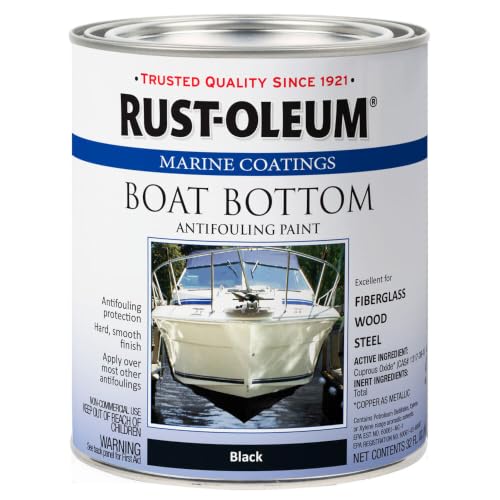
Rust-Oleum Marine Boat Bottom Antifouling Paint
What We Like
- Works on fiberglass, wood, and steel
- Copper release prevents barnacles and algae
- Fast 4-hour recoat, 16-hour launch time
- Hard smooth finish over aged coatings
Trade-offs
- Single quart covers only 110 sq ft
- Hard finish can be harder to sand for reapplication
This paint covers up to 110 square feet per quart, which is enough for a small boat without needing a second can. The hard, smooth finish resists barnacles and algae, and the 16-hour launch time gets you back on the water fast. It is a straightforward option for below-the-waterline protection.
Copper biocides face restrictions in some regions, so check local regulations before buying. This Rust-Oleum relies on traditional copper release, while the TotalBoat JD Select is water-based. If you need a multi-season coating, the TotalBoat Spartan Multi-Season might be a better fit. But for a budget-friendly, effective single-season paint that goes on fast and dries hard, this fits the bill.
Product photos
Interlux Trilux 33 Antifouling Paint

What We Like
- Biolux technology targets slime specifically
- Works on fiberglass, wood, steel, primed aluminum
- Powerful antifouling protection
- Lightweight quart size for small jobs
Trade-offs
- Single color option (white) limits hull aesthetics
- Quart size covers less area than gallon alternatives
The Biolux slime-blocking technology built into Interlux Trilux 33 is its standout feature, directly engineered to stop the biofilm that often slips past standard copper-based paints. That makes it a smart pick if your fiberglass boat spends time in warm, nutrient-rich waters where slime turns the bottom into a slick, drag-inducing mess. The paint also works on wood, steel, and primed aluminum, so you aren’t locked into one hull material. For a quart can, it’s a focused solution for keeping the running surface clean without the heavy copper load of some ablative paints.
You only get white with this paint. That may not match every boat’s color scheme or hide waterline staining as well as a darker shade. And at one quart, this is best for touch-ups or small craft rather than a full hull job on a larger vessel. If you need to cover a larger hull in one go, a gallon of TotalBoat JD Select Water-Based Antifouling Paint would stretch further per coat. But for targeted slime control on a dinghy or a quick seasonal refresh, Trilux 33 does exactly what its name promises.
Product photos
Interlux ACT Antifouling Paint

What We Like
- Season-to-season antifouling protection
- Eliminates paint build-up and sanding
- Works on fiberglass, wood, primed metals
- Best value ablative formula
Trade-offs
- Not for use on aluminum hulls
- Heavy gallon can at 20.1 pounds
A single gallon covers 430 square feet at 2 mils dry film thickness. That is enough to coat a typical small sailboat or powerboat bottom in one go without needing a second can. This generous coverage, combined with an ablative formula that wears away slowly over the season rather than building up, makes it a practical choice for anyone who wants reliable protection without the annual chore of sanding off old layers. It suits fiberglass, wood, and properly primed metal hulls, so it fits the majority of recreational boats on the water today.
The biggest limitation is that this paint cannot be used on aluminum hulls, so aluminum boat owners need to look elsewhere. At 20.1 pounds per gallon, the can is heavy, but that weight reflects the full gallon of paint you’re getting. Compared to the TotalBoat JD Select Water-Based Antifouling Paint, which is a single-season formula, the Interlux ACT delivers season-to-season antifouling protection. For most fiberglass boat owners who want a bottom paint that keeps working year after year, this is a practical choice.
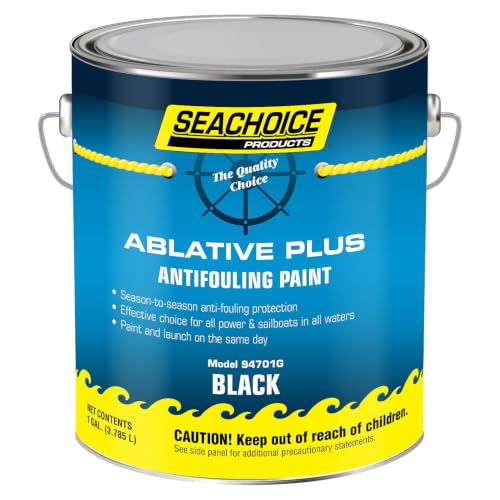
SEACHOICE Ablative Plus Antifouling Paint
What We Like
- Touch dry in 1 hour
- Overcoat in 2 hours
- Launch in 6 hours
- Works on fiberglass, wood, primed metal
Trade-offs
- Not for aluminum hulls
- Single-season ablative formula
A one-hour touch-dry time means you can move from priming to painting to launching in a single day, six hours from final coat to splash. That fast-drying schedule makes SEACHOICE Ablative Plus a practical choice for DIY boat owners who work on a trailer or in a tight haul-out window. Its 25% copper ablative formula is designed for powerboats and sailboats in fresh, salt, and brackish water, and it covers up to 400 square feet per gallon. The paint wears away gradually, releasing biocide as the boat moves, which keeps the bottom clean through a season of regular use.
This is a single-season ablative paint. If you keep your boat in the water year-round or run it hard in warm, fouling-heavy waters, you may need to apply a fresh coat each season. Compare that to TotalBoat Spartan Multi-Season, which carries 38% copper and is designed to last multiple years, but it also takes longer to dry and costs more per gallon. SEACHOICE Ablative Plus is not suitable for aluminum hulls, so if your boat has an aluminum bottom, you will need to look at a dedicated aluminum-safe formula. For fiberglass owners who value speed and simplicity over multi-year endurance, this paint delivers reliable season-long protection without tying up your boat for days.
Product photos
How We Evaluated Antifouling Paints For Fiberglass Boats
Our evaluation focused on manufacturer data, expert recommendations from marine paint professionals, and patterns found in long-term owner feedback across boating forums. We prioritized paints specifically formulated for fiberglass hulls, as aluminum and wood require different chemical compositions.
The three most critical criteria were paint chemistry (ablative vs. Hard), copper content for fouling resistance, and application requirements including dry time, recoat windows, and surface preparation. We also weighed the trade-offs between single-season and multi-season paints to help match the right product to different usage patterns.
An evaluation cannot replicate real-world fouling conditions across different waterways. We focused on verifiable specifications and documented owner experiences.
What To Look For In Antifouling Paints For Fiberglass Boats
Choosing the right antifouling paint means understanding your hull material, local fouling pressure, and how long the boat stays in the water between uses.
Key buying criteria: Paint type (ablative vs. Hard), copper content percentage, compatibility with existing coatings, dry and launch times, and whether the formula works in your water type (salt, fresh, or brackish).
Paint Type: Ablative vs. Hard
Ablative paints wear away gradually as the boat moves through water, releasing biocides continuously and reducing paint buildup over time. They are ideal for boats that are used regularly. Hard paints form a durable, non-sacrificial coating that remains intact through the season, making them better for boats that stay moored for long periods or operate in severe fouling conditions.
Copper Content And Fouling Protection
Higher copper oxide percentages generally provide stronger protection against barnacles and marine growth. Paints with 38% to 65% cuprous oxide are designed for high-fouling waters. Lower copper levels may suffice for freshwater lakes or light fouling areas. Check local regulations, as some regions restrict copper-based paints.
Application And Dry Time
Application requirements vary significantly between water-based and solvent-based paints. Water-based formulas clean up with soap and water and have lower odor, while solvent-based paints require mineral spirits for cleanup. Dry time before launching ranges from 6 hours for fast-drying formulas to 16 hours or more for traditional paints. Consider your workspace ventilation and how quickly you need the boat back in the water.
- Confirm your existing bottom paint is compatible with the new coating before applying.
- Check the recoat window, some paints require sanding if the dry time exceeds a certain period.
- Verify the paint is approved for fiberglass hulls and not restricted to wood or metal only.
- Measure your hull area accurately; coverage rates vary from 110 to 400 square feet per gallon.
- Consider whether you need a barrier coat for bare fiberglass or over old paint.
Rule of thumb: If you use your boat weekly, choose an ablative paint. If the boat sits at the dock for months, a hard paint will last longer between haul-outs.
Antifouling Paints For Fiberglass Boats Compared
The table below compares the key specifications of our seven recommended antifouling paints for fiberglass boats, including paint type, copper content, and best use case.
| Product | Coverage | Dry Time | Hull Materials |
|---|---|---|---|
| TotalBoat JD Select Water-Based Antifouling Paint | Up to 500 sq. ft./gal | 2 hours | Fiberglass, wood, steel |
| TotalBoat Spartan Multi-Season Antifouling Paint | Up to 500 sq. ft./gallon | 2 hours | Fiberglass, wood, steel |
| Pettit Trinidad Pro Hard Antifouling Paint | N/A | Fast dry technology | Fiberglass, wood, steel |
| Rust-Oleum Marine Boat Bottom Antifouling Paint | up to 110 sq ft | Recoat time: 4 hours; Launch time: 16 hours | Fiberglass, wood, steel |
| Interlux Trilux 33 Antifouling Paint | N/A | N/A | Fiberglass, wood, steel, primed aluminum |
| Interlux ACT Antifouling Paint | 430 sq. ft./gal. | N/A | Fiberglass, wood, primed metals |
| SEACHOICE Ablative Plus Antifouling Paint | Up to 400 sq. ft./gal | Touch dry in 1 hour; Overcoat time: 2 hours; Launch time: 6 hours | Fiberglass, wood, and properly primed metal |
Frequently Asked Questions
Can I apply antifouling paint over old paint on a fiberglass boat?
Yes, most antifouling paints are compatible with existing bottom paints, but you must check the manufacturer’s guidelines. Some paints require a barrier coat if switching from hard to ablative or vice versa. Always test a small area first for adhesion.
How long does antifouling paint last on a fiberglass hull?
Single-season paints provide protection for one boating season. Multi-season paints with higher copper content can last multiple years before recoating is needed, depending on water conditions and boat usage.
What is the difference between ablative and hard antifouling paint?
Ablative paint slowly wears away as the boat moves, releasing biocides and preventing paint buildup. Hard paint forms a durable, non-sacrificial coating that stays intact and is better for boats that remain stationary for long periods or face severe fouling.
Can I use antifouling paint on an aluminum boat?
Most antifouling paints are not recommended for aluminum hulls because copper reacts with aluminum, causing galvanic corrosion. Look for paints specifically labeled for aluminum, such as the Interlux Trilux 33, or use a proper epoxy barrier coat.
How do I prepare a fiberglass hull for antifouling paint?
Bare fiberglass requires sanding and application of a primer or barrier coat. Previously painted surfaces need light sanding to create a mechanical bond, followed by cleaning and degreasing. Follow the paint manufacturer’s surface preparation instructions precisely.
The Bottom Line
For most fiberglass boat owners, the TotalBoat JD Select Water-Based Antifouling Paint offers the best balance of easy application, low odor, and effective single-season protection. Its water-based formula makes cleanup simple and is ideal for DIY boaters in VOC-restricted areas.
If you need multi-season protection in high-fouling waters, the TotalBoat Spartan provides excellent long-term value with its 38% cuprous oxide content. Budget-conscious owners should consider the Rust-Oleum Marine Boat Bottom Antifouling Paint for a fast-drying, copper-based option at a lower cost.
The single most important factor in choosing antifouling paint is matching the paint type and copper content to your local fouling pressure and how often you use the boat. A paint that excels in one waterway may not perform the same in another.
