
How to Clean Paint Trays: Step-by-Step (Without the Mess)
This post contains affiliate links. As an Amazon Associate, we earn from qualifying purchases.
Learning how to clean paint trays starts with one split: latex and water-based paint washes off with warm, soapy water while it’s still wet, and oil-based paint needs a solvent like mineral spirits. Clemson University’s waterwise method then settles the rinse water for about 24 hours and pours it down a bathroom drain.
That word “while” is carrying the whole sentence, and it’s the heart of how to clean paint trays. Clemson’s factsheet spells out the consequence of missing it: once a water-based paint dries on a tray, water stops working on it and a solvent becomes the only thing that will. A tray rinsed at four in the afternoon and a tray left until morning are two different jobs.
What follows is the two-route split in detail, the three-bucket method Clemson specifies, the places where the sources genuinely contradict each other, and where the leftover water is actually allowed to go.
Key Takeaways
- Latex comes off wet, oil comes off with solvent. Warm, soapy water handles water-based paint; mineral spirits or paint thinner handles oil-based.
- Three 5-gallon buckets, each about two-thirds full, is the wash system Clemson’s factsheet specifies.
- Settle the wash water about 24 hours in capped buckets out of direct sunlight before pouring it down a bathroom drain.
- Solvent never touches a drain or the ground. Clemson’s wording leaves no room for a storm drain, a garden hose, or a curb.
- No septic system, ever. Clemson rules out paint water of any kind going into a septic tank.
What Actually Separates a Latex Tray From an Oil Tray?
Water is the whole test. Latex and other water-based paints thin and clean up in water, which is why Clemson’s extension service tells you to wash them off before they dry. Oil-based paint won’t budge for water at all.
Water-based paint carries pigment suspended in a water solution, so plain water thins it and warm soapy water lifts it off a tray. Oil-based paint binds pigment in an oil vehicle that water cannot break, and only a solvent such as mineral spirits or paint thinner dissolves the film.
The practical version of how to clean paint trays is a look and a fingernail. A latex film goes matte and slightly rubbery as it cures. An oil film keeps a faint gloss and stays tacky under a nail for hours.
Dutch Boy splits it the same way: warm, soapy water for latex, mineral spirits or paint thinner for oil. Neither approach changes with the brand on the can.
Tray material is where it gets interesting. Metal trays shrug off mineral spirits. Some plastic trays go soft or cloudy after a long soak in thinner, which is one reason the paint tray types you pick matter before you open a can. The best paint trays for cleanup share two features: smooth interiors and rounded corners, because square corners hold paint a rag can’t reach.
The Three-Bucket Wash That Keeps Paint Out of the Drain
Three 5-gallon buckets do the job a running tap can’t. Clemson’s factsheet specifies three of them, each filled about two-thirds with water. The logic is progressive dilution. The first bucket takes the bulk of the paint, the second rinses, and the third leaves the tray nearly clear.
Before you start: Wear gloves for any solvent work and keep the area ventilated; Clemson’s factsheet calls for both every time thinner comes out. Solvent never goes down a drain, inside or outside, and never gets poured on the ground.
Clemson’s waterwise cleaning of painting equipment guidance covers brushes and rollers as well as trays, and the settling step is the part most people skip. Here’s the working order:
- Squeeze the wet paint back into the can. Lean the tray against a wall and let it run, or steer it with a brush. ProRoller recommends this for uncontaminated paint, and skipping it means you’re washing good paint into your buckets.
- Scrub in bucket one. A rag plus a 5-in-1 painter’s tool gets the bulk off. Clemson singles out the 5-in-1 because it reclaims paint from rollers, brushes, and sponges without the mess a bare hand makes.
- Rinse in bucket two, then bucket three. Each pass leaves less pigment behind. Stop early and the third bucket turns grey, which means the water you’re about to pour away still has paint in it.
- Cap the buckets and walk away for about 24 hours. Clemson says out of direct sunlight and undisturbed. Move them halfway through and the settled layer lifts straight back into the water.
Where this goes sideways: Capping the buckets isn’t optional housekeeping. Clemson’s factsheet calls for a protected spot specifically so children and animals can’t drink the water while the paint settles.
Rollers go through the same buckets, and the roller cleaning steps are worth reading separately because a roller holds far more paint than a tray ever will.
Filling and Settling the Buckets
Two-thirds full is the number to remember. Clemson puts the fill at about two-thirds in each of the three buckets, which leaves headroom for a tray to go in without displacing water over the rim. Rubbermaid 5-gallon buckets are the ones I keep stacked in the corner for exactly this.
Twenty-four hours is the settling window. Less than that and the water hasn’t cleared.
Decanting Without Lifting the Sludge
Once the paint has dropped, pour the clear water out inside a bathroom drain. Clemson’s instruction is specific about location: inside, into the sanitary sewer. Not a storm drain, and not onto the yard through a garden hose.
The paint left at the bottom stays put. Once it dries completely, it goes in the trash as household waste.
Where the Sources Disagree on Latex Trays
Two reputable sources tell you to do opposite things with a latex-coated tray. Clemson’s factsheet says wash water-based paint off before it dries, because a dried film needs solvent. ProRoller says let the leftover latex dry completely, then pop it out with a putty knife or your hand.
| Source | What it tells you to do | Timing |
|---|---|---|
| Clemson HGIC | Wash water-based paint off before it dries | While still wet |
| Dutch Boy | Clean trays immediately with warm, soapy water | Right after the job |
| ProRoller | Let leftover latex dry, then dislodge it | After it dries |
The split is about what’s left in the tray. Clemson and Dutch Boy are describing a tray you’re about to reuse. ProRoller is describing residue you couldn’t reach with a rag, which is exactly the case where letting it cure and lifting it out beats scrubbing.
I’ve had both outcomes on the same tray in the same afternoon. The thin wash film peeled in one satisfying piece. The half-inch puddle in the corner did not, and I spent ten minutes with a putty knife getting nowhere politely.
If you only take one rule from this section, take Clemson’s: rinse while it’s wet, though ProRoller instead advises letting leftover latex dry completely and then dislodging it with a putty knife or your hand. Dry-peel is what you do when you’ve already lost that race. It works, and it’s slower every time.
Does the Wash Water Go Down the Drain?
Yes, but only one drain and only after settling. Clemson permits the separated water to go out inside a bathroom drain once the paint has dropped to the bottom of the bucket. Everything else is off limits.
- Storm drains are out. Runoff goes to waterways, not a treatment plant, and Clemson’s factsheet is built around keeping paint out of them.
- The garden hose is out. Clemson specifically rules out washing equipment in the yard.
- Septic systems are out. Clemson warns that improper disposal damages septic systems, and the factsheet excludes them from acceptable disposal entirely.
- Trash needs a capped container. DHEC allows latex paint in household trash only when it’s completely dried and in a capped container.
For anyone on a well and a septic tank, that last bullet changes the whole routine. The three-bucket water can’t go down the sink, so it has to evaporate or leave the property in a sealed container. Dutch Boy’s advice applies here: call your local government or city hall, because each district handles paint waste differently.
The broader dispose of paint water question follows the same logic, and the septic exclusion is the part most guides leave out.
Tray Liners Change the Whole Calculation
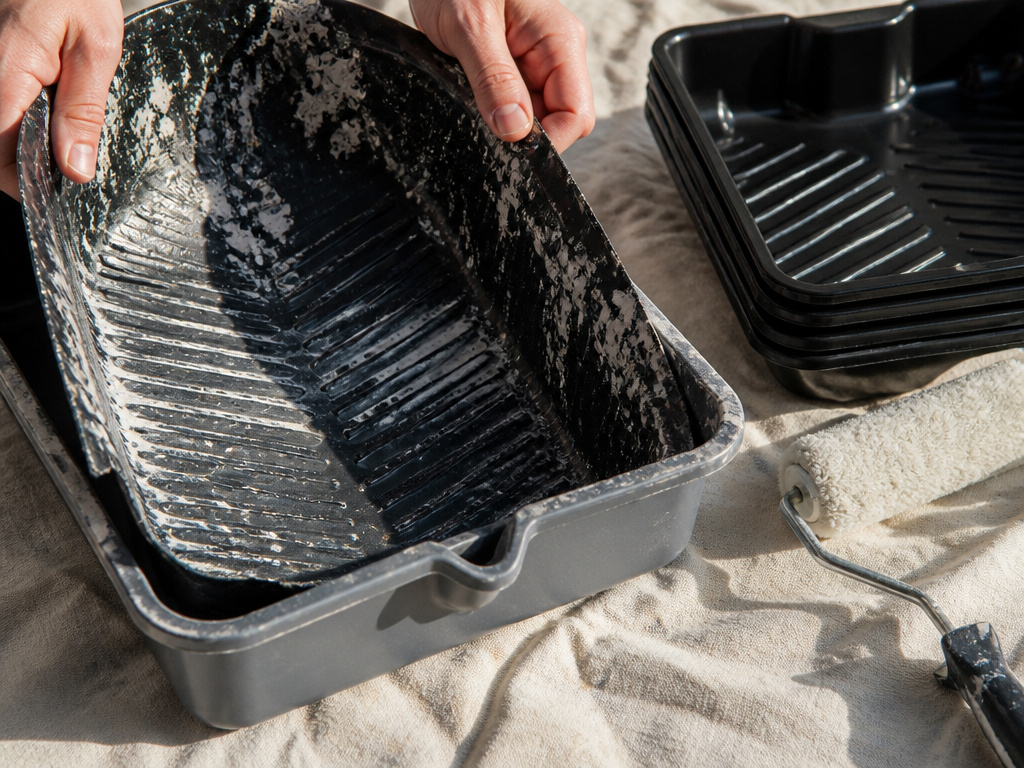
The Purdy NEST 9-inch liner holds 1 gallon, is molded from black polypropylene, and drops into an interchangeable tray system. Two liners inverted make a snap-on lid, and there’s a side pour spout for emptying. For a latex job in a plastic tray, that’s the one I’d reach for.
A liner removes the cleaning question instead of answering it. Lift it out, let the residue dry, throw it away.
When a Liner Beats Washing
A liner wins on latex in a plastic tray. On an oil-based job it just becomes one more solvent-soaked item to deal with, and Clemson’s disposable-liner advice is aimed at reducing cleanup, not adding a step.
Clemson lists disposable liners, brushes, rollers, and sponges among the ways to cut cleanup burden. The tray liners argument gets more interesting once you weigh a box of liners against the water and time a full three-bucket wash takes. The same idea scales up: paint pail liners turn a 5-gallon bucket into something you rinse rather than scrub.
Solvent Gets Reused, Labeled, and Never Poured Outside
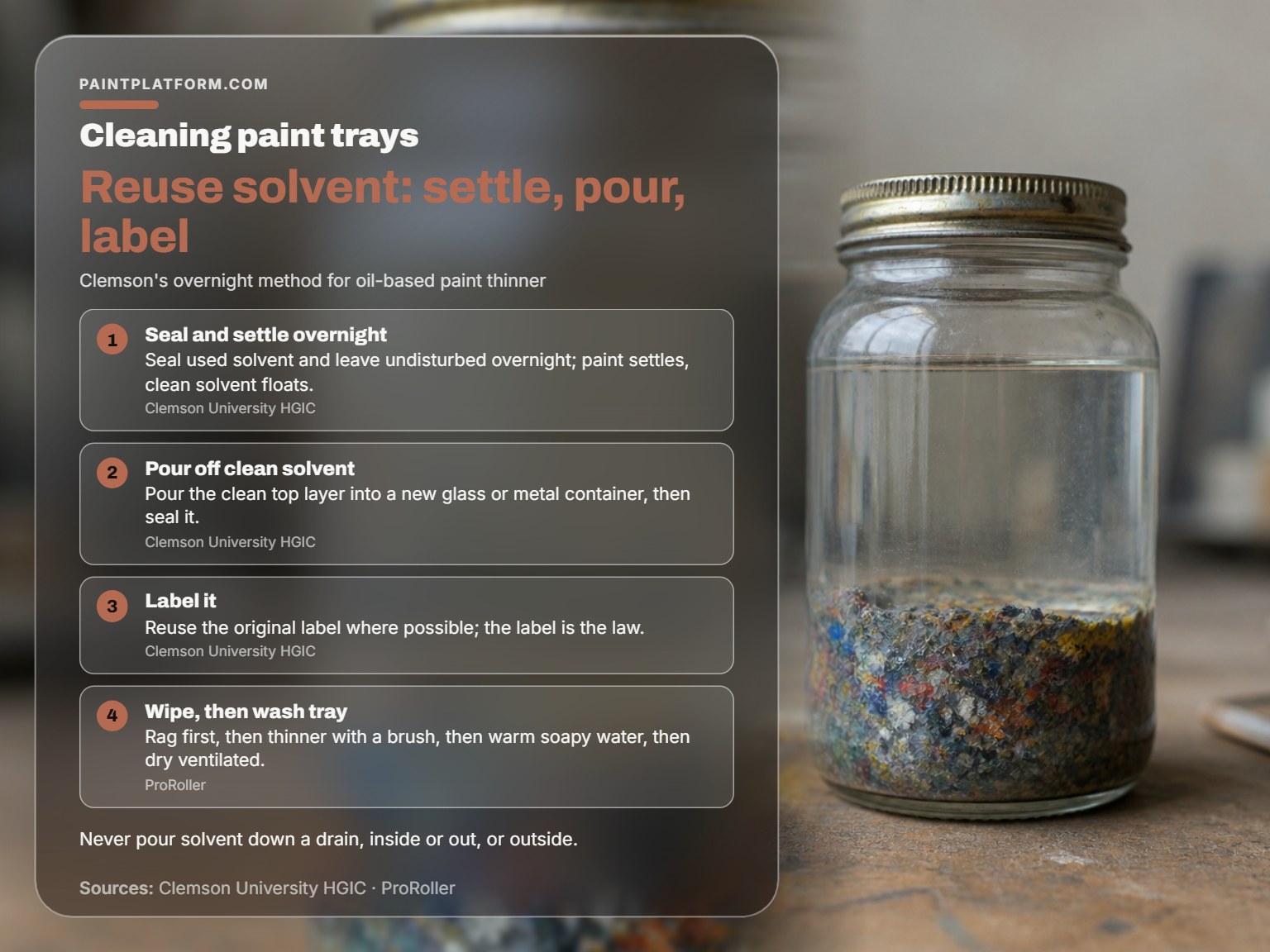
Clemson’s method lets you reuse thinner after an oil-based job, and the sequence is short enough that there’s no excuse for dumping it. Fair warning: this is the part where people cut corners and then wonder why the garage smells like a chemical plant.
- Seal the used solvent and leave it overnight. Paint settles to the bottom and the clean solvent floats on top.
- Pour the clean layer into a new glass or metal container. Clemson specifies glass or metal, then seal it.
- Label it, and reuse the original label where you can. Clemson’s factsheet puts it bluntly: the label is the law, because it carries the storage, use, and safety information.
- Wipe the tray first, then wash it. ProRoller’s order is rag, then thinner distributed with a brush, then warm soapy water, then dry in a well-ventilated area.
Brushes take the same solvent, and the cleaning paint brushes sequence is worth running in the same session so you only handle thinner once.
The Overnight Settling Trick
Overnight is the number. Clemson says place the sealed container where it won’t be disturbed, and that’s the whole trick. Disturb it and the paint you were trying to separate goes back into suspension.
Dutch Boy recommends mineral spirits or paint thinner for oil paint but gives no disposal guidance at all. Clemson’s prohibition fills that gap, and it’s the one to follow: never down a drain, inside or out, never poured outside.
Edgers and scrapers are the easy wins. Dutch Boy’s advice to clean tools immediately applies double here, because a dried edge of paint on the pad of a paint edger is stubborn in a way a flat tray never is.
What to Do With the Dried Paint at the Bottom
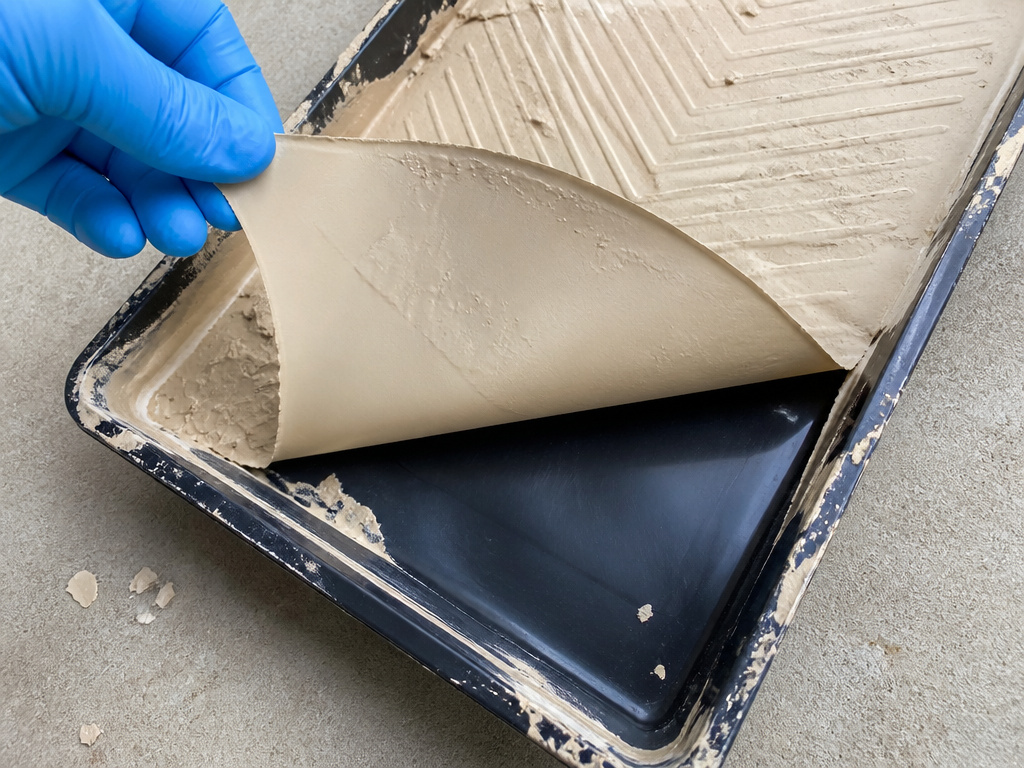
A tray sits in the garage for a week. The paint at the bottom has gone from tacky to solid, and now it lifts out in one piece. That’s the good outcome.
Clemson’s rule is that once the settled paint at the bottom of the bucket dries completely, it goes in the trash as household waste. Completely is the operative word. DHEC allows latex paint in household trash only when it’s fully dried and in a capped container.
If you don’t want to wait, Clemson suggests mixing in cat litter and leaving the buckets in the sun. It works, and it’s the least glamorous sentence here.
| Symptom | Likely cause | Fix |
|---|---|---|
| Rubbery skin across the tray | Latex left to cure in a warm room | Lift it out whole, then wash the tray |
| Rainbow sheen in the rinse water | Oil paint or solvent in the wash | Stop; that water can’t go down a drain |
| Lumps in fresh paint | Dried paint lifting off the tray | Clean the tray before the next pour |
| White crust on a steel tray | Paint residue left on bare metal | Wipe dry after washing |
The lumps row is the one people ignore. ProRoller warns that old paint left in a tray lifts and mixes with fresh paint, and the result is visible skin on the finished wall.
Clemson cites an EPA estimate that 10% of paint bought to paint houses and other structures ends up as leftovers. That’s the number behind DHEC’s advice to use up what you buy, or donate the remainder to a school, community group, or theater group.
Frequently Asked Questions
Can I clean a paint tray in the sink?
Not with wet paint still in it. Clemson’s method settles the wash water for about 24 hours first, then pours the clear top layer down a bathroom drain. Paint going straight into a sink is the exact thing the settling step exists to prevent.
How long should latex wash water sit before I pour it out?
About 24 hours, out of direct sunlight and undisturbed, in a capped bucket. Clemson’s factsheet uses that window so the pigment drops to the bottom and the water on top runs clear.
What do I use on oil-based paint in a tray?
Mineral spirits or paint thinner. Dutch Boy names both. Clemson adds that the used solvent can be reused after it sits overnight and the paint settles out, provided you pour the clean layer into a sealed, labeled glass or metal container.
Can I put the dried paint in the trash?
Yes, once it’s completely dry. DHEC allows latex paint in household trash only when it’s fully dried and in a capped container. Clemson suggests mixing in cat litter and leaving the bucket in the sun to speed that up.
Do tray liners actually save time?
On a latex job in a plastic tray, yes. Clemson lists disposable liners among the ways to reduce cleanup burden. On oil-based paint the liner just adds a solvent-soaked item you still have to deal with.
What if I’m on a septic system?
Clemson rules out septic disposal for paint water, so the three-bucket wash water has to evaporate or leave the property in a sealed container. Dutch Boy’s advice to call your local government applies, because rules vary by district.
The Bottom Line
The trigger is simple. If the paint on the tray is still wet, you’re ten minutes from done. If it’s dry and it’s latex, Clemson says a solvent is needed, while ProRoller advises letting leftover latex dry completely and then dislodging it with a putty knife or your hand. If it’s dry and it’s oil, you’re buying thinner.
None of this applies cleanly on a septic system. Clemson excludes septic disposal outright, so the wash water has to evaporate or leave in a container. That’s a different routine, and it’s worth knowing before you start pouring.
Start with the squeeze. Before any water touches the tray, lean it against a wall and let the wet paint run back into the can. That one move leaves less paint in your buckets, shortens the settling, and keeps pigment out of the drain.
Try it on your next tray and watch how much less grey the third bucket looks.
