
Impressionism Painting Style Explained: How to See It
This post contains affiliate links. As an Amazon Associate, we earn from qualifying purchases.
Impressionism painting style explained simply: artists painted outdoors, fast, in broken dabs of unblended color, chasing the light of one moment instead of a finished studio picture. The name began as an insult. Critic Louis Leroy lifted it from Monet’s Impression, Sunrise in 1874, and the group exhibited eight times together through 1886.
That insult stuck because the paintings really did look unfinished to a jury trained on smooth, varnished surfaces. Get close to an Impressionist canvas and the image dissolves into separate touches of paint. Step back and water, sky, and a crowd of people reassemble themselves.
What follows covers what the surface actually does up close, the pigments that made the loose handling possible, the eight shows that held a group of rivals together, and where the standard story gets its dates wrong.
Key Takeaways
- Twelve of about twenty principal colors the Impressionists used were new synthetic pigments, so the bright palette was partly a materials story.
- Look for colored shadows and missing outlines, not just loose brushwork, when you’re judging a painting.
- Painting outdoors started earlier than Impressionism: Constable was working on the spot around 1813 to 1817.
- Skip the hunt for a signature style. Copying one painting closely teaches more than a month of freestyle.
Impressionism Painting Style Explained: What the Surface Does Up Close
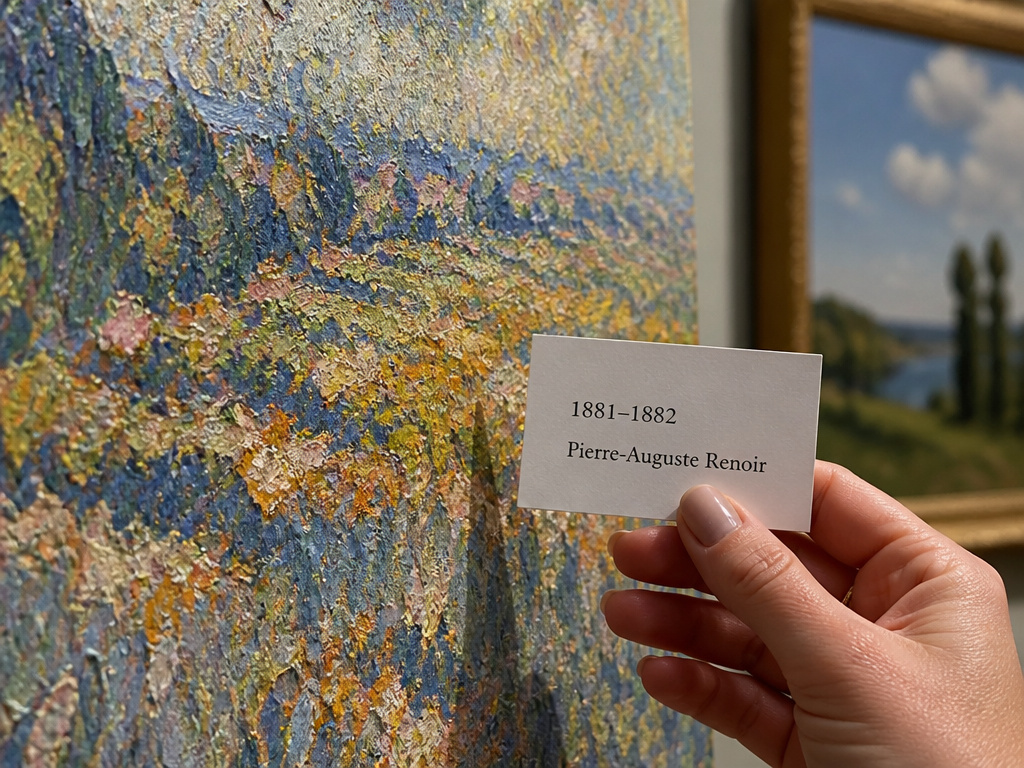
A foot from a late Monet, the painting stops being a picture. The surface is a scatter of separate touches, sitting beside each other without much blending.
Impressionist handling relies on separate, unblended touches of paint laid side by side rather than smoothed together. Forms are suggested with short broken strokes, shadows and highlights are rendered in color rather than gray or black, and precise contour lines are largely absent, leaving edges to resolve optically at a distance.
That’s the whole trick, and it’s a physical one. Each mark stays visible on purpose.
The Broken Dab, Not the Blended Edge
Short strokes that barely describe a form are the most reliable marker of the style. The Met’s own account of the technique names pure unblended colors and an emphasis on the effects of light, applied in strokes that only hint at the shape underneath.
Which brush you pick changes the dab. A flat hog brush gives you a squared-off mark; a round gives you a dot. The difference between brush shapes matters more here than in almost any other style, because every mark you make stays on the surface.
Some painters pushed the paint on thick enough to cast a small shadow. That’s an early version of impasto that later painters took much further.
You can hear it, too. A stiff hog brush dragged across dry canvas makes a rasping sound, like a broom on concrete, and you feel the tooth of the fabric through the handle.
Shadows Painted in Color, Not Gray
The Met notes that Impressionists rendered shadows and highlights in color instead of neutral white, gray, or black. That single habit dates a painting faster than the brushwork does.
Here’s what to look for on the surface:
- Loose, choppy strokes that look rushed, because they often were.
- A violet or blue-green shadow where you expected gray.
- No hard contour lines. Edges blur into the next color instead of stopping.
- A patch near the canvas edge that still looks unfinished.
- Thin, matte paint, because many of them skipped the customary thick golden varnish.
I came at this backwards. I copied the look for years before I understood why the marks were short, and the copying went better once I did.
What most people get wrong: Treating loose brushwork as the whole test. A choppy surface with gray shadows and a hard outline is a sketch, not an Impressionist painting.
Why Eight Exhibitions Between 1874 and 1886 Held the Group Together
Eight shows in twelve years. That’s the whole run, from the first exhibition in 1874 to the last in 1886, and it’s the spine the rest of the story hangs on.
The group organized itself in December 1873 as the Société anonyme des artistes, peintres, sculpteurs, graveurs, and held the first show in the studio of the photographer Nadar, outside the official Salon. The French culture ministry puts the first exhibition at about thirty artists.
The Met Museum Impressionism essay describes a membership that stayed fluid: nine to thirty artists in any given year, with Pissarro the only one who appeared in all eight. Morisot made seven.
| Feature | Official Salon | Independent shows |
|---|---|---|
| Who selected the work | Académie des Beaux-Arts jury | The artists themselves |
| How often | Every year | Eight times across twelve years |
| How it was received | Medals and official approval | Derision first, praise from progressive critics |
| Varnish | Customary thick golden coat | Often skipped entirely |
Manet is the odd one out. He’s usually described as the precursor and unofficial leader of the circle, and he took part in none of the eight exhibitions. The French ministry states that directly, and it’s worth sitting with.
If you want to understand a movement, read its exhibition list before you read its manifestos. The list tells you who kept showing up.
The Pigment Revolution Behind All That Loose Color
Twelve of the roughly twenty principal colors the Impressionists reached for were synthetic pigments developed in the late eighteenth and early nineteenth century.
That figure comes from a pigment analysis published in Clinical Chemistry for the International Year of Chemistry in 2011, and it reframes the whole style. A palette built on new synthetics could hold colors earlier painters had no reliable way to reach.
Squeeze a modern blue onto a palette and you feel the difference. It has a chalky, opaque body that sits on the surface and stays bright instead of sinking into a muddy middle.
You don’t need color theory to see the result, but it helps to know what they were doing: putting pure tones next to each other and letting your eye do the mixing.
I mix by instinct and trial, so I can’t hand you a repeatable recipe for a shadow violet. What I can tell you is that they leaned on colored shadows hard enough that a gray one looks wrong beside them.
Easy to miss: The bright palette was partly a materials story. Try this style with a limited earth-heavy set and the results go muddy, however loose your brushwork gets.
How Do You Tell an Impressionist Painting From a Near Miss?
How do you tell an Impressionist painting from a realist one with loose brushwork? Start with the artist, then the date, then the shadows.
A Getty guide on how to identify Impressionist paintings begins by telling you to get closer, because the strokes look rushed and unblended up close, almost like they were applied in a hurry.
The Three-Second Test
Run these in order and most candidates sort themselves out fast:
- Right artist, right date range, painting of nature: probably Impressionist.
- Right artist, right date range, painting of a ballet class or a woman ironing: still Impressionist.
- Right date range but a smooth varnished surface with hard edges: probably not.
- Wrong date range: keep looking.
The National Park Service’s What is Impressionism classroom page reduces the style to a short checklist: everyday subjects, bright color, bold strokes, and work done outdoors. Their description of close viewing is the useful part, since flecks of color only become objects when you back away.
Depth in these paintings comes from color temperature and softness rather than drawn lines. That’s atmospheric perspective doing quiet work while your eye is busy with the brushwork.
I’d rather see you copy one painting badly than invent a style from scratch. The copying teaches you what the marks are for. The inventing teaches you nothing yet.
Where the Sources Disagree on Impressionism’s Start and Founders
The dates don’t line up, and nobody is lying. Institutions frame the same decade differently, and the differences are worth knowing before you repeat any of them as settled.
| Question | Position A | Position B |
|---|---|---|
| When did it start? | Tate: from the early 1860s | Routledge: flourished 1860 to 1890 |
| Who founded it? | Met: Monet, Degas, Pissarro | Tate: first 1874 show had Monet, Renoir, Degas, Cezanne |
| Who painted outdoors first? | Tate: Constable, around 1813 to 1817 | Met: new rail lines made weekend trips easy |
| How many in 1874? | French ministry: about thirty | Met: nine to thirty across all eight shows |
Take the start date first. Tate says Monet and other Paris-based artists developed the style from the early 1860s, the National Park Service says it originated in France in the 1860s, and Routledge spreads it wider, 1860 to 1890. Three framings, no clean merge.
The founder question splits the same way. The Met names Monet, Degas, and Pissarro as founding members, while Tate’s list for the first exhibition adds Renoir and Cezanne, and the French ministry lists about thirty artists including Morisot, Boudin, Cezanne, Degas, Pissarro, Renoir and Sisley.
Then there’s plein air. Tate credits John Constable with pioneering painting on the spot in Britain around 1813 to 1817, while the Met weights the enabler differently, pointing at new railway lines radiating out of Paris that sent Parisians into the countryside every weekend. The Met weights the enabler differently, pointing at new railway lines radiating out of Paris that sent Parisians into the countryside every weekend.
If you want the modern version of the practice, a plein air painting guide gets you out the door faster than any history book will.
Where this goes sideways: Repeating that the Impressionists invented painting outdoors. Constable was working on the spot decades earlier, and a curator will catch it.
How Do You Paint This Way Without Copying a Museum Piece?
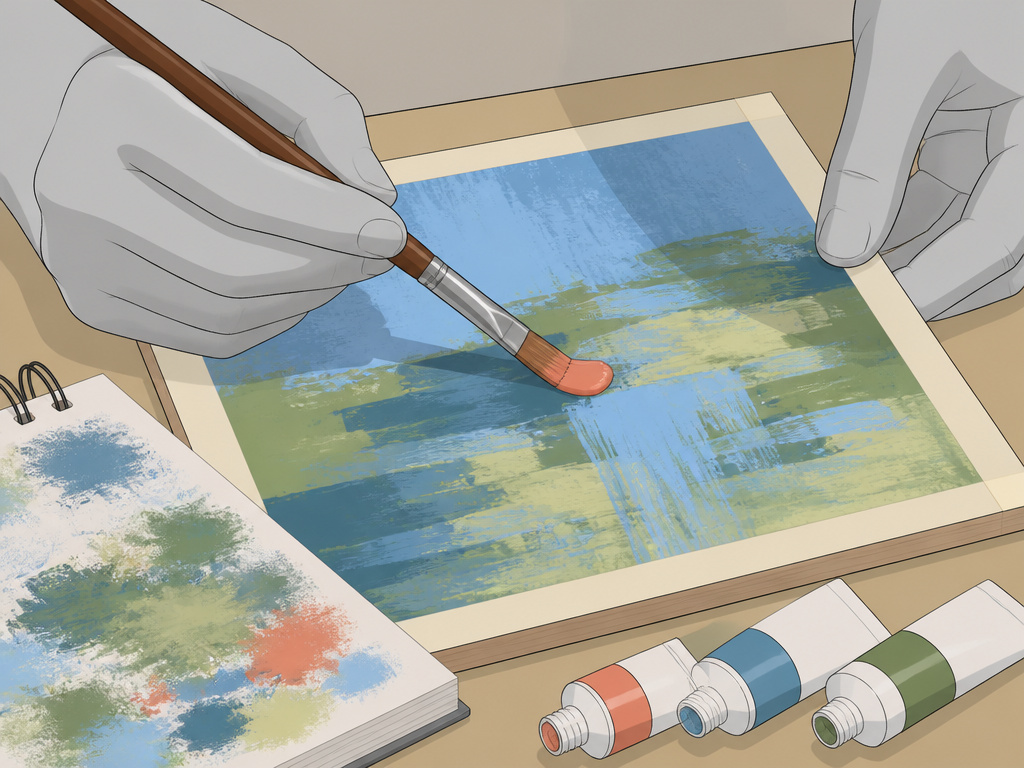
The style is learnable in an afternoon and hard to do well for a month.
I once pushed a second layer onto a canvas that was still tacky, trying to work at the speed these painters worked. The underlayer lifted and dragged into gray streaks, and I lost about an hour of work. What I learned wasn’t “paint slower.” It was that fast painting still has an order.
They could work quickly because they weren’t building up layers. You put a touch down and leave it. That’s essentially alla prima painting: wet paint into wet paint, one session, no waiting for anything to dry.
A Wet-Into-Wet Study in Four Steps
- Tape down a small board and skip the extra ground layers. More prep just gives you time to overthink the first mark.
- Block the big shapes in thin paint first. Skip this and your thick passages slide around on a wet base and never sit still.
- Load the brush, place one mark, leave it. Going back over a wet touch turns a clean dab into mud within seconds.
- Stop while it still looks unfinished. That’s the actual target of the style, and it’s the step nearly everyone skips.
Precious paper makes people afraid to ruin it, and afraid is the wrong posture for this work.
For paint, student-grade is fine for a first year, and a mixed-media pad takes a wet brush better than thin drawing paper.
Do this twenty times and you’ll start noticing what you repeat without deciding to. That’s how you develop a painting style, and it beats sitting down to design one.
Copy the paintings you love, badly and often. Style shows up in the leftovers.
Frequently Asked Questions
What are the main characteristics of Impressionism?
Short broken brushwork, pure unblended color, colored shadows instead of gray, no precise contours, and subjects drawn from ordinary life. The French culture ministry also lists a sometimes unfinished appearance, which they call non finito.
Why is it called Impressionism?
Critic Louis Leroy coined it in the satirical review Le Charivari in 1874, borrowing the title of Monet’s Impression, Sunrise. He meant it as mockery, accusing the painting of being a sketch rather than a finished work.
How many Impressionist exhibitions were there?
Eight, held at intervals between 1874 and 1886. Pissarro exhibited in all eight and Morisot in seven. Manet, often called the movement’s precursor, took part in none of them.
Did Manet exhibit with the Impressionists?
No. The French culture ministry states plainly that he participated in none of the eight exhibitions, despite being widely considered the group’s unofficial leader.
Is Impressionism only about landscapes?
No. The Getty points out that works from the right artists and date range can show ballet classes, women ironing, or bored waitresses and still count. A landscape-only definition fails on those.
How long did the movement last as a group?
About twelve years of collective exhibitions, ending in 1886. Routledge and Tate both treat post-impressionism as the changes that followed from that last show.
The Bottom Line
Here’s your trigger for the next time you’re standing in front of a painting and unsure: get within arm’s length. If the marks stay separate and the shadows carry color, you’re probably looking at an Impressionist work. If everything smooths into one blended surface, you’re not, whatever the wall label says.
This week, pick one painting and copy a four-inch square of it. Not the whole thing. One square, at roughly the same scale as the original marks, on paper you don’t care about.
None of this helps if you work digitally, and I’m the wrong person to ask. I’ve never gotten a brush engine to fake a broken dab in a way that convinced me, so take digital advice from someone who actually paints that way.
The rest of impressionism painting style explained above is detail. The core is three habits: separate marks, colored shadows, and a subject you can see from where you’re standing.
