
How to Choose a Brush for Oil Painting: Step-by-Step
This post contains affiliate links. As an Amazon Associate, we earn from qualifying purchases.
To choose a brush for oil painting, check four things: spring (it should give a little, not too much), shape resiliency (hairs shouldn’t stay spread after use), bristle type (hog or stiff synthetic for heavy paint, soft hair for fluid paint), and a ferrule free of welds.
Spring is the one that’s easiest to feel and hardest to describe, and it’s central to how to choose a brush for oil painting. Press the dry bristles against your thumb and release. A brush with spring snaps back to its original shape. A cheap one bends and stays bent, or flops back with a wobble.
What follows: the four quality tests in detail, a bristle comparison for heavy vs fluid paint, the ferrule and heel details that decide how long a brush survives, and a starter set you can actually afford.
Key Takeaways
- Spring, not stiffness, is the first test. Press the dry bristles against your thumb; a brush with spring snaps back to its original shape.
- Hog bristle for heavy paint, sable or soft synthetic for fluid. The wrong match produces scratchy, meagre patches.
- Never fill paint to the heel. It dries there, spreads the bristles, and the brush loses its point permanently.
- Sizes vary by manufacturer. A Jackson’s No. 8 and a Canson No. 8 are different brushes with the same number.
- Dry bristles up, never down. Stored on the tip, the weight bends the hairs and ruins the shape.
How to Choose a Brush for Oil Painting: Spring and Shape
The test takes one thumb. Press the dry bristles flat, release, and watch what happens.
A quality oil brush has four parts: bristles, heel, ferrule, and handle. The bristles carry paint, the heel joins the bristle mass to the handle, the ferrule is the metal band that secures the whole head, and the handle sets working distance. Spring and shape resiliency are the two qualities that separate a working brush from a smear.
Winsor & Newton names spring and shape resiliency as the two qualities to look for in every oil brush. Spring is how the brush responds to your hand during a stroke. Too much spring and the brush fights you. Too little and the bristles collapse under the paint load, so the stroke goes flat and wide.
Shape resiliency is the second half. A higher-quality brush holds its shape: the hairs don’t spread too much when loaded and don’t stay spread after use. Load a cheap brush with thick paint and the tuft fans out like a worn broom. Load a brush that holds its shape and it stays a tuft.
I test every brush this way before it goes in my jar. Press, release, watch. Most cheap brushes fail at step two.
Common mistake: Judging a brush by how stiff it feels in the package. Stiffness and spring are different things. A brush can be rock-hard and still have no snap, which means it pushes paint around without returning to form.
Which Bristle Type Works for Heavy Paint vs Fluid Paint?
The two types of oil brushes most painters name are bristle and sable. That split is real, but it’s incomplete. Stiff synthetics now sit in the same functional slot as hog, and soft synthetics behave like sable.
| Bristle Type | Best For | Fails At |
|---|---|---|
| Hog bristle | Heavy paint, impasto, wet-in-wet | Fluid paint, fine detail |
| Sable | Thin translucent layers, portrait detail | Heavy body paint, wet-in-wet |
| Stiff synthetic | Heavy paint, water-mixable oils | Fluid paint without enough load |
| Soft synthetic | Blending, fluid paint | Heavy body paint, wet-in-wet |
Hog hair grabs more paint, which is why it’s the standard for working thickly or accentuating brushstrokes. Jackson’s Art describes hog’s natural split ends (called flagging) as the mechanism: the V-shaped tips carry heavy paint and release it in bold strokes. Old Holland calls hog one of the best kinds of brush for oil painting, and Canson recommends boar bristle for impasto.
Sable is the opposite tool. Old Holland says sable-hair brushes suit artists who paint in thin, translucent layers, and they’re ideal for portrait painting and fine detail. Dick Blick identifies Kolinsky as weasel-family hair from Siberia and northeastern China.
Where the sources disagree on soft hair is worth knowing. Winsor & Newton and Jackson’s Art both say soft hair lacks the strength for heavy-body paint and isn’t useful for wet-in-wet layering. Canson, however, lists ox hair (soft and supple) as a valid oil brush for applying diluted colors. Both positions are correct within their scope: soft hair works for fluid paint and fails for thick paint.
For more on natural vs synthetic bristle trade-offs, that comparison goes deeper than this section can.
The Synthetic Durability Contradiction
Old Holland says synthetic brushes last longer than natural hair, don’t shed, and are easier to look after. Canson says synthetic bristles tend to wear out faster, though oil painting doesn’t require keeping the tip in perfect condition the way watercolor does.
Both manufacturers are describing real behavior. Old Holland is comparing care requirements; Canson is comparing tip longevity under load. A synthetic brush survives neglect better and loses its point sooner. Which one matters depends on whether you clean your brushes properly.
Squirrel Hair: Valid or Not?
Winsor & Newton lists squirrel among the soft hairs sable brushes can be made from, implying squirrel is a valid oil-brush option. Old Holland says squirrel-hair brushes aren’t used in oil painting, or at least not widely, because with oil they quickly become unfit for use.
The safer read: squirrel is a watercolor hair. If you want a soft oil brush, sable or soft synthetic is the better bet.
The Ferrule and Heel Details That Decide How Long a Brush Lasts
Old Holland’s specification for a high-quality ferrule is short: free of welds or joints, made of copper or brass, fitting snugly around the handle with no air pockets.
Here’s what to check on the ferrule before you buy:
- No welds or joints. A seam catches solvent and paint, and the metal can start to split with regular use.
- Copper or brass, not plated steel. Plated ferrules flake at the crimp and leave sharp edges that fray the bristles.
- Snug fit with no air pockets. A loose ferrule lets paint creep up under the metal and stiffen the base of the tuft.
- Crimped, not glued. Glue fails in solvent. Crimping survives.
The heel is the other failure point. Winsor & Newton warns against filling the brush with paint up to the heel. Paint dries there, is hard to clean, spreads the bristles, and makes the brush lose its point. That’s a permanent failure. The brush won’t recover.
Where this goes sideways: Loading paint to the heel “for a bigger stroke.” The paint dries into the base of the tuft, the bristles splay, and the brush has no point left.
I ruined a good filbert this way once. Loaded it deep for a big background wash, didn’t clean the heel properly, and the tuft went bushy. The ferrule was fine. The heel was the problem.
Brush Shapes: What Round, Flat, Filbert, Bright, and Rigger Actually Do
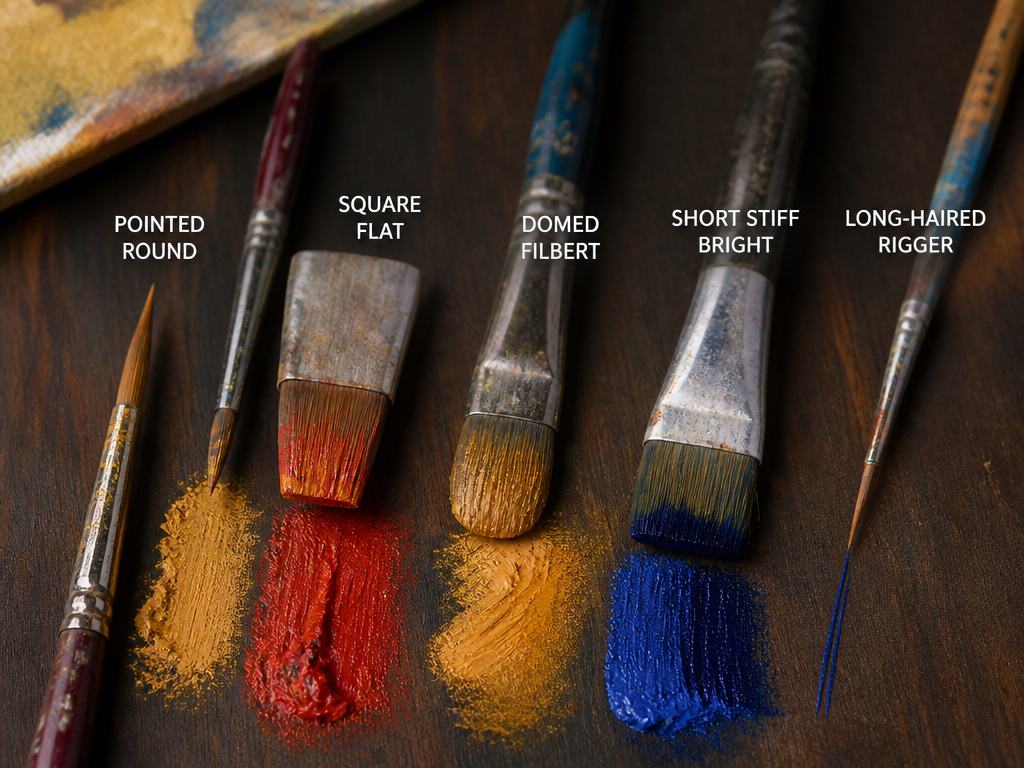
Five shapes cover most oil painting: round, flat, filbert, bright, and rigger. Each one solves a different problem.
| Shape | What It Does | Skip It For |
|---|---|---|
| Round | Detail, linear marks, modulated strokes | Broad coverage |
| Flat | Blocking in, sweeping strokes, thin edges | Fine detail |
| Filbert | Coverage with soft edges, blending | Crisp square marks |
| Bright | Short controlled strokes, impasto, texture | Wet-in-wet layering |
| Rigger | Fine lines, lettering, branches | Anything broad |
A full brush shapes breakdown exists if you want the fan, mop, and angular variants too.
Round and Rigger: Two Ends of the Detail Spectrum
Rounds come in pointed and blunt tips, and both create a modulated linear mark by applying more or less pressure during the stroke. Old Holland describes the rigger as a round brush with longish hairs, useful for fine lines and versatile across oils and watercolors. Winsor & Newton adds that liner and rigger bristles hold a large amount of paint, which lets you pull a long line in one stroke.
Flat vs Filbert: The Domed Edge Difference
A flat makes marks with a distinctive square edge. A filbert is the same brush with rounded sides, so it creates a softer edge and blends better. Old Holland calls the filbert a flat with domed ends, good for coverage and some detail work. Winsor & Newton notes filberts are a favorite among figurative painters for exactly that reason.
Why Brights Fail at Wet-in-Wet
Brights are shorter than flats, with short stiff bristles. That shortness gives more control, but it also means the brush removes the underlayer of paint rather than adding to it. Winsor & Newton is direct about this: brights aren’t suitable for layering wet-in-wet. Use them for impasto and texture instead.
Wet-in-wet layering is like building a sauce. You add a little at a time and taste as you go. A bright scrapes the last layer off instead of adding to it.
How Do Brush Sizes Work Across Brands?
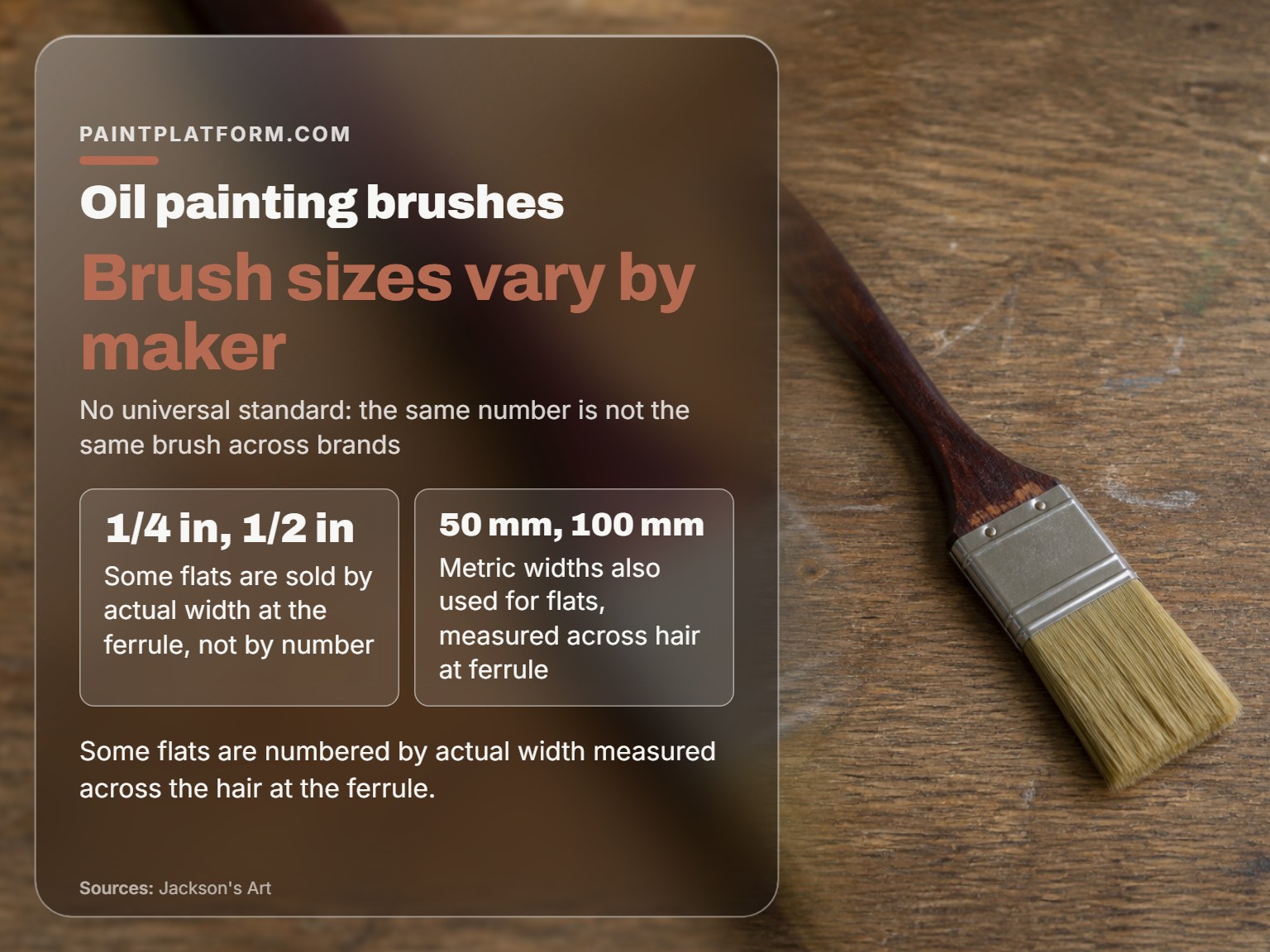
Size numbers vary by manufacturer. Jackson’s Art states there is no universal standard of sizes across brushmakers, and most ranges run from 5/0 (written 00000) through 0, 1, 2 and up to 20 or larger. Canson gives a competing range of No. 0 to No. 24.
Both manufacturers acknowledge their own specifications, so thicknesses and lengths with the same number vary between brands. A No. 8 from one maker is not the same brush as a No. 8 from another.
Some flats skip the numbering entirely and are sold by actual width: 1/4 inch, 1/2 inch, 50 mm, 100 mm, measured across the hair width at the ferrule. That’s the more honest system, and it’s what I look for when I’m buying.
The paint brush sizes guide covers the full conversion if you’re matching a set across brands.
Easy to miss: Buying a “size 10” replacement and finding it’s noticeably smaller than the one it’s replacing. Check the actual millimeter width at the ferrule, not the number on the handle.
How Do You Clean and Store Oil Brushes So They Survive?
Before you start: Mineral spirits and turpentine are flammable and give off fumes that build up in a closed room. Work near an open window, keep the jar lidded between uses, and never leave solvent-soaked rags in a closed bin overnight.
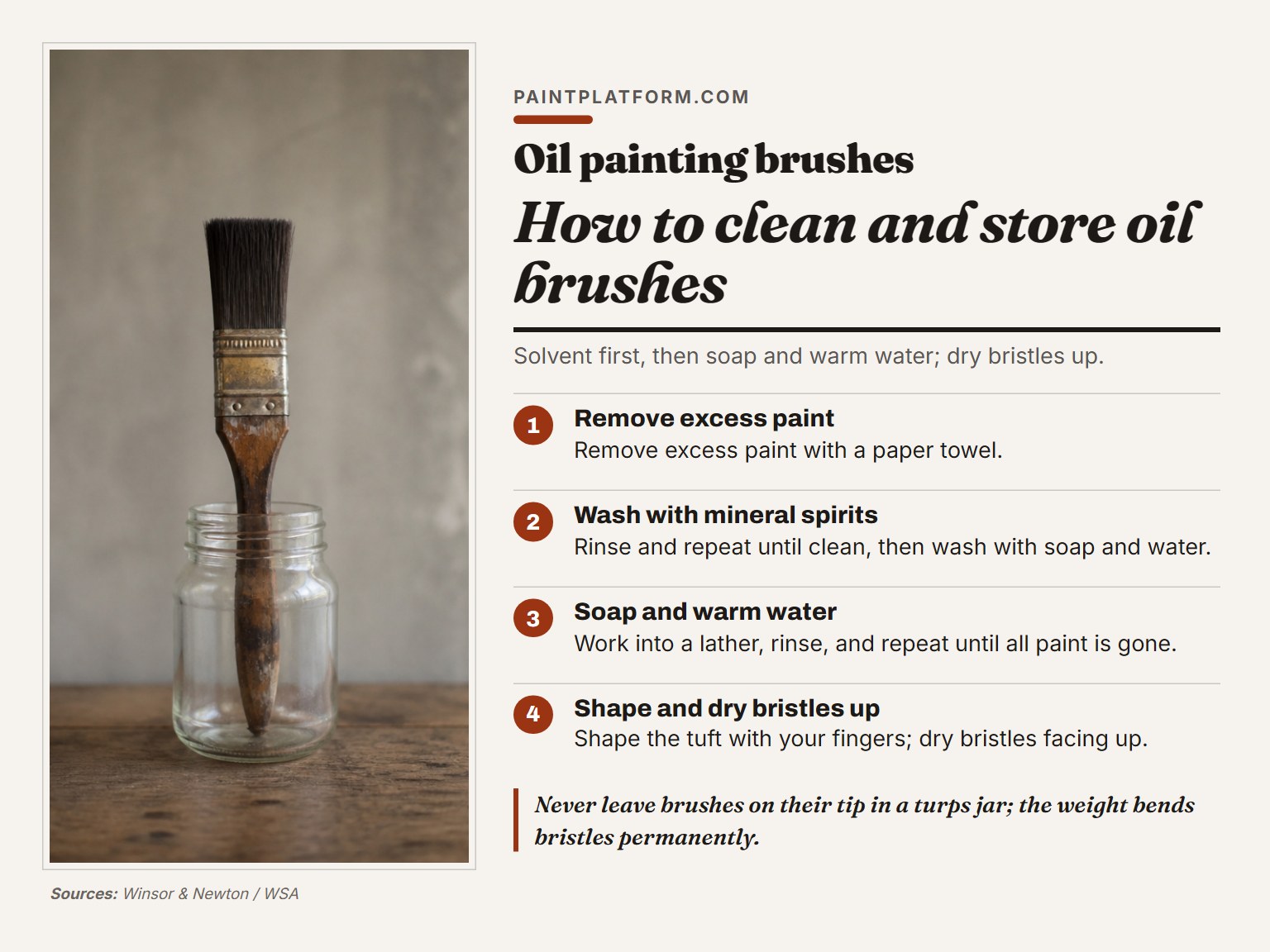
The cleaning sequence is short:
- Remove excess paint with a paper towel. Wipe from the ferrule to the tip, not the other way, so you don’t push paint into the heel.
- Wash with mineral spirits, rinse, and repeat until clean. Winsor & Newton specifies solvent first, then soap.
- Wash with soap and warm water. Work it into a lather and rinse until the water runs clear.
- Shape the bristles with your fingers. Get the original tuft shape back before drying.
- Dry bristles up. Winsor & Newton is explicit: bristles facing down and leaning on the surface will bend and ruin the shape.
The brush is clean when the lather runs white, not grey. If it still smells of solvent after the soap step, it isn’t done.
Isabey recommends drying water-based brushes horizontally or hanging them bristles-down. That’s for watercolor and acrylic, not oil. For oil, Winsor & Newton advises bristles-up, while Isabey recommends drying horizontally or hanging bristles-down (for water-based colours).
Once dry, store brushes in a case designed for brushes. A jar works short-term, but a case keeps the tufts from bending against each other.
For a deeper walkthrough of cleaning oil brushes with solvent and soap, that guide covers the full routine.
The 6 to 9 Brush Starter Set (and What to Skip)
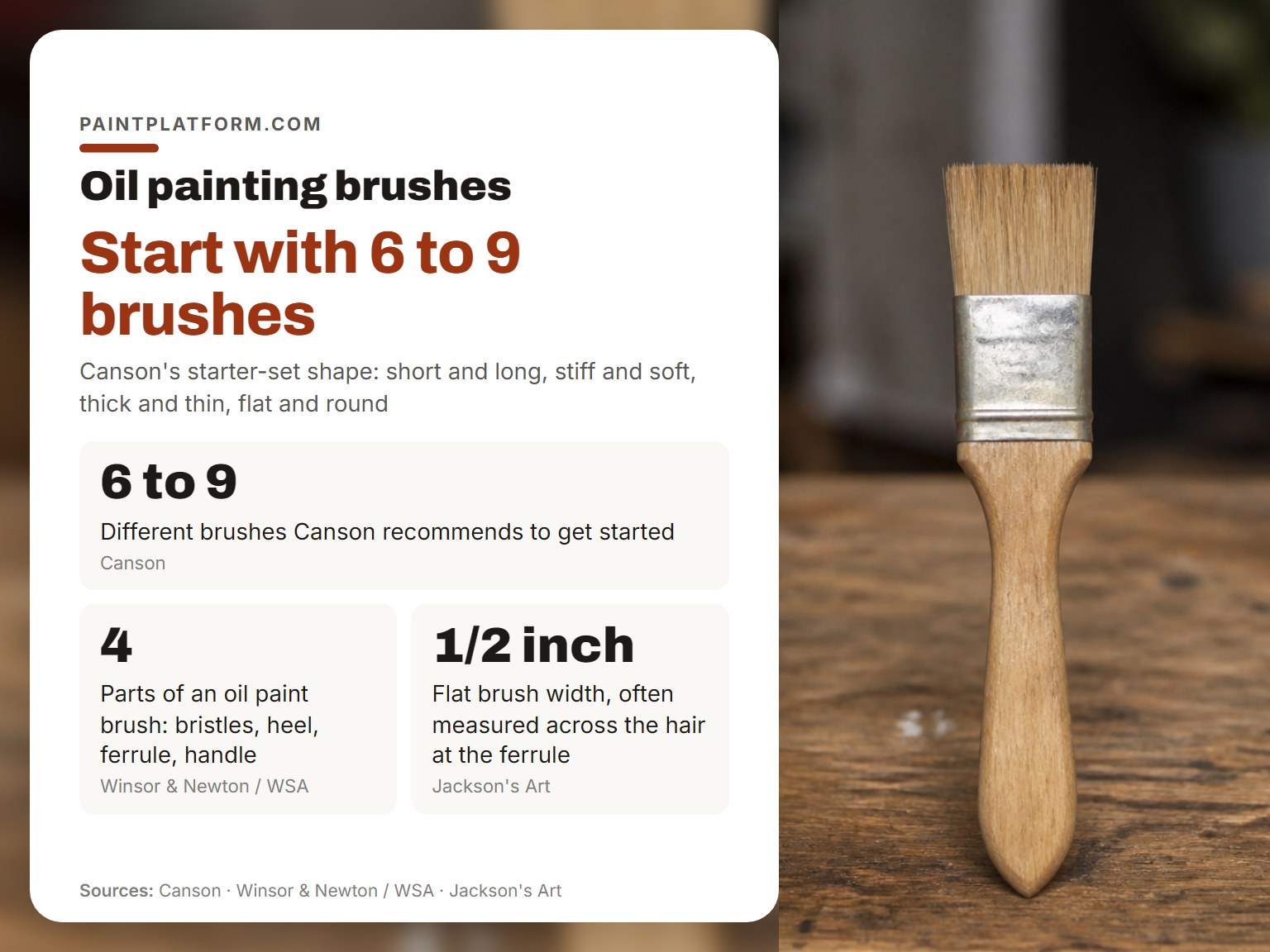
Canson recommends 6 to 9 different brushes to start: short and long, stiff and soft, thick and thin, flat and round. That’s the right shape for a starter set. Here’s what I’d actually buy:
- One flat, 1/2 inch, hog or stiff synthetic. Blocking in and big strokes.
- One round, size 6 or 8, hog. Detail and linear marks.
- One filbert, size 8, hog. Blending and soft-edged coverage.
- One bright, size 6, hog. Short controlled strokes and texture.
- One rigger, size 2, synthetic. Fine lines and lettering.
- One soft mop or blending brush. Softening edges without lifting paint.
For most beginners, hog or stiff synthetic rounds and flats are the right first buy. They’re stiff enough to move real oil paint and cheap enough to use hard without flinching. If you paint with water-mixable oils, Jackson’s Akoya holds its shape better in water than natural hog does. For a step up without going full sable, look for soft synthetic rounds that hold a point well.
A full set of oil paint brushes can wait. Six brushes teach you more than twenty.
I won’t recommend Kolinsky to a beginner. The spring is beautiful and the price tag is a trap. Learn on hog, then upgrade when you can feel the difference in your hand.
I bought a bulk pack of cheap flats once, thinking a brush is a brush. By the third painting, bristles were shedding into wet paint and I was picking them out with a palette knife. Fewer, better-made brushes solved it. I now buy one flat at a time and replace it when the tip goes bushy.
Skip this if: You’re still deciding whether you like oil painting. A chip brush from the hardware store handles an underpainting fine. Let it be a little messy. Buy the good brush when you know you’ll keep going.
For best oil paint brushes by budget and use case, that roundup covers the specific models.
Frequently Asked Questions
Do I need sable brushes to paint with oils?
No. Hog bristle and stiff synthetic brushes handle oil paint well and cost far less. Sable is best for thin, translucent layers and fine detail, which is a specific technique rather than a requirement.
How many brushes should a beginner buy?
Canson recommends 6 to 9 brushes to start, covering short and long, stiff and soft, thick and thin, flat and round. That range gives you enough variety to learn brush handling without overbuying.
Can I use watercolor brushes with oil paint?
Soft hairs like squirrel are a poor fit for oil. Old Holland says squirrel-hair brushes quickly become unfit for use with oil, though Winsor & Newton lists squirrel among the soft hairs sable brushes can be made from. Sable and soft synthetic are the safer soft-hair options for oil.
Why do my brush bristles keep spreading?
Two likely causes. Paint loaded to the heel dries there and spreads the bristles, or the brush has poor shape resiliency and stays spread after loading. Check the heel first, then test the brush’s snap.
Should I dry my brushes bristle-up or bristle-down?
For oil brushes, bristle-up. Winsor & Newton warns that bristles facing down and leaning on a surface will bend and ruin the shape. Isabey’s bristle-down recommendation applies to water-based brushes, not oil.
How do I know when a brush is clean enough?
When the soap lather runs white, not grey, and the brush no longer smells of solvent. If either test fails, repeat the soap step.
The Bottom Line
One rule most brush guides skip: if your brush has paint dried at the heel, the brush is already compromised. The point will go bushy regardless of how carefully you clean it afterward. Check the heel before you buy, and never load paint up to the heel.
Start with six brushes: a flat, a round, a filbert, a bright, a rigger, and a soft mop. Learn what spring feels like on hog before you spend anything on sable. The expensive brush rewards a skill you don’t have yet.
Everything above comes back to one question: how to choose a brush for oil painting without wasting money on tools you can’t use yet. Buy the cheap set. Use it hard. Upgrade when you can feel the difference.
And if you’re still unsure whether oil painting is for you, buy one flat and one round and paint a single study. That’s enough to know.
