
How to Choose a Paint Brush for Acrylics: Synthetic Wins
This post contains affiliate links. As an Amazon Associate, we earn from qualifying purchases.
To choose a paint brush for acrylics, start with synthetic filament (nylon or polyester, often sold as Taklon) and match the shape to the mark you want. Dick Blick, Jackson’s Art, PAL, and DeSerres steer acrylic painters toward synthetics; Canson recommends the same brushes you use for oil painting, and Dick Blick also recommends pure hog bristle for oils and acrylics.
Dick Blick’s reasoning comes down to chemistry. Acrylic paint is a polymer emulsion in water, and it dries fast. Synthetic filament withstands acrylic’s caustic nature with less damage, and the filaments don’t have animal scale structures to trap paint. Sable and squirrel hold water beautifully, which is exactly why they struggle with thick acrylic. Knowing how to choose a paint brush for acrylics means understanding why synthetic filament suits the medium.
What follows is the honest version: where the sources agree, where they split, and the how to choose a paint brush for acrylics answer for what to actually buy first.
Key Takeaways
- Synthetic filament is the default for acrylics, with Dick Blick, Jackson’s Art, PAL, and DeSerres recommending it, while Canson recommends the same brushes you use for oil painting and Dick Blick also recommends pure hog bristle for oils and acrylics.
- Shape changes your mark more than filament does, flat for defined edges, filbert for blended ones, round for lines.
- A size 10 in one brand can be twice the size of a size 10 in another, buy by feel, not number.
- Cheap student brushes are fine for beginners, they shed and lose their point, but they teach you what you actually need.
What Filament Actually Handles Acrylic Paint?
Four of the five sources I checked point to synthetic filament: nylon or polyester, often sold under the trade name Taklon. Dick Blick’s technical sheet is the clearest on why.
Synthetic filaments are manmade of nylon or polyester and can be tapered, tipped, abraded, or etched to raise color-carrying ability. Unlike animal hair, they carry no microscopic scale structure, so paint releases cleanly and the brush washes out faster between layers.
The scale structure matters more than most beginners realize. Animal hair has tiny scales along the shaft that grip pigment. That’s great for watercolor, where you want the brush to hold a puddle. For acrylic, those same scales trap dried polymer you can’t rinse out.
Jackson’s Art recommends acrylic brushes with synthetic fibers that can stand up to regular cleaning. PAL’s trade guide specifies synthetic polyester or SRT Orel Tynex polyester for water-based paints. DeSerres says synthetics are more suitable for acrylic because the paint is a polymer emulsion in water.
If you’re still mapping out your first kit, the broader process of choosing a paint brush follows the same logic: start with the medium, then match the tool.
The One Place Canson Disagrees With Everyone Else
Canson’s acrylic advice opens with a line that stops you cold: use the same brushes you use for oil painting. That means sable and boar bristles, the traditional oil-painting hairs.
Dick Blick’s sheet recommends pure hog bristle for oils and acrylics, so Canson isn’t alone on boar. But on sable, the split is real. Jackson’s Art positions sable as a watercolor hair that would struggle with thick, heavy body paints. Dick Blick calls Kolinsky sable the best material for oil and watercolor, not acrylic.
Here’s the comparison, straight from the sources:
| Filament | Acrylic verdict | Why |
|---|---|---|
| Synthetic (Taklon) | Recommended by Blick, Jackson’s, PAL, DeSerres | Withstands acrylic chemistry, easy to clean |
| Hog bristle | Split verdict | Blick recommends it; Jackson’s notes shorter life in water-based media |
| Sable / Kolinsky | Not recommended by most | Holds water well, struggles with thick acrylic |
| Squirrel | Not recommended | Best water-holding capacity, worst for heavy body paint |
My read: Canson’s advice makes sense if you’re painting thin, fluid acrylics in a watercolor style. For anything with body, Dick Blick, Jackson’s Art, PAL, and DeSerres favor synthetic, while Canson recommends the same brushes you use for oil painting. If you want the deeper breakdown of acrylic paint brushes by brand and use case, that’s covered separately.
Easy to miss: Most new brushes ship with a water-soluble sizing on the hairs. Wash it out with brush soap and water before the first stroke, or the paint beads and you’ll blame the brush.
Which Brush Shapes Actually Earn Their Place in Your Kit?
Shape matters more than most beginners think when you compare a how to choose a paint brush for acrylics. A flat and a filbert will give you different marks even loaded with the same paint.
DeSerres puts it plainly: flat, square-ended brushes produce more defined brush strokes, while filberts produce more blended ones. That’s the whole decision in one sentence.
| Shape | Mark it makes | Best for |
|---|---|---|
| Flat | Defined, blocky strokes | Bold shapes, edges, washes |
| Filbert | Soft, blended strokes | Rounded contours, glazing |
| Round | Long lines, detail | Linework, fine detail |
| Fan | Soft texture | Foliage, delicate effects |
Canson adds a few shapes worth knowing: a universal flat with 2.5 cm wide bristles for washes, a tapered round for long color lines without stopping, and a Kolinski fan for precision detail like hair and reflections. The full paint brush types breakdown covers shapes I haven’t listed here.
Flat vs Filbert: The Mark Test
Load both with the same paint and drag them across scrap canvas. The flat leaves a hard edge you can cut in with. The filbert leaves a soft edge that blends into the next stroke. If you’re painting loose, wet-into-wet, the filbert is the one you’ll reach for. If you’re blocking in shapes, the flat wins.
Canson suggests combining shapes rather than forcing yourself to choose one. That’s the right call. A round, a flat, and a big filbert cover most of what a beginner needs.
How Brush Sizes Work (and Why a Size 10 Isn’t a Size 10)
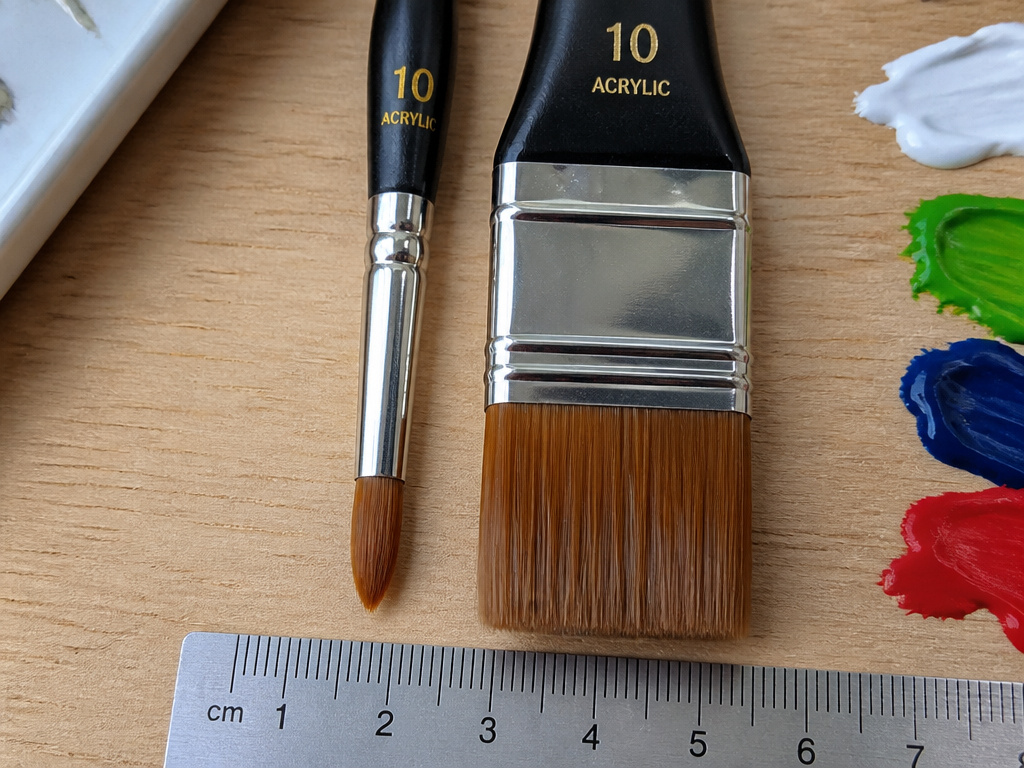
A size 10 in one brand can be twice the size of a size 10 in another. Jackson’s Art says so directly, and Canson’s sizing runs N0 to N24 while Jackson’s runs 5/0 upward.
Why Size Numbers Are Useless Across Brands
Canson states that every manufacturer has its own specifications, so thicknesses and lengths with the same number tend to vary. That means you can’t order a size 8 online and expect it to match the size 8 you already own from a different brand.
Jackson’s Art adds that flats are sometimes numbered in inches or millimeters instead of the 0-to-24 scale, which makes cross-brand comparison even messier. If you’re building a set, the paint brush sizes guide walks through the actual measurements behind the numbers.
My advice: buy in person if you can, or buy from a retailer that lists the actual millimeter width. The number on the handle is a starting point, not a spec.
Handle Length, Ferrules, and the Parts Nobody Mentions
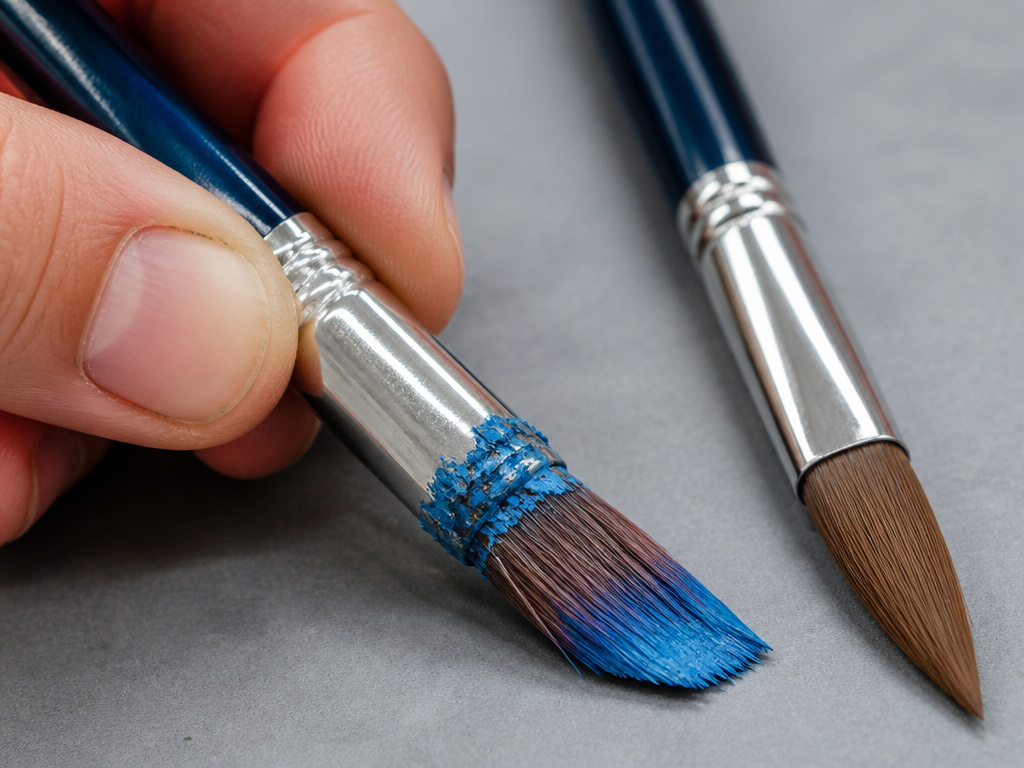
The ferrule is where most brushes die. That’s the metal band holding the bristles, and it’s also where paint collects if you scrub.
Jackson’s Art notes that vigorous painters who scrub the brush on the canvas drive paint up into the ferrule where it’s hardest to clean. Over time the base of the tuft stiffens and only the tip stays flexible. That’s a brush-killer that no filament choice prevents.
PAL’s trade guide has a useful quality check: good brushes have long tapered bristles designed to avoid visible brush strokes, and nailed-in stainless steel ferrules that won’t rust or shed. If the ferrule wobbles or the bristles pull loose when you tug gently, walk away.
Handle length is a softer rule. DeSerres says acrylic brushes have long handles suited for easel work and large surfaces. Jackson’s Art says handle length depends on the medium and the artist’s approach, with long handles suiting arm’s-length work. Canson doesn’t weigh in at all. My take: long handles are nice for easel painting, but a short handle is fine for sketchbook work and tabletop studies. Don’t let handle length be the deciding factor.
The Care Habits That Kill Brushes Faster Than Cheap Materials
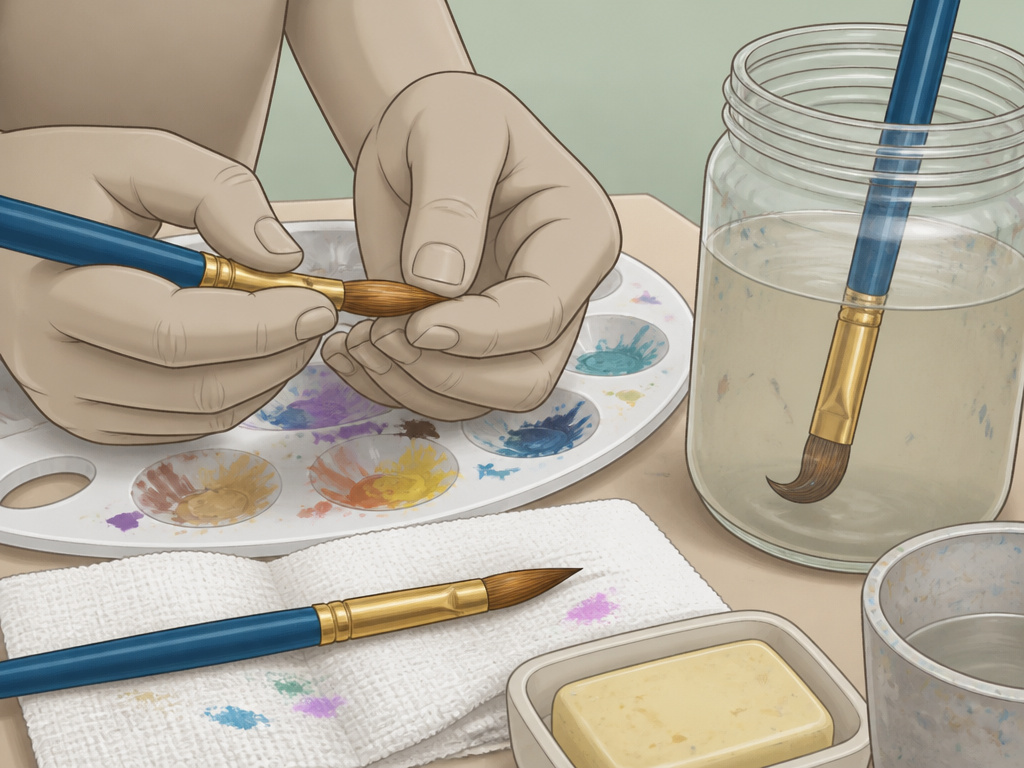
You’ve seen the jar. A brush standing bristle-down in cloudy water, tip bent into a permanent curl. That’s the most common way a brush dies young.
The fix is simple: rinse, wipe, reshape the tip with your fingers, and lay the brush flat or stand it bristle-up.
Where this goes sideways: Leaving a brush bristle-down in water. The weight bends the tips permanently, and no amount of soap fixes a curled tuft.
A few more habits that matter:
- Wash with brush soap, as the fact sheet recommends removing sizing with brush soap and water before use.
If you use conditioner on natural hair brushes, keep it away from the filament. For synthetics, skip it entirely. The cleaning paint brushes routine that actually works is mostly about prompt rinsing, not fancy products.
What to Actually Buy First
You don’t need the expensive set. You need a round, a flat, and a big filbert, and you need to use them hard.
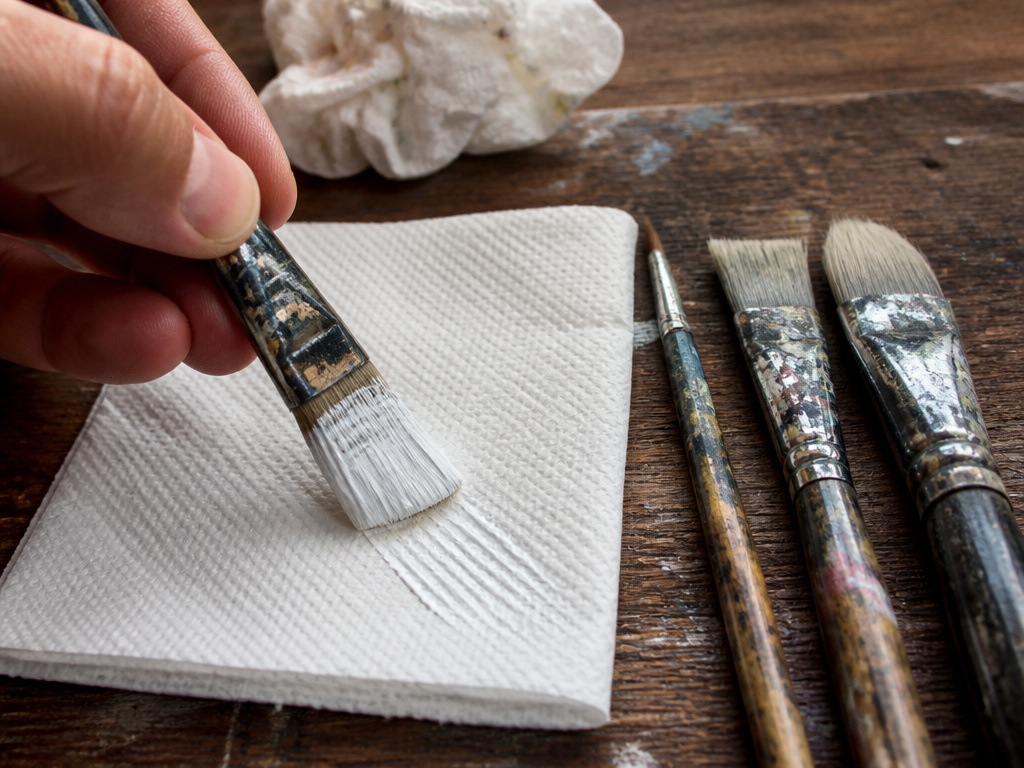
My first few canvases were muddy because I loaded the brush like I was frosting a cake. About a dozen early pieces turned into thick, soupy surfaces before I learned to dab the brush on a paper towel until it left almost nothing behind, then build color in two or three light passes. The brush wasn’t the problem. My loading was.
That lesson is why I’d rather see you buy three cheap brushes and abuse them than one expensive sable you’re afraid to touch. Jackson’s Art makes the same point about cheap brushes: they may shed, lose their point quickly, and have less predictable paint release, but they’re perfectly suitable for beginners, students, experimental techniques, or rough underpainting.
If you want a starting point, here’s what I’d buy:
For a broader look at acrylic paint brush sets that won’t break the bank, that’s covered separately. And if you’re working on canvas specifically, the brushes for canvas painting picks run stiffer for the tooth.
DeSerres publishes a starter set worth copying: Round no. 0, Filbert no. 2, Flat no. 8, Round no. 12, Filbert no. 14, Flat no. 24. That’s six brushes covering detail through broad coverage. You don’t need all six on day one, but that’s the shape of a full kit.
Frequently Asked Questions
Do I really need synthetic brushes for acrylics?
Four of the five sources I checked recommend synthetic for acrylics: Dick Blick, Jackson’s Art, PAL, and DeSerres. Canson is the outlier, recommending the same brushes you use for oil painting. For most acrylic work, synthetic is the safer default.
Can I use my oil brushes for acrylics?
You can, with caveats. Dick Blick recommends pure hog bristle for oils and acrylics. Jackson’s Art notes that hog brushes have less longevity in water-based media because the bristles absorb water and swell. Sable and squirrel are better suited to thin, fluid paints than to heavy body acrylic.
What’s the difference between Taklon and other synthetics?
Taklon is the common trade name for synthetic filament, which can be nylon or polyester. PAL breaks synthetics into three categories: Solid Round Tapered (SRT) Orel Tynex polyester, SRT polyester, and hollow polyester. SRT Orel Tynex is the most popular because of superior stiffness and retention.
How many brushes should a beginner own?
Three is enough to start: a round for lines, a flat for shapes, and a filbert for blending. DeSerres’ starter set lists six brushes from size 0 to 24, which covers detail through broad coverage. You can add shapes as you notice yourself reaching for them.
Do expensive brushes make a difference?
Jackson’s Art notes that cheap brushes may shed, lose their point quickly, and have less predictable paint release, but they’re fine for beginners and rough work. A quality brush lasts for years with simple cleaning and care, per PAL. The gap shows up in consistency, not in whether the brush works at all.
The Bottom Line
If you take one thing from this: buy three shapes and don’t spend more than you need to. Dick Blick, Jackson’s Art, PAL, and DeSerres favor synthetic, while Canson recommends the same brushes you use for oil painting.
The exception is heavy body acrylic on canvas. If you’re pushing thick paint with a palette knife and want visible texture, a stiff hog bristle earns its place alongside your synthetics. Jackson’s Art notes that hog brushes have less longevity in water-based media, so treat them as a texture tool, not your daily driver.
And if your new brush sheds more than a few hairs in the first wash, it’s a bad brush. Return it. A synthetic might lose a few filaments in the first wash, but a steady shed means the ferrule isn’t holding.
Start with one mark. The rest follows.
