
Linen vs Cotton Canvas: Which Should You Buy?
This post contains affiliate links. As an Amazon Associate, we earn from qualifying purchases.
Linen vs cotton canvas is a choice about weight, ground, and how long the piece must last. Artwork Codex and Art Miami say linen moves less with humidity, while Classic Arts argues stability is system-level and a well-constructed cotton can outperform poorly prepared linen. A 10 to 12 oz cotton duck with a proper ground is a solid choice for most work, and it costs a fraction of linen.
The movement is the part that bites you later. In the linen vs cotton canvas debate, Artwork Codex and Art Miami say cotton soaks moisture out of the air and swells, then shrinks back as the room dries, while Classic Arts argues stability depends on weave, preparation, tension, mounting and environment rather than fibre alone. How much that matters depends on your ground, your stretcher, and the room the painting lives in.
What follows: the specs that actually predict how a canvas behaves, the four places the published sources flatly disagree, and a use-case guide you can act on this week.
Key Takeaways
- Weight beats fibre at large sizes. A 48-inch canvas on lightweight cotton will ripple, whatever the label says.
- Two ground coats minimum, each sanded back. One thin coat is the most common corner cut, and it stays invisible until the film cracks.
- Acrylic gesso works on both fibres. Oil grounds have the longer track record on linen, but that’s history talking.
- A keyed stretcher can be re-tensioned years later. A fixed-corner strainer cannot, and you’ll regret it on a big piece.
- Cotton for studies, linen for work you’ll sell. Artwork Codex holds that split, while Vloothuis says linen isn’t worth the cost unless the work is paid for or sold.
What Actually Separates Linen From Cotton
Flax fibre runs long and strong. Cotton comes from short seed hairs, and that difference shows up in how each cloth handles tension, moisture, and a brush.
Linen canvas is woven from flax, a long-staple fibre, while cotton canvas is woven from short seed fibres. The longer flax staple resists stretching and puncture better. Linen’s weave also varies more, with slubs that break up the surface, while cotton duck is mechanically uniform and consistent from roll to roll.
Hold a roll of each up to a window and the weave tells you the rest. A tight, even weave with no slubs is portrait grade. An open weave with visible irregularity is landscape or rough grade.
Then there’s the sound. Tap a taut linen canvas and you get a short, dry thrum, like a snare drum with the wires off. Tap a slack cotton one and the note dies flat under your knuckle. Conservation-minded appraisers treat that resonance as a quick read on structural fatigue, which tells you how much tension the cloth is still holding.
Most shops sell four types of canvas, and the fibre question only applies to two of them. Stretched and roll canvas are woven cloth. Panels and boards are cloth glued to a rigid backing, which changes the whole conversation.
What I check first, in order:
- Weight, listed in oz or g/m2. Heavier cloth takes more punishment and fights you a bit when you stretch it.
- Weave, held up to a window. Slubs mean landscape grade.
- Ground. Oil, acrylic, or none.
- Stretcher type, if the thing is already mounted and you can flip it over.
The Specs That Matter More Than the Fibre Label
339 and 390 grams per square metre. Those are the two weights Jackson’s lists for its cotton duck, and they tell you more about how a canvas will behave than the word linen on the label.
| Canvas | Fibre | Weight | Ground |
|---|---|---|---|
| Claessens Canvas 66 | Linen | 460 g/m2 | Two oil primer coats |
| Claessens Canvas 66AC | Linen | 470 g/m2 | Two coats, acrylic or oil |
| Fredrix Artist Series 548 | 100% cotton | 12 oz, raw | Unprimed |
| Jackson’s cotton duck | Cotton | 339 or 390 g/m2 | Varies by roll |
Claessens Canvas 66 and 66AC share the same weave, 17 warp by 14.5 weft threads per centimetre, and the same 2.10 m roll width. The gap between them is the ground and 10 g/m2 of weight: 460 for the oil-primed 66, 470 for the acrylic-primed 66AC.
Medium weight sits around 7 to 12 oz for cotton and 10 to 14 oz for linen. In any linen vs cotton canvas comparison, drop below that range and you’re buying a surface for sketching, not for a piece you expect to keep.
Judging the best fabric to paint on by fibre alone is how people end up with a lightweight cotton that ripples at 48 inches. Published linen versus cotton canvas analysis puts weight ahead of fibre for large formats, and that matches what I’ve seen on my own easel. The cloth that sags is almost always the thin one.
Does Linen Really Last Longer Than Cotton?
Johannes Vloothuis, writing for Artists Network, argues that duration gives neither fibre an edge because both use the same primers. That’s a blunt claim, and it cuts straight through a lot of linen marketing.
The other side has numbers. MontCarta, citing UCS Art, reports that in controlled museum environments premium linen extends practical lifespan by 20 to 30 percent over high-grade cotton. That’s a real advantage and a modest one.
Then classic-arts.com steps in with the uncomfortable point. Neither linen nor cotton can be guaranteed stable under oil paint for 200 years, and a well-constructed cotton support may outlast poorly prepared linen in a room with wild humidity swings. A fibre’s length does not independently establish how much a finished canvas will expand or distort.
If a painting has to survive a move, a humid summer, and a decade on a wall, the ground and the stretcher will decide that outcome long before the fibre does.
Cotton does have a maintenance cost. MontCarta puts cotton re-stretching at every 5 to 10 years to hold visual integrity, citing humidity movement, though Classic Arts argues stability is system-level. Artwork Codex says linen resists that handling better, which is its argument for work that will be reworked, relined, or shipped, while Classic Arts argues fibre length does not determine stability.
Honestly, this is where I’ve come around. I used to think the linen-versus-cotton question was settled by durability. It’s settled by preparation.
Why Your Ground Decides More Than Your Fibre
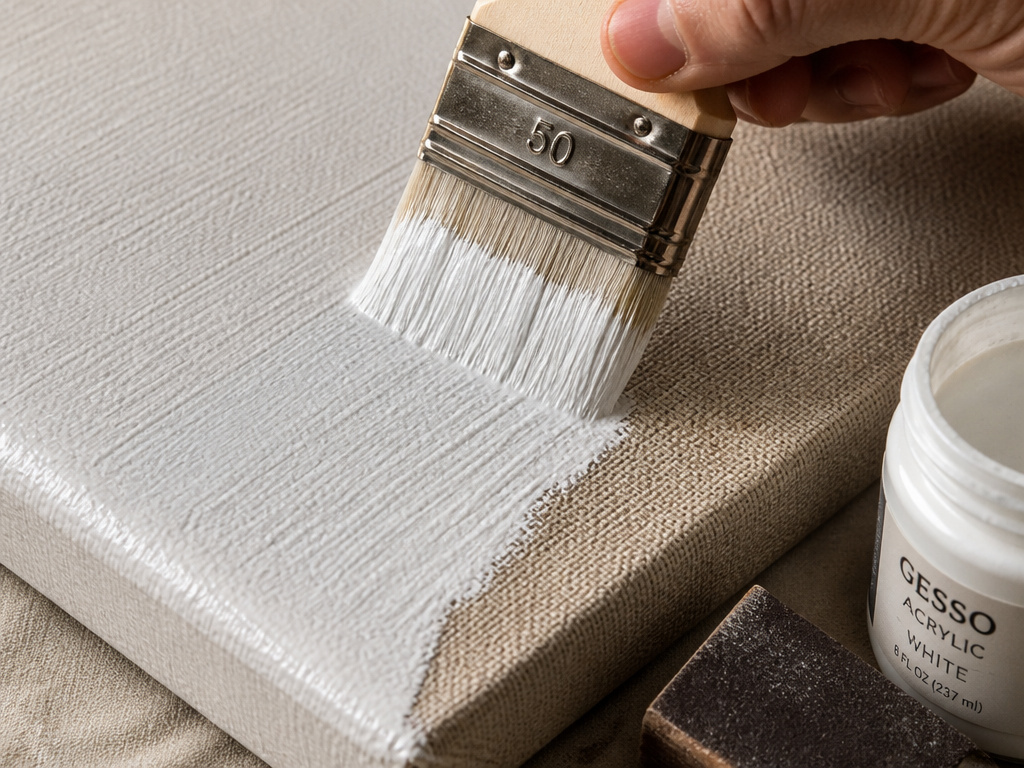
Raw cotton and raw linen will both suffer under oil eventually. A glue size seals the fibres so oil can’t reach and rot them, then two or more coats of ground go on, each sanded back.
Common mistake: One thin coat of ground. It saves a day, it looks perfectly fine on the easel, and it stays invisible until the film starts to crack years later.
Acrylic grounds are fast and absorbent, which flattens the paint slightly. Oil grounds are slow and non-absorbent, which keeps the paint glossy and workable. Both are acceptable, and both work over either fibre.
The difference shows up in your hand. Acrylic gesso has more friction under the brush, which gives you more control for fine detail. Oil-primed canvas is slicker, and the brush skates across it.
I’ve ruined a decent panel by skipping size entirely, back when I thought primer was primer. The paint sank, the surface went dead, and no amount of medium brought it back. Now I keep how to prepare a canvas open on my phone while I work.
Factory priming is its own trap. Some pre-primed canvases are too absorbent, which makes oil paint dry unevenly across the surface. A thin extra layer of gesso settles it, and it’s the cheapest fix in this whole article.
Which paint for canvas material you load onto the brush decides how much that ground matters. Thin, lean paint forgives a mediocre ground. Heavy paint does not.
Where the Published Sources Actually Disagree
Four disagreements matter, and you’ll hit all of them if you read enough.
| Question | One position | The other position |
|---|---|---|
| Acrylic over oil-primed canvas | Claessens lists 66AC for acrylic or oil | Vloothuis says never use oil-primed canvas for acrylics |
| Is linen worth the premium | Vloothuis: only if the painting is paid for or sold | Artwork Codex: linen for finished sale work, especially portraits |
| What drives stability | Artwork Codex and Art Miami: linen moves less with humidity | Classic Arts: stability is system-level, not fibre-level |
| Cotton moisture uptake | MontCarta: up to 27 percent of its weight, versus 20 for linen | Classic Arts: both are hygroscopic, no figure given |
On the acrylic question, I’d trust the manufacturer on what its own product is rated for and trust the painter on what happens in the studio. Test on a scrap first.
On stability, Classic Arts takes the system-level view: weave, tension, mounting, and room conditions all push on the same outcome, and a tight cotton on a keyed stretcher can beat loose linen on a fixed strainer, while Artwork Codex and Art Miami hold that linen moves less with humidity.
The 27 percent moisture figure comes from a single source and nothing else in the set corroborates it. Treat it as a direction, not a measurement.
Which Canvas Should You Buy for the Work You Actually Make?
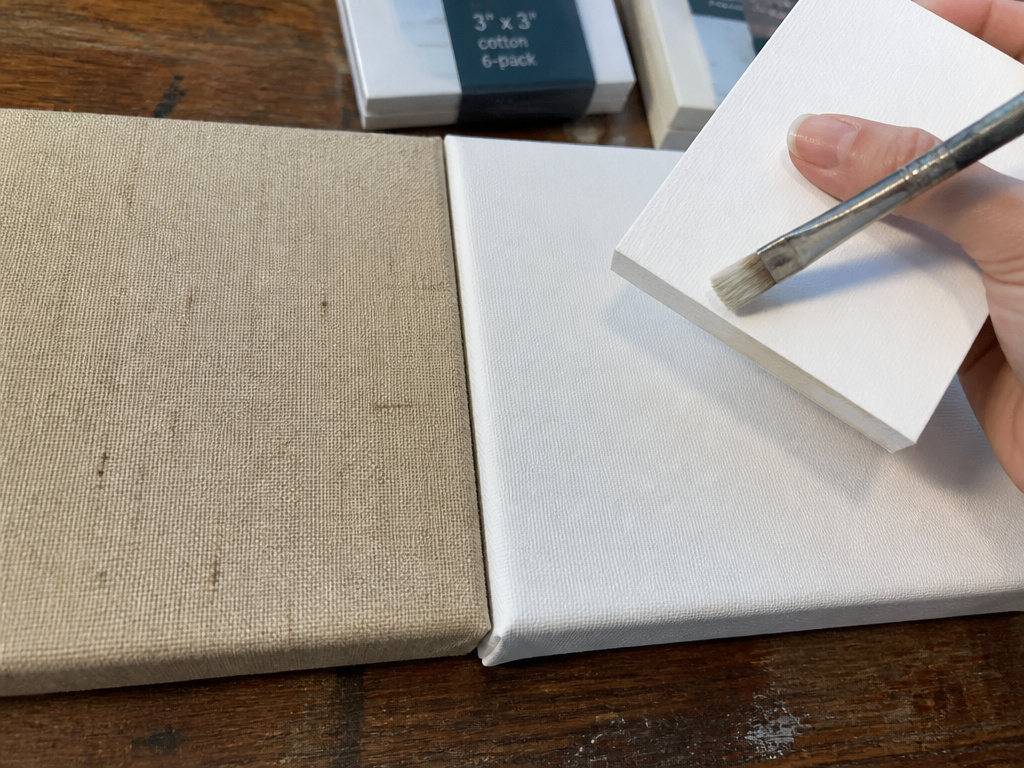
Three cases cover almost everyone: studies, sale work, and acrylic.
If You Paint Studies and Sketches
Cotton, and buy it in multipacks of small sizes, zenmuseum and blog.artweb.com recommend cotton for beginners, though Vloothuis and Artwork Codex favor linen for finished sale work. Fredrix Artist Series 548 is raw and unprimed at 12 oz, which means you size and prime it yourself, and that’s a fine lesson to learn early. Jackson’s duck at 339 g/m2 handles small panels without complaint. Cheap panel multipacks are cheap enough that you stop treating each one as precious, which is the entire point.
This is where the best canvases question has an easy answer. Buy ten small ones.
If You Paint Finished Work to Sell
Artwork Codex recommends linen at smaller scale, especially for portraits and detailed subjects, while Vloothuis says skip it unless the painting is already paid for. Claessens Canvas 66 with its two oil coats is the traditional pairing for oil work.
Vloothuis would tell you to skip it unless the painting is already paid for. He’s not wrong, and I’d still buy the linen for a portrait I care about.
If You Paint in Acrylic
Either fibre works, as long as the ground is acrylic, though Claessens lists 66AC for acrylic or oil while Vloothuis says never use oil-primed canvas for acrylics. Artwork Codex says acrylic gesso reinforces cotton against the moisture issues that hit oil painters and sits on linen just as well, while Vloothuis warns against oil-primed canvas for acrylics. Claessens 66AC is listed for acrylic or oil use.
If you want a shorter list, the canvases for acrylic are the ones with an acrylic or universal ground already on them.
Artwork Codex favors linen on sale work at small scale, while Vloothuis says linen isn’t worth the extra cost unless the painting is paid for or will be sold; cotton wins on studies, on large experiments, and on anything you plan to make ten of.
Stretching and Tension: The Mistakes That Show Up Years Later
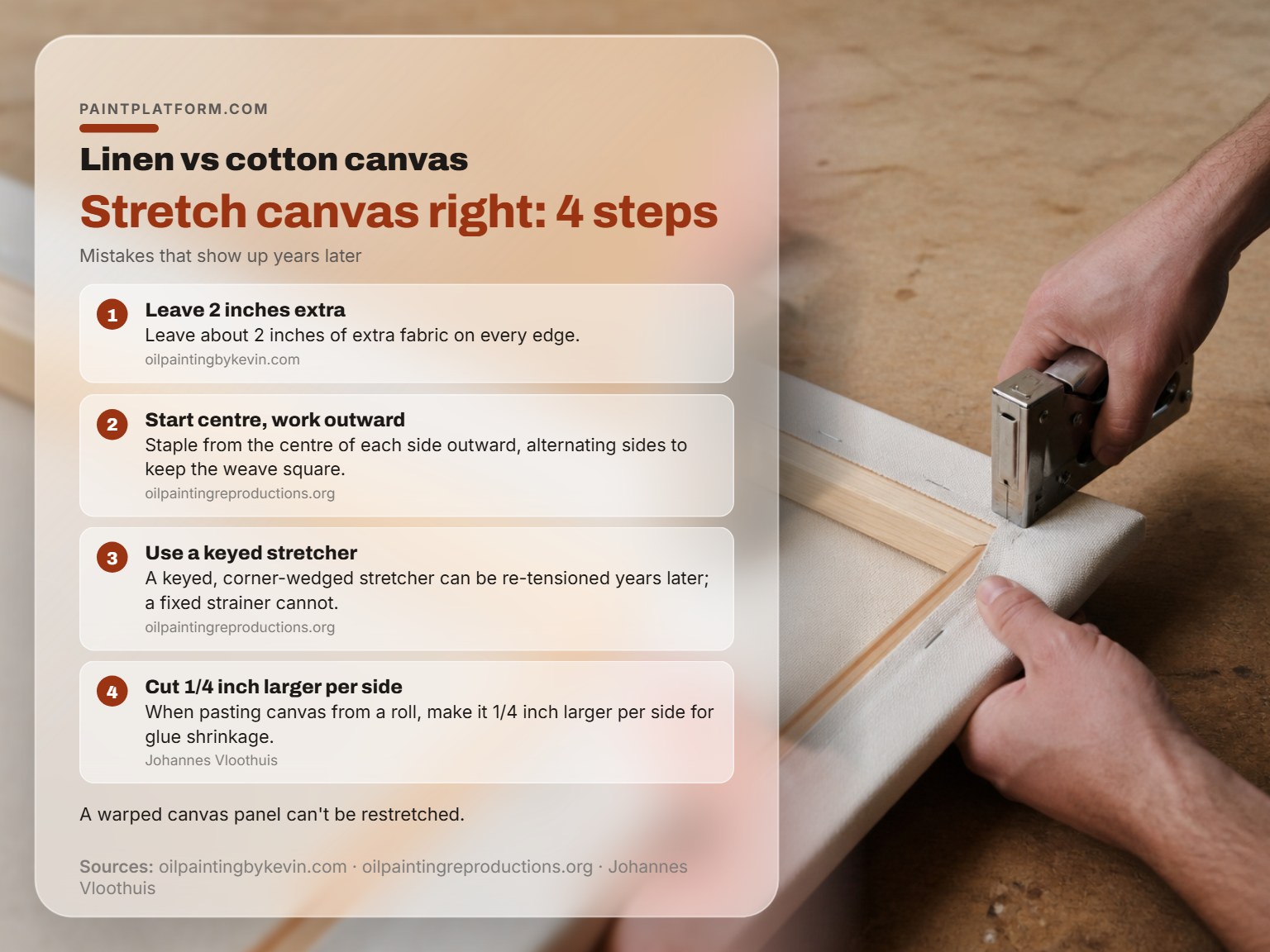
You unroll the cloth, cut it roughly to size, and start stapling from one corner because that’s where your hand landed. Six months later the weave is a parallelogram and the middle of the canvas drums while the corners stay soft.
- Leave about 2 inches of extra fabric on every edge. Skip it and you’ll be short at the corners with nothing to fold over the bar.
- Start at the centre of one side and work outward. Staple one full side first and the weave pulls out of square before you reach the second.
- Alternate sides as you go. Centre-out on opposing sides keeps the tension even and the grain straight.
- Use a keyed, corner-wedged stretcher. A strainer with fixed corners costs less and cannot be adjusted, which is a decision you’ll regret the first time the canvas slackens.
- Cut 1/4 inch larger per side when pasting canvas from a roll. The glue wets the fabric and it shrinks, and the extra margin disappears into the overlap.
Where this goes sideways: A canvas panel that warps can’t be restretched. Lower-quality boards take on moisture and bow, and there’s no key to tap.
That last point is why the stretched canvas vs canvas panel choice matters more than most buyers think. Panels are rigid, portable, and lovely for detail work. They’re also a one-way street.
For pieces where minimal movement matters most, an engineered rigid support is worth considering instead of assuming premium linen solves it. Classic-arts.com makes that case, and it holds up.
Frequently Asked Questions
Is linen canvas better than cotton for oil painting?
Better depends on the job. Artwork Codex and Art Miami say linen is stronger and moves less with humidity, while Classic Arts argues stability is system-level; oil grounds on linen have the longest track record for durability. Quality cotton canvas is perfectly adequate for most painting applications, and several sources call it the standard choice for many professional artists.
Can you use acrylic paint on oil-primed canvas?
The sources split. Claessens lists its 66AC as suitable for acrylic or oil use. Johannes Vloothuis says plainly not to use oil-primed canvas for acrylics. If you don’t know which ground you’re holding, paint a test patch on the edge before you commit.
How much heavier is linen canvas than cotton?
Not dramatically. Medium weight runs about 7 to 12 oz for cotton and 10 to 14 oz for linen. Claessens’ own linen is 460 g/m2 oil-primed and 470 g/m2 acrylic-primed, on an identical weave.
Does cotton canvas need re-stretching?
MontCarta puts it at every 5 to 10 years for cotton to hold its visual integrity, citing humidity movement, though Classic Arts argues stability is system-level. A keyed stretcher with corner wedges lets you tap the tension back without rebuilding the whole thing.
Is a canvas panel as good as stretched canvas?
Panels give you a firm, portable surface that suits detail work and outdoor painting. They cannot be restretched if they warp, and lower-quality boards take on moisture and bow. Stretched canvas gives you spring under the brush and a second chance at tension.
The Bottom Line
Here’s the trigger I’d use. If the painting leaves the house and someone else owns it, Artwork Codex would buy linen, while Vloothuis says linen is only worth it when the painting is paid for or will be sold. If it goes on your wall or into a drawer, buy cotton and put the difference into ground and a keyed stretcher.
One concession: none of this rescues a thin ground. A heavyweight linen with one coat of primer will crack before a 10 oz cotton duck with three.
I’d rather see a beginner wreck ten cheap cotton panels than nurse one expensive linen canvas for a year without touching it. Start messy. The fibre argument can wait until you’ve got a painting worth arguing about.
