
Types of Canvas for Painting: Which One Actually Lasts
This post contains affiliate links. As an Amazon Associate, we earn from qualifying purchases.
The main types of canvas for painting are cotton duck, linen, polyester, and blends, sold primed or unprimed, stretched or as panels. Linen fiber runs two to three times stronger than cotton, and canvas weight is measured in ounces per square yard, where a lighter cloth carries a higher number.
Fiber is only half the story. A peer-reviewed study of artist canvas fabrics found that even when a raw fiber has the right properties, the finished woven cloth may not, because weave geometry exerts a strong influence on how the fabric behaves. That gap between what a fiber promises and what a bolt of cloth delivers is where a lot of types of canvas for painting advice quietly falls apart.
What follows walks the four fiber families, the weight numbering that confuses everyone, the two places where good sources flatly contradict each other, and the stretching steps that decide whether a painting is still flat in twenty years. By the end you’ll know what to buy for the way you actually paint, not the way a catalog imagines you paint.
Key Takeaways
- Linen fiber is 2 to 3 times stronger than cotton, though weave geometry can override what the raw fiber should do.
- Higher canvas numbers mean lighter cloth, and weight also gets quoted in ounces per square yard.
- Skip grounds containing zinc white. Conservation guidance flags them as brittle and prone to delamination.
- A backing board screwed to the reverse is the cheapest long-term protection a stretched canvas can get.
- Some economy pre-stretched canvases ship with a slick coating that has to come off with denatured alcohol.
What Are the Main Types of Canvas for Painting?
Four fibers cover almost everything sold as artist canvas: cotton, linen, polyester, and blends of those three. Everything else is a variation on weight, weave, or surface treatment.
Canvas strength depends on three variables: the choice and quality of the fiber, the thickness of the thread, and the tightness of the weave. A loosely woven cloth made from excellent fiber can perform worse than a tight weave made from ordinary fiber, which is why weight alone tells a buyer very little.
Here’s the short version of each family:
- Cotton duck. The default for most painters. Wide range of weights, good sustained tension when properly stretched and primed, and the name comes from “doek,” the Dutch word for linen canvas.
- Linen. Premium cloth with visible tooth and natural resistance to mold and pests.
- Polyester. Unaffected by humidity, mold, and pests, which matters if your studio is a garage.
- Blends. The murkiest category, and the one where manufacturer claims and measured results part ways most often.
Canvas became a painting surface in 16th-century Venice as a portable answer to fresco and wood panel. The first ones were hemp sailcloth, and linen took over roughly a century later. Hemp and especially linen stayed dominant in Western painting until the later 19th century, when cotton arrived as the cheaper alternative. Cotton duck’s real breakthrough came after World War II, when European linen was scarce and American Abstract Expressionists needed wide, affordable cloth.
Plain Weave, Twill, and Herringbone: What the Threads Are Doing
Most artist canvas is plain weave, also called tabby: the weft thread alternates over and under the warp. That’s the structure you’re looking at when you see a simple grid.
Twill is different. The weft passes over one warp yarn and under two or more, which produces a diagonal pattern across the cloth. Herringbone is a form of twill that reads as a broken zigzag.
Why care? Because the Glasgow fabric study measured stiffness, tensile strength, moisture response, crimp, drape, and lustre across cotton, linen, polyester, polyamides, and carbonized fibers, and concluded that woven geometry can override what the raw fiber should do. Two canvases with the same fiber content can behave like different materials.
Why Canvas Weight Numbers Run Backward
An 8 to 10 ounce canvas is what Blick labels lightweight. That’s the number Blick gives for light cloth, and it’s the one worth memorizing before you read any other label.
The numbering system trips people up because it runs opposite to intuition. Higher numbers are assigned to lighter weights of canvas. The heavier the cloth, the lower the number. Weight also gets quoted directly in ounces per square yard, which is the cleaner way to compare across brands.
| Term | What it means | Where it fits |
|---|---|---|
| Lightweight canvas | 8 to 10 oz per square yard | Sketches and small studies |
| Number weave | Higher number equals lighter cloth | Double-ply yarn, everyday painting |
| Ounce fabric | Weight quoted in oz per square yard | Single-thread cloth for small works |
Number weaves use double-ply yarn, meaning two threads pulled from opposite sides of the loom. Single-thread ounce fabrics are built for small works and sketches, which is why they show up in cheap multi-packs.
Weight and weave tightness together decide how a painting looks and how long it lasts. Neither one alone tells you much.
Linen vs Cotton Canvas: What the Strength Gap Actually Buys You
Linen earns its reputation. Linen fibers are 2 to 3 times stronger than cotton, and properly prepared linen holds a tight stretch through dimensional stability. It also resists mold and pests naturally.
You can see the difference before you ever load a brush. Linen shows slubs, those small raised knots where the thread thickens, and the surface carries a visible tooth that cotton duck smooths away.
| Property | Cotton duck | Linen | Polyester |
|---|---|---|---|
| Fiber strength | Baseline | 2 to 3x stronger than cotton | Strong, best overall property mix |
| Mold and pests | Vulnerable | Naturally resistant | Unaffected |
| Humidity response | Absorbs and releases moisture | Absorbs and releases moisture | Unaffected |
| Pull difficulty | Easiest to stretch | Harder, pliers often needed | Varies by weave |
| Feel and look | Even, uniform grid | Slub texture, visible tooth | Least like natural cloth |
Here’s the part the strength number hides. Heavier linen and factory-primed canvas are harder to pull across a stretcher than raw cotton, sometimes to the point where you need pliers to reach satisfactory tension. Strength in the fiber doesn’t translate into ease in the studio.
The peer-reviewed position is more careful than the marketing. Polyester may have the best combination of physical properties, but it hasn’t matched linen or cotton kinaesthetically or aesthetically. Physical performance and the feel of the surface are two separate scores.
I’d rather see a beginner burn through a six-pack of small cotton panels than nurse one big linen canvas for a year. The panels teach you more per square inch, and you stop treating the surface like it’s judging you.
When Linen Is the Wrong Buy
Linen is the wrong buy when the painting is practice. It’s also the wrong buy if you’re stretching by hand for the first time, because the cloth fights back and a bad stretch on good linen wastes both.
Cotton duck handles the first year fine. So does linen vs cotton cloth in a small size, if you want to feel the difference without committing a roll to it.
Polyester and Blends: Where Good Sources Genuinely Disagree
Two credible sources look at polyester canvas and reach different conclusions. That’s worth knowing before you spend on a synthetic roll.
Utrecht, a manufacturer, states that conservation experts believe polyester canvas will prove more durable than natural fibers in advanced aging. That’s a confident claim, and it’s an appeal to authority rather than a cited test.
Young and Jardine, publishing in Studies in Conservation in 2012, are more measured. They confirm polyester exhibits the best overall combination of properties among the fabrics tested, then explicitly note it has yet to match linen or cotton kinaesthetically or aesthetically. They also warn that suitable raw fiber doesn’t guarantee a suitable finished fabric, because weave geometry matters that much.
Both things can be true. Polyester resists humidity, mold, and pests completely, which is a real advantage in a damp basement studio. It also feels like cloth that came off a machine, because it did.
Blends are worse documented. Utrecht presents them as offering desirable properties of premium fibers at an economical level, with a caution that blends may perform differently from single-fiber cloth when certain sizings are applied. That caution is doing a lot of work in one sentence.
A blend is a bet that the good properties show up and the bad ones don’t. Ask the maker which sizing went on the cloth before you commit to a roll of it.
Primed or Unprimed? The Question Retail Answers Badly
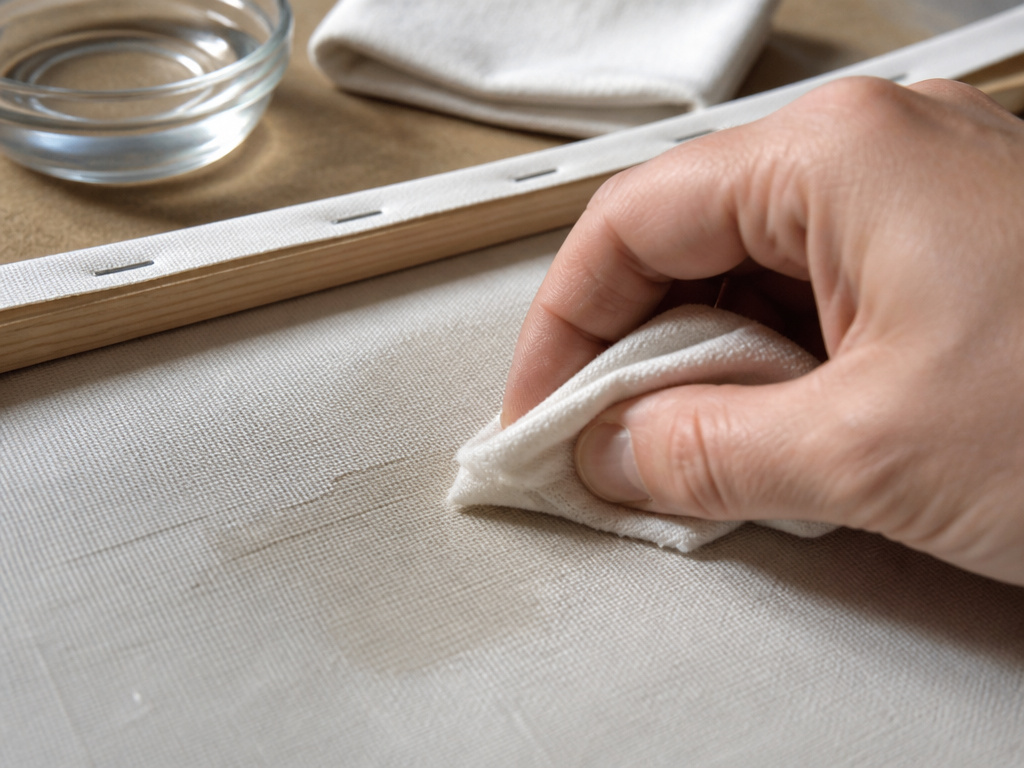
Have you ever unwrapped a cheap pre-stretched canvas and found the surface slightly slick, almost waxy under your thumb? That’s not your imagination and it’s not a defect in the paint you’re about to apply.
Blick says primed canvas comes pre-treated and ready to paint, saving time, while MITRA cautions that the quality of pre-primed canvases can be difficult to evaluate and advises contacting the manufacturer to confirm whether sizing was applied and what type. Conservation guidance says the quality of pre-primed canvases can be difficult to evaluate, and advises artists to contact the manufacturer directly to confirm whether sizing was applied and what type.
Both statements are accurate. They’re answering different questions. One is about convenience, the other about what’s actually sitting between your paint and the fiber.
Unprimed canvas is raw fabric with no sizing and no priming. Any creases from folding disappear during stretching and priming, so a folded blanket isn’t damaged goods.
A canvas stretched in dry conditions and left near a radiator can draw at the corners when humidity returns, and the paint along those corners goes with it.
Common mistake: Buying a ground that lists zinc white. Conservation guidance flags zinc-white grounds as best avoided because they become exceptionally brittle and can cause delamination and metal soap formation. The failure shows up years later, not on the first coat.
How to Check a Pre-Primed Canvas Before You Trust It
Some generic, economy-grade pre-stretched canvases are coated to prevent sticking in the warehouse. That coating has to come off. Wipe the surface with denatured alcohol before you paint on it, and you’ll see whether anything lifts.
Learning to gesso a canvas properly pays you back on every painting after that.
For a state-level reference on materials, the ArtsWA paintings guide PDF covers supports, priming, and installation in plain language.
Stretched Canvas vs Canvas Panel: Match the Support to the Risk
A finished painting leans against the studio wall, face out, and someone’s knee finds the corner on the way past the coffee cup. That’s the whole argument in one sentence.
Flexible supports are more susceptible to physical damage like tears, punctures, and impact cracks. They also respond to environment changes, which shows up as draws in the corners and an overall loss of tension. Conservation guidance encourages artists to affix protective backing boards to the reverse of paintings on flexible supports for exactly this reason.
Rigid panels trade one problem for another. They resist the environmental movement but can warp and crack, and a fabric layer adhered over the face keeps the paint and ground layers somewhat flexible when the panel does move.
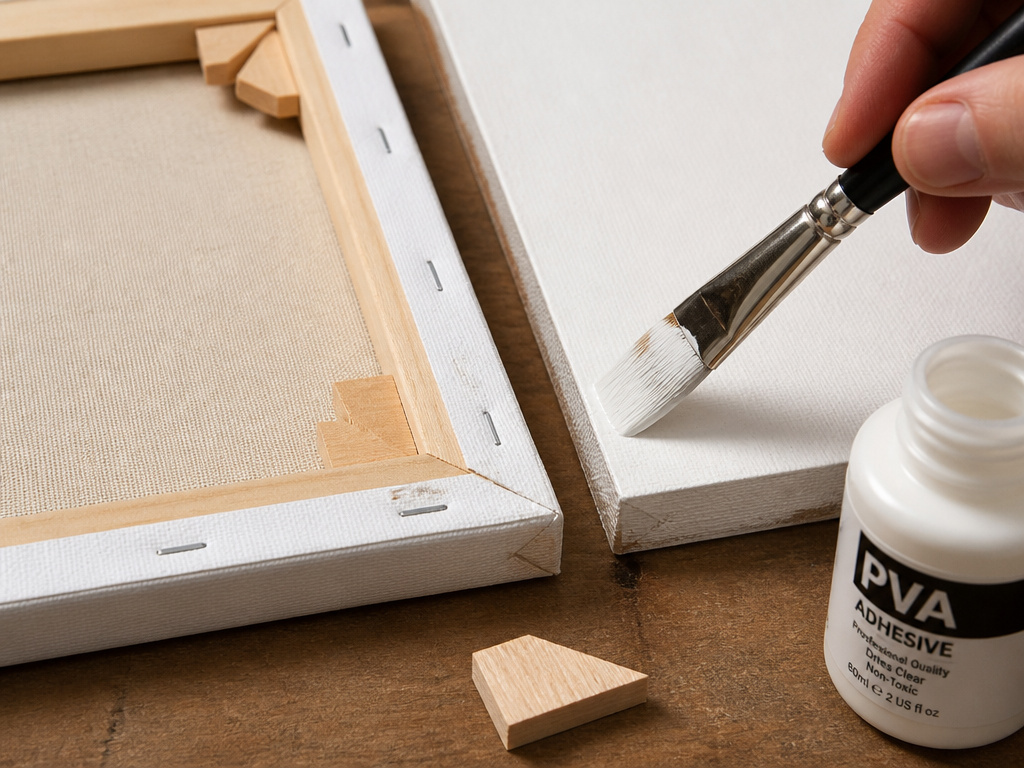
If you’re gluing cloth to a panel, prime the panel front, back, and sides with an artist’s acrylic gesso first. That creates an isolating layer against acids the panel gives off as it ages. Use a non-acidic PVA-based glue.
Where this goes sideways: Using wood glue to stick canvas to a panel. It’s the wrong adhesive for the job and the bond fails at the worst moment, usually while the panel is face-down on a workbench.
If longevity is the goal, the stretcher with expandable corners is the safer read.
Weighing stretched canvas vs canvas panel comes down to how the work will travel and how long it needs to survive. If you want a rigid surface with a longer history behind it, the case for canvas vs wood panel is worth reading before you commit.
How Do You Stretch Canvas So It Survives Twenty Years?
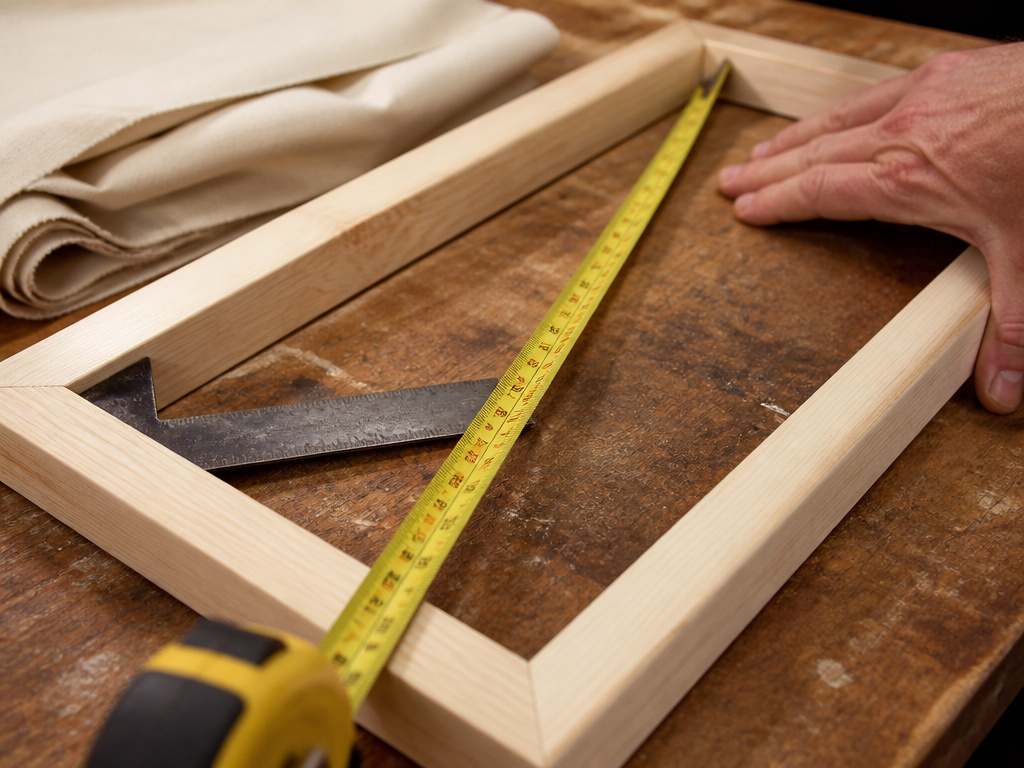
ArtsWA’s painting guide starts with a framing square, and that tells you most of what you need to know. The square comes before the fabric, every time.
Here’s the sequence that matters:
- Assemble the stretcher and check every rail for curvature by sighting down its length. A bowed rail puts uneven tension into the cloth before you’ve pulled anything.
- Cross-measure the diagonals both ways until they’re exactly equal. Unequal diagonals mean the frame is out of square, and no amount of pulling fixes that later.
- Check all four corners at 90 degrees with a framing square, and repeat both measurements as you stretch. Frames drift while you work.
- Align the weave parallel to the stretcher edges before the first staple. A skewed weave pulls into a diamond instead of a rectangle.
- Staple opposite sides in sequence, working center outward, rather than running one full edge at a time. Utrecht states side stapling gives better tension while back stapling for a gallery wrap is generally adequate, whereas ArtsWA specifies staples and tacks without prescribing side or back placement.
- Key out gently, and only in suitable conditions. Done too aggressively or in the wrong environment, keying out damages the canvas support.
There are two accepted approaches to the pull itself, center-to-center and on the bias. Properly executed, both give excellent results. Pick one and get consistent at it.
A properly tensioned canvas should feel taut and even when tapped near the middle.
If the diagonals aren’t equal before the fabric goes on, no amount of pulling later will fix the square. Check twice, staple once.
The Backing Panel Nobody Bothers With
Archival cardboard or another archival panel material does the job.
It’s the least glamorous step in the whole process and one that addresses the moisture movement that cracks grounds. The Getty Conserving Canvas publication goes deeper into how complex these layered supports really are.
Frequently Asked Questions
Is cotton or linen canvas better for beginners?
Cotton duck, for the first year at least. It’s easier to pull to tension, and a mistake on cotton costs you a practice piece rather than a premium panel. Move to linen once your stretching is consistent.
What weight canvas should I buy for acrylics?
Start with something in the lightweight range, around 8 to 10 oz per square yard, for studies and sketches. Remember that the number system runs backward, so a higher number on the label means a lighter cloth. Heavier canvas is generally more durable.
Do I need to prime a pre-primed canvas?
Usually not, but check what’s on it. Conservation guidance notes that pre-primed quality is hard to evaluate and recommends asking the manufacturer whether sizing was applied and what type. Economy pre-stretched canvases sometimes carry a sticking-prevention coating that needs denatured alcohol to remove.
Can I paint on canvas board instead of stretched canvas?
Yes, and for small studies it’s often the better choice.
How do I stop a canvas from going slack?
Add a backing board to the reverse and control the room, not the canvas. Key out gently when you must, and only in suitable conditions.
The Bottom Line
Here’s the threshold I’d hand anyone starting out: buy small cotton panels in a multi-pack and treat every one as disposable. A surface you aren’t afraid of is a surface you’ll actually use.
That advice flips the moment you’re making work you intend to keep. At that point linen on a properly squared stretcher with a backing board is the right call, and the 2 to 3 times fiber strength stops being trivia and starts being the reason the painting outlives you.
One concession, because it’s true: none of this matters if the cloth never gets painted on. A common canvas failure isn’t cracking or delamination.
