
Fresco Painting Technique Explained: The Day’s Work Rule
This post contains affiliate links. As an Amazon Associate, we earn from qualifying purchases.
Fresco painting technique explained in one line: water-dispersed pigment is brushed onto fresh lime plaster, and as the plaster cures it pulls carbon dioxide from the air and locks the color inside the wall. The painter works one section per day, and once the surface sets, the section is done.
That one-day section is the giornata, Italian for “day’s work,” and it drives every other decision in the method: how thick the plaster goes on, which pigments can be used, how the composition gets divided. The wall sets the schedule. The painter works inside it.
What follows walks through the technique as four primary sources describe it, including the places where they flatly disagree, the three categories most modern guides skip, and the one habit a paper painter can borrow from all of it.
Key Takeaways
- One day per section. The giornata rule means a finished fresco is a mosaic of daily work, and a mistake gets chipped off, not painted over.
- The plaster recipe is not settled. Four sources give four different lime-to-sand ratios, from 1:1 to 1:3, and each defends its own.
- Only alkali-resistant pigments survive. Earth colors, smalt, cobalt, and ultramarine make the cut; most modern tube colors do not.
- Mezzo fresco is the third category. A 2024 review identifies a dry-mortar method that most guides fold into secco or ignore entirely.
- Fresco was already fading by 1956. The National Bureau of Standards called it “seldom used or heard of” that year, decades before art schools stopped teaching it.
What actually happens when pigment hits wet plaster?
Fresco is water-based pigment applied to wet lime plaster, and the bond forms as the plaster cures and hardens.
Fresco buono requires water-dispersed pigment applied to fresh lime plaster while the surface is still damp. As the plaster cures, calcium hydroxide reacts with atmospheric carbon dioxide to reform calcium carbonate, and the pigment particles become mechanically encapsulated inside the porosity of the intonaco.
The plaster is usually lime, made by firing limestone in a kiln, adding water to slake it, and mixing in sand for body, though the 2024 review documents gypsum and mixed lime-gypsum mortars too, a wrinkle the fresco painting technique explained above tends to smooth over. The University of Virginia’s Roman fresco description breaks the wall into two layers: the arriccio, a rough undercoat that holds the whole thing together, and the intonaco, the smooth finish coat the painter actually works on.
The 2024 review in the Journal of Cultural Heritage flags that not every fresco mortar is lime-based. Gypsum and mixed lime-gypsum mortars show up in the historical record too, which complicates the tidy “lime plus sand” story most guides tell.
For a paper painter, the important part is the chemistry. The color gets trapped inside the plaster as the plaster hardens around it, which is why an ancient fresco can still read clearly while a modern acrylic mural fades.
The giornata window: why one day is the whole rule
Coit Tower’s own documentation says the artist builds up color “as long as the surface remains moist: up to twelve hours.” The US Senate’s Capitol report says the section must be painted in a single day. The monastery guide says eight hours. Same rule, three different clocks.
I’ve learned the hard way that timing ruins a page. Even after years of painting, I once added a new layer before the one beneath was fully dry, and it lifted into a muddy smear. Now I wait until the surface no longer feels cool before layering.
Fresco painters have the opposite problem. They can’t wait. The plaster sets within a working window the sources put at anywhere from eight hours to a full day, and the whole technique is built around racing that clock. A giornata is sized to what one painter can finish before the surface stops absorbing water, the sources put that window at eight hours to a full day, which is why the composition gets divided into sections before any paint touches the wall.
The monastery guide offers a readiness test: stroke a water-dipped brush across the surface; if the water soaks straight in, you can paint, and if it beads on top, wait.
Where this goes sideways: Painting past the set point. The pigment stops bonding into the plaster and starts sitting on top of it, and within a few years the color lifts off in flakes. Tate calls the dry-plaster version “liable to flake off.”
The Coit Tower fresco techniques page adds a detail that surprises most people: the artist works with a very small wet brush, building intensity through repeated passes as long as the surface stays moist. That’s not decoration. That’s the whole budget.
Four plaster recipes, four answers, one wall
Ask four sources for the lime-to-sand ratio and you get four different numbers. This is the part of fresco where every practitioner, every century, and every wall seems to want its own answer.
| Source | Lime:Sand Ratio | Context |
|---|---|---|
| US Senate Doc 103-27 | 1:3 | Brumidi’s Capitol murals |
| Cennini (1437) | 1:2 | Rich, recently slaked lime |
| Palomino (1715) | 1:1 fresh, 3:2 old | Ratio shifts with lime age |
| St. Gregory of Sinai | 1:2 then 1:1 | Different coats, different ratios |
Here’s the full process the sources agree on:
- Fire limestone in a kiln to drive off carbon dioxide and produce quicklime.
- Add water to slake the quicklime into a putty.
- Let the putty soak for weeks to months, the longer the better.
- Mix the putty with sand or marble dust in the ratio your source recommends.
- Apply in coats, with the final intonaco sized to one day’s work.
Before you start: High-calcium lime is caustic. Wear a dust mask or respirator, cover your eyes with work goggles, and have no exposed skin. Slaked lime should soak before use, the monastery guide says three months (three weeks when time is short), Cennini says some days, and Palomino says four to six months, and it can’t be allowed to freeze.
Why the ratios disagree
Lime freshness, aggregate type, and climate all shift the answer. The 1843 British Commissioners’ instructions capture this clearly: Cennini’s 1:2 works for “rich lime recently slaked,” while Palomino’s 1:1 assumes fresher lime and 3:2 assumes older plaster. The Brumidi painting techniques chapter settles on 1:3 for the Capitol work, which is the sandiest of the four.
I’ve never tried to slake lime myself, and after reading the monastery guide’s safety notes, I’m in no hurry.
The Venetian plaster tradition runs on the same lime chemistry, just polished instead of painted. If you’ve ever wondered why Venetian plaster walls look so deep, it’s the same carbonation reaction doing the work.
The monastery guide adds a wrinkle the others don’t: five or more coats, built up to a combined thickness of 3/4 to 7/8 inches, with medieval work sometimes reaching 2 inches, while Tate and Cennini describe only two coats. The 1843 instructions say the final coat should be about a quarter inch thick, while the IJATES study says a few millimetres and Alberti says no thicker than half a finger’s breadth. The IJATES study says “a few millimetres.” That’s a 10x spread on the same measurement.
The practical takeaway for anyone reading old recipes: each number answers a slightly different question, and the source that matches your lime, your sand, and your climate is the one to follow.
What pigments survive contact with fresh lime
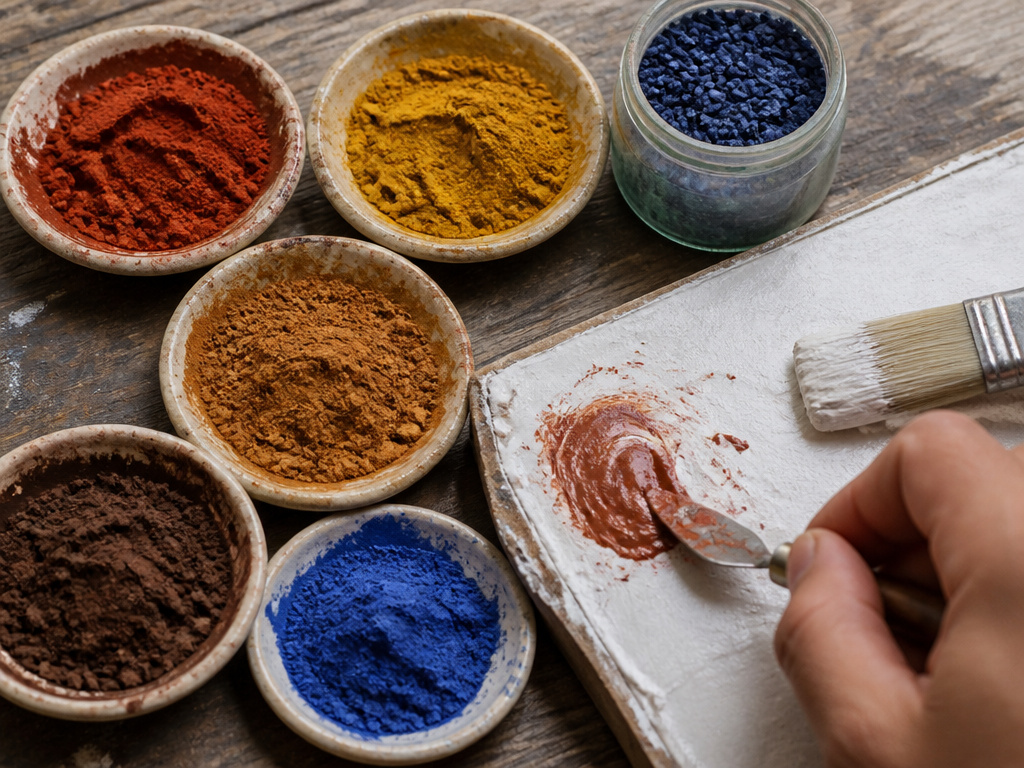
The palette is short. Lime is caustic, and the US Senate report limits fresco pigments to those that resist alkali, though the 2024 review cautions that some non-alkaline-resistant pigment attributions may not always be precise.
- Earth pigments: Indian red, earth green, ochers, siennas, umbers
- Smalt, a cobalt-blue glass pigment
- Cobalt blues
- Ultramarine blue
The US Senate report lists exactly this set, and the constraint explains why fresco palettes feel limited. Cadmium reds, most modern organic pigments, and anything with a dye base will react with the lime and shift color or fade.
My own palette is mostly earth colors already, which is probably why fresco feels familiar to me.
There’s a wrinkle in the 2024 review that anyone citing this list should know about. The authors warn that “the assignment of well-known non-alkaline-resistant pigments to the fresco technique might not always be precise,” because organic-binder identification is difficult. In plain terms: some pigments long assumed to be fresco may have been applied in a later secco touch-up, and the analysis can’t always tell the difference.
Buono, secco, mezzo: which fresco are you looking at?
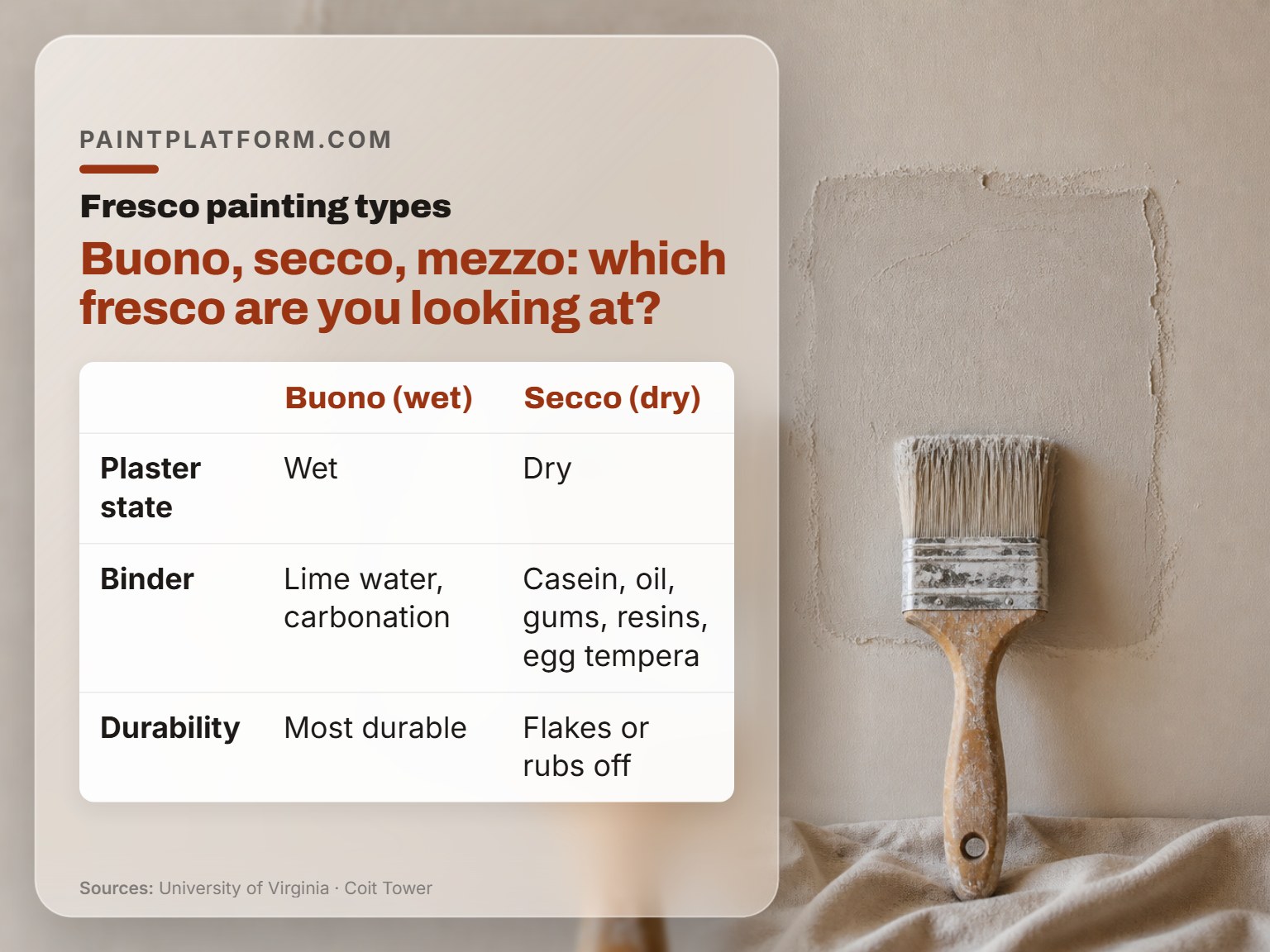
UVA and most guides split fresco into two categories, buono and secco. A 2024 review says there are three, adding mezzo fresco, and the third one changes how you read a wall.
| Category | Plaster State | Binder | Durability |
|---|---|---|---|
| Buono | Wet | Lime water, carbonation | Most durable |
| Mezzo | Dry | Lime water reactivation | Middle |
| Secco | Dry | Casein, oil, egg, gums | Flakes or rubs off |
Fresco buono
True fresco, the technique the Senate report and Tate and UVA all describe. Pigment goes on wet plaster, the plaster cures around it, and the color becomes part of the wall. This is the version that survives for centuries when kept dry.
Fresco secco
Paint applied to dry plaster with an organic binder: casein, oil paint, gums, resins, or egg tempera. The Coit Tower fresco techniques page lists all of these as secco binders. The bond is weaker, and Tate and UVA describe the same failure mode: the paint flakes or rubs off over time, though Coit Tower simply lists the organic binders used.
Mezzo fresco
The third category, defined by the peer-reviewed fresco technique review as pigments mixed with lime water applied to dry mortar and fixed by reactivation of carbonation. It sits between buono and secco: dry application, but a lime-based bond rather than an organic one. Most guides skip it entirely.
Same lime chemistry, different tool.
Why fresco faded and what it teaches a paper painter
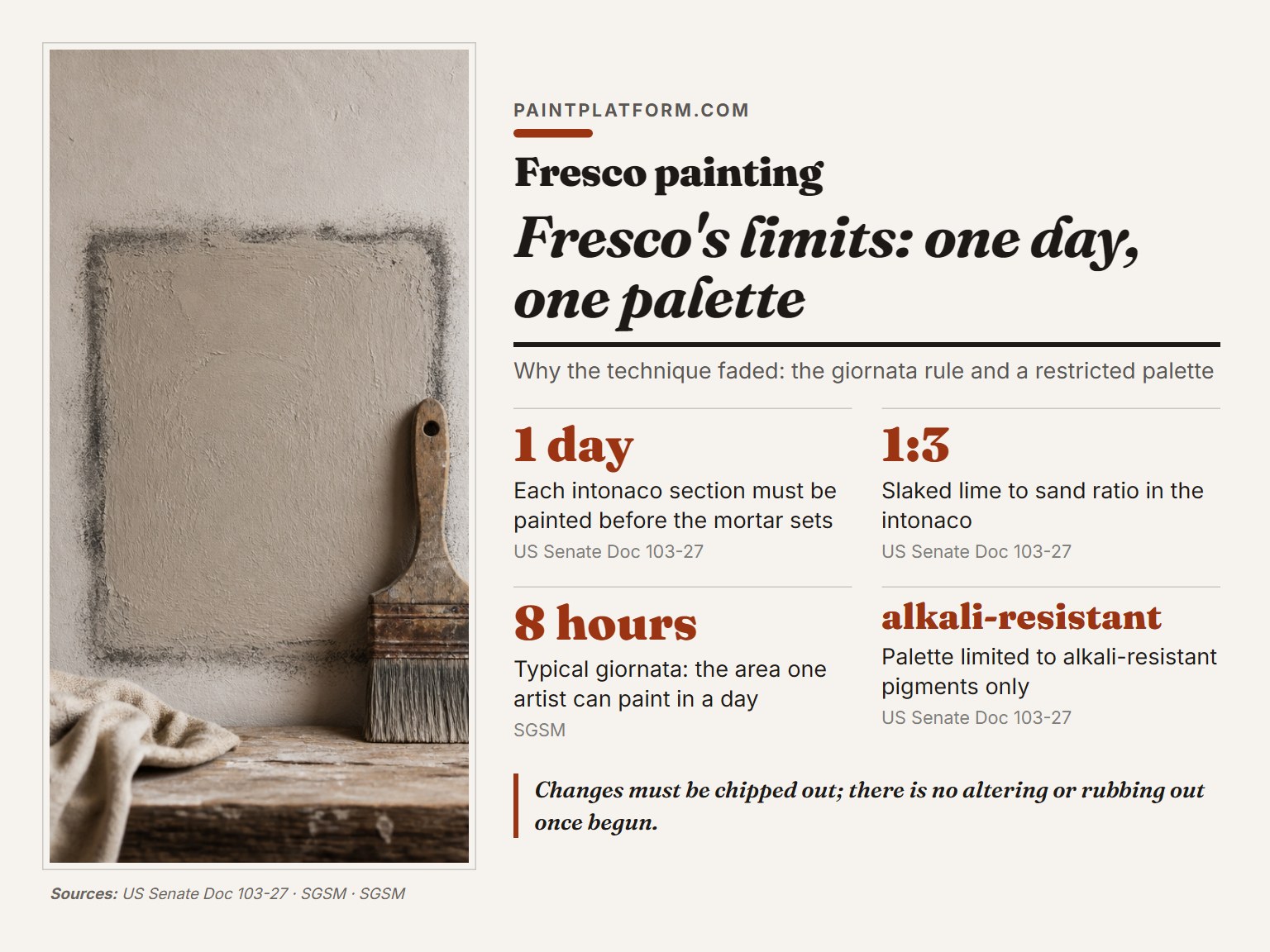
By 1956 the National Bureau of Standards was already writing that fresco was “seldom used or heard of.” That’s a government document calling time of death on a technique that had been standard for centuries.
The 1930s had seen a US revival, with fresco used for a number of murals in the United States. But the technique’s constraints were always going to limit it in a world that wanted faster output:
- The giornata rule caps output at one painter’s daily capacity.
- The palette is limited to alkali-resistant pigments.
- Corrections require chipping out and replastering the section.
A wall mural in acrylic can be revised, moved, or painted by a team. A fresco cannot.
If a technique dies out while a government report insists it’s “well adapted to modern methods,” trust the practitioners, not the report.
The NBS document also claims fresco is “particularly well adapted to the modern methods and demands for speed in finishing,” which sits awkwardly against the giornata rule. The same report admits the technique was already fading. It’s a strange contradiction, and it’s worth reading the original to see how the Bureau tried to reconcile it.
What to steal from fresco for your sketchbook
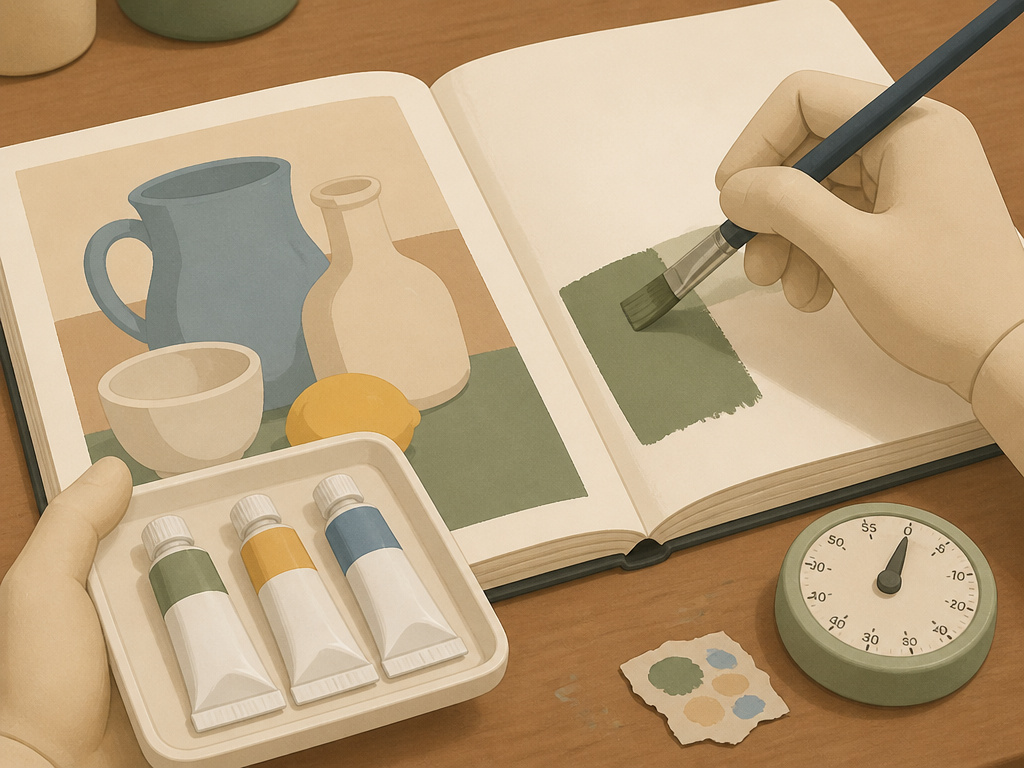
I paint on paper, not walls. I’ve never mixed a batch of lime putty, and I don’t plan to. But three things from fresco have changed how I work in my sketchbook.
The one-day rule
Pick a subject you can finish in one sitting. Give it a hard stop. Don’t touch it after the timer ends. The constraint forces decisions you’d otherwise defer, and deferring decisions is the main reason beginner paintings stall. Start messy, refine later.
Flat shapes first
Fresco painters work from flat color blocks and build intensity through repeated passes. That’s the same logic as underpainting: establish the big shapes first, refine details later. If you’re using gouache, an opaque gouache gives you the coverage fresco flat-shapes need, and it dries matte enough to layer without glare.
Chip it out, don’t paint over it
Coit Tower’s page is blunt about this: “changes in a buono fresco must be chipped out: there is no altering or rubbing out once the design is begun.” In a sketchbook, the equivalent is turning the page. I’ve stopped trying to fix bad pages. Now I turn the page and start over, which is closer to the fresco rule than I expected.
The part nobody mentions: Fresco rewards planning more than talent. The full-size cartoon gets drawn and perforated before the final coat goes on, because once the plaster is wet you’re tracing and painting. The designing happened earlier. The Emory technical art history fresco activity is a good place to feel that constraint on a small scale.
A last note on color: a clean-mixing gouache lets you build a limited palette without mud, which matters when you’re trying to paint flat. Three tubes you know well beat a dozen you don’t.
Frequently Asked Questions
Is fresco painting still done today?
Rarely, and mostly in restoration or commissioned public art. The 1930s saw a US revival for Capitol and Coit Tower murals, but by 1956 the National Bureau of Standards already called it “seldom used or heard of.” A few contemporary artists and conservation programs keep the technique alive, but it’s not a standard art-school subject anymore.
What’s the difference between fresco and mural?
Fresco is a specific mural technique. A mural is any painting on a wall; fresco is one way of making one, using wet lime plaster and water-based pigment. You can have a mural that isn’t fresco (acrylic, oil, mosaic) and you can have a fresco that’s small enough to be a panel.
Can I try fresco at home?
You can try a small practice panel, but the safety warnings are real. High-calcium lime is caustic and dangerous: wear a dust mask or respirator, cover your eyes with work goggles, and have no exposed skin. The plaster also needs time to slake, so a first attempt is a multi-week project, not an afternoon one.
Why do fresco colors look different when they dry?
Because the plaster lightens as it cures, and the artist has to judge how much the colors will shift. The US Senate’s Capitol report calls this an uncontrolled variable in color matching. Paint a test patch, let it dry fully, and compare before committing to a large area.
How long does a fresco last?
If it stays dry, a very long time. The University of Virginia’s Pompeii project notes that true fresco paintings may maintain their durability when kept dry. The failure mode is moisture and the dry-plaster variant, which flakes or rubs off over time.
Before You Go
If you only remember one thing, remember the giornata rule. One day per section, no reworking, chip out what fails. That single constraint explains every other choice in the technique, from the earth palette to the plaster thickness.
If you want to feel the constraint yourself, try a one-day study this weekend. Pick a simple subject, give it a single sitting, and don’t touch it after the timer ends. You’ll learn more about fresco from that hour than from any wall you’ll never build.
None of this makes you a fresco painter. The lime is caustic, the slaking takes months, and a wall is not a sketchbook page. But the rule underneath the technique, that the material sets the schedule and not the other way around, is worth carrying into whatever you paint on.
