
10 Best Waterproofing Paint in 2026
This post contains affiliate links. As an Amazon Associate, we earn from qualifying purchases.
The KILZ Basement and Masonry Waterproofing Paint is the best overall waterproofing paint for sealing basement walls against moisture. It blocks up to 12 PSI of water pressure and has a low-odor formula that makes indoor application comfortable. For homeowners who need long-term mold and mildew protection, the Zinsser WaterTite LX Ultra offers a 10-year guarantee. The Liquid Rubber Foundation Sealant is the best choice for stopping active foundation leaks with its flexible, crack-bridging formula.
Damp basements and leaky foundation walls are a common headache for homeowners. The right waterproofing paint needs to handle hydrostatic pressure, resist alkali buildup from concrete, and create a durable barrier that lasts. A product that fails to address these factors will peel, bubble, or simply let moisture seep through again.
We built this guide by analyzing manufacturer specifications, warranty details, and owner feedback patterns across the most reputable waterproofing paint brands. Our goal is to help you match the right paint to your specific moisture problem, whether that’s a damp wall, an active leak, or a foundation crack.
Top 10 Waterproofing Paints in the Market
Certain content that appears on this site comes from Amazon. This content is provided "as is" and is subject to change or removal at any time.
The Best Waterproofing Paints, Reviewed
KILZ Basement and Masonry Waterproofing Paint

What We Like
- Blocks up to 12 PSI water pressure
- Low-odor formula for indoor use
- Dries to touch in 1 hour
- Resists alkali buildup in high-moisture areas
Trade-offs
- Requires hydraulic cement to fill cracks before application
- Full cure takes 7-14 days before washable
A 12 PSI water-pressure rating means this paint can handle serious hydrostatic pressure on basement walls, stopping moisture from seeping through concrete and masonry even below grade. That kind of protection, combined with low odor and a fast one-hour dry time, makes it a good choice for homeowners tackling damp interior walls or outdoor retaining walls who want a finish that both seals and looks good. The alkali-resistant coating also stands up to the harsh chemical environment of fresh concrete, so you are not repainting every season.
Zinsser WaterTite LX Ultra Waterproofing Paint

What We Like
- 20-year waterproof guarantee
- 10-year mold & mildew guarantee
- Bright white, non-gritty finish
- Applies with brush, roller, or sprayer
Trade-offs
- At 36 lb, heavy for a 1-gallon can
- Only available in white finish
A 10-year mold and mildew proof guarantee sets this apart from most waterproofing paints, making it the clear pick for damp basements or interior masonry where moisture and fungus are constant threats. The bright white, non-gritty finish goes on smoothly with a brush, roller, or sprayer, covering up to 375 square feet per gallon. That means you can coat a good-sized wall without constant trips back to the store. It suits anyone who needs long-term protection against mildew in spaces that stay humid or poorly ventilated.
At 36 pounds, this gallon can is nearly three times heavier than the KILZ Basement and Masonry Waterproofing Paint, which weighs 12.5 pounds. That extra heft makes it awkward to carry up stairs or hold for long stretches. If you’re sealing a small, dry interior wall and don’t need the mold guarantee, the lighter KILZ might be easier to handle. But for serious mildew-prone areas, this Zinsser’s 10-year mold and mildew proof guarantee is worth the extra muscle.
Zinsser Drygard Waterproofing Paint
What We Like
- Stops 10 PSI of water pressure
- Smooth, non-gritty finish
- Low odor formula
- Easy water clean-up
Trade-offs
- Not for use on wood, metal, or drywall surfaces
- Requires a clean, dry surface before application
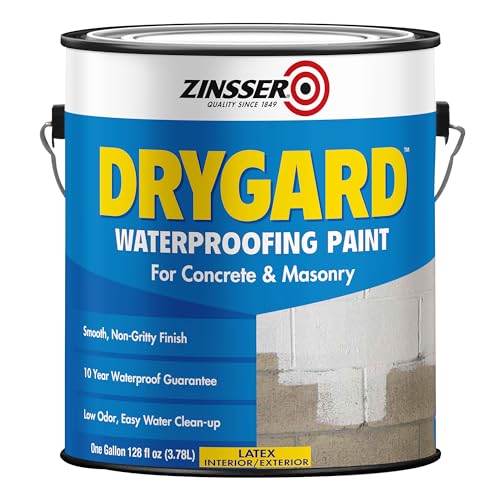
This paint stops up to 10 PSI of water pressure, which means it can handle the kind of dampness or wet conditions typical of concrete and masonry areas like basements and cellars. The smooth, non-gritty finish leaves the wall looking clean and ready for further painting, not like a rough industrial coating. It also has low odor and cleans up with water, making application more pleasant than many solvent-based options.
The 10 PSI rating is the maximum water pressure this paint can stop. So if you are dealing with active water flow or known high-pressure issues, a product like YKF Masonry Pro with its 15 PSI rating would be the safer bet. But for standard basement dampness or occasional seepage, Zinsser Drygard gives you real stopping power in a low-odor, water-cleanup package that is far more pleasant to apply than solvent-based alternatives.
Product photos
Liquid Rubber Foundation Sealant
What We Like
- 900% elongation for crack bridging
- Zero VOCs for safe indoor use
- No mixing required, apply directly
- Adheres to concrete, masonry, wood, metal
Trade-offs
- Heavy at 43.7 lb per 5-gallon pail
- Exterior coverage only 20 sq ft/gal
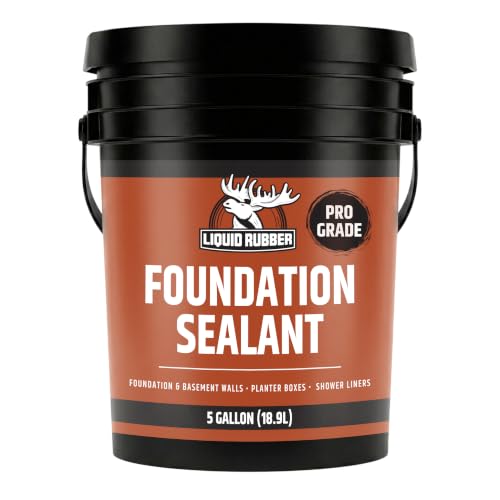
A 900% elongation rating means this sealant can stretch significantly before breaking, which helps it handle foundation movement without tearing. That flexibility, paired with a high-build formula that goes on like paint but cures into a thick rubber membrane, makes it a strong choice for stopping active leaks in basements and around foundations. It bonds to concrete, masonry, wood, and metal, and the water-based formula contains zero VOCs, so you can use it indoors without worrying about fumes. For interior walls, a gallon covers about 50 square feet with two to three coats, which is reasonable for a product built to handle real water pressure rather than just cosmetic dampness.
At 43.7 pounds per five-gallon pail, this sealer is noticeably heavier than a standard gallon of waterproofing paint like KILZ Basement and Masonry Waterproofing Paint, which weighs 12.5 pounds for a gallon. That weight comes from the rubber solids that give it its stretch and thickness, so it is a physical commitment to haul and pour. For someone sealing a foundation with active leaks, the extra effort pays off; for a quick cosmetic touch-up on a dry wall, a lighter paint might be simpler.
AMES Blue Max Liquid Rubber Waterproofer

What We Like
- 900% elongation resists cracking
- Non-toxic and eco-friendly formula
- Works on vertical and horizontal surfaces
- Made in the USA by woman-owned company
Trade-offs
- Requires 24 hours between coats
- 1 gallon pail is heavy at 11.3 pounds
With 900% elongation, this liquid rubber can stretch to nine times its original length without cracking. For a basement wall that shifts with seasonal ground movement or a wooden deck that expands in summer heat, that flexibility helps maintain a lasting seal. AMES Blue Max bonds to concrete, wood, metal, and masonry, and you can brush, roll, or spray it onto both vertical and horizontal surfaces. It is well suited for below-grade foundations and insulated concrete where a flexible membrane is needed.
The trade-off is patience: each coat demands a full 24 hours to dry before the next goes on, so a two-coat job takes at least two days. At 11.3 pounds per gallon, the pail has heft, and the white finish is better suited for interior or below-grade work where appearance matters less than performance.
Product photos
INSL-X WaterBlock Acrylic Masonry Waterproofer
What We Like
- Withstands up to 12 psi hydrostatic pressure
- High alkali resistance up to pH-13
- Fast-drying waterproof coating for masonry
- Suitable for interior and exterior walls
Trade-offs
- Only for vertical surfaces, not horizontal
- Requires 50-90°F surface and air temperature
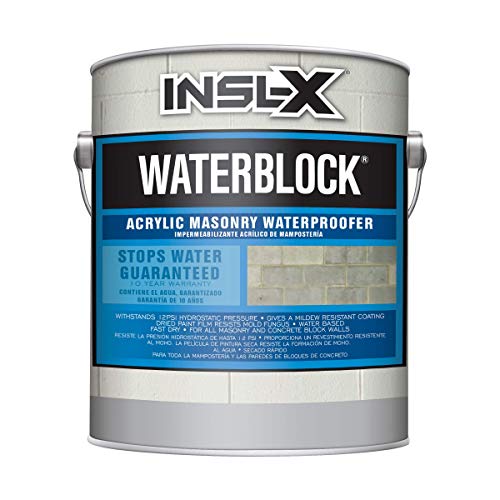
With a 12 psi hydrostatic pressure rating, this paint can handle serious water pressure against basement walls and retaining walls without blistering or peeling. That makes it a good option for exterior masonry where rain and groundwater are constant threats. The water-based acrylic formula dries fast, resists alkali up to pH-13, and works on everything from cinder blocks to stucco and brick. So you can seal a foundation wall in a single project without switching products.
This paint is designed for vertical surfaces only, so it won’t work on floors or driveways. Still, for anyone tackling an exterior masonry wall that needs real waterproofing muscle, the INSL-X WaterBlock delivers the pressure resistance you actually need.
Product photos
Rust-Oleum Watertite Latex Waterproofing Paint

What We Like
- Ultra low odor for indoor use
- Soap and water cleanup
- Resists up to 20 PSI water pressure
- 15-year waterproof guarantee
Trade-offs
- Quart size covers less area than gallon
- Too heavy at 3 pounds for a quart of paint
With a 15-year waterproof guarantee and resistance to 20 PSI of water pressure, this quart-sized can delivers serious protection in a small package. The ultra-low odor and soap-and-water cleanup make it a good choice for indoor projects where ventilation is limited or where you want to avoid strong fumes. It goes on as a smooth, bright white, non-gritty coating that brushes or rolls easily onto dry masonry walls, so you get a finished look that doesn’t feel like a heavy industrial sealant.
The quart size is ideal for patching a leaky basement corner or sealing a small cinder block wall. But if you’re covering an entire basement, you’ll need multiple cans or step up to a gallon like the Zinsser WaterTite LX Ultra. For a quick, low-odor fix on a small interior masonry surface, this Rust-Oleum can is exactly what you need.
KILZ Basement & Masonry Waterproofing Paint Bundle
What We Like
- Two paints for walls and floors
- Interior and exterior use on masonry
- Floor paint resists oil, gas, stains
- Satin finish applies smoothly on horizontal surfaces
Trade-offs
- Floor paint only for horizontal surfaces
- No hydrostatic pressure rating for basement walls
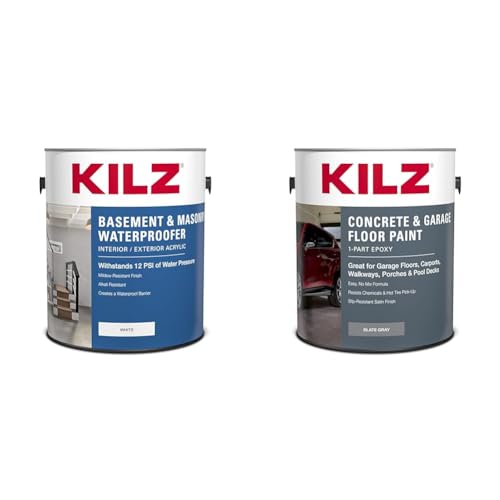
A bundle that pairs a waterproofing paint for porous masonry walls with a durable satin-finish floor paint means you can tackle an entire basement or garage in one purchase. The wall paint works on interior and exterior concrete, cinder block, stucco, and brick, while the floor paint is formulated to resist oil, gasoline, and chemical stains in high-traffic areas. For anyone refreshing a basement or garage from floor to ceiling, this combo saves a second trip to the store and ensures both surfaces get a purpose-built coating.
The floor paint is designed for horizontal surfaces only, so you cannot use it on walls or sloped areas. And while the masonry paint seals porous concrete against moisture, it is formulated for interior and exterior use on walls and masonry surfaces. If your basement has standing water or constant dampness, a heavier-duty waterproofing product may be a better fit. But for a clean, coordinated finish on walls and floors in a dry or moderately damp space, this bundle delivers real convenience.
YKF Masonry Pro Waterproofing Sealer
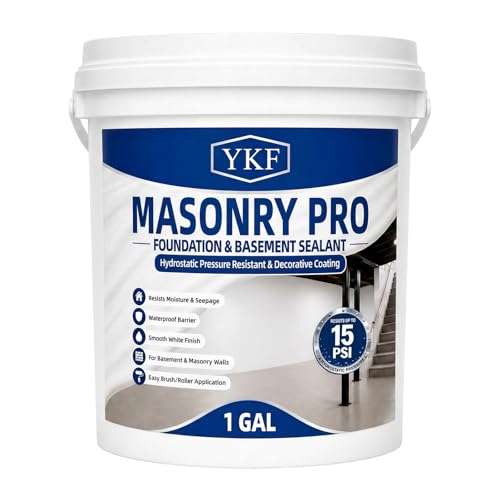
What We Like
- 15 PSI hydrostatic pressure resistance
- Water-based polyurethane, high-solids formula
- Works on dry or slightly damp surfaces
- Smooth white decorative finish
Trade-offs
- Covers only 100 sq ft per gallon
- Requires surface prep and crack repair
- Needs two hours before handling
With 15 PSI of hydrostatic pressure resistance, this coating is built for below-grade walls that face serious water pressure from the soil outside. It suits homeowners dealing with persistent seepage in basements, crawl spaces, or foundation walls, especially those who want a clean white finish rather than a black or gray sealant. The water-based polyurethane formula bonds to properly prepared dry or slightly damp concrete, so you don’t have to wait for bone-dry conditions before starting your project.
Coverage is the trade-off: one gallon covers about 100 square feet. That means a typical basement wall may need two gallons or more, and the two-hour drying time before handling means you’ll need patience between coats. Surface preparation is non-negotiable: the manufacturer says to remove oil, dust, loose paint, dirt, and debris, and to repair active leaks, cracks, and holes before applying. For a homeowner willing to do the prep work and buy enough gallons, this is a focused solution for high-pressure moisture problems.
Product photos
LISRUX Transparent Waterproof Sealant
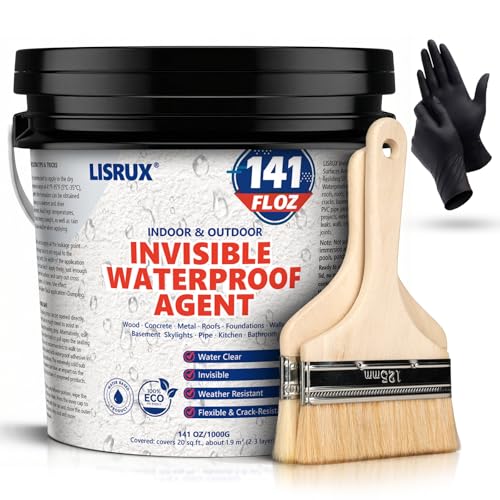
What We Like
- Invisible finish preserves surface appearance
- Self-leveling fills gaps up to 2mm
- Flexible and crack-resistant membrane
- Works on concrete, tile, metal, wood
Trade-offs
- Requires 24-48 hours cure time before water contact
- Needs 3-5 coats for heavy leaks
A 141-ounce container of clear, water-based sealant that cures into an invisible waterproof membrane, so your brick wall, tile grout, or wooden fence keeps its original look while being sealed against moisture. The self-leveling formula fills hairline cracks up to 2mm, and the high resin content promotes adhesion on concrete, metal, marble, and wood. It resists substrate deformation, which helps the coating stay intact as surfaces shift. If you need a waterproofing solution that stays hidden, this is the one to reach for.
The application process requires planning, as each coat needs 24 to 48 hours to cure before the next can go on. For persistent leaks, the instructions recommend repeating the application 3 to 5 times, so a weekend repair can easily stretch into a full week. The water-based clear sealant cures into an invisible membrane that insulates against air, water, and moisture without altering the surface texture or color. That transparency preserves the look of the material underneath, which matters on visible areas like windows, bathrooms, or kitchen tiles. Reviewers note that the self-leveling formula fills gaps up to 2mm, creating a flexible, crack-resistant barrier that withstands substrate movement.
Product photos
How We Evaluated Waterproofing Paints
Our evaluation is based on a thorough review of manufacturer documentation, technical specifications, and patterns in owner feedback from a wide range of sources. We focused on the performance claims each paint makes and how those claims align with real-world moisture problems homeowners face.
We prioritized three criteria above all others. First, hydrostatic pressure resistance is the most important measure of a waterproofing paint’s ability to stop water from pushing through a wall. Second, application and drying requirements matter because a paint that needs perfect conditions or long cure times may not work for every project. Third, surface compatibility and prep needs determine whether a paint will actually bond to your specific wall material.
A research-led evaluation has limits: we cannot replicate every basement condition or measure long-term durability in our own tests. Instead, we rely on the manufacturer’s stated guarantees and the consensus of informed owners to identify the most reliable options for each use case.
What To Look For In Waterproofing Paints
Choosing the right waterproofing paint starts with understanding the pressure behind your moisture problem and the surface you’re painting. Here’s what to look for.
The best waterproofing paint for your project must match the hydrostatic pressure rating to your wall’s moisture level, the surface material to the paint’s adhesion claims, and your schedule to the product’s cure time.
Hydrostatic Pressure Rating
This number, measured in PSI (pounds per square inch), tells you how much water pressure the dried paint film can withstand before failing. Products range from 10 PSI for mild dampness to 20 PSI for more aggressive seepage. If your basement wall shows active water beading or running, choose a paint rated for at least 12 PSI. For light dampness or efflorescence (white mineral deposits), a 10 PSI rating is often sufficient.
Surface Preparation and Crack Repair
No waterproofing paint will bond or seal properly over dirt, oil, or loose paint. Most manufacturers require a clean, sound surface and recommend filling cracks wider than a hairline with hydraulic cement before painting. Some flexible paints, like those with 900% elongation, can bridge small cracks without pre-filling, but they still need a clean substrate. Skipping prep is the most common reason waterproofing paints fail.
Cure Time and Washability
Waterproofing paints often need days or weeks to fully cure before they can handle scrubbing or heavy contact. A paint that dries to the touch in one hour may still be delicate for a week. If your basement is used for storage or living space, look for a product that reaches full washability sooner, or plan to keep traffic off the walls during the cure period.
- Check your wall’s moisture level: is it damp, seeping, or actively leaking?
- Read the surface temperature and humidity requirements before buying.
- Confirm the paint is compatible with your wall material (masonry, concrete, block).
- Measure your wall area to ensure one gallon covers the square footage needed.
- Note whether the paint is for vertical surfaces only or can also be used on floors.
A quick rule: if you can see water running, you need a higher PSI rating and likely a flexible membrane, not just a paint.
Waterproofing Paints Compared
The table below compares the key specifications of our top waterproofing paints side by side, so you can see at a glance which product matches your moisture problem and surface type.
| Product | Water Pressure Resistance | Drying Time | Finish Type |
|---|---|---|---|
| KILZ Basement and Masonry Waterproofing Paint | Up to 12 PSI | Touch in 1 hr, recoat in 4 hr | N/A |
| Zinsser WaterTite LX Ultra Waterproofing Paint | N/A | N/A | Bright white, non-gritty |
| Zinsser Drygard Waterproofing Paint | 10 PSI | N/A | Smooth, non-gritty |
| Liquid Rubber Foundation Sealant | N/A | N/A | N/A |
| AMES Blue Max Liquid Rubber Waterproofer | N/A | 24 hours | N/A |
| INSL-X WaterBlock Acrylic Masonry Waterproofer | Up to 12 psi | N/A | N/A |
| Rust-Oleum Watertite Latex Waterproofing Paint | Up to 20 PSI | N/A | Smooth, bright white, non-gritty |
| KILZ Basement & Masonry Waterproofing Paint Bundle | N/A | Touch in 2 hr, recoat in 4 hr | Satin |
| YKF Masonry Pro Waterproofing Sealer | 15 PSI | 2 hours before handling | Smooth White |
| LISRUX Transparent Waterproof Sealant | N/A | 24-48 hours | N/A |
Frequently Asked Questions
Can waterproofing paint stop an active leak?
Waterproofing paint is designed to seal porous masonry against hydrostatic pressure, but it cannot stop an active leak where water is flowing freely. You must first stop the flow with hydraulic cement or a foundation repair product, then apply the waterproofing paint after the surface is dry.
How many coats of waterproofing paint do I need?
Most manufacturers recommend two coats for optimal protection. The first coat seals the substrate, and the second coat ensures a uniform, pinhole-free barrier. Some high-solids products may achieve full coverage in one coat, but two coats are standard for the best long-term performance.
Can I paint over existing waterproofing paint?
Yes, but only if the existing coating is sound, clean, and well-adhered. Peeling, chalking, or powdery paint must be removed by wire brushing, pressure washing, or chemical stripping before applying a new coat. Adhesion tests with a small patch are recommended before committing to the full wall.
Is waterproofing paint safe for indoor use?
Many modern waterproofing paints are formulated with low or zero VOCs and low-odor properties specifically for indoor basement use. Always check the product label for indoor safety and ventilation requirements. Products like the Liquid Rubber Foundation Sealant are zero-VOC and safe for occupied spaces.
How long does waterproofing paint last?
The lifespan depends on the product quality and the conditions. High-performance paints with 15- to 20-year guarantees, such as the Zinsser WaterTite LX Ultra, can last for decades. That assumes the surface is properly prepared and the coating is not subjected to physical damage or extreme hydrostatic pressure beyond its rating.
The Bottom Line
The KILZ Basement and Masonry Waterproofing Paint is our best overall choice for most homeowners because it balances strong hydrostatic pressure resistance (12 PSI) with a low-odor formula that makes indoor application practical. It needs crack prep and a full cure before washability, but for standard damp basement walls, it delivers reliable protection without overwhelming your space with fumes.
If your basement has a persistent mold or mildew problem, the Zinsser WaterTite LX Ultra‘s 10-year guarantee on microbial growth makes it the smarter long-term investment. For active foundation leaks that need flexibility, the Liquid Rubber Foundation Sealant‘s 900% elongation handles crack movement that rigid paints cannot.
The single most important factor in choosing a waterproofing paint is matching the product’s hydrostatic pressure rating to the actual moisture level on your wall. Overbuying on PSI is safe; underbuying will waste your time and money.
