
9 Best High Temp Engine Paint in 2026
This post contains affiliate links. As an Amazon Associate, we earn from qualifying purchases.
For most engine projects, the Rust-Oleum High Heat 5-in-1 Spray Paint is the best overall choice, thanks to its 2000°F intermittent heat rating and gas-and-oil-resistant ceramic coating. If you need to spray from awkward angles in a tight engine bay, the Rust-Oleum Engine Enamel Spray Paint is the best for any-angle spray. For continuous heat exposure up to 1200°F, the Seymour Hot Spot High Heat Spray Paint delivers a durable, porcelain-like bond.
Choosing the right high temp paint means matching the coating to the specific part you are painting. An engine block runs cooler than an exhaust manifold, and a part that sees continuous heat needs a different formulation than one that only gets hot intermittently. Getting this wrong can lead to peeling, blistering, or discoloration.
This guide is based on a careful review of manufacturer specifications, material data sheets, and patterns in owner feedback from restoration forums and automotive communities. We evaluated each paint on heat tolerance, chemical resistance, application ease, and durability to help you find the right match for your project.
Top 9 High Temp Engine Paints in the Market
Certain content that appears on this site comes from Amazon. This content is provided "as is" and is subject to change or removal at any time.
The Best High Temp Engine Paints, Reviewed
Rust-Oleum High Heat 5-in-1 Spray Paint

What We Like
- Withstands intermittent heat up to 2000°F
- Gas and oil resistant ceramic coating
- Five spray patterns for precise application
- Sprays from any angle
Trade-offs
- Only for intermittent high heat, not continuous
- 30-minute dry time requires patience between coats
A 2000°F heat ceiling means this paint can handle exhaust manifolds, brake calipers, and engine blocks that see extreme thermal spikes without peeling or fading. The ceramic formula resists gas and oil, so it holds up where engine bay fluids splash and bake. That combination of raw temperature tolerance and chemical resistance makes it the go-to can for anyone restoring a hot rod or refreshing a daily driver’s engine bay. It’s especially useful when you want a single product that does the job start to finish.
The 2000°F heat rating on this Rust-Oleum spray is for intermittent use, meaning it handles the heat cycles of automotive parts like exhaust pipes and headers that cool between drives, not sustained red-hot operation. For continuous high-temperature applications, a product like the VHT Engine Metallic, rated to 1200°F, might be more appropriate. The five spray patterns and any-angle nozzle let you reach tight spots without flipping the can, which saves time and frustration on complex parts.
Rust-Oleum Engine Enamel Spray Paint

What We Like
- Sprays at any angle, even upside down
- Resists oil, gas, grease, and rust
- Dries to touch in 20 minutes
- Covers up to 12 sq. ft.
Trade-offs
- 600°F limit is lower than some engine paints
- Full cure requires following label instructions
This paint handles intermittent heat up to 600°F, which covers many engine components like blocks and brackets that don’t see exhaust-level temperatures. The any-angle spray technology is a practical feature: you can spray the can upside down, which helps reach awkward spots without having to tilt the can or waste paint. It also resists oil, gas, and grease, so the finish stays intact if there’s a spill or splash from a leaky gasket.
The trade-off is that 600°F intermittent rating is lower than Rust-Oleum’s own High Heat 5-in-1 (2000°F), so if you are painting exhaust manifolds or turbo housings, this enamel won’t hold up. Stick with the High Heat 5-in-1 for those jobs. For other engine parts, the any-angle spray and the rust-preventive finish make this a practical option that saves you from awkward hand positions and constant can repositioning.
Dupli-Color Engine Paint with CERAMIC

What We Like
- High gloss retention
- Resists oil and automotive fluids
- Won't blister, flake, crack, or peel
Trade-offs
- 500°F heat limit is lower than many engine paints
- Not suited for exhaust headers or turbo manifolds
With a maximum heat dissipation rating and gloss retention that holds up under the hood, this paint resists oil and automotive fluids on contact, so minor leaks won’t immediately ruin the finish. The ceramic formulation handles temperatures up to 500°F, which suits most daily drivers and weekend projects, and the EZ Touch Conical Nozzle helps aim the spray into tight spots around valve covers and block crevices. It won’t blister, flake, crack, or peel, making it a practical choice for a clean, glossy engine bay that stays presentable.
The 500°F threshold here is lower than several competitors. If your exhaust manifold or turbo housing sees sustained heat above that, the Rust-Oleum High Heat 5-in-1 Spray Paint handles up to 2000°F and would be a safer bet for those parts. But for the block, heads, and valve covers where heat is high but not extreme, Dupli-Color’s ceramic formula delivers a glossy finish that resists fluids and peeling. Just keep it away from the hottest exhaust components.
Product photos
Seymour Hot Spot High Heat Spray Paint

What We Like
- Withstands 1200°F continuous heat
- Forms durable porcelain-like bond
- Resists peeling and blistering
- VOC compliant, no lead or cadmium
Trade-offs
- Requires high heat to cure fully
- Aluminum color only in this variant
A 1200°F continuous heat rating puts this paint in a different league for anyone working on grills, stoves, engines, or exhaust systems that see sustained high temperatures. That threshold means coated metal surfaces resist peeling, blistering, and discoloration even under extreme heat exposure. The porcelain-like bond that forms during curing adds real durability, helping extend the life of the coating on hot metal parts. For projects like restoring a stove pipe or painting a fire pit, this is the paint that handles the heat as advertised.
This paint needs significant heat to cure properly, it won’t develop that tough finish until the part sees those high temperatures. And unlike the Rust-Oleum High Heat 5-in-1, which offers five spray patterns and a 2000°F heat resistance rating, the Seymour Hot Spot focuses purely on extreme heat endurance with a VOC-compliant formula. If your project involves metal surfaces that reach up to 1200°F, the Seymour is the right call. For lower-temperature applications, the Rust-Oleum’s broader versatility might serve you better.
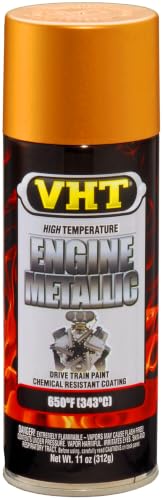
VHT Engine Metallic Paint
What We Like
- Chemical resistant coating
- Withstands 650°F intermittent heat
- Gold flake metallic finish
- Drivetrain-specific formulation
Trade-offs
- Only 650°F limit, not for extreme exhaust
- No gloss or flat options in this color
A 650°F intermittent heat ceiling means this paint handles a hot engine block on a spirited drive but stops short of exhaust manifold temperatures. Its gold flake metallic finish gives engine parts a distinctive look. For builders who want a metallic sheen, this is a paint to consider among high-temp options.
This paint handles intermittent heat up to 650°F, so it works on engine blocks and drivetrain parts but not on exhaust manifolds or turbochargers that run hotter. The gold flake finish adds a custom look, and the chemical-resistant coating holds up against oil and grease. If you want a metallic color that stays put under the hood, this is a practical option.
Product photos
POR-15 High Temperature Paint

What We Like
- Withstands extreme 1200°F heat
- Resists cracking, chipping, peeling
- Corrosion-resistant against weather and salt
- Meets military specification MIL-C-13370
Trade-offs
- Requires 24-hour cure before high heat
- Surface must be fully cleaned and degreased
- Glossy surfaces need sanding with 320 grit
With a heat resistance rating of 1200°F, this paint handles the kind of temperatures you’d find on exhaust components and engine parts without cracking, chipping, or peeling. The flat black finish resists corrosion from weather, salt, and moisture, and it meets military specification MIL-C-13370, so the durability claim has a real standard behind it. That means for anyone working on high-heat metal surfaces, this coating offers reliable protection that stays put.
Patience is key here: you need a full 24-hour cure before the part sees temperatures above 300°F, which means planning your build around drying time. Surface prep is also non-negotiable, every trace of oil, grease, and loose rust must be gone, and glossy surfaces require a 320-grit scuff. Compared to Rust-Oleum’s 5-in-1 High Heat spray, which fires to 2000°F and sprays from any angle, the POR-15 demands more prep but delivers a tougher, more uniform film for extreme-duty applications.
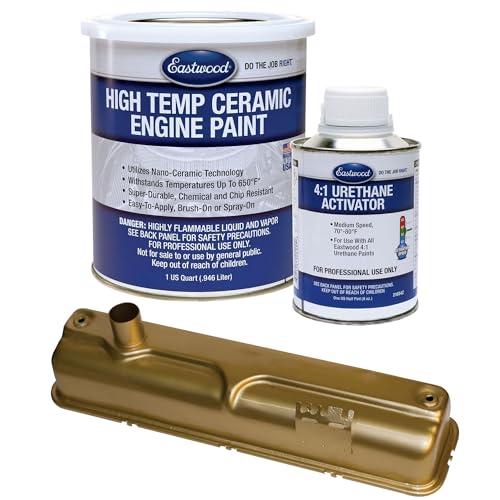
Eastwood Olds Gold High Temperature Ceramic Paint
What We Like
- Nano-ceramic microspheres for toughness
- 650°F resistance without blistering
- Chemical and chip resistant finish
- Flexible brush-on or spray-on application
Trade-offs
- 650°F limit is lower than some competitors' 1200°F+
- Brush-on method requires careful technique to avoid streaks.
With a 650°F heat ceiling, this paint resists blistering and keeps its factory color in the engine bay, while ceramic microspheres and silicone alkyds create a finish that repels oils, degreasers, and fuels. That makes it a natural fit for restorers who want an authentic Olds Gold shade and the durability to match a show-quality build, with the flexibility to brush or spray depending on the part. The combination of chemical resistance and true-to-OEM hue prioritizes long-term appearance over raw temperature extremes.
Where this paint lands on heat tolerance matters. Its 650°F resistance falls short of the 1200°F or 2000°F ratings on picks like Rust-Oleum High Heat 5-in-1 or POR-15 High Temperature Paint, so it’s not the right choice for hot exhaust parts or turbo housings where surface temps climb higher. But for block, heads, and valve covers, where engine bay heat is still intense but stays below that threshold, the ceramic reinforcement gives you a tougher, more oil-resistant finish than standard engine enamels. If your project stays within that temperature window and you value factory-correct color and long-term chemical protection, this paint delivers where others sacrifice durability for sheer heat numbers.
Product photos
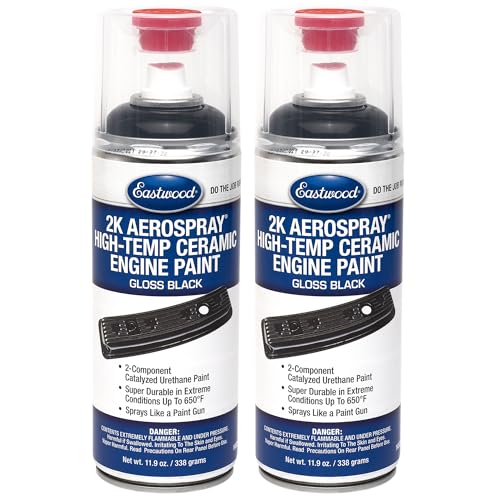
Eastwood 2K Aerospray High Temperature Ceramic Paint
What We Like
- 2-component urethane for extreme durability
- Engineered wide fan pattern for even coverage
- Heat resistant up to 650°F
- Catalyzed technology for a tough finish
Trade-offs
- Max temperature 650°F limits extreme exhaust use
- Once activated, the paint cures quickly inside the can
The 2-Component Urethane Catalyzed Technology in this aerosol means the paint and activator mix only when you spray, giving you a chemical-cured finish that holds up far better than standard single-stage engine paints. With a maximum heat resistance of 650°F, it handles block, heads, and valve covers without issue. However, it falls short of the 2000°F rating on Rust-Oleum’s High Heat line for exhaust components or turbo housings. The wide fan pattern, engineered to mimic a paint gun, lays down a smooth, even coat that reduces tiger-striping and overspray, making it a strong match for anyone restoring an engine bay who wants a professional-looking, long-lasting finish without buying a spray gun setup.
The 650°F maximum temperature means this paint is not suited for exhaust headers or parts that exceed that threshold, where a product like Rust-Oleum High Heat 5-in-1, rated to 2000°F, would be a better fit. For engine blocks, timing covers, and brackets that operate below that limit, the ceramic urethane chemistry delivers a hard, solvent-resistant layer that resists oil and grease better than most single-stage enamels. The two-pack gives you two 11.9 oz aerosols, which is enough for multiple components, though if you only need a small touch-up, you will have a second can left over.
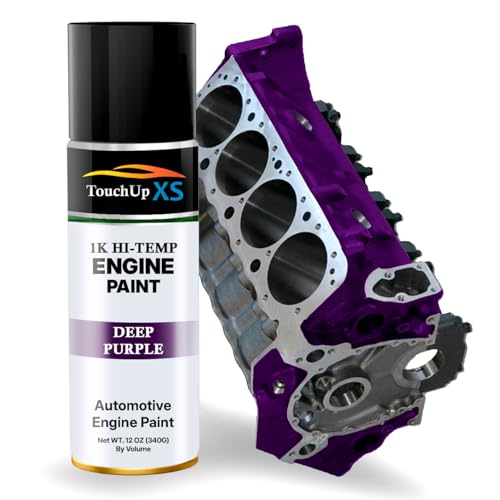
TouchupXS Engine Paint 1K Aerosol
What We Like
- Guards against rust and corrosion
- Resists oil, grease, and fluid damage
- Protects from chips and scratches
Trade-offs
- 500°F limit is lower than some 1200°F+ options
- Only one color (Deep Purple) available
This paint withstands temperatures up to 500°F, so it won’t break down on engine blocks, valve covers, or intake manifolds during normal driving. The formula resists oil, grease, and engine fluids, which means spills won’t ruin the finish. It guards components against rust, corrosion, chips, and scratches, making it a practical choice for engine parts that see heat and fluid exposure.
The 500°F limit means it won’t handle hot exhaust parts or turbo housings the way Rust-Oleum High Heat’s 2000°F rating can. For parts near extreme exhaust heat, that other product is a better fit. But for the engine components this paint targets, blocks, covers, heads, the heat ceiling is sufficient, and the Deep Purple color offers a clean look under the hood.
How We Evaluated High Temp Engine Paints
Our evaluation is research-based, drawing from manufacturer specifications, technical data sheets, and common feedback patterns from automotive restoration communities and DIY forums. We focused on the four criteria that matter most when choosing a high temp engine paint: heat resistance, chemical resistance, application method, and durability.
Heat resistance was the primary filter. We looked at each paint’s stated maximum temperature and whether that rating was for continuous or intermittent exposure. A paint rated for 1200°F continuous heat, like the Seymour Hot Spot, is fundamentally different from one rated for 2000°F intermittent heat, like the Rust-Oleum High Heat 5-in-1. Matching this to your part’s operating temperature is critical.
Chemical resistance and durability were next. Engine paint must withstand oil, gas, grease, and coolant without breaking down. We prioritized paints with ceramic or urethane technologies that resist blistering, chipping, and corrosion. Finally, we considered application ease, including spray patterns, dry times, and whether the paint can be applied from any angle. A research-led evaluation provides a clear framework for comparing what each product offers.
What To Look For In High Temp Engine Paints
The right high temp engine paint protects your work and lasts through heat cycles, fluid exposure, and road vibrations. Focus on temperature ratings, chemical resistance, and how the paint goes on.
Look for a paint whose temperature rating matches your part’s exposure: continuous for manifolds, intermittent for blocks. Prioritize ceramic or urethane formulations for chemical and chip resistance. Check dry time and spray pattern for a smooth finish.
Heat Rating: Continuous vs. Intermittent
Manufacturers list two types of heat ratings. Continuous heat ratings apply to parts that stay hot for long periods, like exhaust pipes and manifolds. Intermittent ratings apply to parts that heat up and cool down, like engine blocks and valve covers. A paint rated for 1200°F continuous heat can handle a manifold, while a 650°F intermittent paint is fine for a block. Using an intermittent paint on a continuously hot part can lead to failure.
Chemical and Fluid Resistance
Engine paint must resist oil, gasoline, grease, and coolant. Many ceramic-based paints offer good chemical resistance, while 2-component urethane paints form a tougher barrier. Check the product description for explicit mentions of oil and gas resistance. Paints that resist these fluids will hold up better against leaks and spills in the engine bay.
Application and Cure Requirements
Spray pattern, dry time, and cure time affect the final result. A paint that sprays from any angle is helpful for tight engine bays. Dry times range from 20 minutes to 30 minutes between coats. Some paints require a heat cure cycle to reach full hardness, often requiring a specific temperature for a set time. Follow the label’s cure instructions to avoid premature failure.
- Match the heat rating (continuous vs. Intermittent) to your specific part.
- Confirm the paint resists oil, gas, and grease for engine bay use.
- Check whether the paint needs a heat cure cycle to reach full hardness.
- Consider spray pattern options and any-angle capability for tight spaces.
- Allow for full cure time before exposing the part to high heat.
A paint that fits your temperature range and resists engine fluids will outlast one that only looks good on the shelf.
High Temp Engine Paints Compared
The table below compares all nine high temp engine paints side by side, highlighting their heat ratings, key features, and best-use cases.
| Product | Heat Resistance | Finish | Resistance |
|---|---|---|---|
| Rust-Oleum High Heat 5-in-1 Spray Paint | 2000°F | Flat Black | Gas & Oil Resistant |
| Rust-Oleum Engine Enamel Spray Paint | 600°F intermittent | Gloss Black | Oil, gas, grease, rust |
| Dupli-Color Engine Paint with CERAMIC | 500°F | Gloss, Red | Oil & automotive fluids |
| Seymour Hot Spot High Heat Spray Paint | 1200°F continuous | Porcelain-like bond | Peeling, blistering, discoloration |
| VHT Engine Metallic Paint | 650°F intermittent | Gold Flake | Chemical resistant |
| POR-15 High Temperature Paint | 1200°F / 648.8°C | Flat Black | Weather & Moisture Resistant |
| Eastwood Olds Gold High Temperature Ceramic Paint | 650°F | Authentic OEM Olds Gold | Oils, degreasers, fuels |
| Eastwood 2K Aerospray High Temperature Ceramic Paint | 650°F | Gloss Black | N/A |
| TouchupXS Engine Paint 1K Aerosol | 500°F (260°C) | Deep Purple | Rust, corrosion, oil, grease, engine fluids |
Frequently Asked Questions
What is the difference between continuous and intermittent heat rating?
Continuous heat rating means the paint can withstand a constant high temperature for long periods, making it suitable for exhaust manifolds and headers. Intermittent heat rating means the paint can handle repeated heating and cooling cycles, which is typical for engine blocks and valve covers. Always match the rating to how your part is used.
Can I use high temp engine paint on a brake caliper?
Yes, but you need a paint specifically rated for brake caliper temperatures, which can exceed 500°F during hard braking. Standard engine paints may not have the heat and abrasion resistance needed for calipers. Look for a paint that explicitly states it is suitable for brake components.
How do I prepare the surface before applying high temp paint?
Surface preparation is critical. Clean the part thoroughly with a degreaser to remove all oil, grease, and dirt. Sand glossy surfaces with 320-grit sandpaper to create a profile for adhesion. Wipe down with a tack cloth or solvent, then apply the paint according to the manufacturer’s instructions.
How long does high temp engine paint take to cure?
Cure times vary by product. Some paints dry to the touch in 20 to 30 minutes but require a full cure of 24 hours or a heat cycle to reach maximum hardness. For example, the POR-15 High Temperature Paint needs a 24-hour cure before exposure to high heat. Always follow the label’s specific cure instructions.
Can I paint over existing engine paint?
Yes, but only if the existing paint is fully cured, clean, and well-adhered. Lightly sand the surface with 320-grit sandpaper to improve adhesion, then clean off all dust. If the old paint is peeling or blistered, strip it completely before applying new paint for the best results.
The Bottom Line
For most engine projects, the Rust-Oleum High Heat 5-in-1 Spray Paint is the best overall choice. It handles up to 2000°F intermittent heat, resists gas and oil, and offers five spray patterns for precise application. This is the paint to reach for when you need a single can that does it all for engine blocks, valve covers, and other high-heat parts.
If your project involves continuous high heat, like an exhaust manifold or a fire pit, the Seymour Hot Spot High Heat Spray Paint is a better fit. It offers a 1200°F continuous rating and a durable porcelain-like bond. For restorers seeking an authentic metallic finish on drivetrain parts, the VHT Engine Metallic Paint delivers chemical resistance and a gold flake look.
The single most important factor in choosing high temp engine paint is matching the heat rating to the part you are painting. Get that right, and you will have a finish that lasts through seasons of driving and working.
