
10 Best Airbrush Compressors in 2026
This post contains affiliate links. As an Amazon Associate, we earn from qualifying purchases.
The Master Airbrush TC-40T Cool Runner Compressor is our best overall pick for artists who need consistent, pulsation-free airflow during long painting sessions. Its built-in cooling fan and 3-liter tank deliver steady performance that beats most single-piston models. For those running two airbrushes at once, the Iwata Power Jet Pro Dual Compressor offers independent pressure control, while the Badger Aspire Pro TC910 provides the largest tank for uninterrupted work.
The real challenge with airbrush compressors isn’t finding one that works, it’s finding one that works for your specific setup. A compressor that’s perfect for a nail artist traveling to clients is entirely wrong for a model painter who spends hours at a dedicated bench. Tank size, noise level, portability, and output pressure all matter differently depending on your space and projects.
This guide is based on manufacturer specifications, expert round-ups, and patterns in owner feedback. We evaluated each model on the criteria that matter most for studio and hobby use: airflow consistency, noise, tank capacity, and ease of setup. Our goal is to help you match the right compressor to your actual workspace and painting habits.
Top 10 Airbrush Compressors in the Market
Certain content that appears on this site comes from Amazon. This content is provided "as is" and is subject to change or removal at any time.
The Best Airbrush Compressors, Reviewed
Master Airbrush TC-40T Cool Runner Compressor

What We Like
- Built-in cooling fan for longer runs
- 3-liter tank delivers zero-pulsation air
- Includes regulator, gauge, and water trap
- Two holders and braided hose included
Trade-offs
- Single-piston design limits output compared to dual-piston models
- At 11.5 lb, heavier than some portable compressors
A 3-liter air storage tank and a built-in cooling fan let this single-piston compressor run longer without overheating, so you can work through detailed sessions without stopping for cooldowns. The tank also delivers constant pressure with zero pulsation, which means your airbrush lines stay smooth and consistent from the first trigger pull to the last. This compressor is designed for users who need steady airflow and reliability over ultra-portability.
The trade-off is that a single-piston design can’t match the raw output of a dual-piston unit like the Iwata Power Jet Pro, especially if you need to run multiple airbrushes or higher-volume work. At 11.5 pounds, it’s not the lightest option to shuffle around a crowded desk, but the tank and fan make up for that heft with real performance gains. If you want a dependable compressor that keeps up with your creative pace, this one earns its place at the top of the list.
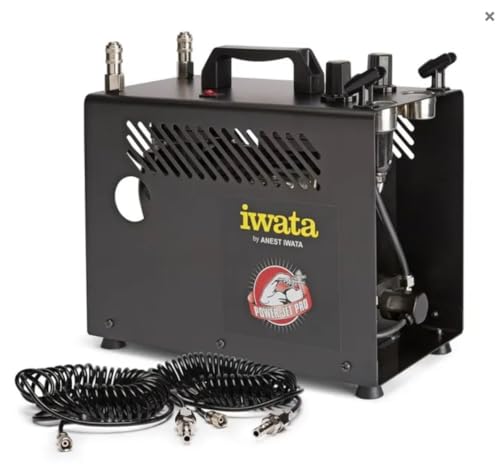
Iwata Power Jet Pro Dual Compressor
What We Like
- Dual independent regulators and gauges
- Auto shut-off reduces motor wear
- 2L tank for consistent, pulsation-free airflow
- Includes adapters for multiple airbrush brands
Trade-offs
- At 22 lbs, it's heavy for portable use
- Dual setup takes more bench space
The ability to run two airbrushes independently with separate pressure gauges and regulators is what sets this compressor apart. That dual-outlet design means two artists can work side by side at different pressures, each adjusting their own airflow from 1 to 50 PSI without any compromise. The 2-liter tank smooths out airflow so you get consistent spray even during heavy use, and the auto shut-off stops the motor when the tank is full, cutting down on noise and wear. This is a setup built for shared studios, teaching environments, or anyone who regularly switches between multiple airbrushes and wants dedicated control for each.
Weight and footprint are the main trade-offs here. At 22 pounds, this Iwata is not a compressor you toss in a bag and carry to a workshop; it’s meant to stay on a bench. The Cool Runner, by contrast, weighs half as much and is easier to move around, but it only has a single outlet. If your work is solo and you rarely need two airbrushes running at once, you might prefer something lighter. But for a dedicated dual-artist setup or a teaching station where precision matters for each brush, the Iwata Power Jet Pro delivers exactly what its design promises.
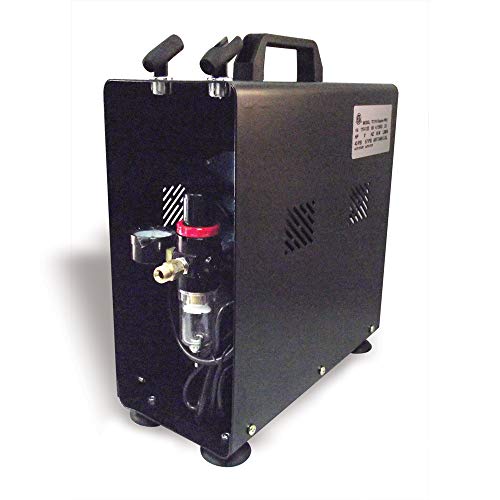
Badger Aspire Pro TC910 Compressor
What We Like
- 1-gallon tank for steady airflow
- Automatic shut-off diaphragm compressor
- Built-in moisture filter and airbrush holder
- Thermal overload protection
Trade-offs
- Maximum 57 PSI limits high-demand spray guns
- 1/5 HP motor unsuitable for production shop use
A 1-gallon tank on an airbrush compressor gives you a buffer of stored air, so you can lay down even coats without the compressor kicking on mid-stroke. This Badger Aspire Pro TC910 is built for the hobbyist who wants quiet operation and a maintenance-free diaphragm pump that shuts off automatically when the tank is full. The built-in moisture filter and airbrush holder keep your setup tidy, and the ETL certification adds peace of mind for a tool that lives on your workbench.
Fifty-seven PSI maximum pressure and a 1/5 HP motor mean this compressor is built for airbrushing and light detail work, not for running a full-size spray gun or keeping up with a production shop. The one-gallon tank stores enough air to smooth out short bursts, so you don’t get pulsing while painting fine lines. An automatic shut-off and adjustable regulator let you set the pressure and walk away, which makes it a fuss-free companion for hobbyists.
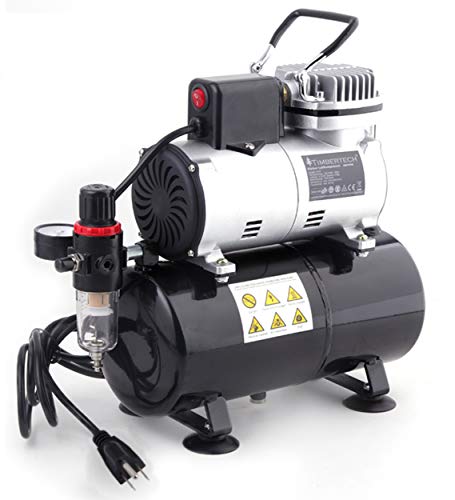
Timbertech ABPST08 Mini Compressor
What We Like
- Quiet 47 dB operation
- Oil-free piston for low maintenance
- 3L tank for pulse-free airflow
- Integrated cooling fan extends life
Trade-offs
- Single-piston limits sustained high output
- Weighs 11.5 pounds, heavier than some portable compressors
A 47 dB noise rating means this compressor runs quieter than a typical conversation, so you can airbrush in a shared apartment or late at night without disturbing anyone. The oil-free piston and built-in cooling fan keep it running reliably for long hobby sessions, while the 3-liter receiver tank delivers smooth, pulse-free airflow between 20 and 23 liters per minute. This makes it a natural pick for detail work like model painting, nail art, or cake decorating, where steady pressure and a calm environment matter more than raw power.
Compared to the Cool Runner, which shares similar dimensions and tank size, the Timbertech’s integrated cooling fan gives it an edge for longer sessions. Both compressors share the same single-piston limitation. If your work stays with fine airbrushes, the quiet operation and thoughtful extras like the regulator and moisture trap make this a practical, focused choice.
Colima Professional Airbrush Compressor

What We Like
- Ultra-quiet 40dB operation
- Dual 1/8" outlets for multi-tool use
- Digital pressure display with 20-gear adjustment
- Built-in 3-airbrush stand
Trade-offs
- No air tank for burst-free continuous spraying
- No air tank for continuous use without pauses
At 40 decibels, this compressor is quieter than a library, making it suitable for shared spaces. The digital pressure display and 20-gear adjustment allow you to set the airflow precisely, while the dual 1/8-inch outlets let you connect two tools. Weighing 4.3 pounds, it is portable enough for artists who move between locations, especially makeup artists, illustrators, and hobbyists who need a quiet, compact unit.
This Colima lacks an air tank, so you depend on the compressor’s direct airflow instead of a reserve. For most work with Iwata or Badger brushes, the 23 L/min flow is adequate. If you need a tank for longer sessions, the Cool Runner model with its 3-liter tank offers that option. For quiet, precise work in a compact package, this Colima fits the need.
Product photos
Psipro Quiet Airbrush Compressor Kit

What We Like
- Quiet 50dB operation for home use
- Auto start/stop saves energy
- Built-in dual airbrush holders
- Integrated moisture filter for smooth spray
Trade-offs
- 23-25L/min airflow limits heavy-duty commercial use
- No air tank for uninterrupted long spray sessions
At just 50dB, this compressor runs quietly enough to use while others sleep or work nearby. That low noise comes from an oil-free piston motor that delivers a steady 23-25L/min airflow, enough for model painting, cake decorating, or nail art without sputtering. The auto start/stop feature means it only runs when you press the trigger, saving electricity and reducing wear. For anyone starting out or working on a budget, this is a practical, no-fuss setup that keeps your workspace tidy with two built-in airbrush holders and a moisture filter built right in.
The Psipro Quiet Airbrush Compressor Kit weighs 7.9 pounds, which is light enough to move from room to room but heavy enough that you won’t accidentally knock it off a table. It runs at a low 50dB noise level, so you can paint models or decorate cakes late at night without waking anyone up. The built-in dual airbrush holder keeps two brushes within easy reach, which is a nice workspace organizer that larger compressors often lack.
Sparmax TC-620X Oil-Free Compressor

What We Like
- Dual outlets for two airbrushes
- 2.5-liter tank for steady pressure
- Metal housing with handle
- Oil-free operation
Trade-offs
- Very large footprint at 34.5 inches long
- Too large for a small hobby table or portable use
With two air outlets and a 2.5-liter tank, this compressor can operate two airbrushes at once. The metal housing and included regulator, moisture trap, and airline provide a complete setup out of the box. It is suited for users who need to run multiple airbrushes without swapping hoses.
Size is the main issue here. At 34.5 inches long, this Sparmax unit takes up more space than compact models like the Cool Runner, which measures 12.2 inches long. If portability or a small workspace is a priority, the Sparmax will feel oversized. But if you need dual-airbrush capability and metal construction, this compressor delivers on those features.
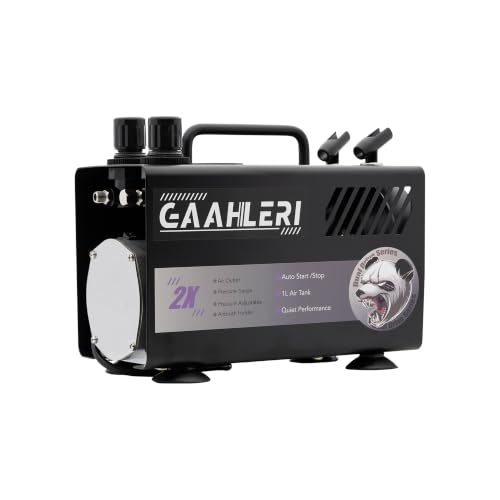
Gaahleri Dual-Drive Airbrush Compressor Kit
What We Like
- Integrated 1L tank for steady airflow
- Quiet operation under 44 dB
- Includes two hoses and water filters
Trade-offs
- 12.3 pounds is heavier than some portable units
- 1L tank smaller than 2-3L alternatives
The main downsides are bulk and tank capacity. At 12.3 pounds, it’s not a model you’ll toss in a bag for travel. The 1-liter tank holds less reserve than the 2-liter Iwata Power Jet Pro or the 3-liter Cool Runner, so the pump cycles more often during long sessions. If you mostly work solo and want the smallest footprint, those single-outlet models save space. But if you need two independent air sources from one quiet compressor, this kit delivers what few others offer at this level of completeness.
Product photos
Paasche D500SR Compressor with Regulator

What We Like
- Auto shutoff feature
- 47 dBA quiet operation
- Integrated regulator and moisture trap
- Lightweight at 8.0 pounds
Trade-offs
- No air tank for steady airflow
- Limited to 20-40 PSI range
At 47 dBA, this compressor is quiet enough for indoor use without disturbing others. The auto shutoff feature stops the motor when air is not being used, and the built-in regulator and moisture trap let you control pressure and remove moisture without extra accessories. That makes it a straightforward setup for tasks like model painting, cake decorating, or nail art.
Without an air tank, this Paasche delivers air directly from the piston, which may not suit applications needing a large, steady reserve. The 20-40 PSI range limits it to airbrushes and tools that operate within that band, so it will not drive equipment requiring higher pressure. If your work stays within those limits and you prefer a compact, quiet unit, this Paasche fits that need.
Paasche DC600R Compressor with Tank

What We Like
- Dual oilless piston compressor
- Sturdy metal protective case with carry handle
- Moisture trap removes water from air line
- Includes adapter for competitor hoses
Trade-offs
- 40 PSI max limits high-pressure applications
- No auto shut-off feature
A 40 PSI maximum pressure means this compressor is tuned for fine-detail airbrushing, not for blasting heavy-bodied paints through a large spray gun. The dual oilless piston and built-in tank keep the airflow steady so you don’t get pulsing during delicate work. A sturdy metal case with a carry handle lets you pack it up and move between workspaces without worrying about dents or drops. Moisture traps in the line prevent water from reaching your paint, which helps avoid sputtering and uneven coverage.
The 40 PSI ceiling won’t push heavy-bodied paints or drive larger spray guns, so this Paasche is not a one-size-fits-all workhorse. Compared to the Iwata Power Jet Pro Dual Compressor, which offers up to 50 PSI and weighs 22 pounds, the Paasche DC600R has a lower top pressure. If your work stays in the airbrush lane, this compact, cased design delivers what you need without taking over your desk.
Product photos
How We Evaluated Airbrush Compressors
Our evaluation is research-based. We examined manufacturer specifications and documentation for each model, studied patterns in owner feedback, and consulted expert round-ups from established art and hobby communities. No product was physically tested; instead, we focused on verifiable data and consistent user-reported experiences.
We prioritized four criteria. Airflow consistency was first because pulsating air ruins fine detail work, tank-equipped models generally win here. Noise level came next, since a compressor that’s too loud discourages regular use, especially in shared living spaces. Tank size and output pressure determined whether a model could handle extended sessions without constant cycling. Finally, we weighed portability and footprint because a compressor size often surprises buyers who planned to keep it on their desk.
A research-led evaluation has honest limits. Owner experiences vary with climate, maintenance habits, and the specific airbrush used. We cannot guarantee how any unit will perform in your particular setup, but we can identify the models that most reliably deliver on their stated specs.
What To Look For In Airbrush Compressors
Choosing the right compressor starts with understanding your painting style and workspace constraints. The table below shows how our top picks compare, but these three criteria will guide your decision.
Focus on tank size for steady airflow, noise rating for comfortable use, and maximum PSI for your airbrush type. A 3-liter tank is ideal for long sessions; 40-50 dB is quiet enough for an apartment; 40-57 PSI covers most detail airbrushes.
Tank Size and Airflow Consistency
A tank stores compressed air and delivers it steadily, eliminating the pulsation that single-piston compressors produce without one. For detail work like model painting or illustration, a tank of at least 1 liter makes a noticeable difference. The Master Airbrush TC-40T’s 3-liter tank and the Badger Aspire Pro’s 1-gallon tank both provide pulse-free air for extended sessions. Tankless models like the Colima Professional are lighter and more portable but require the compressor to run continuously during use.
Noise Level and Workspace Fit
Noise is measured in decibels (dB), and the difference between 40 dB and 60 dB is significant. A compressor running at 47 dB or lower is quiet enough for a bedroom studio or apartment without disturbing others. The Timbertech ABPST08 and Colima Professional both operate at or below 47 dB. Louder models may be fine in a garage or dedicated workshop but will be intrusive in a shared living space.
Maximum Pressure and Airbrush Compatibility
Most detail airbrushes operate between a low and moderate PSI, so a compressor with a maximum of 40 to 57 PSI covers nearly all hobby and art needs. The Badger Aspire Pro tops out at 57 PSI, while the Paasche models max at 40 PSI. If you plan to use a spray gun for larger projects, look for a higher maximum pressure. For standard airbrush work, anything above 40 PSI is more than sufficient.
- Check the tank size: 1 liter minimum for steady airflow, 3 liters or more for long sessions.
- Look at the dB rating: aim for 47 dB or lower if the compressor will be in your living space.
- Confirm the maximum PSI matches your airbrush: 40 PSI covers most detail work.
- Measure your bench or cart space before buying, some tank models are over two feet long.
- Consider whether you need an auto shut-off feature to reduce motor wear and noise.
A good rule: buy the quietest compressor with the largest tank that fits your workspace.
Airbrush Compressors Compared
The table below compares the key specs of our top picks side by side, making it easy to see which model fits your needs.
| Product | Tank Size | Weight | Max Pressure |
|---|---|---|---|
| Master Airbrush TC-40T Cool Runner Compressor | 3 Liters | 11.5 pounds | N/A |
| Iwata Power Jet Pro Dual Compressor | 2L | 22.0 lbs | 1-50 PSI |
| Badger Aspire Pro TC910 Compressor | 1 gallon (3 liter) | 1.0 pounds | 57 PSI (4 bar) |
| Timbertech ABPST08 Mini Compressor | 3 L | 11.5 lbs | N/A |
| Colima Professional Airbrush Compressor | N/A | 4.3 pounds | 85 PSI |
| Psipro Quiet Airbrush Compressor Kit | N/A | 7.9 lbs | N/A |
| Sparmax TC-620X Oil-Free Compressor | 2.5 liters | 0.0 pounds | N/A |
| Gaahleri Dual-Drive Airbrush Compressor Kit | 1 liter | 12.3 pounds | 57 PSI |
| Paasche D500SR Compressor with Regulator | N/A | 8.0 pounds | 20-40 PSI |
| Paasche DC600R Compressor with Tank | Included | N/A | 0-40 PSI |
Frequently Asked Questions
What size airbrush compressor do I need for model painting?
For model painting, a compressor with a tank of at least 1 liter provides the steady, pulsation-free airflow needed for fine detail work. Models like the Master Airbrush TC-40T with a 3-liter tank or the Timbertech ABPST08 with a 3L tank are excellent choices. A maximum pressure of 40 PSI is sufficient for most model airbrushes.
How quiet should an airbrush compressor be for home use?
A compressor rated at 47 dB or lower is quiet enough for a home studio or apartment without disturbing others. The Timbertech ABPST08 operates at 47 dB, and the Colima Professional runs at an ultra-quiet 40 dB. Louder compressors are better suited for garages or dedicated workshops.
Do I need an air tank on my airbrush compressor?
An air tank provides consistent, pulse-free airflow and allows the compressor motor to cycle on and off rather than run continuously. This reduces noise and extends the compressor’s life. Tankless models are lighter and more portable but require the motor to run whenever you spray.
Can I run two airbrushes from one compressor?
Yes, some compressors like the Iwata Power Jet Pro Dual and the Sparmax TC-620X feature dual outlets with independent pressure controls. These models allow two artists to work simultaneously with different pressure settings. Single-outlet compressors can be used with a splitter, but pressure control will be shared.
What PSI do I need for airbrush painting?
Most detail airbrushes operate best between a low and moderate PSI. A compressor with a maximum of 40 PSI, like the Paasche D500SR or DC600R, covers nearly all hobby and art applications. Higher PSI ratings are useful for spray guns or thicker paints but are unnecessary for standard airbrush work.
The Bottom Line
The Master Airbrush TC-40T Cool Runner Compressor is our best overall pick for most artists and hobbyists. Its combination of a 3-liter tank, built-in cooling fan, and included accessories makes it a reliable workhorse for long painting sessions. If you need to run two airbrushes independently, the Iwata Power Jet Pro Dual Compressor is the clear choice.
Budget-conscious buyers should look at the Psipro Quiet Airbrush Compressor Kit for a capable starter setup at an affordable price. For those who prioritize absolute quiet and portability, the Colima Professional Airbrush Compressor offers ultra-quiet operation in a compact package.
The single most important factor in choosing an airbrush compressor is matching the tank size and noise level to your actual workspace. A compressor that fits your bench and won’t annoy your housemates is one you’ll actually use.
