
Scaffolding Safety for Exterior Painting: The Load Rules
This post contains affiliate links. As an Amazon Associate, we earn from qualifying purchases.
Scaffolding safety for exterior painting starts with the load math: every scaffold and component must hold its own weight plus 4 times the maximum intended load, and fall protection kicks in at 10 ft (3.1 m). The duty rating sets the rest, at 25 psf for light work, 50 for medium, and 75 for heavy per OSHA’s scaffold selection fact sheet, while Cal/OSHA 1640(c)(1) routes light-duty interior scaffolds to 1,500 lb per ledger or upright and 15 psf average.
Four times the maximum intended load sounds generous until you count what actually lands on the planks: two painters, a bucket, a ladder, and the next can waiting its turn. That multiplier is a design floor for scaffolding safety for exterior painting, and it covers the shock of a dropped bucket plus the sideways push of a mesh wrap catching wind.
What follows walks the load factors, the duty table, the two places where the standards genuinely disagree, and the base-and-guardrail details that decide whether a tower stands or tips.
Key Takeaways
- 4x is a design floor, not a comfort margin. It assumes a qualified person made a realistic assessment of what gets loaded on at every stage.
- Duty rating caps what you can stack. OSHA FS-3760 and Cal/OSHA 1637 set light duty at 25 psf, while Cal/OSHA 1640(c)(1) routes light-duty interior scaffolds to 1,500 lb per ledger or upright and 15 psf average.
- The tie-in trigger depends on the scaffold class. OSHA 3150 requires guying or tie-in for supported scaffolds with a height-to-base ratio greater than 4:1, while the Northern Tool manual requires rolling/free-standing tower platform height not to exceed three times the smallest base dimension, above which it must be guyed or tied.
- Guardrail height requirements shift between the tower manual and Cal/OSHA. The Northern Tool manual sets the top rail at 40–44 in. Above the work surface, while Cal/OSHA §1640 sets the top rail top edge between 42 and 45 in. Above the platform.
- Training is a legal condition of use. Only trained and authorized persons belong on a scaffold.
What Does the 4x Load Rule Actually Cover?
The multiplier covers the whole assembly, not just the planks. Each scaffold and each component must support its own weight plus four times the maximum intended load without failure.
Suspension scaffolds carry separate multipliers. Non-adjustable suspension ropes must support six times the maximum intended load. Adjustable ropes must support six times the rated hoist load or twice the stall load, whichever is greater, and hoist stall load cannot exceed three times the rated load. Federal capacity rules set all four figures.
Those figures come from the OSHA 1926.451 scaffold general requirements, and they exist because scaffolds fail from loads nobody planned for. A dropped bucket lands as a shock load well above its resting weight. A tower wrapped in mesh catches wind like a sail, and OSHA’s planning guidance says to design for that wind load.
Here’s the multiplier stack in one place:
- 4x the maximum intended load, the baseline for every scaffold and component, own weight included.
- 6x, non-adjustable suspension ropes.
- 6x rated hoist load, or 2x stall load, adjustable suspension ropes, whichever figure is higher.
- 3x, the ceiling on hoist stall load.
A 4x factor only works if the design reflects reality. OSHA’s scaffold selection guidance is blunt about this: the design has to incorporate a realistic assessment of maximum intended loads at all stages of erection and loading, not just the finished state.
25, 50, or 75 psf: The Duty Rating Decides What You Can Stack
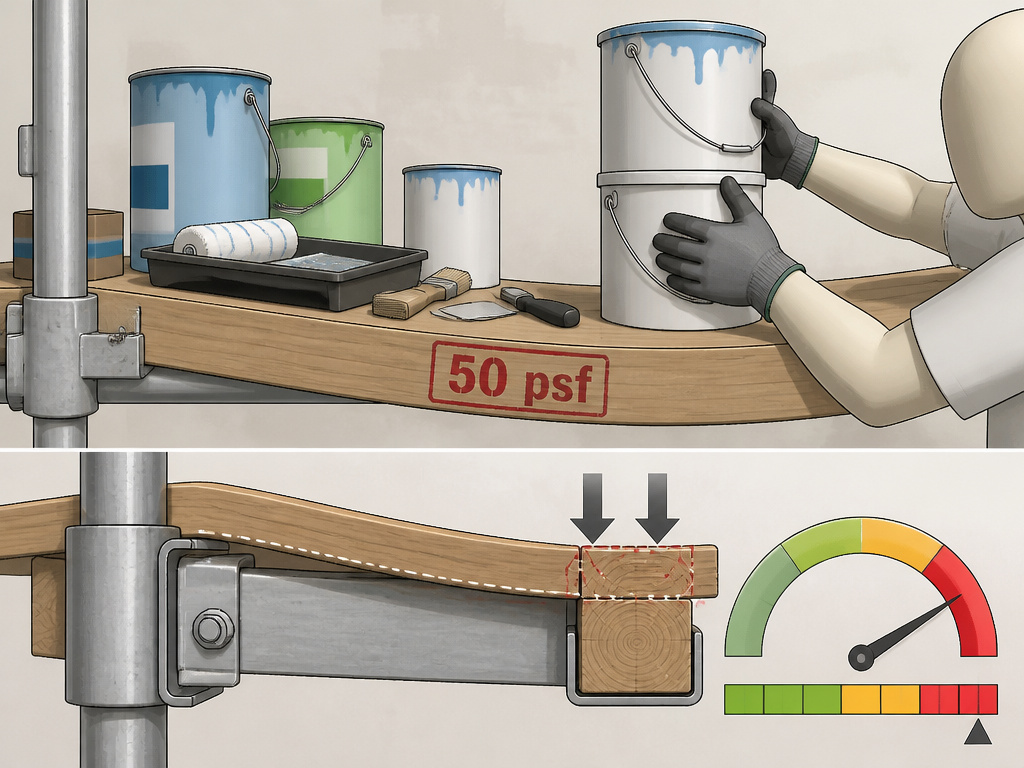
Three numbers cover almost every painting scaffold you’ll rent or buy. Light duty is 25 psf, medium duty is 50 psf, and heavy duty is 75 psf, per OSHA’s scaffold selection fact sheet, while Cal/OSHA 1640(c)(1) routes light-duty interior scaffolds to 1,500 lb per ledger or upright and 15 psf average.
| Duty rating | Load rating | What it covers |
|---|---|---|
| Light duty | 25 psf | A limited number of workers and hand tools |
| Medium duty | 50 psf | Workers, hand tools, and materials being installed |
| Heavy duty | 75 psf | Workers, tools, and stored materials |
| Special duty | Above 75 psf | Engineer-determined (California only) |
Pounds per square foot is a density, not a total when you compare a scaffolding safety for exterior painting. A small platform at 25 psf holds less total weight than a large platform at the same rating. A scaffold rating works like a stockpot’s fill line: it tells you what fits, not what you can cram in.
California adds a fourth tier. The Cal/OSHA scaffold general requirements list special-duty scaffolds above 75 psf, rated by an engineer, and set light, medium, and heavy at the same three figures as the federal fact sheet, though Cal/OSHA 1640(c)(1) routes light-duty interior scaffolds to 1,500 lb per ledger or upright and 15 psf average.
Then it gets untidy. Cal/OSHA 1640(c)(1) routes light-duty interior scaffolds to a different loading basis entirely: no more than 1,500 lb on any single ledger or upright, and no more than 15 psf averaged across the whole platform, while federal 1926.451 sets no psf table at all and defers to design by a qualified person plus the worked examples in the subpart appendix.
Where this goes sideways: Reading the duty rating as a per-person limit. It’s an average across the platform, so piling materials at one end can overload a single ledger while the platform average still looks legal. The plank sags first, then the ledger splits.
Two Tie-In Rules Are in Circulation, and They Don’t Agree
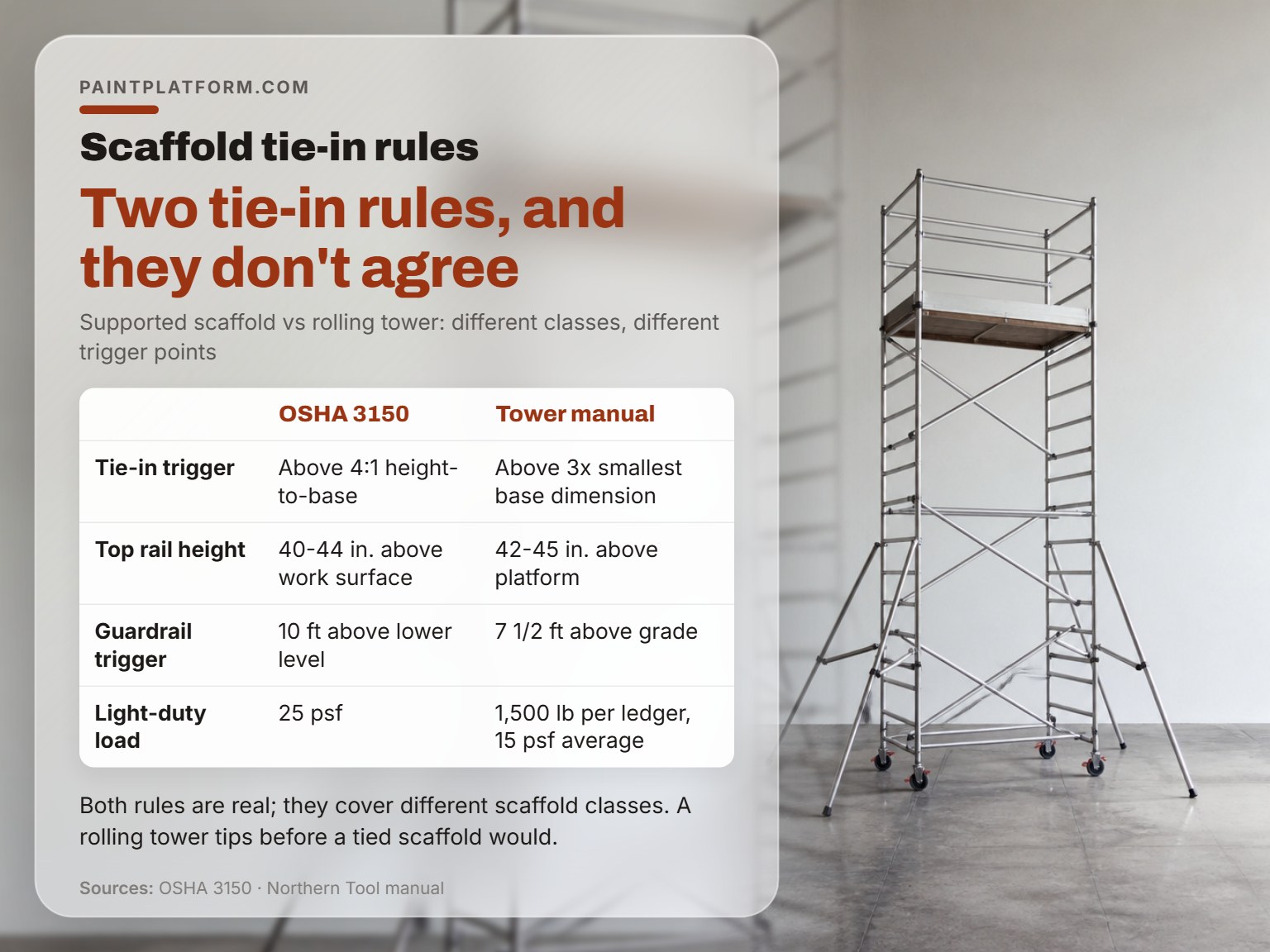
Supported scaffolds with a height-to-base ratio greater than 4:1 require guying or tie-in, according to the OSHA guide to scaffold use. The assembly manual for a rolling access tower states a tighter rule: platform height must not exceed three times the smallest base dimension.
| Question | One position | The other position |
|---|---|---|
| Tie-in trigger | Above 4:1 height-to-base (OSHA 3150) | Above 3x smallest base dimension (tower manual) |
| Top rail height | 40-44 in. Above work surface (tower manual) | 42-45 in. Above platform (Cal/OSHA 1640) |
| Guardrail trigger | 10 ft above lower level (federal) | 7 1/2 ft above grade (Cal/OSHA 1640) |
| Light-duty load | 25 psf (Cal/OSHA 1637) | 1,500 lb per ledger, 15 psf average (interiors) |
Both rules are real, and they cover different scaffold classes. A rolling tower is free-standing and mobile, so it tips long before a tied supported scaffold would. Apply the 4:1 figure to a rolling tower and you under-brace it.
The practical read: OSHA 3150 requires guying or tie-in for supported scaffolds with a height-to-base ratio greater than 4:1, while the Northern Tool manual requires rolling/free-standing tower platform height not to exceed three times the smallest base dimension, above which it must be guyed or tied. And if you’re stacking two lifts on a rolling tower, tie it off regardless of the ratio.
Setting Up on Grass, Gravel, or a Slope
The ground looks flat until the outrigger sinks. On grass, gravel, or a driveway with a crown, the base is the part of the job that decides everything above it.
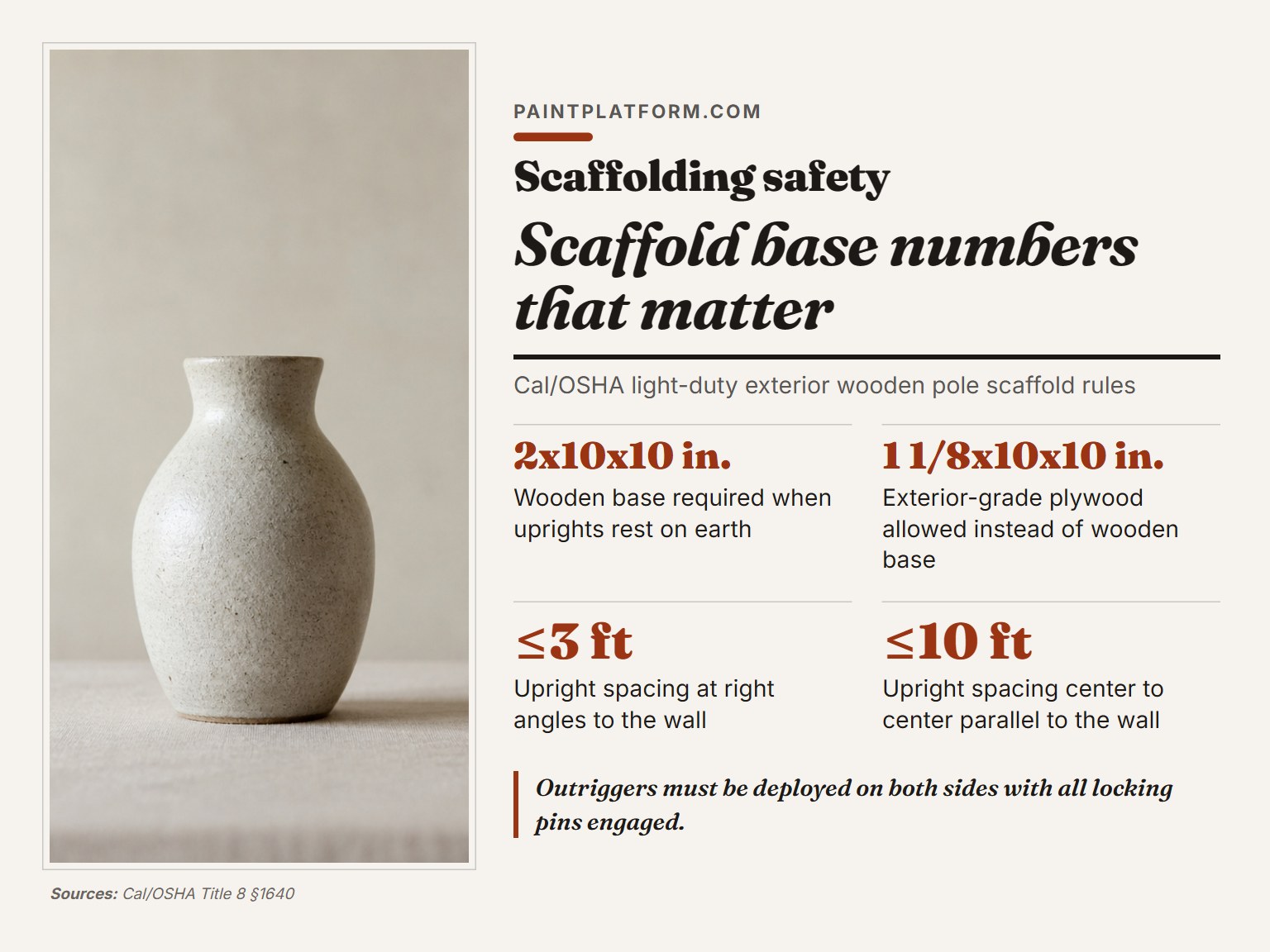
Before you start: Outriggers must be deployed on both sides with every locking pin engaged. Any cantilever side bracket needs its locking pins in place, because bracket leverage can lift a frame apart. Stay at least 10 ft from energized power lines, and probe the ground for soft spots before the first frame goes up.
Time on the platform is set by the wall, not the scaffold. Good surface preparation means one pass instead of three, and fewer hours standing on a plank.
Here’s the order that works:
- Probe and clear the ground. Skipping this is how a tower leans by the second lift, and you won’t notice until the planks feel wrong underfoot.
- Set a base that meets the Cal/OSHA equivalent: a 2 in. By 10 in. By 10 in. Wooden base or a 1 1/8 in. By 10 in. By 10 in. Piece of exterior-grade plywood. When uprights rest on earth, Cal/OSHA requires the equivalent of a 2 in. By 10 in. By 10 in. Wooden base, or a 1 1/8 in. By 10 in. By 10 in. Piece of exterior-grade plywood. Skip it and the upright punches into soft ground under load.
- Deploy outriggers on both sides. One side down and one side up turns a stable tower into a lever.
- Square the frame before you pin it. A pin that needs force means the frame is racked, and a forced pin ovalises the hole until it walks out under load.
- Plank it, then tie it. Never move a platform up to the next level before the new ledgers are set and ready to receive the planks.
A locking pin seats with one clean click. If you’re hammering it, stop and check the frame.
What Counts as a Solid Base
Cal/OSHA’s light-duty exterior rules spell out the base in detail. Uprights resting on a surface that might cause slipping need a continuous sill or another means of holding them in place. On earth, the base plate requirement above applies.
The numbers around the frame matter too. For light-duty exterior scaffolds up to 20 ft, uprights must be 2 in. By 4 in. Lumber or heavier, spaced no more than 3 ft apart at right angles to the wall and no more than 10 ft center to center parallel to it.
Outriggers, Sills, and the Slipping Problem
An out-of-plumb tower shows it at the wall. The gap between the top rail and the siding widens as you go up, and that widening gap is the visual tell that the base has moved.
Outriggers only work when they’re down and pinned. A tower rolled into position with the outriggers folded up is a tip-over waiting for the first sideways push, which on a painting job arrives the moment somebody leans out to cut in an edge.
How High Does the Guardrail Have to Be, and Who Decides?
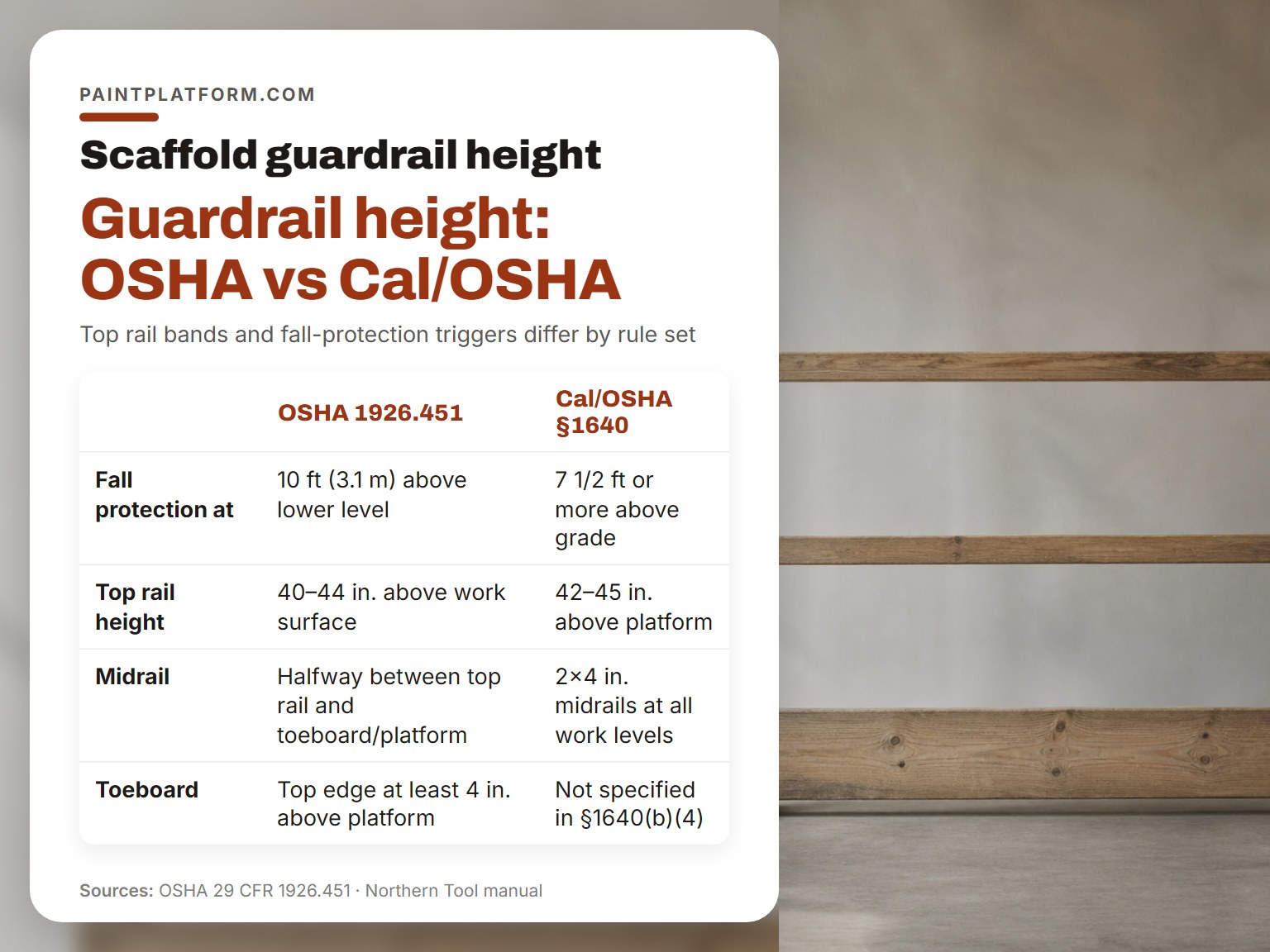
Guardrail triggers differ by source: OSHA 1926.451 requires fall protection at 10 ft (3.1 m) above a lower level, while Cal/OSHA §1640 requires open sides and ends of intermediate working levels 7 1/2 ft or more above grade to be guarded with a top rail and midrail.
The parts break down like this:
- Top rail, 40-44 in. Above the work surface per the Northern Tool manual; 42-45 in. Above the platform under Cal/OSHA §1640.
- Midrail, placed halfway between the top rail and the toeboard or platform.
- Toeboard, top edge at least 4 in. Above the platform.
- Uppermost platform. Cal/OSHA calls for a double 2 in. By 4 in. Top rail there, though a single 2×4 with an allowable bending stress of at least 1,900 psi is permitted.
Build to the tighter number when you’re unsure which rule set applies. A top rail at 43 in. Sits inside both bands, and a guardrail two inches out of spec is the kind of thing an inspector finds in the first minute.
The Open Area Under the Backrail
Cal/OSHA caps the open area under the backrailing at 8 in. Wide, and requires the working platform to cover the entire space between uprights apart from that gap. Platforms must be at least 20 in. Wide and within 14 in. Of the structure wall.
Stacked materials are the other trap. When loose materials on the platform exceed toeboard height, the toeboard has to be raised or mesh panels added. On a painting job that means paint cans, rollers, and drop cloths, which pile up faster than anyone plans for.
Narrow Frame Scaffolds and the Tip-Over Problem
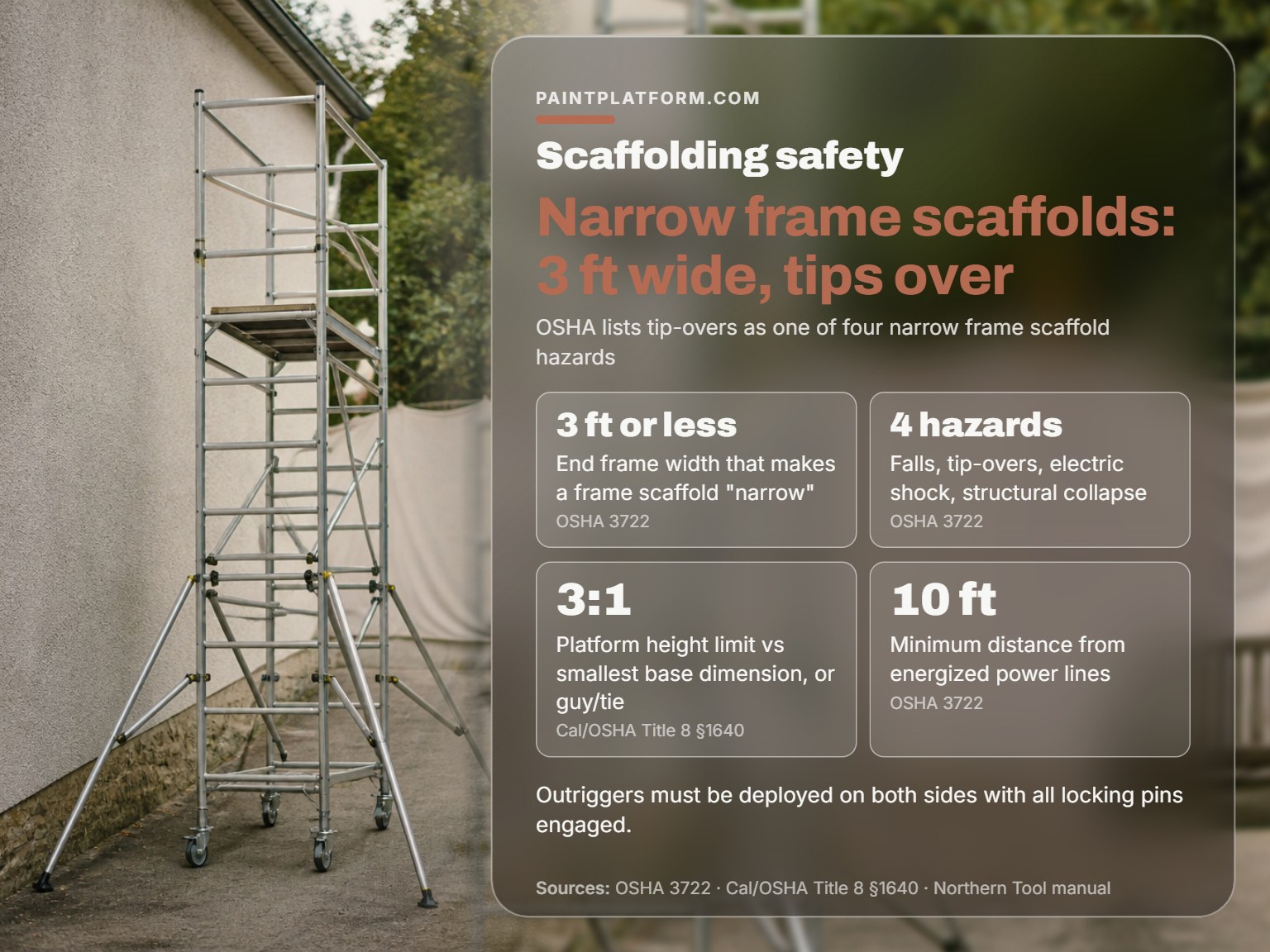
A narrow frame scaffold has an end frame 3 ft wide or less. OSHA’s fact sheet on the type lists tip-overs as one of four hazards, alongside falls from an elevated level, electric shock, and structural collapse.
These are the frames you see on painting jobs because they’re built to be moved constantly. OSHA notes they suit painting, drywall, and plastering, and that they can be adapted to stairs, ramps, and other uneven surfaces.
Adapting to uneven ground changes the base requirements. A frame levelled on a slope needs sill and outrigger treatment that a flat driveway doesn’t, and the 3:1 height rule gets tighter in practice because the effective base is smaller.
I’d take a scaffold over a ladder for exterior trim every time. OSHA’s own fact sheet notes a scaffold can be the safer choice where you change position often, which is exactly what cutting in trim is. The catch is that a narrow frame tips sideways, so the outriggers aren’t optional equipment.
The scaffold vs ladder call lands on scaffold for most exterior painting, because you’re repositioning every few feet. If you stay on a ladder for the low sections, the same 10 ft power-line clearance applies, along with the rest of the ladder safety basics.
Suspended Staging for Tall Exterior Walls
Suspended staging hangs from overhead rigging rather than rising from the ground. California regulates the painters’ version separately from frame scaffolds, and the safety line specs are specific.
The painters’ suspended staging requirements call for safety lines of at least 5/8 in. Manila or 3/4 in. Sisal rope, with a figure-8 knot every 6 ft. Each line must reach at least 6 ft below the lowest position at which the staging can be used, and each employee gets one.
Cal/OSHA also caps painters’ suspended staging width at 20 in., narrower than a frame scaffold platform. That width limit is why staging suits long, flat wall runs and struggles with anything that needs reach.
Tall exterior painting is where staging earns its keep over a tower, because you’re not rebuilding the base at every lift. The trade is that everything now hangs from anchors you can’t inspect from the platform.
The part nobody mentions: The safety line has to hang from above and be securely tied, and it has to reach at least 6 ft below the lowest working position. A line cut to platform height is the wrong length, and nobody finds out until it matters.
Training, Ties, and the Design Sign-Off
Three things have to happen before anyone steps onto a platform: a hazard assessment, a design by a qualified person, and training delivered in language the worker understands.
What the Training Has to Cover
OSHA’s narrow frame fact sheet lists the required ground, and it’s broader than most people assume:
- How to use the scaffold and determine maximum load limits when handling materials.
- Recognizing and avoiding electric shock, falls from height, and struck-by hazards.
- Erecting, inspecting, moving, operating, maintaining, and repairing the scaffold.
Only trained and authorized persons should use a scaffold, and the training has to come from a qualified person who recognizes the hazards of that scaffold type and understands the control procedures.
Ties are the other half. Cal/OSHA requires ties to the structure at no more than 20 ft apart horizontally and vertically, using double-looped No. 12 iron wire, single-looped No. 10 iron wire, or 1 in. By 4 in. Boards with at least two nails at each connection. Ledgers attached to the permanent structure must be as secure as if nailed to an upright with five 8-penny nails.
The eCFR scaffold specifications appendix gives allowable plank spans for 2 in. By 10 in. Nominal lumber, which is where you check a plank before you trust it. Tube and coupler scaffolds over 125 ft (38 m) must be designed by a registered professional engineer.
For the assembly sequence itself, the scaffolding setup walkthrough covers the order from base to planks. Get that order wrong and the tie-in you just built has nothing solid to pull against.
Frequently Asked Questions
How much weight can a painting scaffold hold?
It depends on the duty rating, not the size. OSHA’s scaffold selection fact sheet sets light duty at 25 psf, medium at 50 psf, and heavy at 75 psf, while Cal/OSHA 1640(c)(1) routes light-duty interior scaffolds to 1,500 lb per ledger or upright and 15 psf average. Separately, every scaffold must support its own weight plus four times the maximum intended load without failure.
Do I need fall protection on a 10-foot scaffold?
Federal rules require fall protection at 10 ft (3.1 m) above a lower level. If you’re working in California, Cal/OSHA requires open sides and ends of intermediate working levels 7 1/2 ft or more above grade to be guarded with a top rail and midrail.
Is a scaffold safer than a ladder for exterior painting?
OSHA’s narrow frame fact sheet notes that scaffolds can be the safer choice in some situations, and points out that they let workers keep their balance and work more easily from the platform. For painting, where you reposition constantly, that advantage is real.
What’s the difference between light-duty and medium-duty scaffolding?
OSHA’s scaffold selection fact sheet rates light duty at 25 psf for a limited number of workers plus hand tools, medium duty at 50 psf for workers, hand tools, and construction materials being installed, and heavy duty at 75 psf for stored materials as well, while Cal/OSHA 1640(c)(1) routes light-duty interior scaffolds to 1,500 lb per ledger or upright and 15 psf average.
How far should a scaffold be from power lines?
Stay at least 10 ft from energized power lines, per OSHA’s narrow frame scaffold fact sheet. That clearance applies whether you’re rolling a tower into position or reaching out with a roller on an extension pole.
Can I put a scaffold on grass?
Yes, with a base that meets the Cal/OSHA equivalent: a 2 in. By 10 in. By 10 in. Wooden base or a 1 1/8 in. By 10 in. By 10 in. Piece of exterior-grade plywood. When uprights rest on earth, Cal/OSHA requires the equivalent of a 2 in. By 10 in. By 10 in. Wooden base, or a 1 1/8 in. By 10 in. By 10 in. Piece of exterior-grade plywood. Outriggers go down on both sides with all locking pins engaged.
The Bottom Line
One trigger worth taping to the frame: the Northern Tool manual requires rolling/free-standing tower platform height not to exceed three times the smallest base dimension, above which it must be guyed or tied, while OSHA 3150 requires guying or tie-in for supported scaffolds with a height-to-base ratio greater than 4:1. That single check catches more bad setups than any other number here.
The source caveat is real, and it’s the part that surprises people who move. Everything above assumes you’ve confirmed which rule set applies to your job, because the guardrail trigger differs between OSHA 1926.451 at 10 ft and Cal/OSHA §1640 at 7 1/2 ft, and the top rail band differs between the Northern Tool manual at 40–44 in. And Cal/OSHA §1640 at 42–45 in.
I’d rather spend the extra time on the base than explain a lean. Start with the ground, pin the outriggers, then climb.
