
Paint Brush Sizes Guide: What the Numbers Mean
This post contains affiliate links. As an Amazon Associate, we earn from qualifying purchases.
A paint brush sizes guide measures three things: width across the ferrule, thickness at the base, and length-out from ferrule to tip. Width is the number printed on the label. Thickness and length-out decide how much paint the brush holds, and neither appears on most packaging.
The length-out figure is where two brushes stamped with the same width start behaving like different tools. A short, stiff length-out lays paint down in tight controlled strokes. A longer one carries more and lets it go slower. Which one you want depends entirely on the surface in front of you.
What follows is the width chart two manufacturers would argue about, the thickness numbers that never make it onto the label, and a ten-minute test you can run before you commit to a set.
Key Takeaways
- Width is one of three dimensions, not the whole story. Thickness and length-out change how a brush loads and releases paint.
- Same task, very different brush.
- Nylon and polyester blends are Sherwin-Williams’ pick for latex, natural China bristle for oil-based paints and varnishes.
- Artist brush numbers don’t travel between brands. A size 10 from one maker is not a size 10 from another, and no international standard fixes it.
- Buy one brush and test it on scrap before you buy the set. Ten minutes of testing beats a year of guessing.
What a Paint Brush Sizes Guide Actually Measures
ASTM D5301 is the only formal standard that touches brush dimensions, and it covers terminology, materials and methods for determining those parameters rather than fixing nominal widths. That distinction matters. The standard tells you how to describe a brush. It doesn’t tell you that a 2-inch brush is 2 inches of anything in particular.
The physical characterization of paint brushes standard is also explicitly a practice, not a definitive analytical method for deformulating a brush. So the numbers on a catalog page are manufacturer convention, not law.
Brush width is measured across the ferrule at the base of the bristles, thickness is measured at that same base, and length-out runs from the ferrule face to the tip. Manufacturers publish all three in catalog spec tables, but retail packaging usually prints only width. That gap explains why two brushes labelled the same width feel different in the hand.
Here’s how those three numbers actually line up across two well-known series.
| Brush | Width | Thickness | Length-out |
|---|---|---|---|
| Purdy Black Bristle Adjutant | 1-1/2″ | 3/8″ | 2-3/8″ |
| Purdy Black Bristle Adjutant | 2″ | 7/16″ | 2-5/8″ |
| Purdy Black Bristle Adjutant | 3″ | 1/2″ | 3-1/8″ |
| Wooster 4230 | 1-1/2″ | 3/8″ | 2-1/8″ |
| Wooster 4230 | 2″ | 7/16″ | 2-3/8″ |
| Wooster 4230 | 2-1/2″ | 1/2″ | 2-5/8″ |
Notice how thickness climbs while length-out barely moves.
That’s the part nobody tells you. A wider brush holds more paint mostly because it’s thicker at the base, not because the bristles reach further.
The Width Chart Two Manufacturers Would Argue About
Ask what width paints a door and the answers don’t line up. PAL, the New Zealand brush maker, publishes a millimetre table that maps 50 mm to doors, skirtings and architraves.
Both are describing trim work. Both are describing doors. They disagree by more than half an inch.
| Task | PAL (mm) | Sherwin-Williams (in) | The gap |
|---|---|---|---|
| Windows, door trim, cabinets | 25 mm | 2-1/2 to 3 in | PAL picks a brush less than half the width |
| Doors and skirtings | 50 mm | 2-1/2 to 3 in | They meet near 2-1/2 in |
| Walls and ceilings | 75 mm | 4 to 5 in |
The pattern is consistent. PAL goes narrow and specific, matching brush to substrate. Sherwin-Williams goes wide and general, giving you one number that covers a lot of ground.
Neither source is wrong. They’re answering different questions. PAL is answering “what fits this surface.” Sherwin-Williams is answering “what covers this surface fastest.”
Sherwin-Williams does say outright that brush width choice is personal preference. That’s unusually honest for a manufacturer, and it’s a useful permission slip.
Which Brush Width Do You Actually Need for Trim and Doors?
Twenty-five millimetres, if the PAL table is the one you trust, that’s PAL’s recommendation for windows, architraves, door trims, skirtings, scotia and cabinets, while Sherwin-Williams sends the same trim and corner work to 2-1/2 to 3 inch.
From there the table steps up in a rhythm that makes sense once you see it laid out:
- 25 mm for tight spots: windows, architraves, door trims, skirtings, scotia, cabinets.
- 38 mm for detailed trim work, including chairs, cots, fret work, letter boxes and craft work.
- 50 mm for doors, skirtings, architraves, handrails, trellis, balustrades and rough work.
- 63 mm for medium work: doors, skirtings, architraves, handrails, balustrades.
- 75 mm for large unbroken surfaces: weatherboards, walls, ceilings, roofs, floors, decks, block work.
- 88/100 mm for very large unbroken surfaces: weatherboards, walls, roofs, battened ceilings, fences, floors.
Sherwin-Williams sorts the same problem by brush shape instead. Angle sash brushes are trimmed at an angle with rounded ends, built for holding comfortably while you paint trim and corners. Trim brushes have a straight cut-line and rounded ends, and can stretch to larger areas. Wall brushes are bigger, with a straight cut-line and square ends, made for walls and side paneling.
If you’re stuck between the two shapes, the practical difference between an angled brush and a flat brush comes down to how much of your work happens in a corner versus on a flat run.
Common mistake: Buying one 2-inch brush and using it for walls, trim and cutting in.
I’ve watched faint brush lines sit in raking light after the second coat cured. Nobody notices them from standing height. That’s worth remembering before you spend an evening chasing them.
Why a 2-Inch Brush From Two Brands Isn’t the Same Size
Purdy’s Black Bristle Adjutant series runs from 1-1/2 inch to 3 inches wide, with length-out growing from 2-3/8 inch to 3-1/8 inch. The brush gets wider. The bristles don’t get longer.
That single fact breaks the most common assumption in this whole topic. Bigger brush does not mean longer bristles. Within that series, capacity scales with thickness, and thickness climbs from 3/8 inch to 1/2 inch as the width grows.
What each dimension actually changes:
- Thickness sets how much paint the brush can carry in one dip.
- Length-out sets how the paint leaves the brush. Longer flags release slower and lay down smoother.
- Short length-out gives you edge control and a stiffer feel.
- Handle length changes your reach. It doesn’t change the brush’s behavior at all.
I’d rather paint trim with a cheap 1-1/2 inch angle sash than a good 3 inch flat. The narrow brush fits the moulding profile, and fitting the profile is most of the job.
Wooster sells a 5229 variety pack with a 1 inch thin angle, a 1-1/2 inch angle and a 2 inch flat. That’s a cheap way to feel three sizes on your own walls before spending more.
Numbering Systems: Artist Brushes vs Decorating Brushes
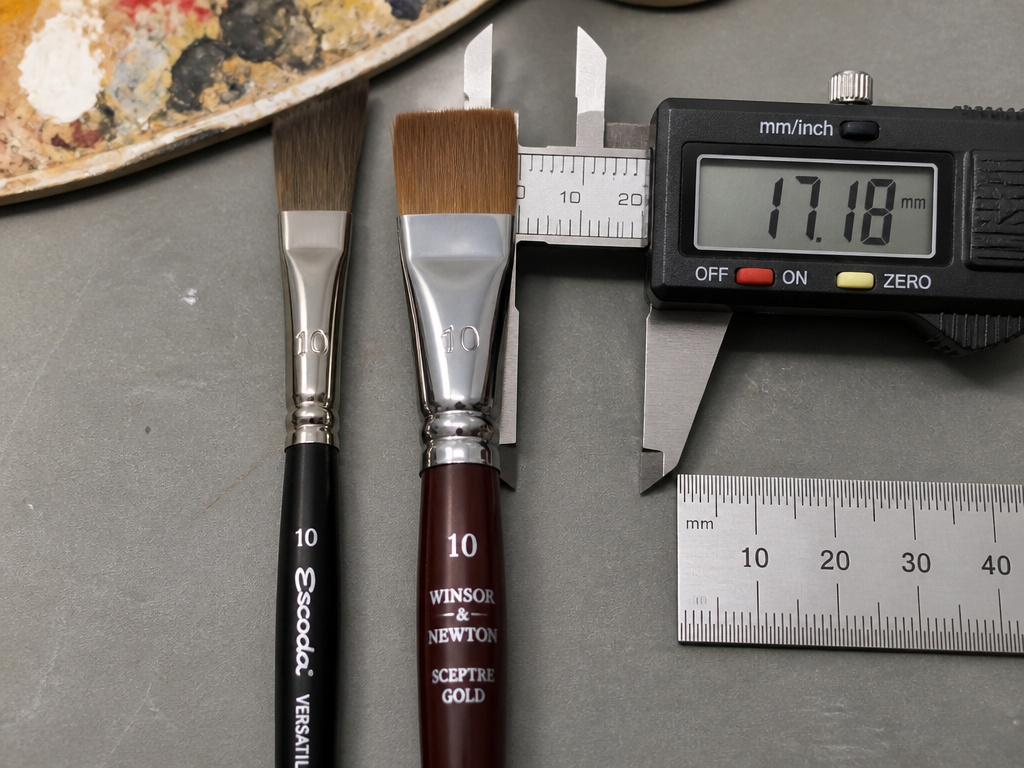
Artist brush numbers run from 000 to 24 in the common range, with extremes stretching from 0000 to 50. Those numbers identify relative size within the same brush type and the same manufacturer. That’s the whole system.
No international body imposes a measuring standard on them. A size 10 from one maker is not reliably a size 10 from another, and the numbering applies almost exclusively to round and flat shapes. Other shapes get sized by width and length instead.
The increments follow a pattern too. Small sizes climb by 1 up to size 10, then larger sizes jump by 2 from there.
Why a Size 10 Means Nothing Across Brands
Because the number is relative, not absolute. It tells you where a brush sits inside one manufacturer’s lineup. It tells you nothing about what it will do on your paper compared to a different brand’s size 10.
The frustration is real and it isn’t new. A commenter on the Jackson’s Art blog put it plainly: metric and imperial charts showing all three brush dimensions are the most user-friendly information a manufacturer can provide. Without them, buying online is guesswork.
That’s the same three-dimension problem from the top of this article, showing up in a completely different corner of brush buying.
The Federal Odd-Number Rule
Federal specification A-A-3193 handles angular sash brushes differently again. It uses odd-numbered sizes only: 5, 7, 9, 11 and 13.
A brush sold as “soft” in a shop may not meet that line.
A brush number is a house style, not a measurement. Ask for the millimetres before you buy, every time.
If you paint small figures rather than walls, miniature paint brushes run on the same relative numbering, which is why the same size can feel wildly different between two brands.
Bristle Material Decides More Than the Number on the Handle
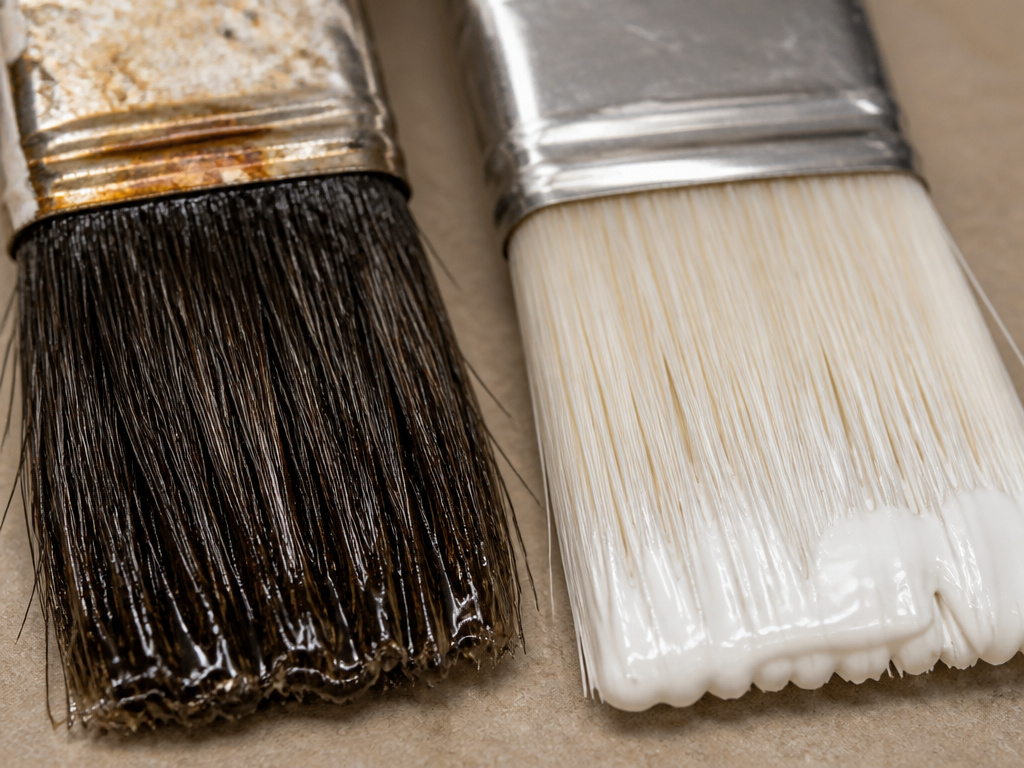
Nylon is the strongest and most expensive material in a paint brush, according to Sherwin-Williams. That single sentence explains a lot of the price spread on a shop shelf.
Sherwin-Williams recommends a nylon and polyester blend as the best choice for all latex paints and coatings. For oil-based paints, stains and varnishes, it recommends natural China bristle. The company also notes that many painters prefer a synthetic brush for oil coatings anyway.
That’s a genuine split, and it’s worth naming. The material-to-coating rule is a starting point, not a fence.
Synthetic vs Natural: What Each Is Actually For
The two China bristle types aren’t interchangeable either. Black China bristle is stronger, thicker coarse hair, suited to oil-based paints and epoxies. White China bristle is soft and thin, built for stain, varnishes, polyurethanes and clear coatings.
On the synthetic side, the named lines sort by job:
- Wooster Chinex FTP uses an extra-firm mix of 100% Chinex filaments, aimed at fast-drying and low VOC coatings.
- Wooster Ultra/Pro is a soft blend of 100% nylon filament that performs well in low humidity and cooler temperatures.
- Wooster Super/Pro blends nylon and polyester for all paints in all climates.
- Purdy Black Bristle is specified for oil-based paints, stains, epoxy and spar urethanes.
- Purdy Nylox Black is specified for latex paints and primers.
Sherwin-Williams’ own Contractor Series nylon/polyester line has been its most popular choice for latex for the past 15 years, and it comes in 20 different sizes. That’s a manufacturer claim, not an independent test result.
For acrylic work specifically, acrylic paint brushes follow the same synthetic logic, just at a smaller scale.
Before you start: Solvent-based paints and varnishes give off strong fumes, so open a window and keep air moving before the can is open, not after your head starts swimming. Lay the drop cloth before you pour, because a tipped container spreads further than the brush ever will.
One more thing about the ferrule. Rinse right up to the base of the bristles, every single time.
How to Test a Brush Size Before You Buy a Whole Set
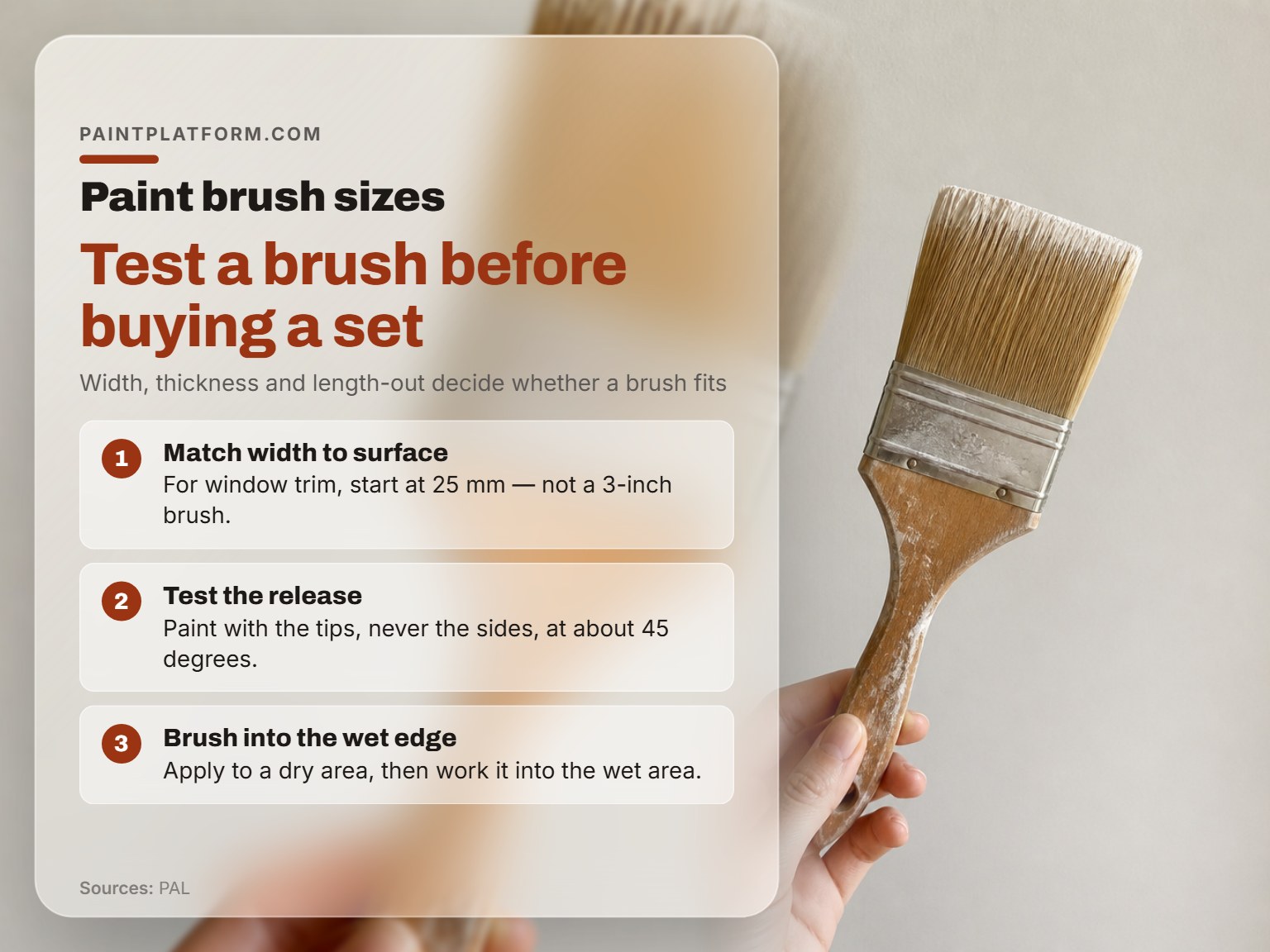
Three things tell you whether a brush fits: width against the surface, thickness against your hand, and length-out against the paint.
- Match the width to the narrowest surface you’ll paint. If you’re doing window trim, start at 25 mm. Skipping this step is how people end up buying a 3-inch brush and fighting every corner.
- Check the thickness against your grip. Hold it before you buy.
- Load it lightly and test the release. PAL advises painting with the brush tips, never the sides, holding at about a 45 degree angle and working mostly from the wrist. If the brush fights that angle, it’s the wrong brush for you.
- Brush into the wet edge. PAL’s method is to apply paint to a dry area and then work it into the wet area so the overlap blends. Skipping this leaves a visible line at every join.
- Clean it properly the same day. Dried paint in the ferrule is permanent. It pushes the bristles apart and the brush never comes back.
- Scuff between coats. PAL recommends a light scuff sand between coats and care to protect the surface coat while sanding. On new walls and ceilings, a final light sanding with 100-200 grit sandpaper is the recommendation.
The Ten-Minute Test
My own worst habit early on was loading the brush like I was frosting a cake. Paint crept under the edge on nearly every repeat, and I kept blaming the tape. Now I dab the brush on a paper towel until it leaves almost nothing behind, then build the color in two or three light passes.
Small bleeds stopped bothering me after that. They see the rhythm.
If you’re starting from zero, a paint brush set for beginners is usually cheaper than buying singles, but check what widths are actually inside.
Frequently Asked Questions
What is the most common paint brush size?
For trim and cutting in, US retail guidance such as Sherwin-Williams puts the workhorse range at roughly 2-1/2 to 3 inches, while PAL’s metric table puts windows and door trim at 25 mm and doors and skirtings at 50 mm. For walls, Sherwin-Williams lands at 4 to 5 inches, while PAL’s table uses 75 mm and 88/100 mm for large unbroken surfaces.
Does brush width include the ferrule?
Width is measured across the ferrule at the base of the bristles, so the ferrule is the reference point rather than an addition to the measurement. Thickness is taken at that same base. Length-out runs from the ferrule face out to the tip of the bristles.
Why does a size 10 brush look different between brands?
Artist brush numbering is relative within a single manufacturer’s range, and no international standard fixes the actual dimensions. Sizes climb by 1 up to size 10, then by 2 for larger sizes, but the physical measurements behind those numbers vary from maker to maker.
Is a wider brush always faster?
Only on large unbroken surfaces. On trim, a wide brush forces you into awkward angles and more strokes, and more strokes is where lap marks and brush lines come from. PAL maps 25 mm to windows and door trim for exactly this reason.
Do I need natural bristle for oil-based paint?
Sherwin-Williams recommends natural China bristle as the best choice for oil-based paints, stains and varnishes. The same company notes that many painters prefer a synthetic brush for oil coatings anyway, so it’s a preference with a strong default rather than a rule.
The Bottom Line
Here’s a trigger worth adopting: if a brush listing doesn’t state thickness and length-out anywhere, don’t buy it online. Width alone tells you almost nothing about how the brush will load and release, and the two numbers that do are the two nobody prints on the box.
This paint brush sizes guide has one honest limit. If you’re painting a single door and nothing else, all of this is overthinking. Buy a 2-inch angle sash in a nylon/polyester blend, paint the door, and get on with your weekend.
If you want one answer for a whole house: a 2-inch angle sash for trim and cutting in, a 4-inch flat or wall brush for the big runs, and a 25 mm for windows and cabinets. Three brushes. That covers the large majority of what a room actually asks for.
Buy them cheap, use them hard, and replace them without guilt. The sizing chart matters far less than the number of hours the brush spends in your hand.
