
Foam Brush vs Bristle Brush: Which Should You Use?
This post contains affiliate links. As an Amazon Associate, we earn from qualifying purchases.
In the foam brush vs bristle brush decision, foam lays a flat, mark-free coat on small smooth surfaces with thin finishes, while bristle carries more paint and handles thick coatings, texture, corners, and oil-based products. Foam is built to be thrown away; a bristle brush lasts for years with cleaning.
Thin finishes are where the foam brush vs bristle brush argument turns, because a foam brush applies coating with a flat sponge face instead of a bundle of filaments. No filaments means no channels to drag a ridge into the film. It also means nothing to carry paint down into a groove.
What follows is the part the comparison tables skip: where the sources actually contradict each other, which coating flips the answer, and a ten-minute test that tells you which brush your project wants before you open a can.
Key Takeaways
- Foam wins on flat, smooth surfaces with thin finishes like stain, sealer, craft acrylic, glaze, and water-based polyurethane.
- Bristle wins on texture, thick coatings, corners, and oil-based products, and it holds significantly more paint per dip.
- The polyurethane question splits by base. Foam suits water-based poly; natural bristle such as China bristle or hog hair is the pick for oil-based.
- Natural bristle and water-based paint fight each other. Natural hair absorbs the water and loses shape, so reach for synthetic on latex.
- A cheap bristle brush is worse than cheap foam. Cheap bristles leave grooves and shed hairs; cheap foam just runs out of paint.
What Actually Separates a Foam Brush From a Bristle Brush
Polyurethane foam on a stick. That’s the whole design, and it explains nearly every strength and failure below.
A foam paint brush consists of a polyurethane foam head fixed to a wooden or plastic handle; coating is absorbed into the foam and released under pressure. A bristle brush carries paint between natural hairs such as hog bristle or ox hair, or between synthetic nylon or polyester filaments, releasing the load through controlled strokes.
The basic paintbrush form has not changed much in a very long time. What changed is the material doing the carrying.
Foam brushes: a polyurethane wedge on a handle
A foam brush spreads coating with a flat face. There are no individual filaments, so there is nothing to drag a ridge into the film. That is the entire reason foam leaves a mark-free coat on flat, smooth surfaces with thin materials.
Higher-density foam gives a smoother finish and lasts longer than the loose, crumbly stuff. You can feel the difference before you buy. Press a fingernail into the head; a higher-density one springs back, and a cheap one dents and stays dented.
Most foam brushes also have a beveled edge, which is genuinely useful for sharp lines and corners. That part is a design feature, not a happy accident.
Capacity is the weak point. Foam holds very little coating, so on anything bigger than a cabinet door you reload constantly, and constant reloading is exactly what creates lap marks and uneven coverage.
Bristle brushes: hog hair, ox hair, nylon, polyester
Bristle brushes carry paint in the gaps between filaments, which is why they hold significantly more per dip. That single fact drives most of the rest of this.
Material matters more than brand. Natural bristles, hog bristle or ox hair, hold and release oil-based coatings smoothly. Synthetic filaments, nylon or polyester, resist water and keep their shape, which makes them the pick for latex and other water-based products.
Natural bristles absorb moisture out of water-based paint and lose their edge. They also shed a bristle or two onto the surface. Rough, textured surfaces snap the tips off natural bristles outright, and the brush paints less evenly from then on.
Cheap bristle brushes are their own category of bad. They leave grooves and shed hairs, and no amount of technique rescues either one.
If you are still working out what to buy, choosing a paint brush starts with the filament, not the handle.
Where the Foam Brush vs Bristle Brush Advice Falls Apart
The advice gets messy the moment polyurethane enters the conversation.
Every comparison page repeats the same tidy table. Foam is cheap, disposable, and mark-free. Bristle is pricier, reusable, and handles texture and oil-based coatings. That frame is accurate as far as it goes, and it collapses the second you ask a specific question.
Here is what the sources behind this piece actually say, including the places they contradict each other.
- Foam and polyurethane. Hunker calls foam a poor choice for thick clear finishes because the foam may introduce bubbles. Brushes-China says foam often produces fewer visible brush marks than standard bristle on polyurethane and varnish. ImproveWood splits it by base and says foam suits water-based poly but not oil-based.
- Foam and oil-based paint. ImproveWood says foam is not recommended for oil-based polyurethane because it absorbs the thicker product. PaintingProGuide says foam is fine for small oil-based projects and touch-ups, with a solvent-compatibility caveat.
- Varnish. One Brushes-China page favors foam for fewer marks on clear finishes. A second Brushes-China page says natural bristle gives better control and smoother release for varnish. Same publisher, two pages, opposite answers.
- Reuse. Hunker says foam is best for one-off projects and that repeated cleaning makes the foam crack and fall apart. Brushes-China says most foam is limited-use but some can be reused if cleaned carefully. PaintExplained lands on single-use or very small jobs.
- Which one is smoother. PaintingProGuide gives the win to foam on flat, smooth surfaces with thin paint. Brushes-China gives the win to a natural bristle brush with oil-based paints, varnishes, stains, and wood finishes.
- A real side-by-side. A builder on the West Coast Paddler forum tipped off the same thinned finish with a cheap foam brush on one kayak deck and a Purdy synthetic bristle brush on the other. He got more pronounced brush marks on the foam side. A second forum member replied that he could not see any difference in the photos.
- Manufacturer versus owners. The same builder reported that System Three recommended a bristle brush when he asked about applying their finish, while experienced users of that same product use foam successfully.
Rule of thumb: When two sources give opposite answers about the same coating, the coating’s viscosity and base are doing the deciding, not the brush. Match the brush to the liquid and the argument mostly resolves itself.
That is not a satisfying answer if you want one brush to rule them all. It is the honest one.
Which Brush Goes With Which Coating?
Answer the coating first and the brush usually picks itself.
| Factor | Foam brush | Bristle brush |
|---|---|---|
| Finish on flat, smooth surfaces | No bristle marks | Can leave marks, especially latex on drywall |
| Paint capacity | Low; reloads constantly | High; carries more per dip |
| Thick or high-viscosity coatings | Drags, saturates, flattens | Handles well |
| Rough or textured surfaces | Tears, skips, leaves crumbs | Works coating into the texture |
| Reuse | Limited; cracks with repeated cleaning | Years with proper care |
Oil-based paint and oil-based polyurethane
Natural bristle is the better choice here, and the reason is mechanical. Natural hairs hold and release oil-based coatings smoothly, and they keep more product on the brush instead of swallowing it. Foam absorbs the thicker oil-based product rather than laying it down.
China bristle and hog hair are the traditional picks for oil-based polyurethane. PaintingProGuide softens this slightly and allows foam for small oil-based touch-up work, so treat that as the narrow exception rather than the rule.
Water-based paint and water-based polyurethane
Synthetic bristle or foam, depending on size. Natural bristles absorb water, swell, and lose shape, which is why they are the wrong tool for latex.
The natural vs synthetic bristle split decides this one, and it matters more than the foam-versus-bristle question you started with. For water-based poly on small and medium flat surfaces, foam is a popular choice because it leaves no brush marks.
Stain, sealer, and primer
Foam is well suited to stain, especially gel stain, because it lays the product on evenly. Wipe the excess back with a lint-free rag. On very rough wood, a bristle brush or a rag works the stain into the grain better than foam can.
Sealer goes with foam for thin coatings on small smooth surfaces. Primer goes with bristle, which loads better and holds up on larger areas.
Varnish and clear finishes
This is the contested one, and I am not going to pretend it is settled. One Brushes-China page says foam produces fewer visible marks on varnish. Another page from the same publisher says natural bristle gives better control and smoother release.
Hunker sits with the bristle camp on thick clear finishes, citing bubbles. ImproveWood sits with foam, but only for the water-based version.
Once you are cutting in around casing, the angled brush vs flat brush question matters more than foam versus bristle anyway.
Why Foam Tears on Rough Wood and Drags on Thick Paint
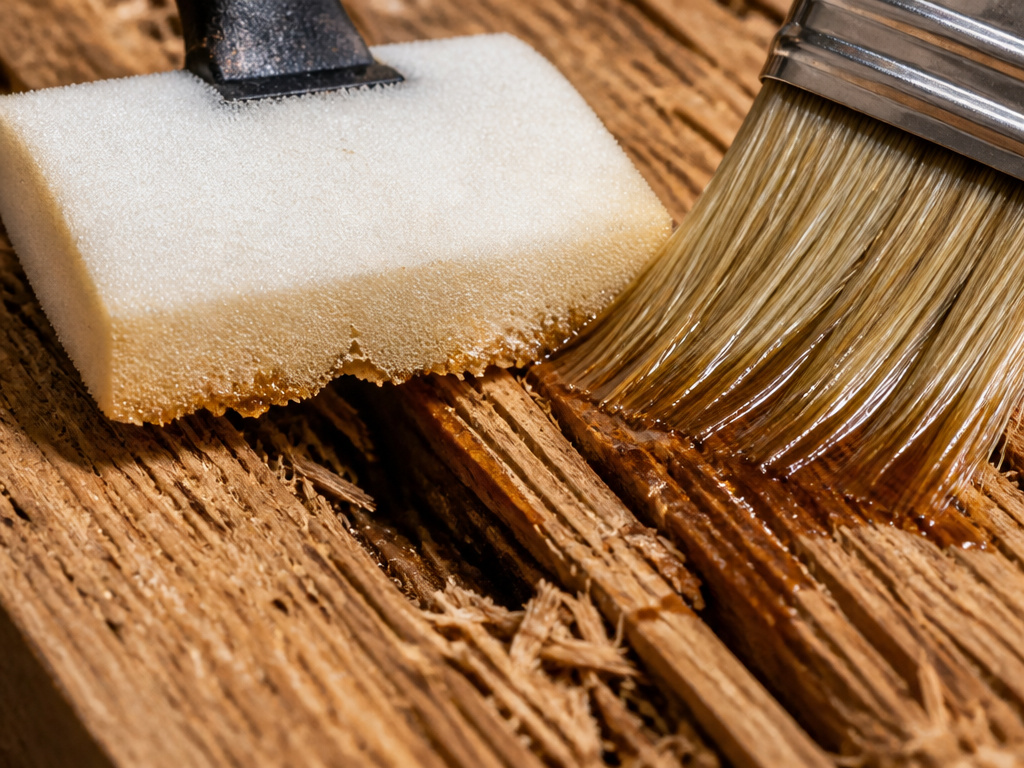
A flat foam face bridges over a groove instead of reaching into it.
That is the whole mechanism. Bristles flex and push coating down into crevices, brick, raw wood, and carved detail. Foam has no filaments to push with, so it skips the low spots and catches on the high ones. On abrasive surfaces the foam edge tears and leaves crumbs in the film.
Thick coatings fail for a related reason. Foam’s open cells load up with heavy product, the head goes soggy and sloppy, and from there you get edge marks or a coat too thick to level out.
Solvents are the third failure. Some solvent-containing finishes break the foam down while you are still using it, and very old foam brushes disintegrate on their own before they ever touch a can.
Where this goes sideways: Running one foam brush through an entire can of thick finish. By the third or fourth reload the head is saturated, and it starts laying edge marks or a coat thick enough to show every stroke.
There is a genuine conflict on rough surfaces, and it is worth naming. Hunker warns that rough, textured surfaces snap the tips off natural bristles. PaintingProGuide lists textured surfaces as a bristle strength. Both can be true at once if the bristle is synthetic, but neither source says that out loud, so I will: use synthetic on texture, keep natural bristle on smooth work.
How Do You Test a Brush Before It Touches the Project?
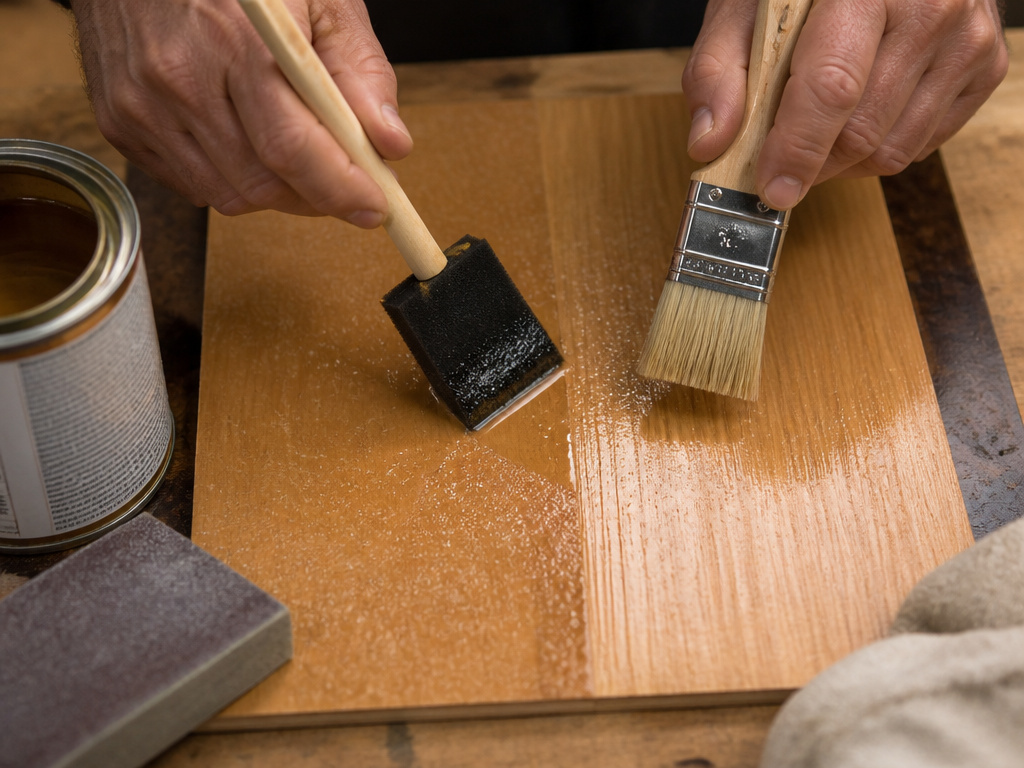
Four checks, ten minutes, one scrap panel.
Before you start: Solvent-based finishes give off fumes that build up fast in a closed room, so open a window and pull air through with a fan. Some solvent-containing finishes break foam down while you work, so test the head on scrap before it goes into a full can. Keep the scrap and the rags out of the room you sleep in.
- Sand and dust a scrap of the same material. Both brush types perform poorly on dirty or uneven surfaces, so a test on a glossy offcut tells you nothing about your actual project.
- Load the brush and lay one thin coat. Thin coats plus a light tip-off is the standard fix for foam bubbles; skipping the tip-off leaves them locked in the film.
- Look at the film at a low angle, not straight on. Bristle marks show as fine ridges and foam failure shows as bubbles or crumbs, and neither is visible from directly above.
- Wipe the head on the rim and watch how much it gives back. Foam that releases a puddle at once will splatter; remove the excess before the brush touches the surface.
Try this before your next project: coat half a scrap panel with foam and half with bristle, let both dry, and run a fingertip across each. Your hand will settle the argument faster than any table.
The Reuse Argument, and Why I Still Buy Foam in Packs
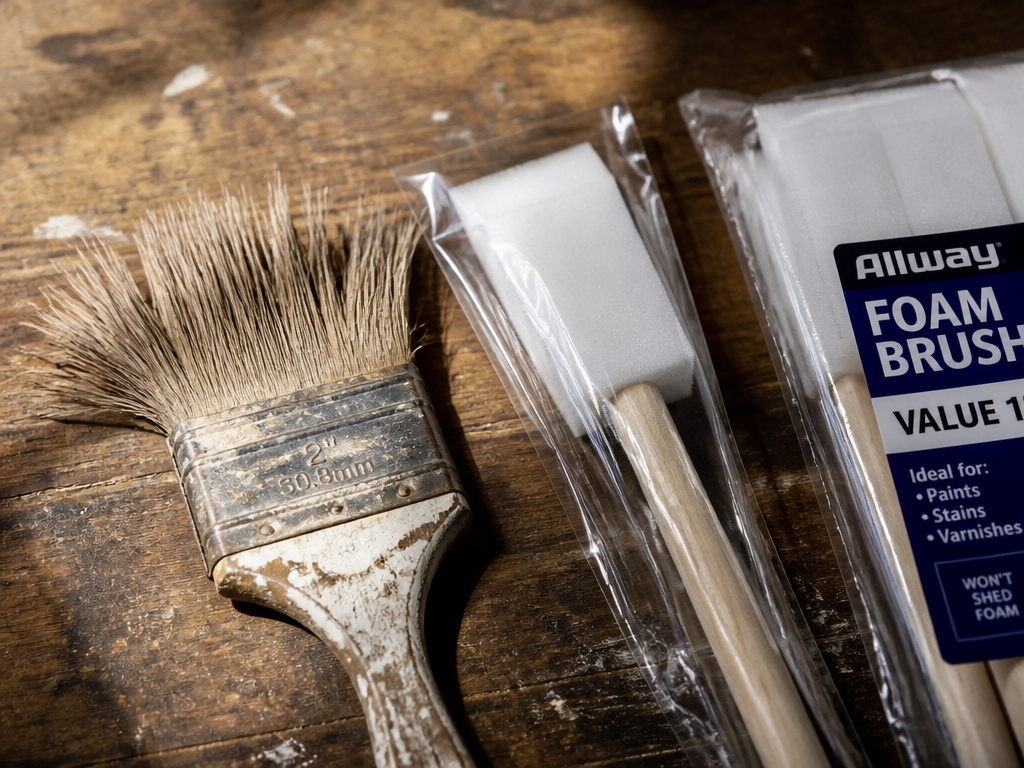
Cheap foam is meant to be thrown away, and that is a feature.
The sources split on how many uses you get. Hunker is blunt: foam falls apart more easily than bristle, and cleaning and reusing it repeatedly makes the foam crack and fall apart. Brushes-China allows that some foam can be reused if cleaned carefully. PaintExplained puts it at single-use or very small jobs.
Bristle goes the other way. A bristle brush can be cleaned repeatedly for years before it needs replacing, though it does become less effective over time, especially with extended use in hot weather.
Most of the failures covered here are brush care and storage problems wearing a disguise. A natural bristle brush left standing on its bristles in water dries into a fan shape and stays that way, and no cleaner brings it back.
I buy foam in a pack and treat each one as a single session. The moment I start babying a foam brush, I am spending more time cleaning it than the finish is worth.
What I’d Actually Keep in the Brush Cup

Three brushes cover almost everything I paint.
The advice I got starting out was to use the biggest brush I could handle. On a postcard-sized panel that was wrong. A big brush swallowed the whole composition in two strokes, and I only got the control I wanted when I dropped to a medium. Scale flips the answer, and foam versus bristle is the same story in a different material.
They take abuse, they keep a usable edge, and I do not wince when one gets left in a jar.
It costs a lot and it punishes ordinary beginner mistakes, which is the opposite of what a first brush should do.
What I would add before anything else: a big cheap flat wash brush. It teaches loose handling faster than any detail brush, and it costs almost nothing to ruin.
Frequently Asked Questions
Is a foam brush or a bristle brush better for polyurethane?
It depends on the base, and the sources genuinely disagree past that point. Foam is well suited to water-based polyurethane and is not recommended for the oil-based version, which it tends to absorb. For oil-based, natural bristle such as China bristle or hog hair is the preferred choice. Hunker separately warns that foam can introduce bubbles into thick clear finishes.
Can you use a foam brush with oil-based paint?
Some sources say yes for small jobs and touch-ups, others say no. PaintingProGuide allows foam on small oil-based projects and advises checking the packaging for solvent compatibility. ImproveWood says foam is not recommended for oil-based polyurethane at all. Some solvent-containing finishes break the foam down while you are using it, so test on scrap first.
Why does my foam brush leave bubbles in the finish?
Foam is an open-cell material, so it can trap air and release it into the coating. The fix is technique rather than a different brush: apply thin coats and lightly tip off the bubbles before the film starts to set. Thick clear finishes make it worse, which is why Hunker steers foam away from them.
Do you have to throw foam brushes away after one use?
Most foam products are intended for limited or disposable use. Hunker notes that repeated cleaning makes the foam crack and fall apart, and PaintExplained puts foam at single-use or very small jobs. Brushes-China allows that some foam can be reused if cleaned carefully, so it varies by product.
What is the difference between natural and synthetic bristle brushes?
Natural bristles, hog bristle or ox hair, hold and release oil-based coatings smoothly and are the traditional pick for oil-based paint, varnish, and oil-based polyurethane. Synthetic filaments, nylon or polyester, resist water and keep their shape, which makes them right for latex and water-based finishes. Natural bristles absorb moisture from water-based paint and lose their edge.
The Bottom Line
Here is the trigger I actually use. If you can feel texture under a fingertip, the foam stays in the pack. If a fingernail drags across the surface and you hear nothing, foam is fair game.
That single test resolves most of the arguments above, because texture is what breaks foam and smoothness is what makes it look good.
One concession: none of this matters if the surface is dirty, greasy, or unsanded. Both brush types perform poorly on a surface that was not prepped, and a perfect brush on a bad surface is just an expensive way to spread dust around.
And a stance I will defend: I would rather see a beginner burn through a pack of cheap foam on scrap panels than buy one good bristle brush and be afraid to use it. Start before you feel ready. The brush you actually pick up beats the one you are saving.
