
10 Best Epoxy Primers For Cars in 2026
This post contains affiliate links. As an Amazon Associate, we earn from qualifying purchases.
For car bodywork, the foundation matters most. The SprayMax 2K Epoxy Primer Black is our Best Overall pick because it dust-dries in just 15 minutes and delivers professional-grade 2K bonding strength with corrosion resistance on both steel and aluminum. For a direct-to-metal job, the Eastwood 2K Epoxy Gray Primer excels, while DIYers on a budget should look at the Kirker Enduro Prime DTM Epoxy Primer for maximum coverage per dollar.
Choosing the right epoxy primer means balancing drying time, surface compatibility, and application method. A fast aerosol works for spot repairs, but a gallon kit makes sense for a full panel or entire car. Getting this wrong can mean adhesion failure or rust creeping back under your paint.
This guide is research-based, drawing from manufacturer specifications, expert round-ups, and patterns in owner feedback. We evaluated the top options across ten products to help you match the right primer to your specific project.
Top 10 Epoxy Primers For Cars in the Market
Certain content that appears on this site comes from Amazon. This content is provided "as is" and is subject to change or removal at any time.
The Best Epoxy Primers For Cars, Reviewed
SprayMax 2K Epoxy Primer Black
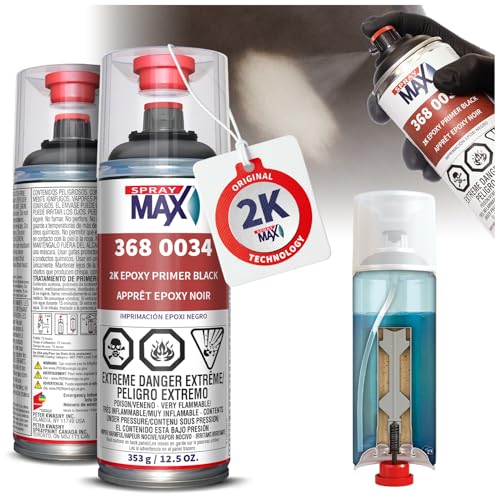
What We Like
- Dust-dry in just 15 minutes
- Variable nozzle for precise spray control
- Corrosion-resistant on steel and aluminum
- Professional-grade 2K bonding strength
Trade-offs
- 12.5 oz can covers less area than gallon kits
- Requires activation before use
A 15-minute dust-dry time means you can move from primer to sanding within hours, not days. That speed, paired with the variable nozzle for precise control, makes this aerosol a practical shortcut for small jobs like a fender repair or motorcycle tank without dragging out a compressor. It provides adhesion and rust protection on steel, aluminum, and galvanized metal surfaces. For the DIYer or shop pro who needs professional-grade adhesion in a compact can, this is an efficient way to get a 2K epoxy foundation without mixing a full gallon.
At 12.5 ounces, this can is best for spot repairs and small panels rather than whole-car jobs. The Eastwood 2K Epoxy Gray Primer covers 10-16 square feet but weighs 1.2 pounds. SprayMax balances corrosion resistance and fast drying with aerosol convenience for smaller metal projects.
Eastwood 2K Epoxy Gray Primer
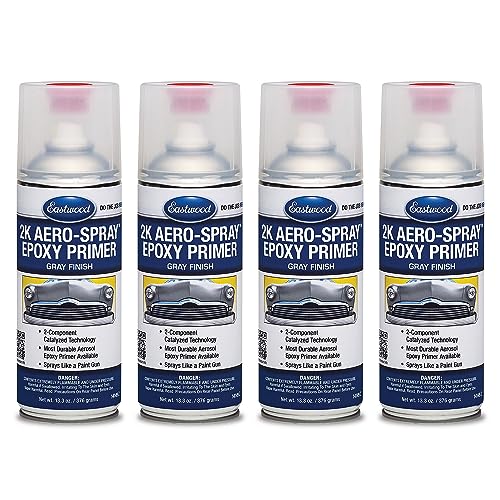
What We Like
- Direct-to-metal corrosion prevention
- Wide fan spray pattern nozzle
- 48-hour pot life after activation
- Works on aluminum, steel, fiberglass
Trade-offs
- Requires NIOSH breathing equipment for safety
- Must use in well-ventilated area away from flame
The two-component epoxy formula bonds directly to bare metal, aluminum, steel, or fiberglass, sealing out moisture and preventing rust before your topcoat goes on. The 48-hour pot life after activation gives you flexibility to use the can over a couple of days without rushing. For anyone tackling a project that needs a tough, lasting foundation on raw surfaces, this kit delivers professional-grade adhesion without needing an HVLP sprayer.
The trade-off is safety gear: the catalyzed formula requires NIOSH-approved breathing protection and a well-ventilated workspace, so it’s not a grab-and-go rattle can. Compared to the SprayMax 2K Epoxy Primer Black, which is a single aerosol can, the Eastwood four-pack offers more cans for larger jobs. If you need a gray primer for direct-to-metal durability, this Eastwood kit is a straightforward option.
Custom Shop DTM Epoxy Primer Sealer

What We Like
- 1:1 mix ratio for precise, easy mixing
- No induction time needed before application
- Anti-corrosive additives for rust defense
- Direct-to-metal adhesion on multiple surfaces
Trade-offs
- 4-hour pot life limits working time for large jobs
- Requires reducer for sealer use, adding a step
A 1:1 mix ratio means you measure equal parts primer and hardener, no math, no guesswork, and no induction time before you spray. That simplicity makes this kit a natural fit for anyone who wants a reliable DTM epoxy without the fuss of complex ratios or waiting. It bonds directly to bare metal, steel, aluminum, fiberglass, and sanded OEM finishes, while the anti-corrosive additives fight rust and salt spray. For a shop that values consistent, fast results, this is a straightforward choice that delivers adhesion and protection without extra steps.
A 4-hour pot life forces you to plan your work in shorter bursts. If you are tackling a full car body or a large industrial piece, you will need to mix smaller batches or work quickly. This Custom Shop kit shines for the builder who wants gallon-level coverage and a forgiving mix, but it demands discipline with the clock.
Product photos
Speedokote Epoxy Fast Dry DTM Primer

What We Like
- Easy 4:1 mix ratio
- Excellent adhesion and corrosion resistance
- Lays down super smooth
- Works on steel, aluminum, fiberglass, body fillers
Trade-offs
- Requires optional reducer for full thinning flexibility
- Needs a spray gun and mixing equipment
The 2.1 low VOC formulation keeps solvent levels down, which matters if you’re spraying in a space with limited ventilation. Mixing is a simple 4:1 ratio, four parts primer to one part activator, so there’s no complicated math. The primer sticks well to steel, aluminum, fiberglass, body fillers, and existing finishes, meaning you can use it as a first coat on bare metal or as a sealer over sanded paint.
If you want to thin the primer for a finer spray, you’ll need to buy Speedokote’s 0 VOC reducer (SMR-0075) separately and add 5-10% to the mix. That’s an extra purchase and step compared to a product that comes ready to use. The gallon kit gives you enough material for several panels, but you’ll need a spray gun and mixing containers to apply it.
Eastwood Epoxy Primer Black Autobody Paint
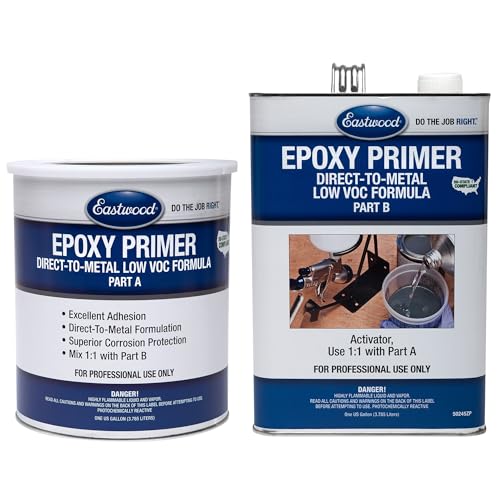
What We Like
- Excellent adhesion and corrosion resistance
- Fast drying, sandable in 2-3 days
- Works over steel, aluminum, fiberglass, fillers
- 50-state compliant low VOC formula
Trade-offs
- At 18.8 lb, heavy for small projects
- 2-3 day dry time before sanding
- Maximum operating temperature of 150°F
This epoxy primer covers approximately 140 square feet per gallon, so a single gallon can handle a large area like a car hood or a truck bed without needing to reorder mid-project. The epoxy bonds to steel, aluminum, fiberglass, body fillers, and existing finishes, so you can use it over mixed surfaces without switching primers. It also dries fast enough to sand in two to three days, keeping your timeline on track.
This kit weighs 18.8 pounds, so it’s a heavy-duty option best suited for large jobs rather than quick spot repairs. The SprayMax 2K Epoxy Primer Black aerosol is only 0.9 pounds, making it lighter for small-scale work. But for covering a big surface like a car hood or truck bed, the Eastwood’s roughly 140 square feet per gallon gives you the volume you need without constant refills.
Product photos
Kirker Enduro Prime DTM Epoxy Primer

What We Like
- Includes both primer and catalyst
- 1:1 mix ratio simplifies measuring
- Works on steel, aluminum, fiberglass, and fillers
- Can be used as a sealer
Trade-offs
- Requires two to three days before it can be sanded
- Not suitable for use over unprepared or oily surfaces
This kit gives you a full gallon of primer and a full gallon of catalyst mixed 1:1, so measuring is straightforward and you have plenty of material for a whole car or multiple panels. The epoxy bonds well to steel, aluminum, fiberglass, body filler, and existing finishes, and it provides corrosion resistance. You can also convert it into a sealer for later steps, which adds flexibility to your workflow.
The main thing to plan around is the cure time: the primer is sandable after two to three days, so you need to schedule your project accordingly. That longer cure allows the coating to bond tightly, and the ability to use it as a sealer gives you options. If you can wait, the volume and simple mix make this a practical choice for getting a professional-grade epoxy layer down.
LiME LiNE 2K Epoxy Primer Sealer

What We Like
- Isocyanate-free formula for safer application
- Direct-to-metal anti-corrosive protection
- Non-sanding formula saves prep time
- Works as primer or sealer
Trade-offs
- Two-component requires mixing before use
- Surface must be washed, cleaned, and sanded
LiME LiNE 2K Epoxy Primer Sealer is built around a single decisive feature: an isocyanate-free two-component formula. That means you get the adhesion of a professional epoxy primer on bare metal, fiberglass, and aluminum, without the isocyanate hardeners found in many traditional primers. It also doubles as a sealer and skips the sanding step between coats, so you can move from prep to topcoat faster.
Like any two-part epoxy, you have to mix it before spraying, and surface prep still demands washing, cleaning, and sanding to get that anti-corrosive bond. For a DIYer or small shop that values a direct-to-metal formula without isocyanate, that extra step is part of the process.
Car-Rep 2K Epoxy Primer with Wise 2K Technology
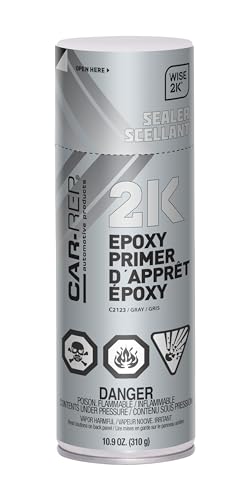
What We Like
- No mixing or activation needed
- Unlimited potlife for convenience
- Wet-on-wet overpaintable when touch dry
- Humidity-activated crosslink for durable finish
Trade-offs
- 11 oz can covers less area than larger kits
- Requires ambient humidity to cure properly
Car-Rep’s Wise 2K Technology means this primer has unlimited potlife and requires no mixing or activation, so you can spray it straight from the can without worrying about a ticking clock. That makes it a perfect fit for automotive plastics, where you often need to work in short bursts or over multiple panels. The humidity-activated crosslink creates a tough epoxy surface that bonds well to tricky substrates like carbon fiber and most automotive plastics, giving you corrosion resistance without the hassle of traditional two-part systems.
This 11-ounce aerosol covers less area than a quart or gallon kit, so for a full car body you’ll need multiple cans. Compared to the SprayMax 2K Epoxy Primer Black, which is also an aerosol epoxy primer for metals, Car-Rep’s design offers the convenience of no mixing and unlimited potlife for small jobs on plastics. The SprayMax can may be preferred for larger metal panels depending on coverage needs.
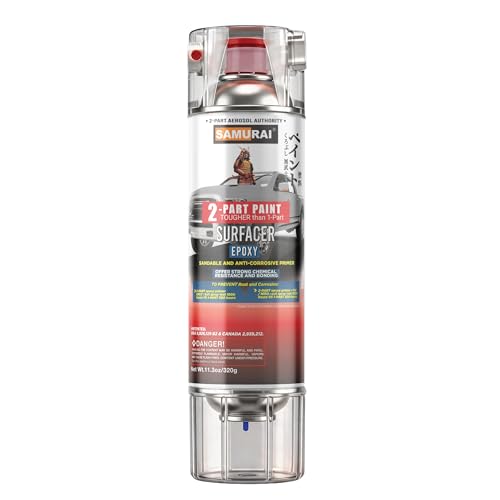
SAMURAI 2-Part Epoxy Primer Spray
What We Like
- Two components mix inside a single can
- No air compressor needed for application
- Excellent sanding properties for smooth finish
- Strong adhesion for base and top coats
Trade-offs
- Only one can per pack limits large jobs
- Not suited for full-vehicle painting without buying multiple cans
A single aerosol can that holds both hardener and paint solution means you get a true 2K epoxy primer without needing a spray gun or compressor. That convenience makes it ideal for small touch-ups, spot repairs, or anyone who doesn’t have a full paint booth setup. The product is designed to prevent rust and corrosion, and the excellent sanding properties let you smooth the surface before your top coat goes on. For a quick, portable solution that still delivers professional-grade bonding, this system is hard to beat.
Coverage is the trade-off: a single can works well for a fender, a door, or a small patch panel, but if you’re painting a whole car, you’ll need several cans, which adds up. Still, for the DIYer who values simplicity and wants a true two-component epoxy without the mess of mixing, this SAMURAI can is a smart grab-and-go option.
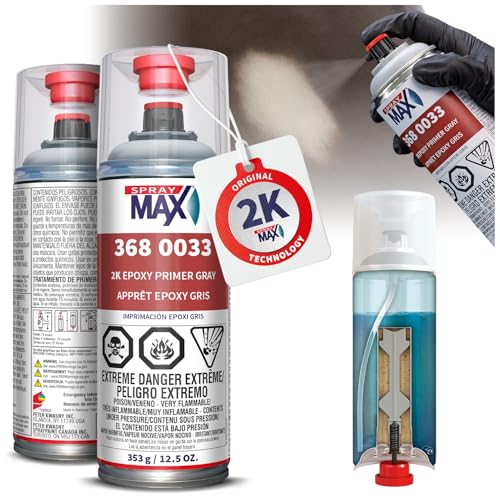
SprayMax 2K Epoxy Primer Gray
What We Like
- Dust-dry in just 15 minutes
- Variable nozzle for precise control
- Corrosion-resistant on steel and aluminum
- Professional-grade 2K bonding strength
Trade-offs
- Aerosol can limits coverage for large panels
- 12.5 oz can limits coverage for large panels
Dust-dry in just 15 minutes means you can move through a project without long delays between coats. This aerosol delivers professional-grade 2K epoxy adhesion and corrosion resistance on steel, aluminum, and galvanized metal, making it a strong pick for small-to-medium automotive repairs or touch-ups. The variable nozzle gives you precise control over the spray pattern, so you can get an even coat without needing a compressor or spray gun. It suits DIYers and shop pros alike who want a fast, reliable foundation for their topcoat.
The SprayMax 2K Epoxy Primer Gray comes in a 12.5-ounce aerosol can, so it’s best suited for small jobs or touch-ups rather than covering large surfaces like an entire car body. Larger kits such as the Eastwood 2K Epoxy Gray Primer list 10-16 sq ft of coverage, making them more economical for big projects. For focused repairs on metal, aluminum, or steel, this can is convenient and quick to use.
Product photos
How We Evaluated Epoxy Primers For Cars
Our evaluation focused on real-world application needs rather than lab conditions. We examined manufacturer data sheets for each product’s mix ratio, pot life, drying time, and substrate compatibility. We also studied patterns in owner feedback from experienced DIYers and professional painters to understand which primers actually perform in a garage or shop setting.
The four criteria that mattered most were adhesion strength across common substrates (steel, aluminum, fiberglass), corrosion resistance, ease of mixing and application, and drying time. A primer that bonds well but takes three days to sand may be fine for a full restoration, but it is wrong for a same-day touch-up.
A criteria-based evaluation has limits. Individual results depend heavily on surface preparation, ambient conditions, and application skill. What we offer is a clear, criteria-based comparison to narrow your choices.
What To Look For In Epoxy Primers For Cars
Choosing an epoxy primer starts with understanding your project size, substrate, and timeline. The right product saves time, money, and frustration.
The best epoxy primer for your car matches your project size, substrate type, and drying time needs. Prioritize adhesion and corrosion resistance, then choose between aerosol convenience and gallon-kit economy.
Mix Ratio and Pot Life
Epoxy primers are two-component systems that require mixing a resin with a hardener. The mix ratio determines how easy it is to measure accurately. A 1:1 ratio (like the Custom Shop DTM Epoxy Primer Sealer or Kirker Enduro Prime) is simplest for beginners, while a 4:1 ratio (Speedokote Epoxy Fast Dry DTM) offers more flexibility with reducers.
Pot life is the window you have to apply the mixed product. A 48-hour pot life (Eastwood 2K Epoxy Gray Primer) suits large jobs, while a 4-hour pot life works for smaller projects but demands pace.
Substrate Compatibility
Not all epoxy primers stick well to every surface. Most premium options work on steel, aluminum, and fiberglass, but some also handle body fillers and plastics. The Car-Rep 2K Epoxy Primer with Wise 2K Technology is specifically formulated for automotive plastics and carbon fiber. If you are painting over bare metal, look for a direct-to-metal (DTM) formulation like the Eastwood 2K Epoxy Gray Primer or Custom Shop DTM Epoxy Primer Sealer for best corrosion prevention.
Drying Time and Sandability
Drying time varies dramatically. Some aerosols dust-dry in 15 minutes (SprayMax 2K Epoxy Primer Black and Gray), while gallon kits like the Kirker Enduro Prime require two to three days before sanding. The Eastwood Epoxy Primer Black Autobody Paint is sandable in 2-3 days. Your timeline matters: a fast-drying aerosol is ideal for same-day spot repairs, while a longer-curing kit often produces a harder, more durable film.
- Check the recommended dry time before sanding or topcoating.
- Verify the maximum operating temperature if the part will see engine heat.
- Confirm whether the primer requires a separate reducer or activator.
- Look for 50-state low VOC compliance if you live in a regulated area.
- Ensure the nozzle or spray tip matches your desired fan pattern.
A slower cure usually means a tougher finish, but only if you can wait.
Epoxy Primers For Cars Compared
The table below compares the key specifications and best-use scenarios for each of the ten epoxy primers we evaluated.
| Product | Type | Application | Substrates |
|---|---|---|---|
| SprayMax 2K Epoxy Primer Black | 2K Epoxy Primer | Aerosol can with variable nozzle | Metal, Aluminum & Steel |
| Eastwood 2K Epoxy Gray Primer | 2K Epoxy Primer | Aerosol | car body panels, aluminium, steel, or fiberglass |
| Custom Shop DTM Epoxy Primer Sealer | Epoxy Primer / Sealer | 1:1 Mix | Bare metal, steel, aluminum, fiberglass, gelcoat, plastics, OEM finishes |
| Speedokote Epoxy Fast Dry DTM Primer | Epoxy Fast Dry DTM Primer & Sealer | 4:1 mix | Steel, aluminum, fiberglass, body fillers, existing finishes |
| Eastwood Epoxy Primer Black Autobody Paint | Epoxy Primer | 2 Gallon Kit | Steel, aluminum, fiberglass, fillers, existing finishes |
| Kirker Enduro Prime DTM Epoxy Primer | DTM Epoxy Primer | 1:1 with catalyst | Steel, aluminum, fiberglass, body fillers, existing finishes |
| LiME LiNE 2K Epoxy Primer Sealer | 2K Epoxy Primer/Sealer | 2 Quart kit | Bare metal, fiberglass, aluminum |
| Car-Rep 2K Epoxy Primer with Wise 2K Technology | 2K Epoxy Primer | Aerosol Can | Metals, Carbon Fiber, Plastics |
| SAMURAI 2-Part Epoxy Primer Spray | 2-part epoxy aerosol | Aerosol can | N/A |
| SprayMax 2K Epoxy Primer Gray | 2K Epoxy Primer | Aerosol with variable nozzle | Metal, Aluminum & Steel |
Frequently Asked Questions
Can I apply epoxy primer over existing paint?
Yes, but only if the existing paint is fully cured, clean, and properly sanded with fine grit sandpaper. Epoxy primer bonds mechanically, so any gloss or contaminant will prevent adhesion. For best results, strip to bare metal on areas with peeling or failing paint.
How long can I wait before topcoating epoxy primer?
Most epoxy primers have a recoat window that varies by product. If you exceed the maximum recoat time, you must scuff-sand the primer before applying basecoat or topcoat. Check the manufacturer’s data sheet for your specific primer.
Do I need a respirator when spraying epoxy primer?
Yes. Epoxy primers contain isocyanates or other sensitizers that can cause respiratory issues. The Eastwood 2K Epoxy Gray Primer specifically requires NIOSH breathing equipment. Even isocyanate-free formulas like the LiME LiNE 2K Epoxy Primer Sealer release harmful vapors during spraying. Always use a proper respirator in a well-ventilated area.
What is the difference between epoxy primer and etching primer?
Epoxy primer provides superior adhesion and corrosion resistance on bare metal, aluminum, and fiberglass. Etching primer contains acid that chemically bonds to metal surfaces but offers less durability and corrosion protection. For automotive bodywork, epoxy primer is the stronger foundation, especially on steel panels.
Can I use epoxy primer as a sealer?
Many epoxy primers can double as sealers when reduced properly. The Custom Shop DTM Epoxy Primer Sealer and Kirker Enduro Prime DTM Epoxy Primer are formulated for this dual use. Using epoxy as a sealer provides a uniform color base and improves topcoat adhesion, but you must follow the manufacturer’s reduction instructions.
The Bottom Line
For most DIYers and shop pros, the SprayMax 2K Epoxy Primer Black is the best overall choice because it combines professional-grade 2K bonding strength with a 15-minute dry time and corrosion resistance. Its aerosol format is convenient for small metal repairs and panels without needing a spray gun.
If your project involves bare steel or aluminum and you need maximum corrosion prevention, the Eastwood 2K Epoxy Gray Primer offers direct-to-metal performance with a generous 48-hour pot life. Budget-conscious buyers tackling a full car should consider the Kirker Enduro Prime DTM Epoxy Primer, which delivers the most material per dollar in a simple 1:1 mix.
The single most important factor in choosing an epoxy primer is matching the product’s drying time and coverage to your project size and schedule. A fast aerosol for a spot repair, a gallon kit for a full panel, and always, always prepare the surface properly.
