
10 Best Motor Paint in 2026
This post contains affiliate links. As an Amazon Associate, we earn from qualifying purchases.
For a durable, great-looking engine finish, we recommend the Dupli-Color Engine Paint with Ceramic as the best overall. Its ceramic resin formula resists heat up to 500°F and stands up to oil and automotive fluids without blistering or peeling. For higher temperature needs, the Rust-Oleum Automotive Engine Enamel (best high heat resistance) and the VHT Engine Metallic Paint (best for high temperatures) are excellent alternatives.
The challenge with motor paint is finding a coating that survives the harsh environment under the hood. Constant heat cycles, oil leaks, and road grime can quickly ruin a cheap finish. You need a paint that bonds to bare metal, resists chemicals, and won’t flake off when the engine gets hot.
This guide is based on a thorough analysis of manufacturer specifications, expert round-ups, and patterns in owner feedback. We focused on heat resistance, chemical durability, and ease of application to help you choose the right paint for your specific engine project.
Top 10 Motor Paints in the Market
Certain content that appears on this site comes from Amazon. This content is provided "as is" and is subject to change or removal at any time.
The Best Motor Paints, Reviewed
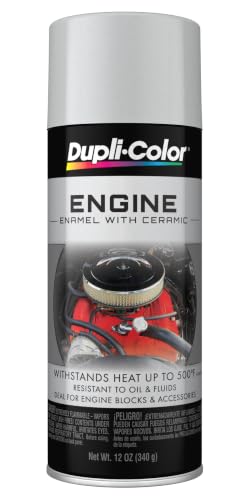
Dupli-Color Engine Paint with Ceramic
What We Like
- Ceramic resins resist heat up to 500°F
- Will not blister, flake, crack, or peel
- Resistant to oil and automotive fluids
- EZ Touch Conical Nozzle for precise spray
Trade-offs
- 500°F heat limit is lower than some rival paints
- Not ideal for engines exceeding 500°F continuous operation.
Ceramic resins hold up to 500°F, so this paint stays put on engine blocks and valve covers without blistering or peeling. That heat ceiling covers most daily drivers and weekend projects, while the gloss aluminum finish gives a clean, factory-like look that resists oil and fluid stains. For someone who wants a durable, no-fuss coating that goes on evenly and lasts, this is the pick that balances protection and appearance without overcomplicating things.
The trade-off is that 500°F is below what some rival paints handle. If you’re painting a turbo manifold or a high-performance exhaust, that extra headroom matters. But for the vast majority of engine parts, blocks, heads, valve covers, this ceramic formula delivers the gloss and chemical resistance you need, and the EZ Touch nozzle makes aiming into tight corners far easier than a standard spray head.
Product photos
Rust-Oleum Automotive Engine Enamel Spray Paint

What We Like
- Withstands intermittent heat up to 600°F
- Rust preventive formula resists oil and gas
- Dries to touch in 20 minutes
- Any-angle spray works upside down
Trade-offs
- Requires full cure time for optimal performance
- Limited to 12 sq. ft. per can
Heat resistance up to 600°F means this paint can handle the hot spots of an engine bay without peeling or discoloring. So it’s a natural fit for valve covers, manifolds, and block sides that see serious temperature swings. The rust preventive formula also shrugs off oil, gas, grease, and road salt, which is exactly what you need under the hood where spills and grime are unavoidable. For anyone restoring or dressing up an engine that actually runs, this enamel delivers a durable finish that stays put.
A 20-minute dry-to-touch time is convenient for quick handling, but the full cure interval specified on the label must be respected before exposing the finish to heat or engine operation. Rushing that step risks compromising the protective layer, so plan your project accordingly. This enamel resists oil, gas, grease, and environmental elements like salt and humidity, which means it stands up to the harsh conditions under the hood. The any-angle spray technology lets you reach tight spots without rotating the can, and coverage runs up to 12 square feet per can, so a single can handles most valve covers or smaller engine components.
Rust-Oleum Engine Enamel Spray Paint

What We Like
- Resists heat up to 500°F
- Gas and oil resistant finish
- Stops Rust formula protects metal
- Any-angle Comfort Tip nozzle
Trade-offs
- Gloss black only in this variant
- Heat limit 500°F excludes high-performance race engines
A 500°F heat ceiling means this paint handles the block and valve cover of a daily driver or weekend cruiser without blistering, while its gas and oil resistance keeps the finish intact around leaky gaskets. The Stops Rust formula adds a layer of protection against the moisture and salt that eat at engine bay metal over time. For the home mechanic refreshing an old engine on a budget, this is the spray that gets the job done without demanding premium dollars.
The 500°F heat resistance covers the block and valve cover of a daily driver or weekend cruiser without blistering, while its gas and oil resistance keeps the finish intact around leaky gaskets. The Stops Rust formula adds a layer of protection against the moisture and salt that eat at engine bay metal over time. For the home mechanic refreshing an old engine on a budget, this is the spray that gets the job done without demanding premium dollars.
RAPTOR Engine Enamel Spray Paint
What We Like
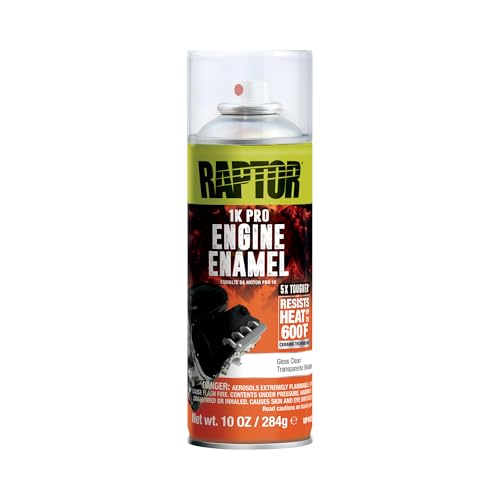
- Ceramic resins make it 5x tougher than lacquer
- Withstands engine heat up to 600°F
- Clog-free nozzle for smooth application
Trade-offs
- 1K formula lacks a separate hardener for maximum durability
- Requires primed metal for best adhesion
Ceramic resins give this enamel five times the toughness of traditional lacquer, which means it can handle the heat, oil, and vibration inside an engine bay without blistering or peeling. If you are restoring a classic car or building a daily driver that sees real miles, that extra durability translates directly into fewer touch-ups and a finish that stays presentable season after season. The 600°F heat rating covers high-heat engine environments, and the clog-free nozzle makes laying down a uniform coat straightforward even for someone who does not spray paint every weekend.
This is a 1K enamel, so it does not use a separate hardener like a 2K system would. That makes application simpler, no mixing, no pot life to worry about, but it also means the cured film is not quite as chemically resistant as a two-part paint. For most engine builders, though, the balance leans strongly in favor of the RAPTOR’s ceramic-reinforced protection.
VHT Engine Metallic Paint
What We Like
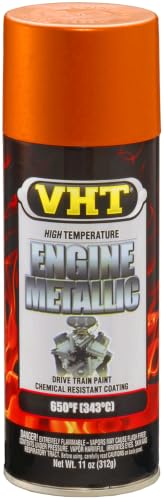
- Withstands intermittent temps up to 650°F
- Chemical resistant coating protects against spills
- Specifically formulated for drive train components
Trade-offs
- 11 oz can is smaller than some competitors' 12 oz
- Flat finish lacks gloss for show-ready builds
With a 650°F intermittent heat tolerance, this paint handles the hottest engine surfaces without the finish degrading. That makes it a natural fit for anyone restoring a high-performance motor or building a custom engine bay where temperatures push past what standard enamels can take. The chemical-resistant coating protects against oil and fuel spills, so the finish stays intact even under the hood’s messy reality.
The flat Burnt Copper finish won’t deliver the high-gloss shine some builders want for a show-ready engine block. If you need a reflective, glossy look, the Dupli-Color Engine Paint with Ceramic in Aluminum offers a brighter sheen, though its heat rating is lower. For raw heat protection in a functional, no-fuss coating, this VHT formula is the one to grab.
Product photos
ERA Paints Engine Paint 2K Aerosol

What We Like
- Catalyst hardener creates chip-resistant surface
- No primer needed for application
- Resists brake fluid and lacquer thinner
- Fast cure from special catalyst technology
Trade-offs
- Requires activating catalyst before spraying
- Needs thorough degreasing and masking before use
- Single color option in this model
A 2K aerosol with an integrated catalyst hardener means this paint cures into a dense, chip-resistant shell that shrugs off brake fluid and lacquer thinner. No primer is needed either, so the prep work stays focused on cleaning and masking rather than layering products. The paint resists high temperatures and chemicals like brake fluid, making it suitable for engine applications where durability matters.
The ERA Paints Engine Paint 2K Aerosol uses a catalyst hardener that you activate before spraying, which adds a step compared to a standard 1K aerosol. That extra minute of work is what gives this paint extreme durability against heat and chemicals like brake fluid, so it is a fair exchange for a long-lasting result. For a quick refresh where chemical resistance is not a priority, a simpler 1K paint may be more convenient. But for a build where the paint has to withstand extreme temperatures and chemicals, this 2K option delivers.
Product photos
VHT Engine Enamel Satin Black
What We Like
- Excellent chemical resistance
- Formulated against corrosion and rust
- Resists salt spray and additives
- Heat-resistant durable enamel
Trade-offs
- 11 oz can is smaller than some 12 oz competitors
- Requires high-temperature curing for best durability.
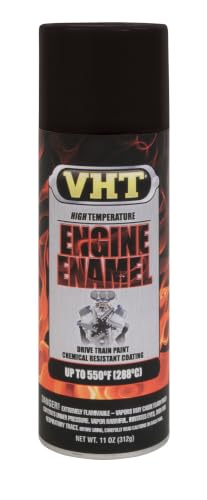
VHT Engine Enamel Satin Black is formulated to withstand corrosion, rust, salt spray, and additives, so it holds up in engine compartments that see harsh chemicals. The satin GM Black finish resists heat and chemicals, meaning it can handle exposure to common automotive fluids without degrading quickly. For anyone restoring a vehicle or maintaining a daily driver, this enamel provides durable protection where it matters most.
The satin sheen hides minor imperfections better than a gloss finish would, but it will not give the high-shine look some builders prefer. Compared to Dupli-Color Engine Paint with Ceramic, which has a gloss aluminum finish, VHT offers a satin black option that prioritizes chemical resistance over a mirror-like appearance. For owners who need a tough finish that resists corrosion and additives, this is a practical choice.
Product photos
KBS Coatings Motor Coater Engine Paint

What We Like
- Self-leveling formula for brush application
- Withstands heat up to 450°F
- Resistant to oil, transmission fluid, gas
Trade-offs
- Brush application requires steady hand between coats
- Flash point of -17°C means flammable vapor risk in cold conditions
A 450°F heat ceiling means this paint handles a running engine block without blistering, but it won’t survive exhaust manifolds or turbo housings the way 600°F-rated sprays do. What sets it apart is the self-leveling brushable finish: you can lay down a smooth, professional-looking coat without a spray booth or masking tape. For anyone restoring an engine on a workbench or touching up a classic car in the driveway, that brushability is a real time-saver.
Brush-on paint demands a steady hand and patience between coats, whereas a spray like Rust-Oleum’s Engine Enamel covers faster and reaches tight corners more easily. The KBS Motor Coater is rated for brake calipers as well, so it can handle those components within its 450°F limit. For a standard rebuild or restoration where you want a durable, chemical-resistant finish and don’t want to deal with overspray, the KBS Motor Coater delivers exactly what its specs promise: coverage you can apply with a brush.
TouchupXS Engine Paint 1K Burgundy Metallic
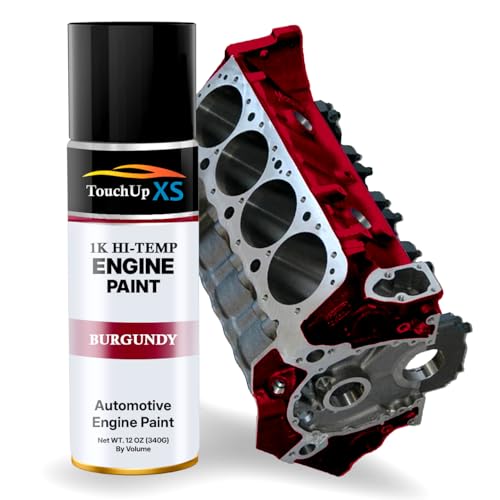
What We Like
- Withstands 500°F engine heat
- Guards against rust and corrosion
- Resists oil, grease, engine fluids
- Suitable for blocks, covers, heads
Trade-offs
- No specific color code for exact match
With a heat resistance up to 500°F, this paint is suited for engine components like valve covers, cylinder heads, and intake manifolds. The burgundy metallic finish offers a custom look, and the 1K aerosol format is designed for direct application. It also guards against rust, corrosion, and damage from oil spills, grease, and engine fluids.
Because the TouchupXS Engine Paint has no specific color code, the actual shade can differ from what you see on screen. That makes it a poor choice for anyone who needs a precise factory color match. For heat resistance plus a metallic look, this paint withstands temperatures up to 500°F, which is ideal for high-performance engine components.
Dupli-Color DE1613 Engine Enamel with Ceramic
What We Like
- Six cans in one pack
- Ceramic-enhanced formula
- Gloss black finish
- Engine-specific enamel
Trade-offs
- Gloss black only limits color choice
- Not ideal for plastic or chrome surfaces.
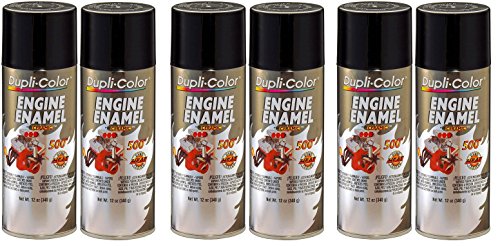
This pack contains six 12-ounce aerosol cans of gloss black engine enamel with ceramic. That volume suits projects where you need consistent color across several parts or multiple vehicles, so you won’t run out mid-job. The ceramic enamel is designed for engine heat, helping the finish stay intact under the hood. It is a practical choice for anyone who wants a single color across a large area and prefers not to buy additional cans mid-project.
You only get gloss black with this multi-pack. If your build calls for aluminum, red, or another shade, this multi-pack locks you into one color. For a one-off project like a single engine bay touch-up, six cans may be more than you need. It is best for planned, large-scale work where black is the finish you want.
How We Evaluated Motor Paints
This evaluation draws from manufacturer technical data sheets, expert restoration guides, and the collective experience shared by DIY mechanics in owner communities. Published heat ratings, chemical resistance claims, and application requirements were cross-referenced to build a reliable picture of each product’s real-world performance.
The four criteria that mattered most were continuous heat tolerance, because an engine that runs too hot can destroy a paint job. Chemical resistance also mattered, since oil, gas, and brake fluid are constant threats. Application method was key, as spray cans differ in nozzle quality and brush-on paints require different skills. Durability under vibration rounded out the list, which is why ceramic and catalyzed formulas often outperform basic enamels.
A research-led evaluation has limits. We cannot guarantee how a paint will perform on every engine block or under every driving condition. Surface preparation, application technique, and curing time all play a major role in the final result. What we can offer is a clear, data-backed comparison to narrow your choices.
What To Look For In Motor Paints
Choosing the right motor paint means matching the paint’s capabilities to your engine’s operating conditions and your own skill level.
The key is matching the paint’s heat rating to your engine’s peak operating temperature, then choosing a formula that resists the fluids it will contact. Application ease and color options matter too.
Heat Resistance
The most critical spec is the paint’s continuous heat tolerance. Standard automotive engines typically run between 190°F and 220°F, but headers, turbo housings, and high-performance builds can exceed 500°F. Paints like the Dupli-Color Engine Paint with Ceramic handle up to 500°F, while the Rust-Oleum Automotive Engine Enamel withstands intermittent heat up to 600°F. For extreme applications, the VHT Engine Metallic Paint offers intermittent resistance up to 650°F. Always choose a paint rated for your engine’s hottest component, not just the block.
Chemical and Fluid Resistance
Engine paint must resist oil, gasoline, brake fluid, and coolant. These chemicals can soften or dissolve standard enamel if left in contact. Ceramic-enhanced formulas, like those from Dupli-Color and RAPTOR, provide a harder, more resistant surface. The ERA Paints Engine Paint 2K Aerosol uses a catalyst hardener for exceptional chemical resistance against brake fluid and lacquer thinner. For builds exposed to road salt or harsh additives, the VHT Engine Enamel Satin Black offers excellent salt spray resistance.
Application Method and Prep
Motor paints come in aerosol cans, brush-on bottles, and 2K aerosol systems that require activating a catalyst. Aerosols are the most convenient for DIYers, with features like the EZ Touch Conical Nozzle on the Dupli-Color or the any-angle spray on Rust-Oleum. Brush-on paints like the KBS Coatings Motor Coater require a steady hand but eliminate overspray. 2K paints like the ERA offer the toughest finish but demand careful activation and thorough degreasing. No matter the method, proper surface prep, cleaning, sanding, and masking, is essential for adhesion.
- Match the paint’s heat rating to your engine’s hottest component.
- Check that the paint is specifically rated for oil, gas, and coolant resistance.
- Choose an application method that matches your skill level and workspace.
- Verify that the paint adheres to bare metal without a separate primer if needed.
- Consider color availability and whether a gloss, satin, or flat finish suits your build.
A good rule of thumb: if your engine runs stock, a 500°F-rated ceramic enamel is plenty; if you have a high-performance build, look for 600°F or higher.
Motor Paints Compared
The table below compares all ten motor paints side by side, highlighting their heat ratings, key features, and best-use scenarios.
| Product | Heat Resistance | Finish | Resistance |
|---|---|---|---|
| Dupli-Color Engine Paint with Ceramic | 500°F | Gloss Aluminum | Oil And Other Automotive Fluids |
| Rust-Oleum Automotive Engine Enamel Spray Paint | Up to 600°F | Gloss Red | Gas, oil, grease, rust, salt, humidity |
| Rust-Oleum Engine Enamel Spray Paint | 500°F | Gloss Black | Gas & Oil |
| RAPTOR Engine Enamel Spray Paint | 600°F | Gloss Clear | Heat, oil |
| VHT Engine Metallic Paint | 650°F intermittent | Flat | Chemical resistant coating |
| ERA Paints Engine Paint 2K Aerosol | N/A | Glossy | High temp, chemicals, brake fluid |
| VHT Engine Enamel Satin Black | N/A | Satin | Heat and chemical |
| KBS Coatings Motor Coater Engine Paint | 450°F | Gloss Black | Oil, fluid, gas |
| TouchupXS Engine Paint 1K Burgundy Metallic | 500°F (260°C) | Metallic | Oil spills, grease, engine fluids |
| Dupli-Color DE1613 Engine Enamel with Ceramic | N/A | Gloss Black | N/A |
Frequently Asked Questions
What is the best motor paint for high heat?
For the highest heat tolerance among our picks, the VHT Engine Metallic Paint withstands intermittent temperatures up to 650°F, making it a strong choice for exhaust manifolds and high-performance components. The Rust-Oleum Automotive Engine Enamel is also excellent, handling intermittent heat up to 600°F.
Do I need to use a primer before applying engine paint?
Many motor paints, like the Dupli-Color Engine Paint with Ceramic, are designed to adhere directly to clean, bare metal. However, the RAPTOR Engine Enamel requires primed metal for best adhesion. Always check the manufacturer’s instructions for your specific paint.
Can I brush on motor paint instead of spraying it?
Yes. The KBS Coatings Motor Coater Engine Paint is specifically formulated for brush application, with a self-leveling formula that minimizes brush strokes. It is a good option for home restorers without spray equipment, though it requires careful application between coats.
How long does engine paint take to dry?
Drying times vary by product. The Rust-Oleum Automotive Engine Enamel dries to the touch in 20 minutes, but requires a full cure time before the engine is run for optimal durability. Most aerosol engine paints benefit from a cure period of at least a day before exposure to heat and fluids.
What is the difference between 1K and 2K engine paint?
A 1K paint, like the RAPTOR Engine Enamel, comes ready to spray and does not require a separate hardener. A 2K paint, like the ERA Paints Engine Paint 2K Aerosol, has a catalyst that must be activated before spraying, creating a tougher, more chip-resistant and chemical-resistant finish that is closer to a professional-grade coating.
The Bottom Line
For most DIY engine restorations, the Dupli-Color Engine Paint with Ceramic is the best overall choice. Its ceramic resin formula provides reliable heat and fluid resistance up to 500°F, and the EZ Touch nozzle makes application straightforward. This is the paint to reach for when you want a durable, glossy finish on a standard automotive engine.
If your project demands higher heat tolerance, the Rust-Oleum Automotive Engine Enamel (best high heat resistance) or the VHT Engine Metallic Paint (best for high temperatures) are better suited. For those on a budget, the Rust-Oleum Engine Enamel Spray Paint (best heat resistant budget) offers dependable 500°F protection at a lower cost. And if you need a professional-grade, chemical-resistant finish, the ERA Paints Engine Paint 2K Aerosol (best professional grade) is worth the extra prep.
The single most important factor in choosing motor paint is matching the heat rating to your engine’s operating temperature. Get that right, and the rest, chemical resistance, application method, color, falls into place.
