
Fire Retardant Paint Guide: What the Spec Sheets Say
This post contains affiliate links. As an Amazon Associate, we earn from qualifying purchases.
A fire retardant paint guide starts with the application sheet, not the label. Firefree Class A reaches its Class A rating at 6 mils dry film thickness, Protecta Interior Paint FR-1 needs 310 to 520 g/m2 wet on bare wood, and NBS Report 6885 found conventional flat paint matched fire retardant paint at the same heavy coverage.
Those three numbers decide the whole category, which is the fire retardant paint guide question. Every product below gets judged on a wet rate, a substrate, and a cure window, and none of that appears on the front of the can. Get the rate wrong and the film behaves like ordinary latex paint, which is the finding that still makes a National Bureau of Standards report worth reading.
What follows: five products, the four specs that actually decide performance, and the places where the manufacturers flatly contradict each other. By the end you’ll read any fire retardant can in about a minute and know whether it belongs on your wall.
Key Takeaways
- Coverage rate beats brand name. NBS Report 6885 found conventional flat alkyd and latex paints performed comparably to fire retardant coatings at the same heavy coverage, with one intumescent system as the exception.
- Firefree Class A hits Class A at 6 mils dry, and any exterior use requires the Firefree Exterior (FfE) topcoat tested to ASTM D2898 Method B.
- Wood moisture limits split hard: 12% or less for Firefree Class A, 25% or less for the Fire-Shield 1500 spec.
- One freeze ruins the can. Interchar says frozen material must be discarded and never thawed and applied.
- California Building Code Chapter 7A does not permit coatings as a compliance method in wildfire-prone construction, whatever the label implies.
What the Fire Retardant Paint Label Leaves Out
The useful information on a fire retardant can sits in the application sheet, not on the front, as any fire retardant paint guide will tell you. Firefree Class A is a water-based latex intumescent coating, and its Class A rating only holds at 6 mils dry film thickness.
An intumescent coating forms a char layer when heated. The NFPA coatings fact sheet reports that intumescent films can swell up to 20 times their original dry-film thickness. That swelling insulates the wood underneath and slows the spread of flame across the surface. Firefree Class A reaches its Class A rating at 6 mils dry film thickness.
The NFPA coatings fact sheet is blunt about the limits of the whole category. It notes that gel coatings protect for a matter of hours, and it recommends ember-resistant design features and a maintained home ignition zone ahead of any coating.
That 6 mils figure is doing a lot of work. Firefree’s own instructions say the product needs an experienced, professional painter working in strict compliance with the recommended thickness.
Which Fire Retardant Paint Fits Your Surface?
Match the product to the substrate first, then to the room. Protecta Interior Paint FR-1 wants wood-based board at least 12 mm thick and 510 kg/m3 or denser, while Protega Wood-S takes 8 mm board at 338 kg/m3 and up.
| Product | Rated for | Wet rate on bare wood |
|---|---|---|
| Firefree Class A | Interior; exterior with FfE topcoat | Class A at 6 mils dry |
| Protecta Interior Paint FR-1 | Indoor, Type Z2 conditions | 310-520 g/m2 (220-370 microns) |
| Protega Wood-S | Indoor only, any colour | 400 g/m2 plus 100 g/m2 topcoat |
| International Fire-Shield 1500 | Interior trim, wainscot, paneling | 190 ft2 per gallon |
Bare Wood, Acrylic, or Solvent-Based
Protecta is the clearest example of why the substrate line matters. On bare wood it goes on at 310 to 520 g/m2 wet, which works out to 220-370 microns of wet film.
Over Dulux Endurance+ Matt acrylic the rate drops to 390 g/m2, or 280 microns. Over Dulux Trade Satinwood, a solvent-based paint, it’s the same 390 g/m2 and 280 microns. Same product, three different numbers depending on what’s underneath.
The fire class shifts too. Protecta reaches B-s1,d0 on bare wood and over acrylic, but only B-s2,d0 over solvent-based paint. Any existing coating that isn’t one of those named paints has to come off completely first.
If you’re coating trim, doors, or paneling rather than a flat wall, the fire retardant paint for wood breakdown sorts the same products by substrate.
A mantel or surround near a firebox is a separate problem from a wall, and fireplace paint covers the surfaces that see radiant heat rather than flame.
Why the Coverage Rate Decides Whether It Works
250 square feet per gallon per coat. That’s the coverage NBS Report 6885 used when it tested fire retardant and conventional paints side by side, with 72 hours of drying between coats.
The study’s second conclusion is the one worth taping to a shelf. Fire retardant effectiveness depends heavily on coverage rate, substrate type and density, coating composition, and the undercoat-overcoat combination. Four variables, and the brand name isn’t one of them.
Think of it like building a pot of soup. You add stock in stages and taste as you go. Dumping every ingredient in during the first minute gives you a different dish, and a coating applied in one starving pass gives you a different film.
I picked a satin finish off a tiny chip once. It looked soft and pretty. On a full 12-foot wall with a window across from it, it turned into a mirror for every roller mark.
Now I paint a sample board roughly 2×3 feet, tape it to the wall, and walk past it morning and evening. Sheen shows up at angles, not head-on, and a chip never shows you that. A wet film works the same way: the rate is invisible from straight on.
Three things move the result more than the logo on the can:
- Wet film thickness, which you can check with a gauge before the coat sets.
- Substrate density and thickness, because a thin board pulls heat differently than a dense one.
- The undercoat and overcoat pairing, which the Protecta rates above show changing a fire class.
A coat applied too thin reads flat and dry within the hour, and the grain shadow still shows through it. That’s the look of a film that won’t swell when it needs to.
Does Fire Retardant Paint Actually Beat Regular Paint?
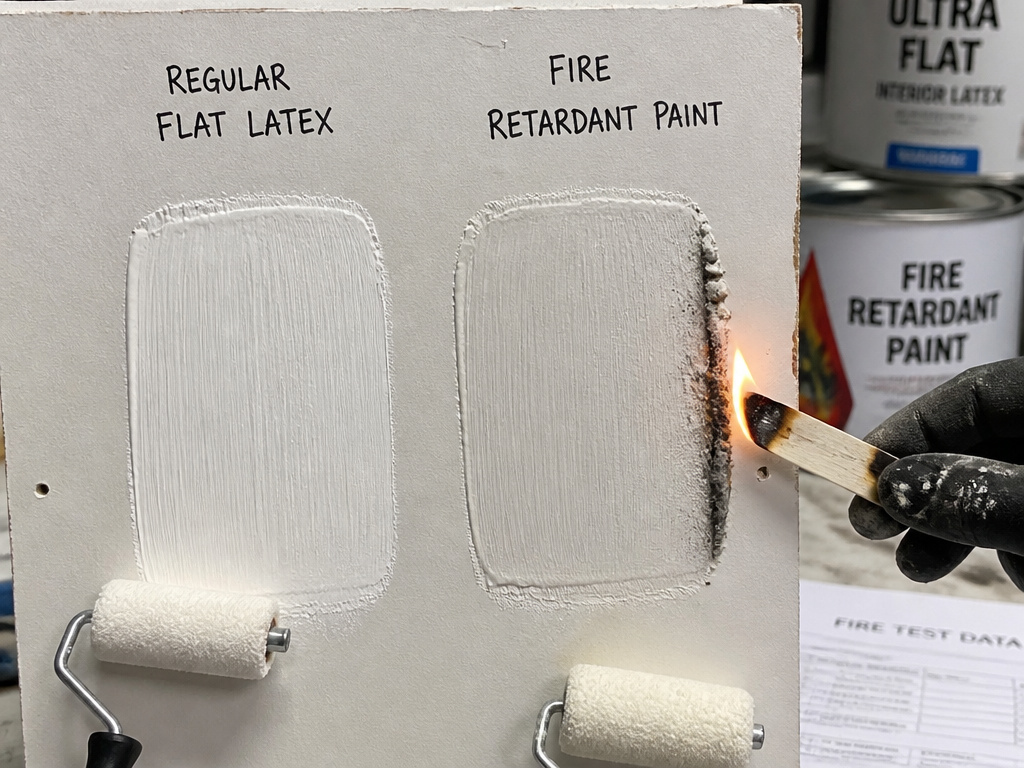
At equal heavy coverage, the NBS data says no for most of the products tested. Conventional flat alkyd and latex paints performed comparably to fire retardant coatings, with one intumescent system as the exception.
That’s an uncomfortable finding if you’ve just bought a pail. The NIST surface flammability report is public, and it’s the reason the coverage rate argument keeps coming back.
Skip fire retardant paint on a wall you’re repainting for looks. The film costs more, cures slower, and the NBS work says ordinary flat latex at the same heavy rate lands in a similar range. Buy it when a code, an inspector, or a real ignition risk is asking for it by name.
The exception matters, though. One intumescent system in that study was the exception, and intumescent chemistry is exactly what Firefree, Protecta, and Protega all sell. The category isn’t useless. It’s just narrower than the marketing.
Where the Manufacturers Disagree (and Why You Should Care)
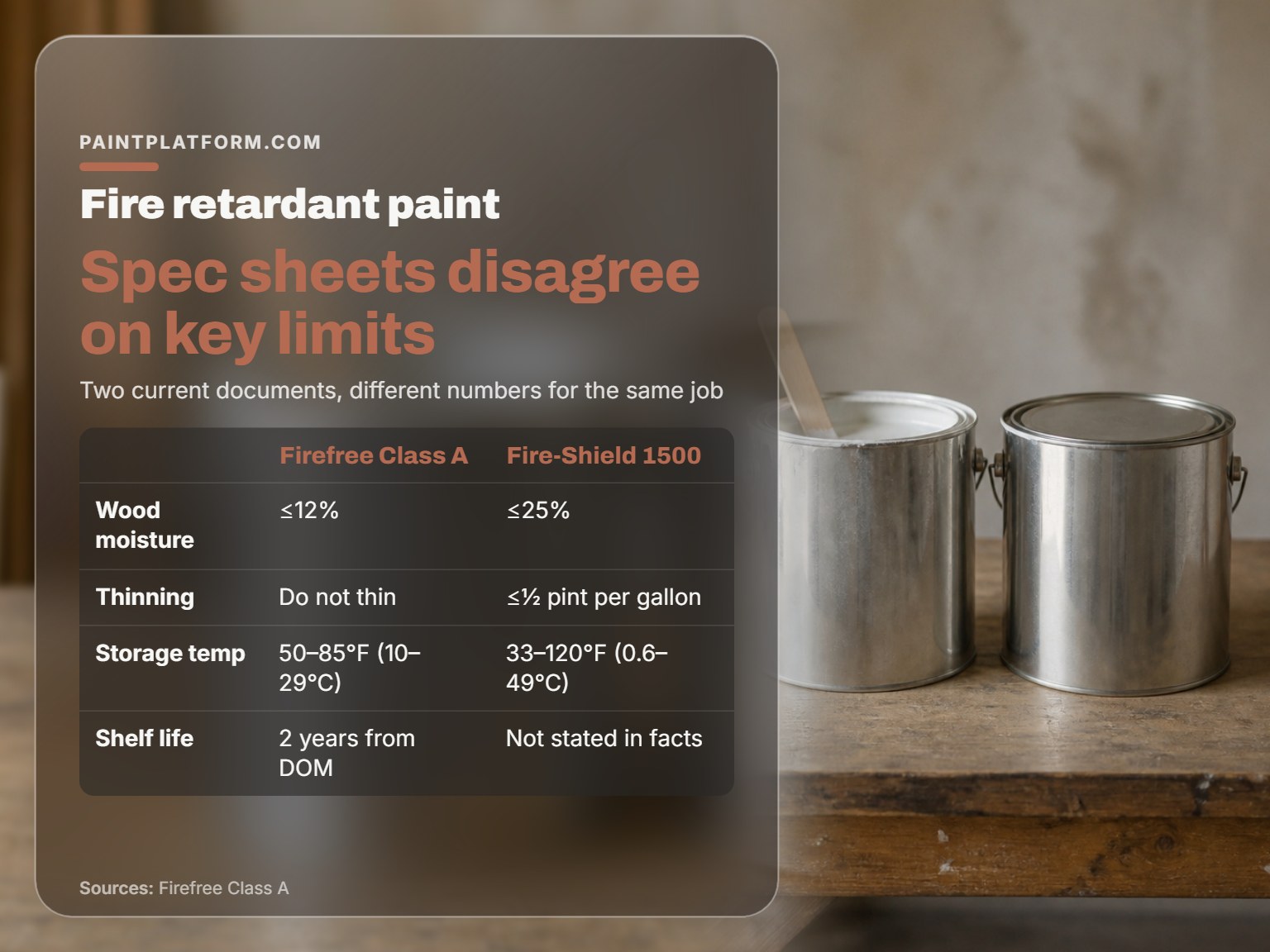
The spec sheets contradict each other, and every one of those documents is current.
| Spec | What the documents say | Who says it |
|---|---|---|
| Wood moisture | 12% or less | Firefree Class A |
| Wood moisture | 25% or less | Fire-Shield 1500 spec |
| Minimum wood thickness | 12 mm | Protecta FR-1 |
| Minimum wood thickness | 8 mm (6 mm on A1/A2) | Protega Wood-S |
| Thinning | Do not thin at all | Firefree Class A |
| Thinning | Up to 1/2 pint water per gallon | Fire-Shield 1500 spec |
Relative humidity splits three ways. Firefree says don’t apply above 75%. Interchar says apply below 80%. Protecta’s Type Z2 category covers internal conditions below 85% RH.
Storage limits divide the same way. Firefree wants 50-85 F (10-29 C), Interchar wants 4-25 C (39-77 F), and the Fire-Shield spec allows 33-120 F (0.6-49 C). If you’re also handling heat resistant paint on the same job, don’t assume the storage rules carry across.
Shelf life is the widest gap. Firefree states 2 years from date of manufacture. Interchar states 12 months at 25 C. The USDA Forest Service Forest Products Laboratory, cited in the NFPA fact sheet, reported that fire retardant coatings have an uncertain shelf life in exterior use and would need regular reapplication.
Use the strictest number in the group when two products share a wall: Firefree Class A requires wood moisture of 12% or less, while the Fire-Shield 1500 spec allows up to 25%, so dry to 12% and you satisfy both documents at once.
The Recoat Window Nobody Plans For

The first coat looks dry at hour two. The surface has stopped throwing light back, the sheen is gone, and your hand says it’s finished.
Small confession: I rushed a second layer once while the first was still damp and lifted the color underneath. An hour of work gone in about four seconds. Now I press the back of my hand to the surface before I load the brush again.
With an intumescent film the stakes are higher than lifted color. Fire-Shield 1500 gives 2 to 4 hours before the second coat. Interchar recommends 4 air exchanges per hour during application, and warns that portable fans in direct contact cause skinning or wrinkling. That last one runs against instinct, since more airflow usually reads as faster drying.
Where this goes sideways: Recoating before the film has released its water traps moisture under a skin. The surface looks set, then blushes chalky white within a day or two.
The paint fumes safety basics apply here too, especially the air-exchange number, because a slow-curing film in a closed room is a ventilation problem as much as a coating problem.
Here’s the sequence I’d follow on any panel:
- Check wood moisture with a pin meter before the can is open. Over 12% for Firefree, stop and wait.
- Apply the first coat at the rate on the sheet, not at the rate that feels comfortable.
- Wait the full low-end window, then test with the back of your hand rather than a fingertip.
- Keep heavy moisture off the film for at least 10 days after the last coat, per Firefree’s instructions.
Can You Use It Outside or in a Wildfire Zone?
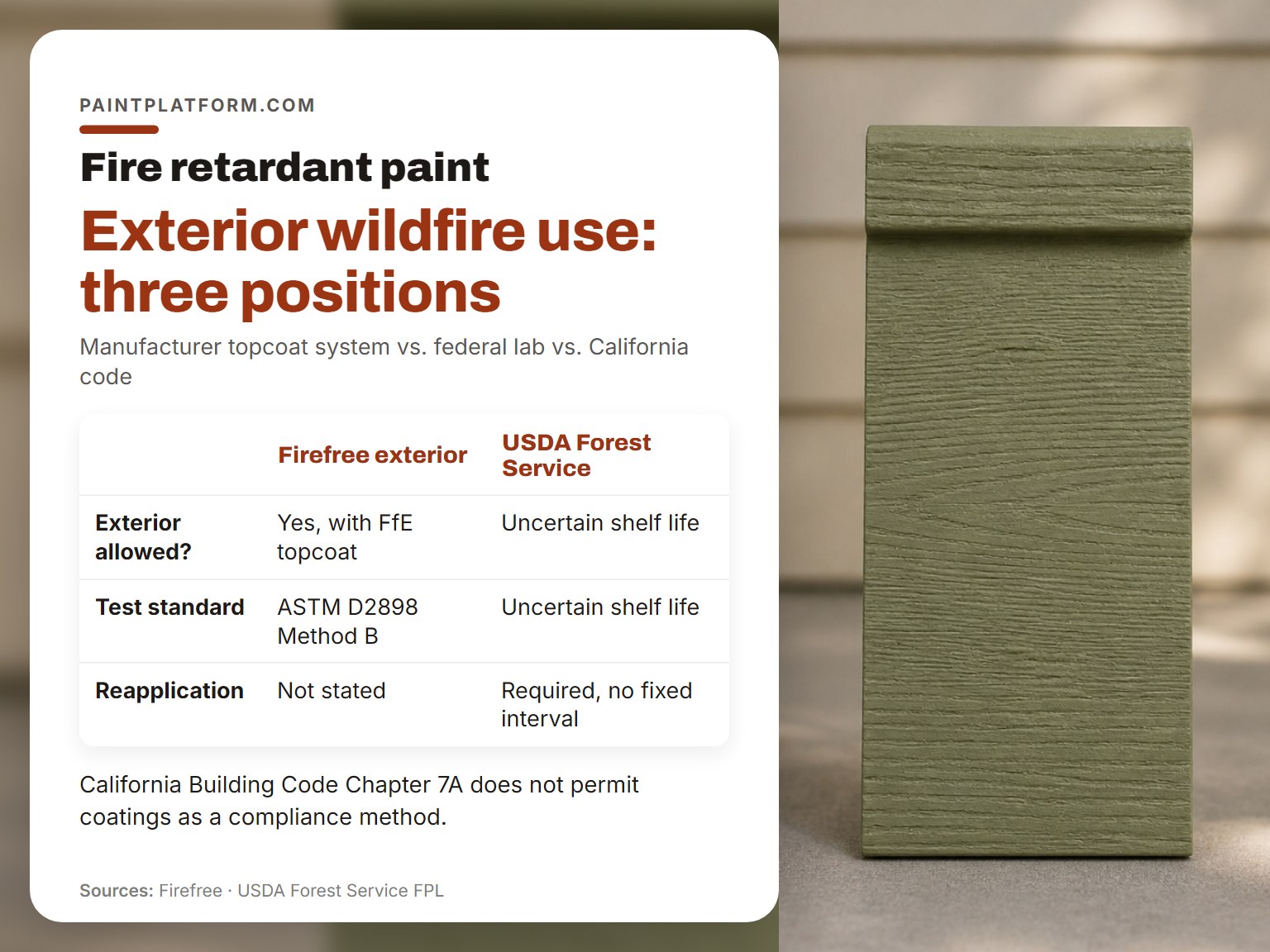
Exterior use is where the documents split hardest, and the split isn’t a matter of interpretation. Firefree supports exterior wildland-urban interface work only when the Firefree Exterior (FfE) acrylic topcoat goes over the Class A base, and that topcoat is tested to ASTM D2898 Method B.
The California Rule
California Building Code Chapter 7A does not permit coatings as a compliance method for wildfire-prone construction. Firefree Class A is listed by the California State Fire Marshal and listed and inspected by the International Code Council, and it complies with the ASTM E84 Extended 30-minute test. Both of those things are true at the same time as the Chapter 7A exclusion.
Skip this if: You’re in a Chapter 7A zone and counting on a coating to satisfy the code. The coating may still be worth applying for extra protection, but it will not be the thing that passes your inspection.
What the Forest Service Says
The USDA Forest Service Forest Products Laboratory reported an uncertain shelf life for fire retardant coatings in exterior use, plus a need for regular reapplication, with no fixed interval given. The NFPA fact sheet goes further and recommends ember-resistant design features and home ignition zones ahead of coatings as a strategy.
So you have three positions that don’t reconcile: a manufacturer with a tested topcoat system, a federal lab saying exterior life is unpredictable, and a state code that won’t accept coatings at all. Plan for the strictest one that applies to your address.
Frequently Asked Questions
How long does fire retardant paint last?
Protecta Interior Paint FR-1 has a stated working life of at least 5 years, and Protega Wood-S has an assumed intended working life of 5 years. In exterior use, the USDA Forest Service Forest Products Laboratory reported an uncertain shelf life with a need for regular reapplication.
Does fire retardant paint work on drywall?
The European assessments here are written for wood-based substrates plus any A1 or A2-s1,d0 substrate. Protecta FR-1 requires wood at least 12 mm thick and 510 kg/m3 dense. Drywall isn’t a wood-based board, so that classification doesn’t automatically carry over. Get the manufacturer’s written confirmation before you specify it.
Can I apply fire retardant paint myself?
Firefree Class A calls for an experienced, professional painter working in strict compliance with the instructions and the recommended thickness. The Fire-Shield 1500 specification requires an applicator certified by the manufacturer. Protecta FR-1 can go on by brush, roller, or spray gun, but the wet rate still has to be hit.
What happens if fire retardant paint freezes?
Firefree Class A cannot be exposed to freezing temperatures, and application during extreme weather including winter isn’t recommended. Interchar is harsher: frozen material shall be discarded and never thawed and applied. For Interchar, frozen material shall be discarded and never thawed and applied.
Is fire retardant paint the same as heat resistant paint?
No. Fire retardant coatings are rated on reaction to fire, which is how a surface contributes to flame spread. Heat resistant coatings are rated on surviving high temperature without failing. A wood substrate and a firebox surround are different problems with different products.
The Bottom Line
Here’s the trigger I’d use. If a code official, an inspector, or an insurance document is asking for a rating, buy the product whose sheet matches your substrate and hire the applicator that sheet requires. If nobody is asking, ordinary flat latex applied at a heavy rate gets you closer than the marketing suggests, and the NBS data says so out loud.
The concession is real, though. Everything above assumes an interior wall in a normal room. Drop below freezing during application, push past the relative-humidity limit (75% for Firefree Class A, 80% for Interchar, 85% for Protecta’s Type Z2), or work in a Chapter 7A zone, and the calculus changes completely.
Start with one panel. Coat a scrap of the actual board you’re painting, at the rate printed on the sheet, and look at it in daylight tomorrow. That single habit has saved me more rework than any product choice I’ve ever made.
