
Glow in the Dark Paint Guide: 2 to 8 Hours
This post contains affiliate links. As an Amazon Associate, we earn from qualifying purchases.
Glow in the dark paint guide, short version: phosphorescent paint stores light and gives it back slowly, and the can tells you how slowly. Rust-Oleum Specialty brush-on is rated up to 2 hours, Glow In The Dark Max 4 to 8 hours. A white undercoat and a full charge decide the rest.
That charge is where the marketing numbers in this glow in the dark paint guide start to wobble. Rust-Oleum’s catalog says to let a painted object sit in light for several hours, while a craft retailer argues a household bulb never gets the pigment to full output at all. Both can be true, because zinc sulfide responds most strongly to deep blue and ultraviolet light.
What follows compares the three Rust-Oleum formulas on glow time and coverage, walks the prep that decides whether the glow reads at all, and lays out the places where the manufacturers contradict each other outright.
Key Takeaways
- Glow time is a product spec, not a paint property. Brush-on runs up to 2 hours, Imagine 2 to 4 hours, Max 4 to 8 hours under what the sheets call optimal conditions.
- White undercoat first, always. NIST and every Rust-Oleum sheet agree the surface changes the brightness, so glow output isn’t fixed by the paint alone.
- The recoat interval is contested. Rust-Oleum says two coats 45 minutes apart. Art ‘n Glow says 10 to 15 minutes.
- Humidity ceilings differ by SKU. Below 85% for the brush-on label, below 65% for the Max aerosol.
- Outdoor glow is a maintenance item. Rust-Oleum states periodic re-application may be needed for outdoor use and gives no interval.
Glow in the Dark Paint Guide: How Long Does It Actually Glow?
Up to 2 hours for Rust-Oleum Specialty brush-on, 2 to 4 hours for Imagine, and 4 to 8 hours for Glow In The Dark Max. Those are the manufacturer’s own ratings, and they’re the only numbers worth planning a project around.
Phosphorescent paint absorbs energy from visible light and releases it slowly as a low-intensity afterglow. Zinc sulfide pigments activate fully after roughly five minutes of exposure, but produce a dim, short-lived glow that fades within hours. Strontium oxide aluminate pigments, the type listed on the Rust-Oleum Imagine data sheet, hold their afterglow longer.
The spread between 2 and 8 hours is real. It comes from the pigment and the film, not from marketing. NIST’s legacy circular on luminous paints puts phosphorescent afterglow somewhere between a few minutes and several hours, which is the same range the cans cover.
The glow in the dark paint category splits into brush-on, aerosol, and craft formulas, and the rated glow time moves with the format.
| Formula | Rated glow | Coverage per can | Dry to touch |
|---|---|---|---|
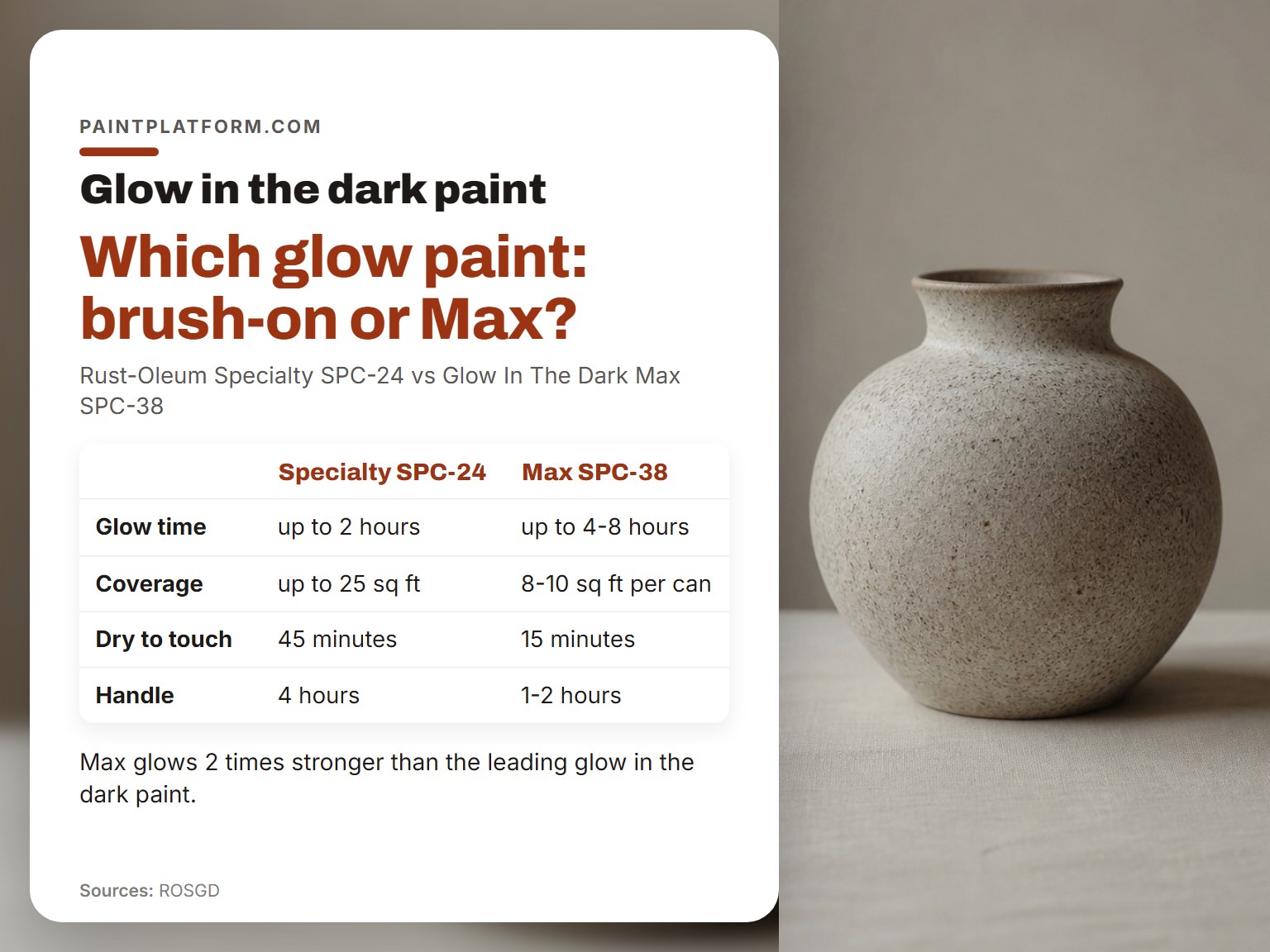
| Rust-Oleum Specialty brush-on (SPC-24) | Up to 2 hours | Up to 25 sq ft | 45 minutes |
| Rust-Oleum Imagine (SPC-87) | 2 to 4 hours | 8 to 10 sq ft | 15 minutes |
| Rust-Oleum Glow In The Dark Max (SPC-38) | 4 to 8 hours | 8 to 10 sq ft | 15 minutes |
Rust-Oleum’s catalog page and its data sheets don’t use identical numbers for overlapping products. Read the sheet that matches the can in your hand.
In a fully dark room the afterglow reads as a soft green wash. Crack a door and it flattens to almost nothing, which is the point NIST makes about the effect being best appreciated in complete darkness.
If you want the long end of that range, the glow in the dark spray paint format is where it lives.
The White Undercoat Does More Work Than the Paint
NIST Letter Circular 703 is blunt about it: the surface under phosphorescent paint changes how bright the paint looks, which is one reason the circular calls for a manufacturer-supplied undercoater.
Every Rust-Oleum sheet says the same thing in fewer words. Use over a white or light colored surface. The 7 oz label goes further and recommends a white Rust-Oleum latex primer for adhesion and hiding, especially on bare wood and metal. Max says a white primer gives the brightest glow.
Wildfire, which makes a different product entirely, recommends Rust-Oleum Universal Acrylic Primer or Zinsser Bulls Eye 1-2-3 under its luminescent paints and says maximum brilliance comes over lighter colors.
The substrate lists don’t match across SKUs, either:
- The Specialty brush-on data sheet lists wood, metal, drywall and plastic.
- The product catalog page lists plaster, masonry and unglazed ceramic.
- Max covers wood, metal, drywall, ceramic, plastic and more.
None of that is cosmetic. A clean, dry, neutral surface is a precondition in NIST’s circular, and a dark or unsealed one swallows the light the pigment just released.
One distinction worth keeping straight. Phosphorescent paint glows on its own after charging. The radioactive luminous paints NIST describes, the kind used on watch dials, carried roughly one part radium to 20,000 parts zinc sulfide base and needed no prior exposure at all. The glow paints sold for craft and home projects are the phosphorescent type.
Two Coats 45 Minutes Apart, or 10 to 15? Where the Sources Split
Two sources answer the recoat question with numbers that can’t both be right. Rust-Oleum’s Specialty Glow In The Dark data sheet says apply two coats 45 minutes apart. Art ‘n Glow, a glow paint retailer that publishes its own tutorials, says 10 to 15 minutes.
The Recoat Interval, Side by Side
Art ‘n Glow’s warning is specific: rushing the second coat removes the glow from the first and leaves a dark spot. That’s a real failure mode.
Rust-Oleum’s 45 minutes is tied to 77 degrees F and 50% relative humidity. Rust-Oleum’s Specialty sheet says two coats 45 minutes apart, while Art ‘n Glow’s tutorial says 10 to 15 minutes, so treat them as two rules from two sources.
When a manufacturer and a tutorial disagree on timing, the can in your hand wins. The tutorial is describing a different product, even when the labels look alike.
How Many Coats Before It Stops Helping
Rust-Oleum says to apply more coats for increased glowing effect. Art ‘n Glow says additional coats after the first three won’t make much difference in brightness.
Rust-Oleum says to apply more coats for increased glowing effect, while Art ‘n Glow says additional coats after the first three won’t make much difference in brightness.
There’s a mechanical reason the coat count matters more than it sounds. Rust-Oleum specifies a dry film thickness of 1.5 to 2.5 mils per coat. Brush a coat too long and you’ve thinned the pigment layer below spec while thinking you were smoothing it.
Overworking a brush is the quiet way to lose glow.
What Temperature and Humidity Do You Actually Need?
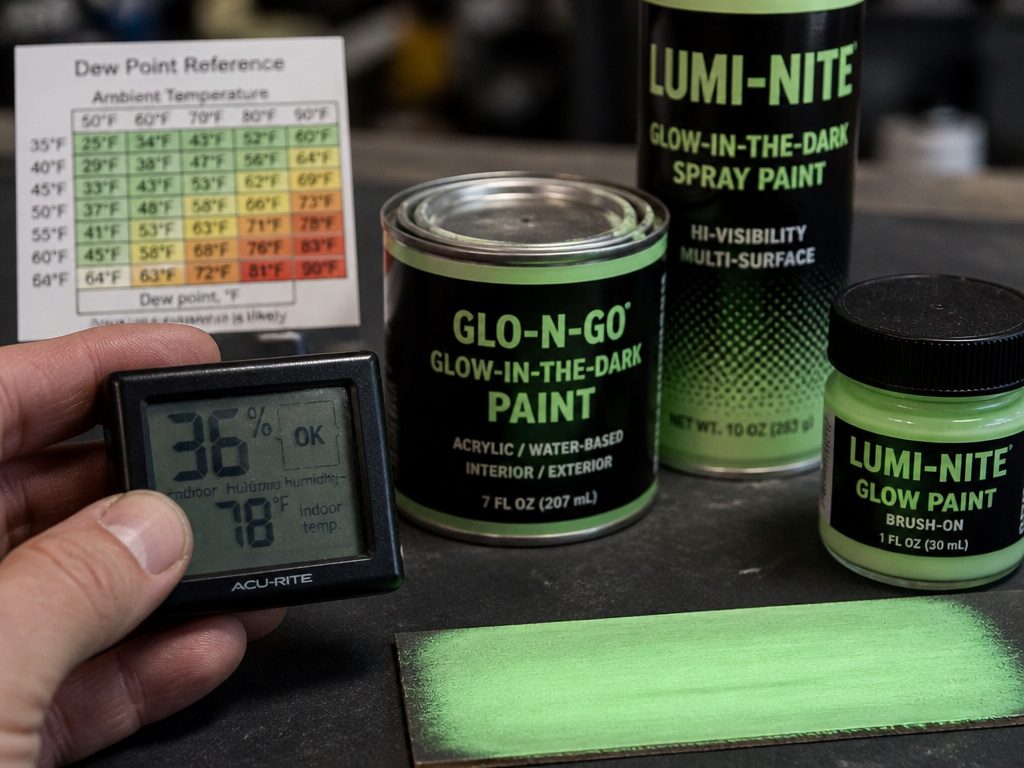
50 to 90 degrees F is the window Rust-Oleum prints on the 7 oz Glow In The Dark label, with humidity below 85%.
That’s the brush-on number. Max aerosol carries a tighter ceiling, below 65% humidity, on the same brand’s data sheet. Wildfire’s luminescent paints want 50 to 85 degrees F, air and surface at least 5 degrees F above the dew point, and an optimal band of 60 to 80 degrees F at 30 to 60% relative humidity.
Three products, three different answers. Pick the one that matches your can.
Easy to miss: A 45-minute recoat time is quoted at 77 degrees F.
Dry times aren’t directly comparable across SKUs either. Specialty brush-on is referenced to 77 degrees F and 50% relative humidity. Max is referenced to 70 to 80 degrees F at 50% relative humidity.
So when one sheet says 45 minutes to touch and another says 15, check the reference conditions before comparing.
The 4-Step Application Order (and the Step Everyone Rushes)
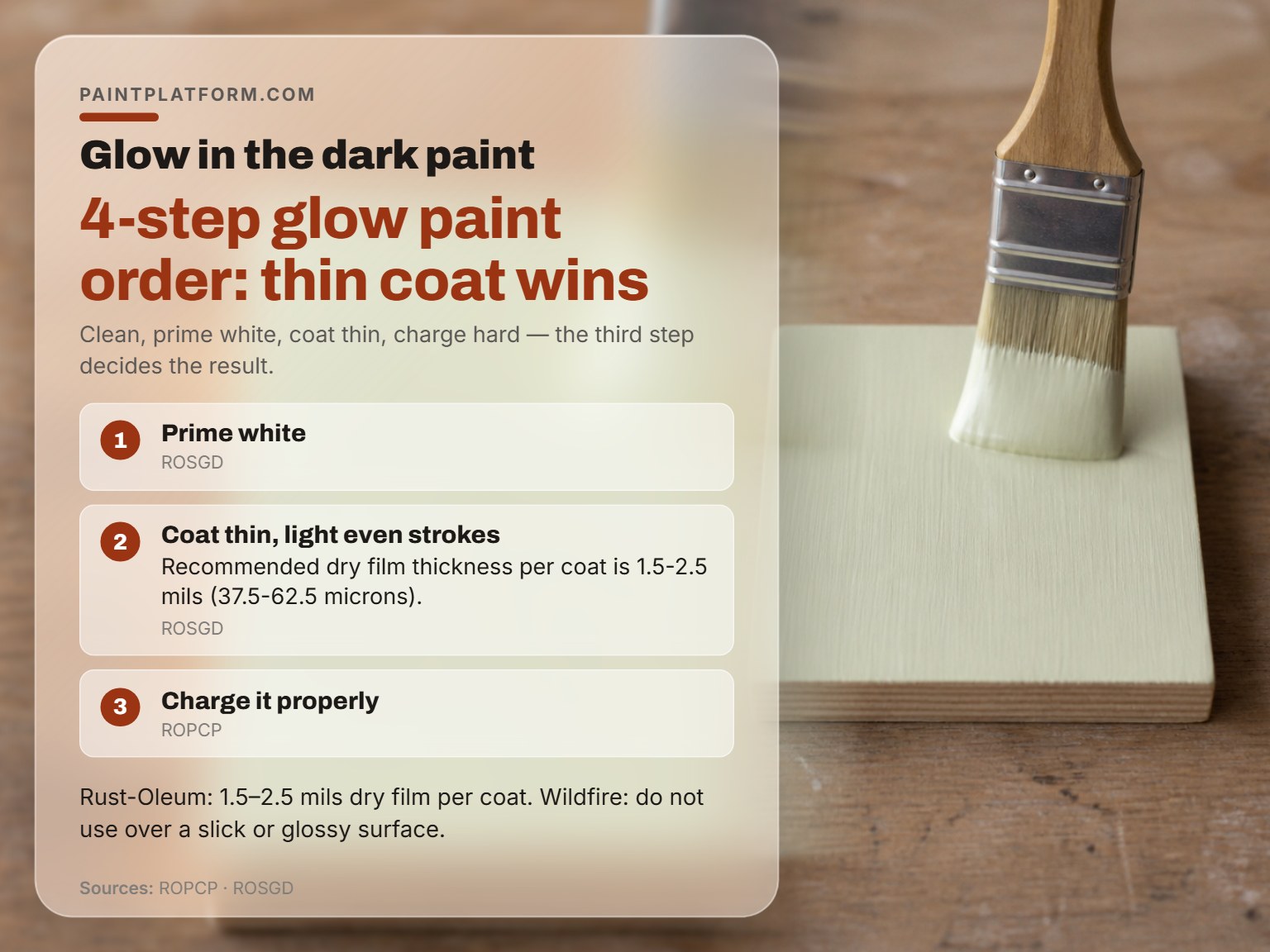
Four steps: clean, prime white, coat thin, charge hard. The third step decides the result.
Before you start: Sanding or scraping old paint can release lead dust, and the Rust-Oleum sheets call for a NIOSH approved respirator plus HEPA vacuum and wet mop cleanup. Clean up wet Max paint with xylol or mineral spirits. Clean wet paint with xylol or mineral spirits, and protect both products from freezing.
- Clean and dull the surface. Wash off dirt, grease, oil, salt and chemical contaminants, rinse, and let it dry completely. Remove loose paint and rust with a wire brush or sandpaper, and lightly sand glossy surfaces. Rust-Oleum says to lightly sand glossy surfaces before applying, while Wildfire says do not use its paints over a slick or glossy surface at all.
- Prime white. Bare wood and metal get a white latex primer. Wildfire names Rust-Oleum Universal Acrylic Primer and Zinsser Bulls Eye 1-2-3 as its recommended undercoats. Skip it and the glow reads dimmer no matter how many glow coats go on top.
- Coat thin, in light even strokes. Aim for 1.5 to 2.5 mils dry film per coat, so work fast and stop. Neutral glow paints go on nearly invisible for the first two or three coats, which is normal and not a sign you need more paint.
- Charge it properly. Rust-Oleum’s catalog says to let the object charge in light for several hours. Sun, a UV flashlight, or a black light all beat a ceiling fixture.
Charging: Five Minutes or Several Hours?
Three sources, three positions. Rust-Oleum’s catalog says several hours. A 2015 conservation study by Jansen and colleagues found zinc sulfide pigment completely activated after a minimum of five minutes of visible light, and more effective when absorbing deep blue to ultraviolet. Art ‘n Glow says household lights won’t charge glow paint to full potential and recommends sun, a UV flashlight, or a black light.
The five-minute figure is an activation threshold under suitable light. The several-hours figure is a practical instruction for an object sitting in a room. They’re measuring different things.
What all three agree on: ordinary room light is the weakest option.
Why Your Glow Faded in Three Weeks
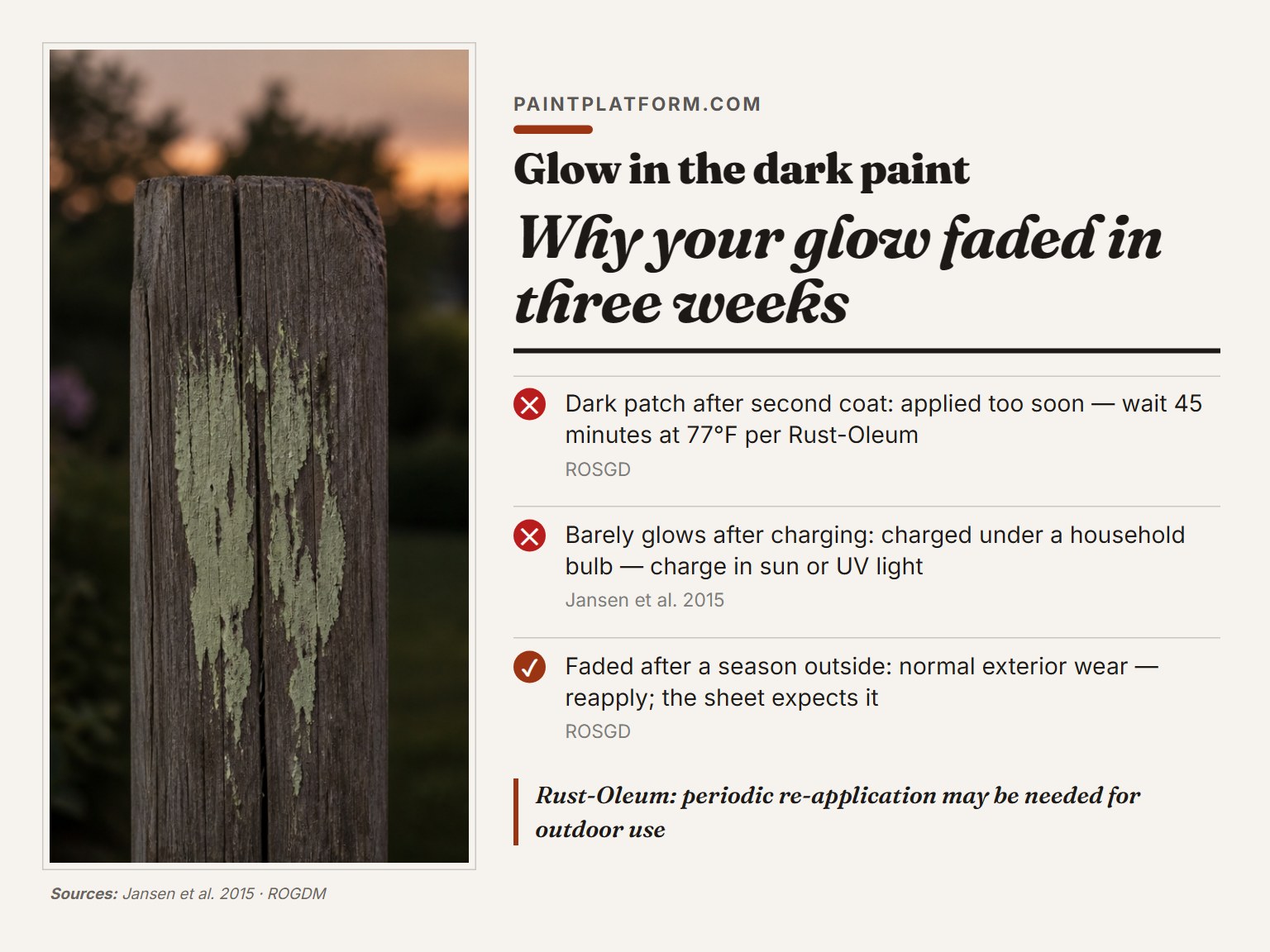
Outdoor glow paint is a maintenance item. Plan on repainting it, and the sheets back that up.
Rust-Oleum says periodic re-application may be needed for outdoor use on the brush-on sheet, and gives no interval. Nobody knows your exposure.
Wildfire is a different case and worth separating. Its Visible Luminescent Paints are UV paint meant to be seen under a blacklight rather than to glow after the lights go out. They’re for interior surfaces only, and the sheet warns the fluorescent pigments fade in 3 months or less in direct sunlight.
If you’re shopping for a fence, a mailbox, or a set of steps, exterior glow in the dark paint is its own category with its own expectations. Long-term pigment aging is a research question rather than a product question, and the peer-reviewed glow pigment research on luminescent materials is the place to start.
| Symptom | Likely cause | Fix |
|---|---|---|
| Dim from the first night | Dark or unprimed substrate | White primer, then recoat |
| Dark patch after the second coat | Second coat applied too soon | Wait the full 45 minutes at 77 degrees F per Rust-Oleum, or 10 to 15 minutes per Art ‘n Glow |
| Barely glows after charging | Charged under a household bulb | Charge in sun or with a UV light |
| Faded after a season outside | Normal exterior wear | Reapply; the sheet expects it |
Every one of those is a rushed step, and every one is fixable.
Tape a Sample Board to the Wall Before You Commit
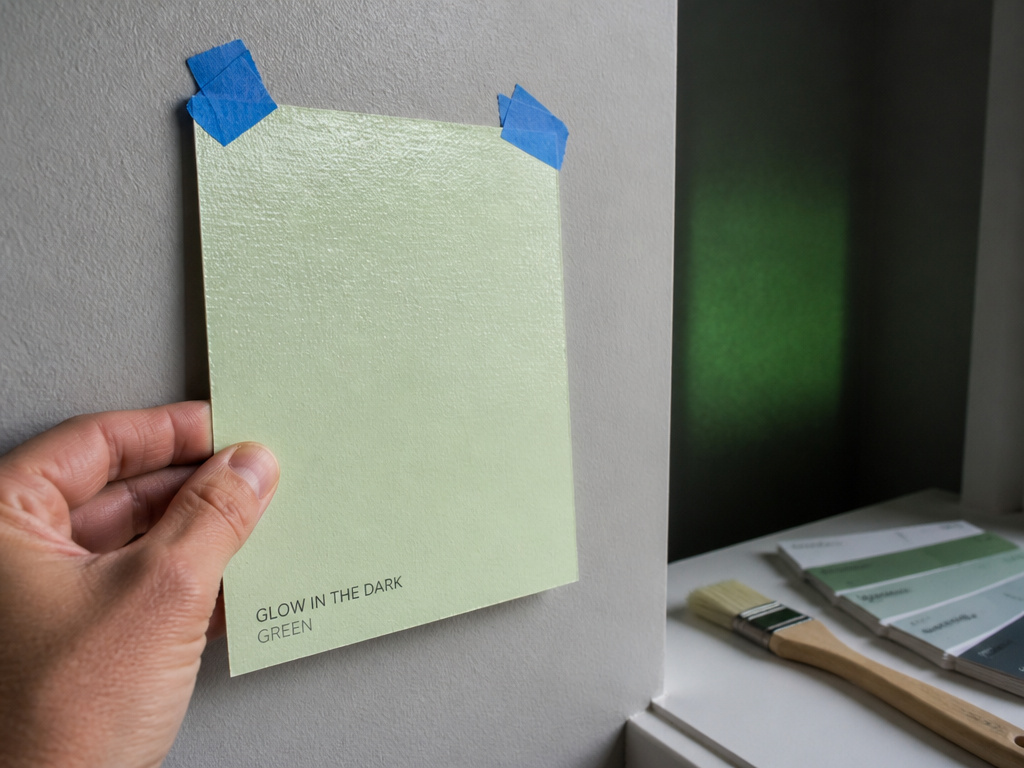
I picked a satin off a chip once because it looked soft and pretty. On a full wall with a window across from it, it turned into a mirror for every roller mark.
Now I paint a sample board and look at it in the morning and again in the evening before I decide anything. Tape it to the wall and walk past it a few times. Sheen shows up at angles, not head-on, and a chip never shows you that.
Glow paint needs the same treatment, only more so. The effect is judged in the dark, from across the room, not under a desk lamp at arm’s length.
If the project is a bedroom or a hallway, glow in the dark wall paint is the format to test, and the board is where you find out whether it reads at the distance you’ll actually stand.
I squint at my work to check values, a habit I picked up after a painting looked great up close and flat from across the room. Squinting blurs the detail and shows whether the lights and darks are working. Do the same in a dark room with a glow board.
Which Glow Product Actually Earns a Place in Your Kit
Do you need a specialty paint in your kit at all, or is this a one-project novelty?
My honest answer: specialty paints are fun to try, and a beginner should get regular acrylic behaving first. One specialty product at a time, tested on scrap, is the only way I’ve found to know whether it earns shelf space.
For a first glow purchase, Rust-Oleum Specialty Glow In The Dark (SPC-24) is the sensible brush-on. It covers up to 25 sq ft and dries to the touch in 45 minutes. If you want the long glow on a hard surface, Glow In The Dark Max (SPC-38) is the step up, at 4 to 8 hours and 8 to 10 sq ft per can.
What I’d Skip
- Buying three glow products at once. You’ll use one and store the other two until the shelf life runs out.
- Glow paint for a room with a nightlight. Any other light source flattens the effect.
- Wildfire’s luminescent line for a home project. It’s built for blacklight effects, interior only, and fades fast in sun.
For canvas work, glow in the dark acrylic paint is the format that behaves like the acrylics you already know. For a costume, glow in the dark body paint is a separate product line with its own instructions, and I wouldn’t assume wall-paint advice transfers.
One at a time.
Frequently Asked Questions
How long does glow in the dark paint last after charging?
It depends on the formula, and the range is wide. Rust-Oleum Specialty brush-on is rated up to 2 hours, Imagine 2 to 4 hours, and Glow In The Dark Max 4 to 8 hours under what the data sheets call optimal conditions. NIST’s circular on luminous paints puts phosphorescent afterglow anywhere from a few minutes to several hours.
Do I need a white undercoat?
Yes, if you want the brightest result. Every Rust-Oleum sheet says to use the product over a white or light colored surface, and the 7 oz label recommends a white latex primer for adhesion and hiding on bare wood and metal. NIST’s circular makes the same point: the surface under the paint affects how bright the paint looks.
Can I use glow in the dark paint outside?
You can, but expect to reapply. Rust-Oleum states that periodic re-application may be needed for outdoor use and gives no service interval. Don’t confuse phosphorescent glow paint with UV-reactive products like Wildfire’s line, which the manufacturer restricts to interior surfaces because the fluorescent pigments fade in 3 months or less in sunlight.
How many coats do I need?
Two or three is the working range. Rust-Oleum says to apply more coats for increased glowing effect, while Art ‘n Glow says additional coats past the first three won’t make much difference in brightness. Keep each coat at 1.5 to 2.5 mils dry film.
What’s the difference between glow in the dark paint and UV paint?
Glow in the dark paint is phosphorescent: it charges under light and releases a slow afterglow in darkness. UV paint is fluorescent: it looks flat under normal light and lights up only while a blacklight is on it. Wildfire’s Visible Luminescent Paints are the second type.
Can I put glow paint over a glossy surface?
The sources split here. Rust-Oleum says to lightly sand glossy surfaces before applying. Wildfire says do not use its paints over a slick or glossy surface at all. On a factory finish, scuff it and test a small area first.
The Bottom Line
Everything above assumes you’re painting something you’ll actually look at in the dark. If the room has a nightlight, a streetlight through the window, or a phone screen on the nightstand, the effect mostly disappears, because NIST’s own note is that light from any other source decreases it markedly.
So start with one can and one board. Prime a piece white, give it two coats 45 minutes apart at room temperature, charge it in the sun, then look at it from across the room at night with every light off.
If the board doesn’t read from where you’ll stand, extra coats won’t rescue it. Art ‘n Glow’s own tutorial says additional coats past the first three don’t add much, and the fix is a different product, not a thicker one.
And if the project lives outdoors, decide now that it’s a repaint. Rust-Oleum says periodic re-application may be needed and gives no interval, so the honest answer is that you’ll find out.
