
Eggshell vs Satin Paint Finish: Which Should You Buy?
This post contains affiliate links. As an Amazon Associate, we earn from qualifying purchases.
Eggshell vs satin paint finish separates on measured gloss, not on the word printed on the can: contractor references put eggshell near 10 to 25 percent at 60 degrees and satin near 26 to 40, and satin carries more binder for scrubbing. For most walls, eggshell is the safer buy. Painters DC, Bernardo’s Painting, and Benjamin Moore put satin in hallways, kitchens, and kids’ rooms, though AB Painting and Drywall says eggshell may be better for high-traffic areas such as hallways.
Gloss is read with a glossmeter at 60 degrees for most coatings, then again at 85 degrees for low-sheen products, because raking light down a long wall shows things a head-on look misses. The Master Painters Institute sorts coatings into seven gloss levels, and it says outright that names like eggshell, velvet, and satin are subjective and inconsistent between manufacturers.
That one admission explains a lot about the eggshell vs satin paint finish question. Two brands can both print “eggshell” on the lid, measure differently, and neither one is lying to you.
What follows is the measured version: the actual data-sheet numbers, the places where the sources genuinely disagree, and a room-by-room call you can defend to a painter. Plus the sample-board test that settles it on your own wall.
Key Takeaways
- Match brand, line, and finish exactly when you extend or touch up an existing wall. “Eggshell” alone is a guess.
- Eggshell hides flaws better. Satin reflects light at sharper angles and turns every patch into a visible highlight.
- Satin carries more binder, and most comparisons give it the durability edge, though AB Painting and Drywall says eggshell is typically easier to clean and may be better for high-traffic areas, and a premium low-sheen can out-scrub a budget high-sheen.
- Wait 1 to 4 weeks before washing a freshly painted wall, depending on the product.
- Paint a small board or wall section and look at it at an angle, morning and evening, before you commit.
What the Gloss Numbers Actually Say
MPI, the Master Painters Institute, sorts every coating into one of seven gloss levels and tests the number regardless of what the manufacturer prints on the label.
Gloss is measured with a glossmeter at 60 degrees for most coatings and again at 85 degrees for low-sheen products, an angle the Master Painters Institute compares to sighting down a long wall. MPI defines seven gloss levels, from flat at level 1 to high gloss at level 7. The standard applies regardless of the name printed on the label.
That 85-degree reading is the one that decides whether you love or hate a wall. A satin finish under a window at the far end of a hallway turns into a map of every roller lap, patch, and seam, and you will not see any of it standing back looking straight on.
Here is what five real products publish on their technical data sheets. These are US sheets, and Canadian versions can differ, so ask your retailer for the local one.
| Product and labelled finish | Gloss at 60 degrees | Sheen at 85 degrees |
|---|---|---|
| Behr Dynasty, matte | 3 to 6 | 3 to 6 |
| Benjamin Moore Aura, matte | not listed | 3 to 6 |
| Behr Premium Plus, eggshell | 7 to 12 | 17 to 22 |
| Sherwin-Williams Emerald, satin | not listed | 10 to 20 |
| Benjamin Moore Regal Select, semi-gloss | 50 to 60 | not listed |
Look at the middle rows. Behr Premium Plus eggshell reads 17 to 22 at 85 degrees, while Sherwin-Williams Emerald satin reads 10 to 20. On paper, that eggshell can look shinier down a long wall than that satin.
Which is exactly MPI’s point. If you are sorting through wall paint finishes, accept early that the name is marketing and the number is the spec.
Why One Brand’s Eggshell Can Outshine Another Brand’s Satin
Two contractor sources publish tidy gloss ranges, and the manufacturer sheets quietly undercut them.
| Source | Eggshell gloss at 60 degrees | Satin gloss at 60 degrees |
|---|---|---|
| Painters DC | 10 to 25 percent | 26 to 40 percent |
| Custom Colonial Painting (citing Wade Paint Co.) | 10 to 25 percent | 25 to 35 percent |
| Behr Premium Plus data sheet | 7 to 12 | not published |
| Bernardo’s Painting and HomeInspectionInsider | “slightly higher sheen than satin” | slightly lower sheen |
Three separate disagreements live in that table. Painters DC and Custom Colonial Painting both put eggshell at 10 to 25 percent, but Behr’s own eggshell sheet lists 7 to 12, below the floor those blogs treat as universal. Bernardo’s Painting and HomeInspectionInsider both claim eggshell actually has slightly higher sheen than satin, which runs against both contractor ranges.
The data sheets settle the specific case rather than the general rule. A low sheen paint at the same published number can still scatter raking light differently, because the resin package differs as much as the gloss target does.
So when a painter proposes switching brands mid-project, ask for the gloss numbers of both products in the eggshell vs satin paint finish debate. Not the finish names. The numbers.
Which Finish Hides Wall Flaws Better?
Eggshell, according to most of the sources, though not all of them.
HomeInspectionInsider says eggshell hides surface imperfections better because its lower sheen reflects less light. AB Painting and Drywall says eggshell hides brush strokes while satin’s sheen brings them out. Painters DC describes satin’s higher gloss creating “flashing,” a visible shadow and highlight on bumps, patches, and seams that eggshell’s lower sheen would diffuse away.
Benjamin Moore lands in the same place from the manufacturer side, noting that satin is more likely to show lap marks and surface flaws. That is worth sitting with, because the same company recommends satin for high-traffic walls.
Bernardo’s Painting disagrees. It argues satin’s slight gloss is subtle enough not to highlight small wall blemishes, and that it holds its appearance better over time. That position is in the minority, and it assumes a wall that has been prepped properly.
Run a palm across a cured satin wall and it feels slick and faintly cool. Eggshell gives a little drag, like the nap of a cotton shirt. That texture difference is the same thing your eye picks up as softness.
I ask for the data sheet before I ask for an opinion. Anyone who can hand you a gloss number is telling you something the person saying “satin is more durable” cannot.
If you are weighing matte vs eggshell for a low-traffic room, the same logic applies with even less sheen on the wall.
Which Rooms Should Get Eggshell and Which Need Satin?
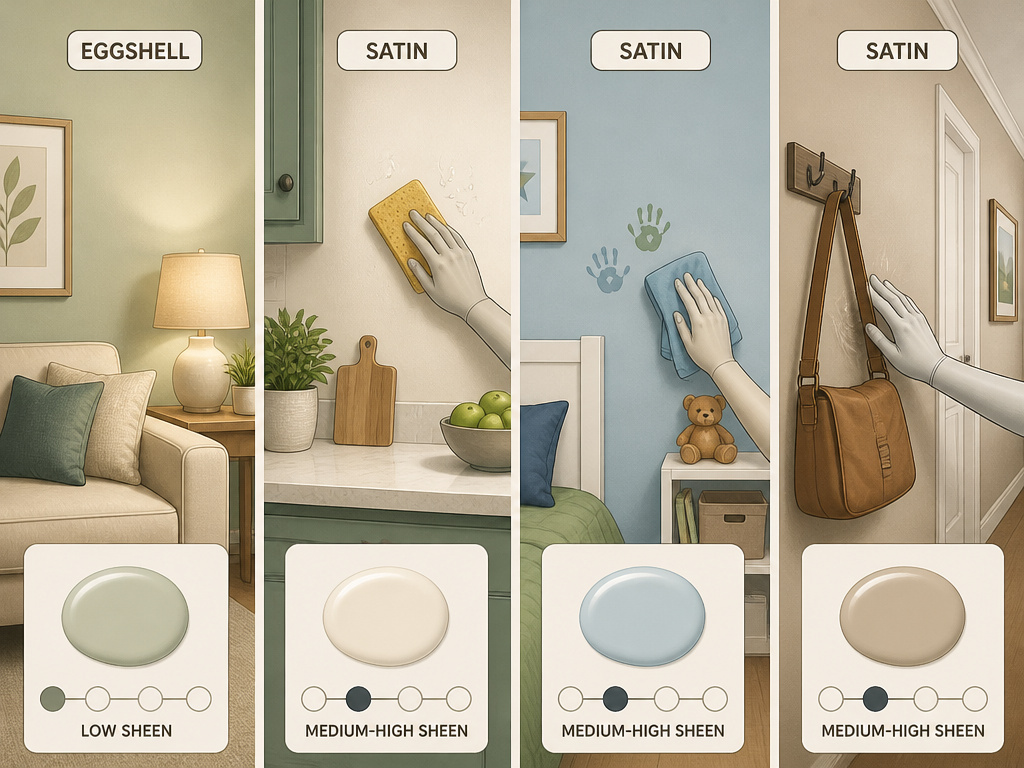
Three things decide this room by room: how often hands touch the wall, how wet the room gets, and how flat the drywall is.
Eggshell is the default for most living space, and the sources are close to unanimous on it:
- Living rooms, family rooms, dining rooms, and adult bedrooms, where a soft glow reads better than a hard reflection.
- Home offices, finished basements, and condo walls, where one finish throughout keeps future touch-ups simple.
- Older plaster and patched drywall, where any sheen above eggshell will find every wave.
- Hallways, in the Benjamin Moore positioning, which calls eggshell easy to clean, nearly shine-free, and suited to family rooms and most areas of a home.
Satin gets the rooms that get handled:
- Entries, hallways, and stairwells, where bags and shoulders brush the wall daily.
- Kids’ rooms and playrooms, where handprints arrive faster than you can wipe them.
- Kitchens and bathrooms, with a caveat on bathrooms that I will get to.
- Laundry rooms and mudrooms, which Painters DC says must have satin.
Painters DC says it specifies both finishes in the same home on 90 percent of its interior projects, and Custom Colonial Painting cites the American Coatings Association for the figure that eggshell and satin together make up roughly 60 percent of interior wall paint sold in the US. A paint sheen guide for rooms is only as useful as the gloss numbers behind it, though.
Small confession: I used a washable matte in a hallway where my gear bag bumps the wall almost daily. Scuffs wiped off with a damp sponge, and it hid patched dents better than the eggshell beside it. Modern washable matte is a different animal from old flat, and I wish I had quit being snobby about it years earlier.
The Sample Board Test That Settles It
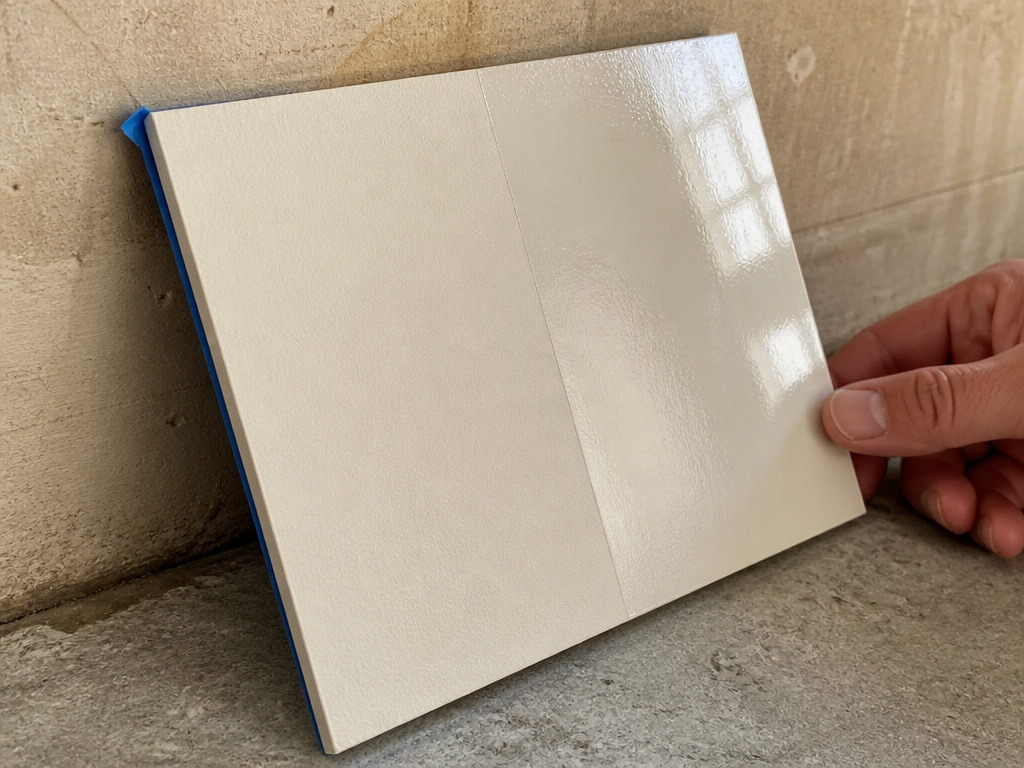
There is a small board leaning against my basement wall right now, painted half in eggshell and half in satin, with a strip of tape on the back.
I built it after picking satin off a tiny chip because it looked soft and pretty. On a full wall with a window across from it, that satin turned into a mirror for every roller mark I had left. The chip never showed me that, because a chip is too small to catch raking light.
Before you start: Solvent and VOC exposure is real even in low-odour products, so keep a vented exhaust fan running and hold indoor humidity between 30 and 50 percent. Canada’s federal regulation caps interior flat coatings near 100 grams per litre and non-flat finishes at 150, and most premium lines sit under 50, but Health Canada still says to ventilate regardless of the label. Never judge a finish under store lighting alone.
Here is the sequence that actually works:
- Get a sample pot of each finish in the same brand and line. Comparing two brands at once gives you two variables and no answer.
- Paint a small board or a section of the actual wall. A chip is not a test, it is a swatch.
- Let it dry a full day, which is what Roy & Paul Cabinet Painting recommends before you decide anything.
- Tape it to the wall and walk past it at an angle, morning and evening. Sheen shows up in passing, not head-on.
- Look along the wall as well as straight at it, which is Sherwin-Williams’ own advice, because a low-angle view reveals a difference that disappears face-on.
- Write the brand, line, and finish on the quote before anyone opens a can.
Benjamin Moore and Custom Colonial Painting say satin shows lap marks more than eggshell does, while Bernardo’s Painting argues satin’s slight gloss is subtle enough not to highlight small blemishes, so the roller for satin and a wet edge do more for the final look than the paint itself. A roller for eggshell is more forgiving, which is part of why eggshell stays popular with people painting their own walls.
Durability, Scrubbing, and the Cure Window Nobody Waits For
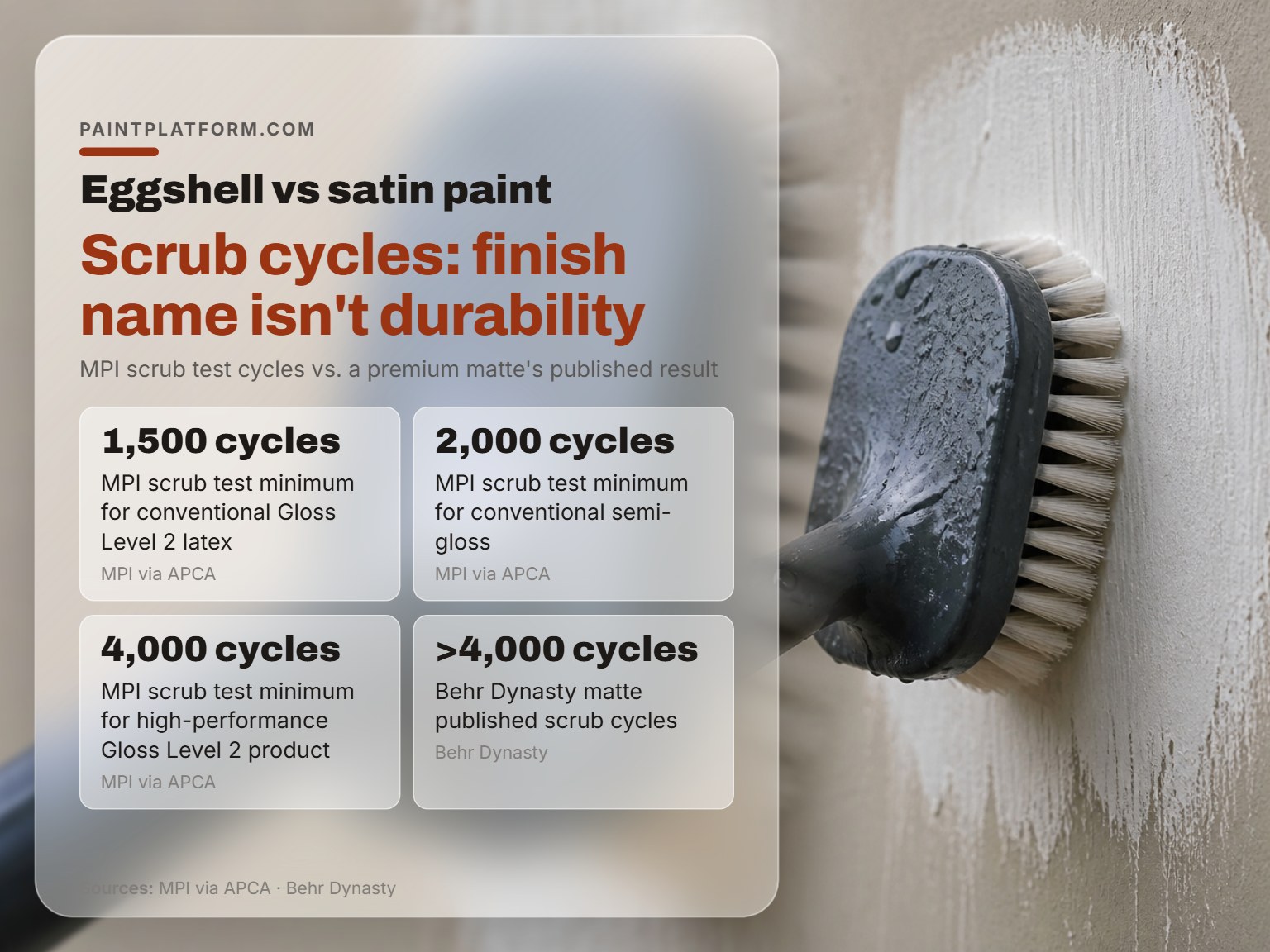
Scrub cycles are where durability actually lives, and the spread between products is wider than the spread between finish names.
MPI’s scrub test runs a wet nylon brush back and forth until the film wears through. A conventional Gloss Level 2 latex has to survive 1,500 cycles. A conventional semi-gloss has to survive 2,000. A high-performance Gloss Level 2 product has to survive 4,000.
That last number is the one that reframes the whole argument. Behr lists more than 4,000 scrub cycles for Dynasty matte, which means a matte can out-scrub a mid-tier satin from a lesser line. Reviewto.ca makes the same point directly: a premium low-sheen paint can beat a budget higher-sheen one, so sheen alone does not determine durability.
Burnishing is a separate test, and it is the one nobody warns you about. It measures how much a low-sheen film polishes up when rubbed, which is why you get shiny patches beside light switches and on hallway corners. Behr lists less than 2 units of sheen change for Dynasty matte in its burnish test.
Then there is cure time, and this is where most repaints go wrong:
- Benjamin Moore Regal Select and Aura: clean after 2 weeks.
- Behr Dynasty: full cure at 1 week.
- Behr Premium Plus: 2 weeks before washing, full cure at 4 weeks.
- General guidance across data sheets: 1 to 4 weeks before scrubbing any finish.
Common mistake: Scrubbing a spot off a wall that is two days old. The film has not crosslinked yet, so the mark comes off along with a patch of the finish, and you will see the dull spot every time the light hits it.
Foter, HomeInspectionInsider, and Bernardo’s Painting all say satin carries more binder than eggshell, which is the mechanism behind its edge on scuffs and stains, though AB Painting and Drywall says eggshell is typically easier to clean and may be better for high-traffic areas such as hallways. AB Painting and Drywall describes it using resin rather than binder and reaches the same conclusion. The full spread of paint finishes runs from flat to high gloss, and each step up buys scrubbing power at the cost of hiding.
Matching an Existing Wall Without a Visible Patch
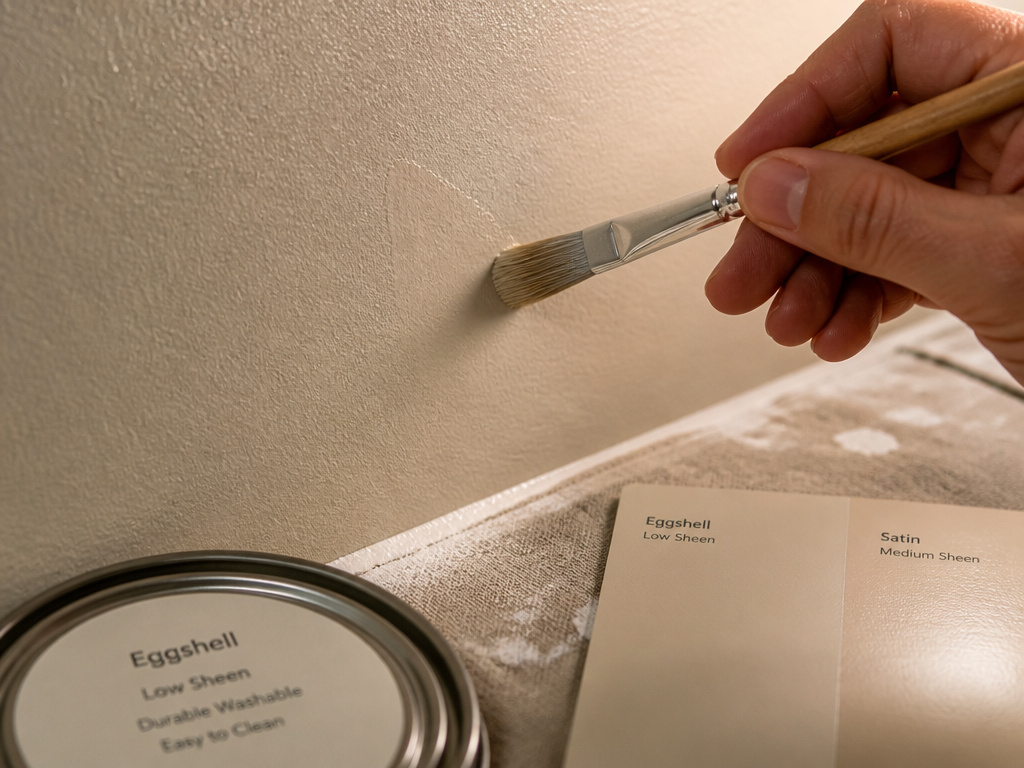
Matching an existing wall starts with the data sheet, not the color chip.
Custom Colonial Painting says eggshell is more forgiving during touch-ups, because its lower sheen blends a spot repair into the surrounding wall. Satin’s reflectivity can make a touch-up patch stand out, particularly when you are using paint that has been sitting in the can for several months.
MPI’s guidance through Reviewto.ca is blunt: match the brand, the line, and the finish exactly, not just “eggshell.” If you cannot, ask for the gloss numbers of both products before you buy.
Match the brand, the line, and the finish. “Eggshell” on its own is a guess dressed up as a specification.
The same logic runs through satin vs semi-gloss on trim and doors, where a half-step in gloss is far more visible than it sounds on paper. And Benjamin Moore rates semi-gloss poor at hiding imperfections, advising against high gloss on anything that is not completely smooth.
Where the Advice Breaks: Bathrooms, Kitchens, and VOC Rules
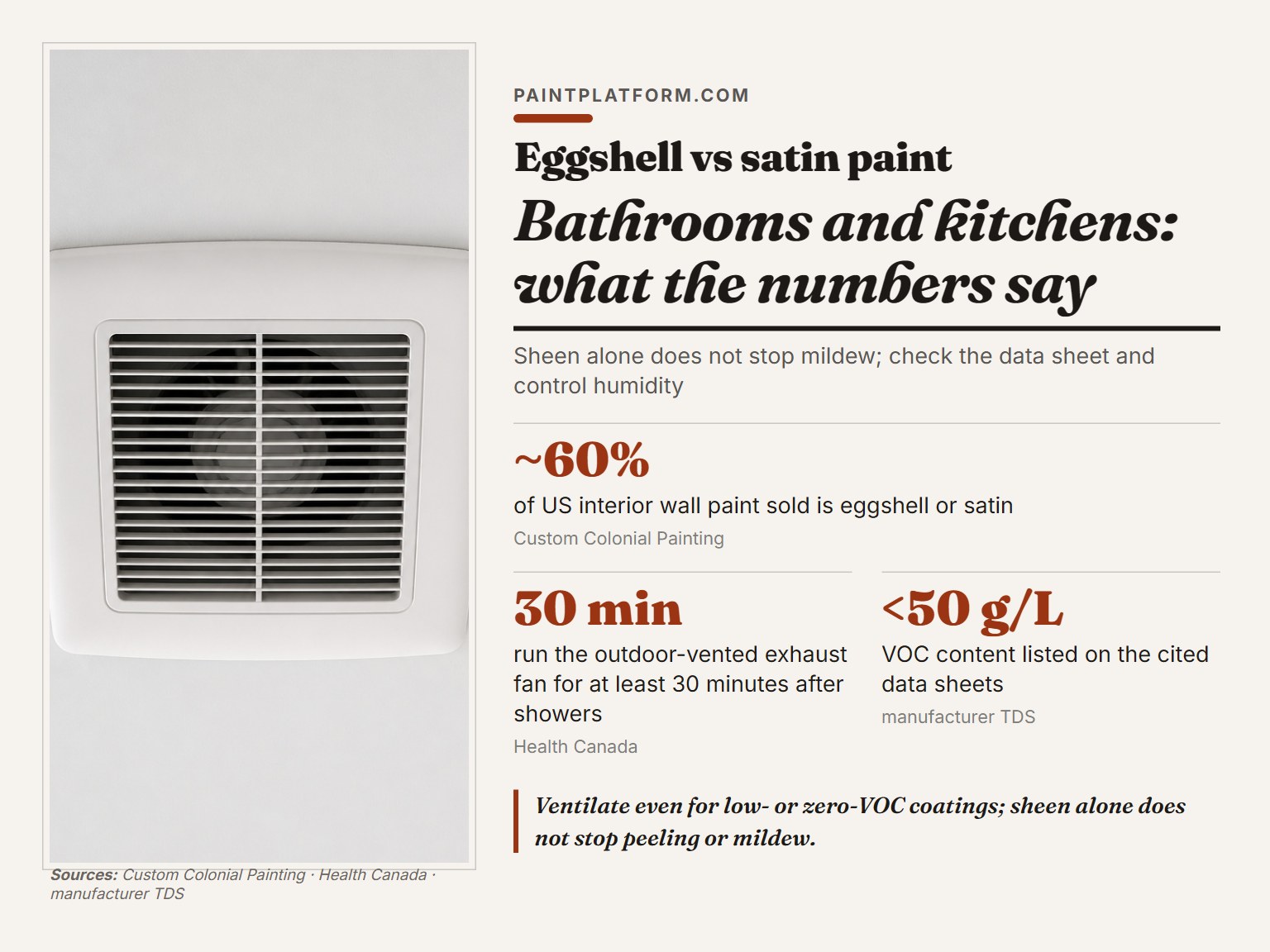
Roughly 60 percent of interior wall paint sold in the US is eggshell or satin, according to the American Coatings Association figure cited by Custom Colonial Painting, so the stakes here are not small.
Bathrooms: Mildew Resistance Beats Sheen
Benjamin Moore’s data sheets add a constraint that overrides the sheen argument entirely: in a bathroom, sheen alone does not stop peeling or mildew. Choose a product that states mildew resistance on its data sheet, as Regal Select and Aura both do. Benjamin Moore Canada also sells Aura Bath & Spa in matte for high-humidity rooms, which tells you a bathroom does not have to be shiny.
Health Canada’s contribution is the part nobody wants to hear. Run an exhaust fan vented outdoors during showers and for at least 30 minutes after, and keep indoor humidity between 30 and 50 percent. No paint holds up on a wall that stays wet.
I learned the sheen half of this the hard way. My first bathroom got semi-gloss because everyone said moisture, and every drywall seam and bad patch showed up under the vanity light. I redid it in satin and the room looked much cleaner.
The bathroom paint sheen question has a better answer than “go shiny,” and it starts with the mildew statement on the sheet.
Kitchens: Degrease Before You Choose
Kitchen walls are their own argument, and the kitchen wall sheen decision is really about grease. Painters DC uses satin as the standard for kitchen walls and semi-gloss for kitchen cabinets. Roy & Paul Cabinet Painting goes further and says cabinets and trim need a hard-curing enamel, because flat, eggshell, and matte stay soft and never fully harden the way cabinets require.
My own line sits a little flatter than the contractor standard. I am fine with eggshell on most kitchen walls, and satin directly behind the stove where the grease wipes happen. Using the flattest finish that still wipes clean means you only go shinier in a small zone.
One more thing worth knowing: VOC content and odour are different measures. The data sheets cited here list under 50 grams per litre, and Benjamin Moore lists Regal Select at zero, but Health Canada still recommends ventilation even for a coating marketed as low or zero VOC.
Frequently Asked Questions
Is satin or eggshell better for a hallway?
Satin, in most contractor guidance. Painters DC and Bernardo’s Painting both put satin in hallways and stairwells because bags, shoulders, and boots leave marks that need wiping, though AB Painting and Drywall says eggshell may be a better choice for high-traffic areas such as hallways. Benjamin Moore also recommends satin or pearl for high-traffic walls. If your hallway walls are old plaster or badly patched, though, eggshell will look better because it hides what satin exposes.
Can I use eggshell in a bathroom?
You can, and Painters DC argues against it on the grounds that eggshell stains more easily and degrades faster under repeated cleaning. The bigger issue is that sheen alone does not prevent mildew. Choose a product that states mildew resistance on its data sheet, as Benjamin Moore’s Regal Select and Aura both do, and fix the ventilation first.
Why does my satin wall show every roller mark?
Because satin reflects light at sharper angles than eggshell does. Painters DC calls the result “flashing,” where a bump or patch throws a visible shadow and highlight. Benjamin Moore notes satin is more likely to show lap marks and surface flaws. Better prep, a skim coat on rough drywall, and a wet edge while rolling all reduce it.
Does a higher sheen always mean a tougher paint?
No. Reviewto.ca makes the point that a premium low-sheen paint can out-scrub a budget higher-sheen one, citing MPI’s 4,000-cycle standard for high-performance Gloss Level 2 products. Behr lists more than 4,000 scrub cycles for Dynasty matte. The product line matters as much as the gloss level.
Can I touch up satin without it showing?
It is harder than eggshell. Custom Colonial Painting says satin’s reflectivity can make touch-up patches stand out, especially with paint that has been stored for several months. Match brand, line, and finish exactly, and feather the edge rather than dabbing at the center of the mark.
The Bottom Line
Here is the trigger I would actually give you. If your walls are older plaster, patched drywall, or lit hard from one end of the room, drop one sheen level below whatever the room chart recommends. Eggshell instead of satin, matte instead of eggshell. The hiding you gain is worth more than the scrubbing you give up, and the washable mattes from Behr and Benjamin Moore have closed most of that gap anyway.
The concession: none of this helps if the room stays wet. A bathroom with no vented fan and indoor humidity above 50 percent will peel in any sheen, and a mildew-resistant data sheet beats a glossy wall every time.
Start with one small board, painted in two finishes and taped where the light actually hits. Walk past it tomorrow morning and again with the lamps on. That board will tell you more than any chart, including mine.
