
Tinted Primer Pros and Cons: When Tinting Pays Off
This post contains affiliate links. As an Amazon Associate, we earn from qualifying purchases.
Tinted primer pros and cons come down to one number: how much tint the product allows. Zinsser High Hide Cover-Stain caps universal colorant at 2 oz per gallon, while Protec PP-2500 accepts up to 20% tinter. Tinting helps most on big color changes and barely helps on like-for-like repaints.
That gap between 2 oz per gallon and 20% changes the tinted primer pros and cons. On Zinsser you’re nudging. On Protec you’re mixing a formula.
What follows: the real case for tinting, the real cost of it, and the point where the manufacturer numbers stop agreeing with each other.
Key Takeaways
- Tint load is product-specific. Zinsser caps at 2 oz per gallon; Protec PP-2500 takes up to 20%. Check the TDS before you mix.
- Tinting pays off on big color changes. A primer tinted toward the topcoat absorbs less of the topcoat’s pigment, so each coat covers more.
- Dry-time claims disagree. Zinsser says tint prolongs dry time; Glasurit attributes longer dry times to high build, not tint.
- Tinting doesn’t replace blending. AkzoNobel’s TSB AN24.01 says so in writing.
- Over-tinting is a real risk. Glasurit caps at 10 parts per 100; Transtar caps at 5% tint paste.
What Tinted Primer Actually Does (and What It Doesn’t)
Tinted primer hides the old color so the topcoat doesn’t have to cover it alone. That’s the whole job.
Tinted primer is a primer-surfacer mixed with a small amount of colorant, usually a tint paste or universal colorant. The mix shifts the primer’s color toward the topcoat so the finish coat needs fewer passes to reach full hiding. Tint load limits vary by product and are printed on the technical data sheet.
The paint and primer in one combo has confused this conversation for years. A combo is thicker paint with some bonding resin in it. It doesn’t block a stain, and it doesn’t shift color the way a tinted primer does.
I keep a can of Zinsser Cover-Stain in the garage for exactly this reason. It’s an oil-based stain blocker that happens to accept a little colorant. That’s a different product from a tintable primer-surfacer.
The Tint Load Numbers Don’t Agree Across Brands
Five products, five different tint ceilings, and a range from 2 oz per gallon to 20%. That’s not a rounding error. It’s the difference between a product you can nudge and one you have to measure like a recipe.
| Product | Tint Ceiling | Colorant Type |
|---|---|---|
| Zinsser High Hide Cover-Stain | 2 oz per gallon | Universal colorant |
| XIM 400C NT Tintable Base | 6 oz per gallon | Universal colorant |
| Transtar 6464 Roll-It | 5% tint paste or 10% toner | Tint paste or basecoat toner |
| Glasurit 285-60 | 10 parts per 100 | 568-408 tint paste |
| Protec PP-2500 | Up to 20% | PT-G tinter |
So when someone says “you can tint primer,” ask which primer. The ceiling on Zinsser is a third of the ceiling on XIM.
Before you start: Tinted primer is still primer. Glasurit’s TDS says products are for professional trained personnel only, and appropriate respiratory protection should be worn at all times. Protec’s hardeners contain isocyanate, so read the SDS before you open the can.
Here’s how I check a product before I tint it:
- Find the TDS. Search the product name plus “TDS” or “technical data sheet.” Skipping this step is how people end up tinting a product that wasn’t designed for it.
- Find the tint ceiling. Look for “tint,” “colorant,” or “tinting paste” in the mixing section. If you can’t find a number, call the manufacturer. Guessing is how a batch gets ruined.
- Measure by volume, not by eye. A splash of tint paste is not a measurement. Over-tinting can push a product past its cap.
- Write the ratio on the can. Sharpie on the lid. Next time you mix, you’ll know what worked.
If you want the short list of products that already publish a tint ceiling, the best tinted primers page has them sorted by substrate.
Where Tinting Pays Off: Big Color Changes
A dark navy bedroom and a pale sage topcoat that still didn’t cover. That was my first attempt at a color change without tinted primer. My arm was sore for two days.
The second time, I weighed the tinted primer pros and cons and asked the paint counter to tint the primer toward the sage. Tinted primer first, then topcoats, done. Same wall, same paint, half the labor.
The reason is hiding. A primer tinted toward the topcoat absorbs less of the topcoat’s pigment, so each coat covers more. Zinsser’s TDS says this directly: tinting the primer toward the topcoat improves the hiding power of the topcoat.
Where tinting earns its keep:
- Dark to light. Navy, charcoal, or deep red under a pale topcoat. This is the case where tinting saves a coat or two.
- Big color family jumps. Warm beige to cool gray. The undertone shift is where a tinted primer does the most work.
- Ceilings and large flat surfaces. Roller texture plus a light topcoat is a coverage problem. Tint the primer and the topcoat goes on thinner.
Red walls under a pale topcoat were a different story. The tinted primer saved me a lot of grumbling, not because red is harder to cover but because red pigment is translucent in a way that navy isn’t.
If you’re priming walls that are already painted, the primers for painted walls breakdown covers which products accept tint and which don’t.
Where Tinting Bites You: Dry Time and Pot Life
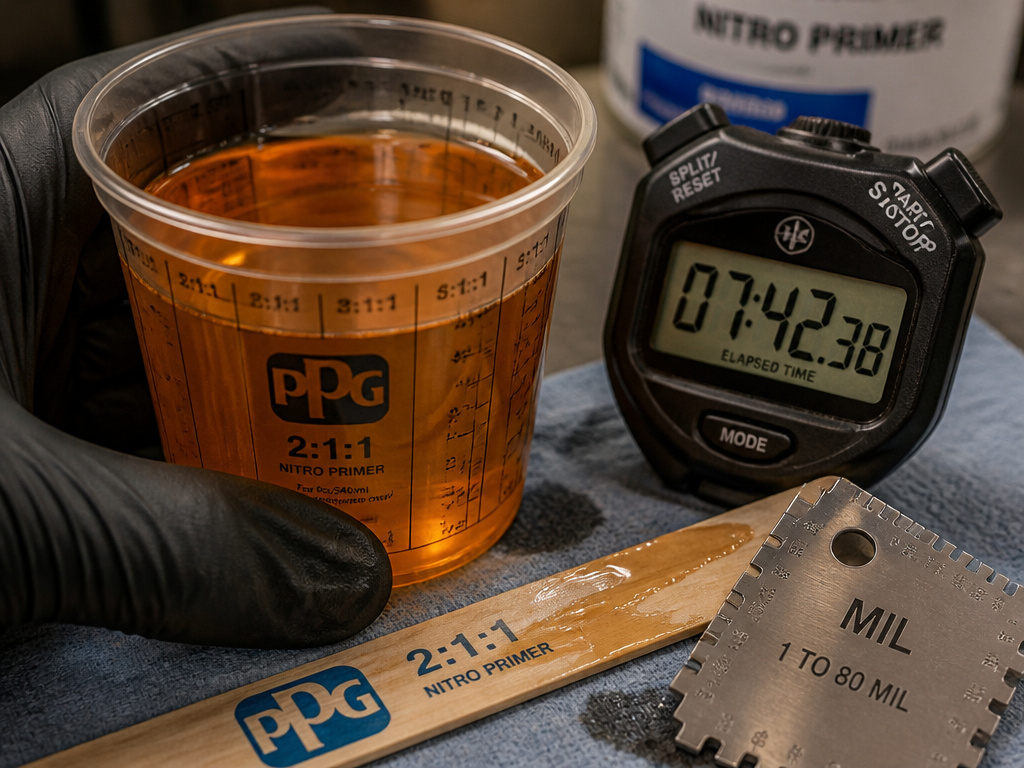
Tint is a chemical addition, and it changes the clock. The question is how much, and the manufacturers don’t agree.
| Product | Pot Life or Dry Time | Note |
|---|---|---|
| Glasurit 285-60 | 1 hour at 68F / 20C | Dry times lengthen at 6.0 mil build |
| Sherwin-Williams P47 | 1 hr at 70F, 45 min at 80F, 30 min at 90F | Heat shrinks the window fast |
| Martin Senour 5103 | 1 hr at 70F, 45 min at 80F, 30 min at 90F | Same curve as P47 |
| Protec PP-2500 | 1 hour at 25C | Topcoat within 45 min in wet-on-wet |
| Transtar 6464 | 1.5-2 hr dry to sand at 70F | 1 hr at 85-90F, 30 min at 140F bake |
Zinsser’s TDS says the addition of tint will prolong the dry and cure time. Glasurit’s TDS attributes longer dry times to high build (6.0 mils across 3-4 coats), not to tint. That’s a real disagreement between manufacturers, and it matters if you’re on a schedule.
I once pushed a product past its tint cap. The primer never fully cured, and I ended up sanding it back to bare wood. Read the cap. Then read it again.
If your primer is water-based, the water-based vs oil-based primer comparison explains why tint behaves differently in each chemistry.
Do You Need a Separate Primer Under Tinted Primer?
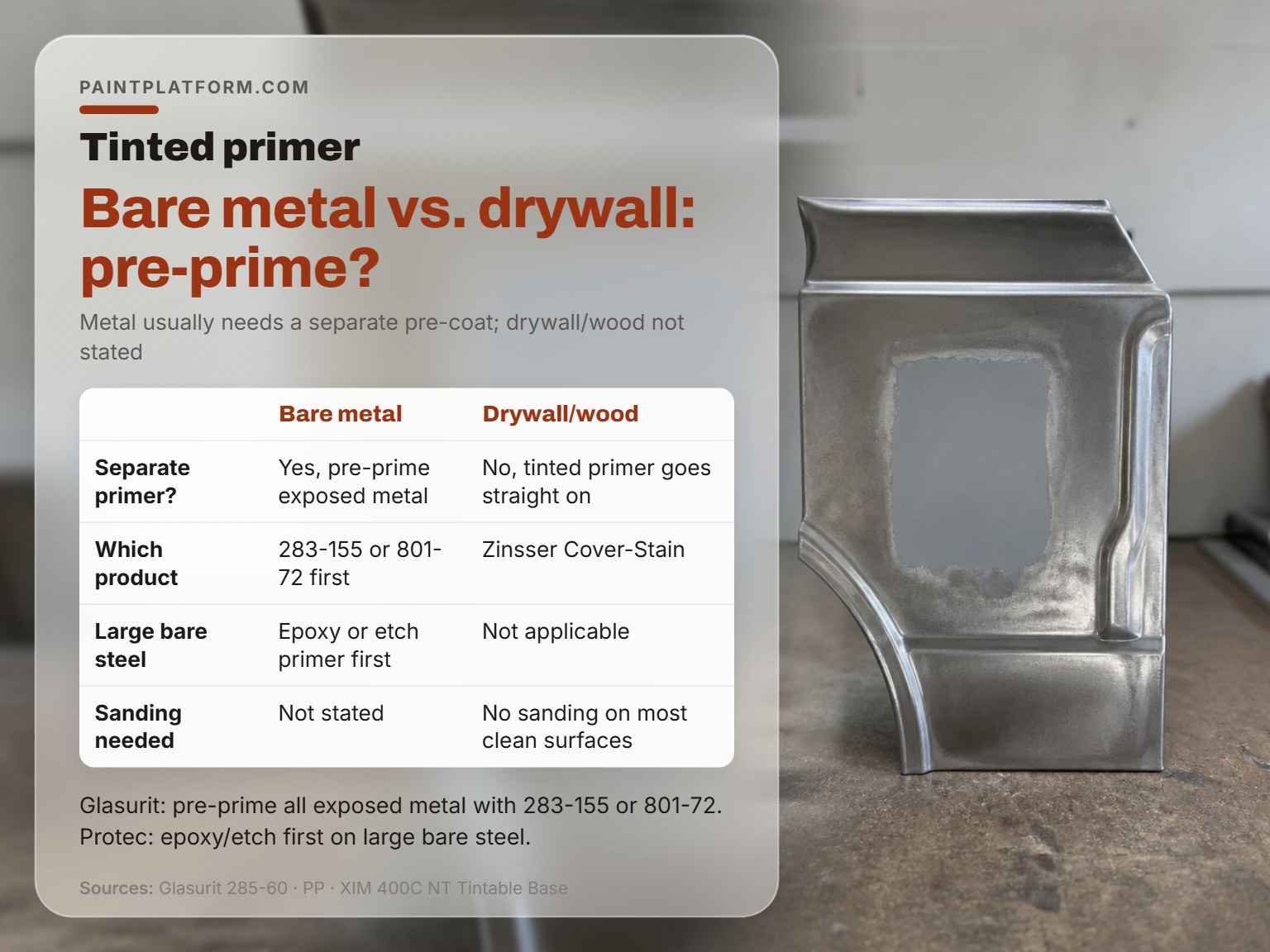
Glasurit 285-60 requires a pre-prime on exposed metal. Zinsser Cover-Stain goes straight onto clean drywall.
On bare metal, the answer is almost always yes. Glasurit says to pre-prime all exposed metal areas with 283-155 or 801-72 before applying tinted 285-60. Protec says large areas of bare steel and areas where polyester body filler will be applied should be coated first with epoxy or etch primer (AP-4110, PP-3450, or AP-4441).
Transtar 6464 is the exception. It’s direct-to-metal, no self-etch needed, and it’s roller-applied by design. That’s a different process from the spray-applied products, and the tint ceiling reflects it.
Bare Metal: Almost Always Needs a Pre-Coat
Pre-priming is the step people skip because the tinted primer looks like it’s doing the job. It isn’t. The pre-coat handles adhesion and corrosion. The tinted primer handles color.
Wood, Drywall, and Previously Painted Surfaces: Usually Doesn’t
On sound, previously painted drywall or clean wood, the tinted primer goes straight on. Zinsser Cover-Stain is designed for exactly that. XIM 400C NT says no sanding is required for most clean, paintable surfaces.
The primer vs undercoat distinction matters here. An undercoat is a surfacing layer. A primer is an adhesion layer. Tinting helps the surface, not the adhesion, so don’t skip the adhesion layer hoping the tint will cover for it.
If you’re sealing a porous surface before paint, the primer vs sealer comparison explains where each one stops.
Does Tinting Actually Replace Blending?
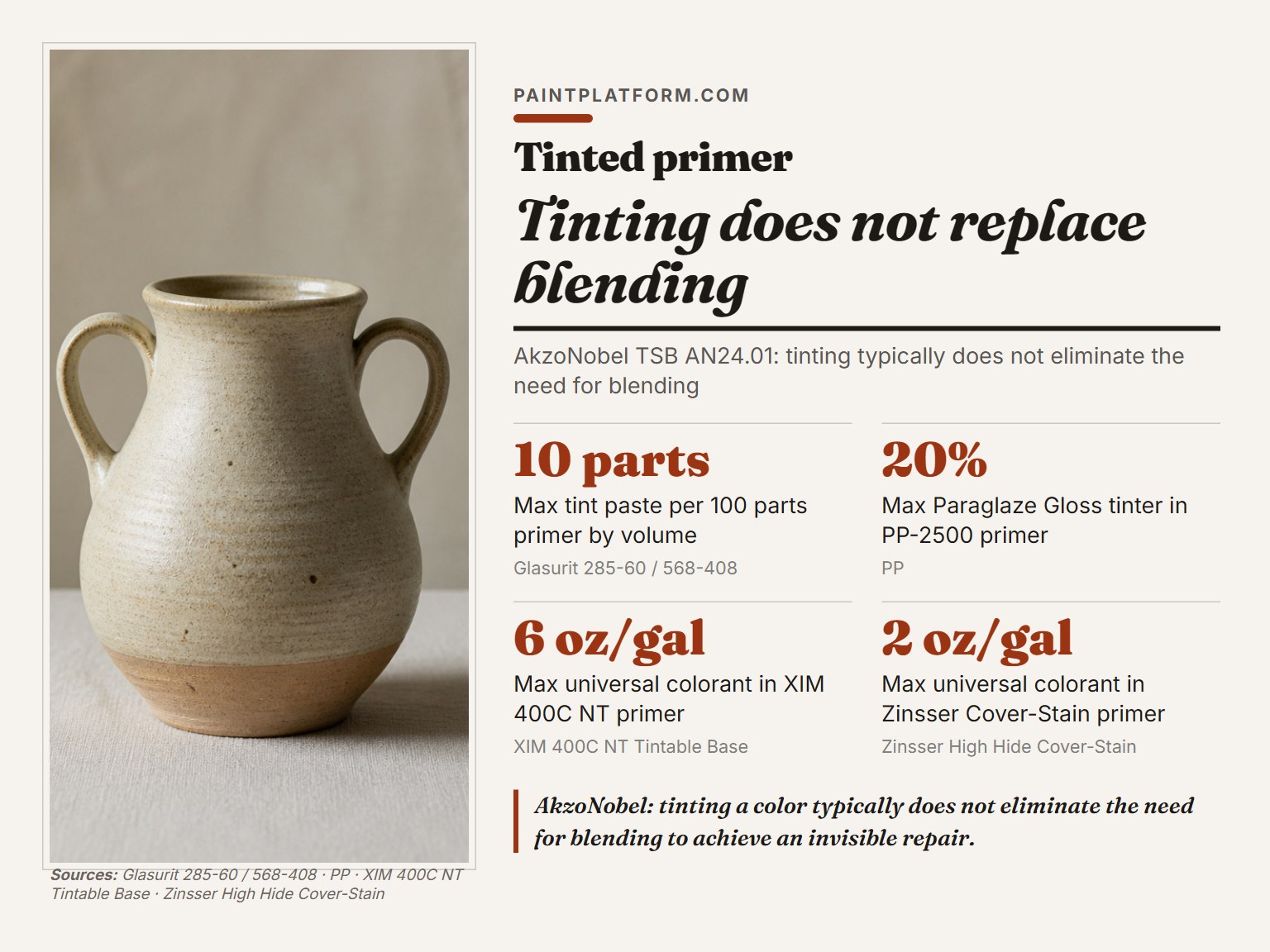
AkzoNobel’s TSB AN24.01 says tinting a color typically does not eliminate the need for blending to achieve an invisible repair. That’s the manufacturer’s own technical bulletin, dated May 2024.
The TSB also says OEM color tolerance varies greatly across the global vehicle manufacturing industry, and color variants appear due to differing paint suppliers and manufacturing locations. Tinting gets you closer. Invisible is a different job.
Tint the primer toward the topcoat. Don’t tint it toward the old color. The topcoat is what the eye sees, and the primer’s job is to meet it halfway.
For a house painter, this matters less than for a collision shop. But the principle holds: if you’re doing a partial repaint and thinking tinted primer gets you out of blending, the TSB says no.
When Tinting Primer Is a Waste of Money
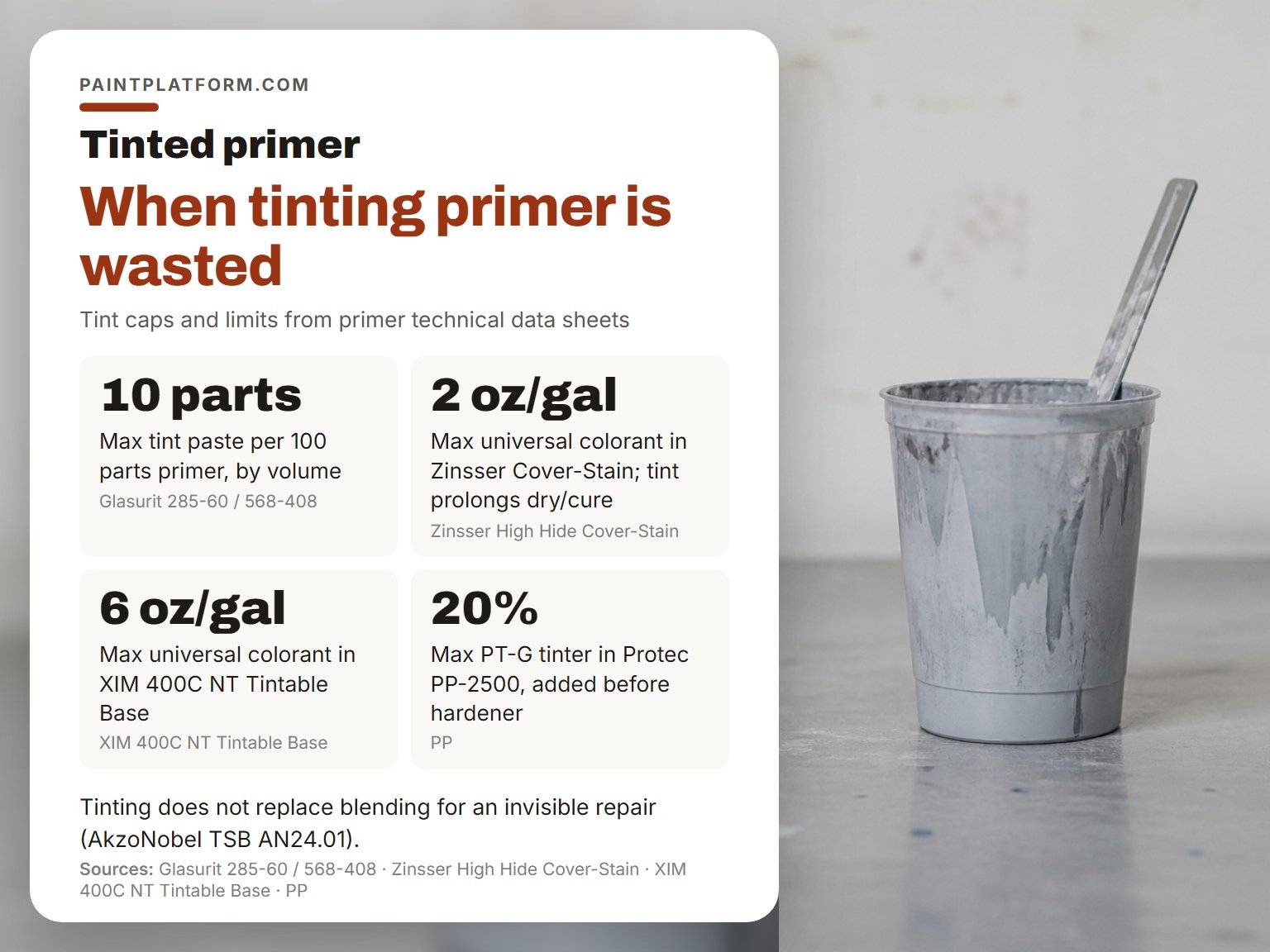
Tinting primer is a waste on two jobs. I’ve done both, so I know.
- Like-for-like repaints. Tan to tan, no tint needed. The topcoat covers in one pass either way, and you’ve added a mixing step for nothing.
- Stain blocking. A tinted primer doesn’t block a stain. That’s a stain-blocking primer’s job, and a shellac-based one does it best.
Where this goes sideways: Tinting a stain-blocking primer and expecting it to block better. Zinsser Cover-Stain blocks stains because it’s an oil-based primer with stain-sealing resins. Adding colorant doesn’t improve that, and it can thin the film if you push past 2 oz per gallon.
The stain blocking primer guide covers which products actually block and which just hide. Tinted primer is in the second category.
Tinting primers dark for every job is overrated. It helps on certain color changes and does nothing on the rest. Save it for the jobs where the numbers say it matters.
Frequently Asked Questions
Does tinting primer actually help with coverage?
Yes, on big color changes. A primer tinted toward the topcoat absorbs less of the topcoat’s pigment, so each coat covers more. Zinsser’s TDS says tinting toward the topcoat improves the hiding power of the topcoat. On a like-for-like repaint, the effect is negligible.
How much tint can I add to primer?
It depends on the product. Zinsser High Hide Cover-Stain caps at 2 oz per gallon. XIM 400C NT caps at 6 oz per gallon. Transtar 6464 caps at 5% tint paste or 10% basecoat toner. Glasurit 285-60 caps at 10 parts per 100. Protec PP-2500 accepts up to 20%. There is no single safe number.
Can I tint any primer?
No. Only products labeled tintable accept colorant. Zinsser Cover-Stain is tintable to off-white and pastel shades. XIM 400C NT accepts up to 6 oz of universal colorant per gallon. A standard latex primer that isn’t labeled tintable shouldn’t get colorant added.
Is tinted primer worth it for a small room?
Usually not. The tinting step adds time and a mixing variable. On a small room with a similar color, the topcoat covers in one pass anyway. Save the tint for big color jumps or large surfaces where the extra coverage pays off.
Does tinted primer replace a stain-blocking primer?
No. Tinted primer hides color. Stain-blocking primer seals the stain under a film. They do different jobs. A basic latex primer over a water stain is the classic mistake here. If you have a water ring or a smoke stain, you need a stain blocker, tinted or not.
The Bottom Line
Check the TDS before you tint anything. If the tint ceiling is 2 oz per gallon, you’re nudging. If it’s 20%, you’re mixing a formula. Those are two different jobs, and treating them the same is how a batch gets ruined.
This week, pull the TDS for whatever primer is already in your garage. Find the tint ceiling. That one number tells you whether tinting is a quick upgrade or a way to waste an afternoon.
Progress over perfection. Start with the number.
