
Stain-Blocking Primer Guide: Water, Ink, Tannin, Smoke
This post contains affiliate links. As an Amazon Associate, we earn from qualifying purchases.
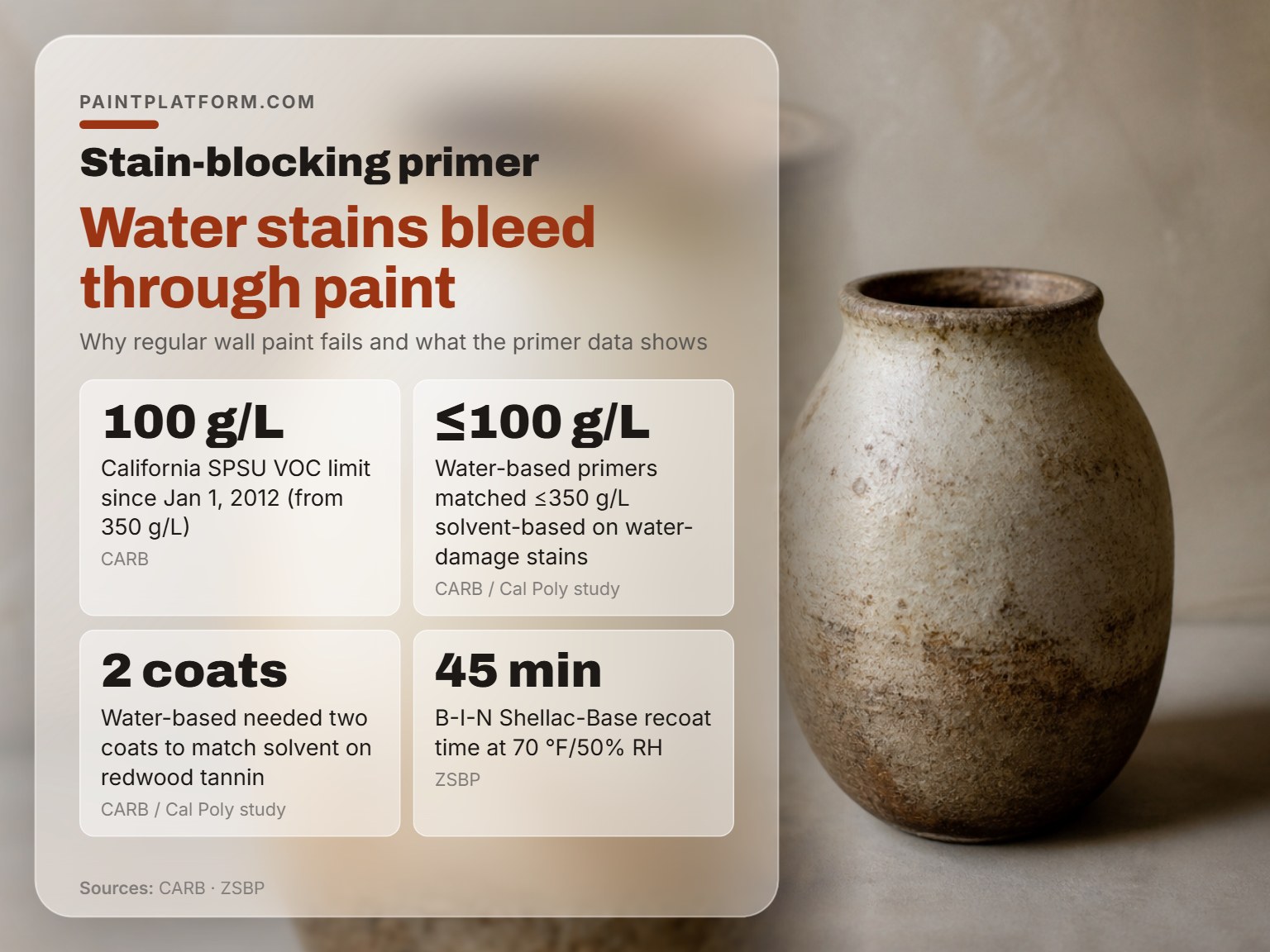
A stain-blocking primer guide starts with matching the product to the stain: in CARB’s study, water-based primers at 100 g/L VOC matched solvent primers at 350 g/L on marker, cedar, and water stains, but redwood tannin needed two coats.
California dropped the SPSU VOC limit from 350 g/L to 100 g/L on January 1, 2012, and the Cal Poly study, run for the California Air Resources Board, tested whether the new low-VOC products actually work. On marker, cedar, and water stains, they did. Redwood was the exception, and it’s the exception that trips people up.
What follows breaks the job down by stain type: water rings, ink, tannin, smoke, and the odd marker scribble. Each section names the primers that actually handle it, the temperature floors that decide whether the coat cures or fails, and the cases where shellac is the only thing that stops the bleed.
Key Takeaways
- Water-based primers at 100 g/L VOC matched solvent primers at 350 g/L on marker, cedar, and water stains in CARB’s Cal Poly study.
- Redwood tannin is the exception: water-based primers needed two coats to match the best solvent products at one.
- Temperature floors differ by brand: Benjamin Moore Max Block goes on above 40 °F, Miller 4700 stops at 45 °F, Dunn-Edwards BLOCK-IT Premium stops at 50 °F, and Zinsser B-I-N Shellac-Base goes on in freezing temperatures.
- Topcoat timing is not one number: Max Block wants a topcoat the same day, BLOCK-IT Premium allows up to 14 days.
- Shellac is the heavy hammer for smoke, marker, and odors, and it dries to touch in 20 minutes.
Why Water-Based Primers Beat Their Reputation
The blanket claim that water-based primers are weaker than solvent is not supported by the stain-blocking primer guide, though solvent primers still beat water-based on green highlighter and redwood tannin. That year the Cal Poly team finished a study for the CARB low-VOC primer report, testing water-based products at 100 g/L against solvent products at 350 g/L on marker, cedar, and fire and water damage stains. On all three, the low-VOC water-based products matched the solvent products.
A study conducted for the California Air Resources Board found water-based primers at or below 100 g/L VOC matched solvent-based primers at or below 350 g/L on marker, cedar, and fire and water damage stains. Redwood tannin was the documented exception, where two coats of water-based primer were required to match the best solvent products.
I still see the “solvent is stronger” line repeated in forum threads. The reason it survives is that the two systems fail in different places. Solvent primers beat water-based on green highlighter. Water-based beat solvent on red Sharpie. If your only test is one marker, you’ll draw the wrong conclusion about the whole category.
Where water-based primers win outright:
- Odor. No solvent smell in a closed room.
- Cleanup with warm soapy water, not denatured alcohol.
- Dry time: recoat times vary by product, from 45 minutes for B-I-N Shellac-Base to 3 hours for Miller 4700.
- Regulatory headroom: 100 g/L or lower keeps you inside the California limit that took effect January 1, 2012.
For a full water-based vs oil-based primer breakdown, the pattern is consistent. Water-based wins on odor, cleanup, and dry time. Solvent wins on a narrow band of stains, mostly green dye and some red inks. Neither one wins everything.
Which Primer Handles Which Stain?
Match the stain, not the brand. A primer shelf works like a small kitchen: you can cook almost anything with salt, a pan, and a knife, and you can prime almost anything with three products. The trick is knowing which three.
| Primer Type | Best For | Watch Out For |
|---|---|---|
| Water-based acrylic (e.g. Miller 4700) | Marker, cedar, general stain blocking | Redwood tannin needs two coats |
| Waterborne alkyd (e.g. Dunn-Edwards BIPR00) | Water rings, tannin, low VOC jobs | Overnight dry on water-sensitive stains |
| Shellac (e.g. Zinsser B-I-N) | Smoke, odor, marker, ink | Strong fumes; denatured alcohol cleanup |
| Oil-based | Exterior bare wood, some red inks | Long dry time, strong solvent smell |
Water Rings and Ceiling Stains
A water ring is the test case for every stain-blocking primer. I tried a paint-and-primer combo over a brown water ring once and the stain bled back through within about a day. A real stain-blocking primer is what stops it.
Two rules before you prime. Fix the leak first, and let the drywall go bone dry. If the paper feels soft or bubbly, cut it out and patch. If it’s firm and just stained, scrape the loose bits and prime.
For water stains, stain-blocking primers built around shellac or a waterborne alkyd work. Zinsser B-I-N Shellac-Base Primer is the one I reach for on a ceiling patch, because one coat blocks water, nicotine, ink, and smoke stains and it dries to touch in 20 minutes.
Marker, Ink, and Crayon
Marker color matters. Solvent-based primers beat water-based on green highlighter. Water-based beat solvent on red Sharpie. If you’re covering a kid’s wall art, identify the marker color before you buy the primer.
For how to paint over ink stains, the routing is the same as marker. The Cal Poly study tested marker blocking under ASTM D7514-09, with stains dried 24 hours, primer at 3 mil wet film applied perpendicular to the stains, and a topcoat after another 24 hours. Zinsser B-I-N Shellac-Base Primer blocks ink in one coat.
The Temperature and Recoat Numbers That Actually Decide the Job
Benjamin Moore Max Block goes on above 40 °F, Miller 4700 must not be applied below 45 °F (though it lists a 35-95 °F application range), Dunn-Edwards BLOCK-IT Premium and the two Zinsser water-based products stop at 50 °F, and Zinsser B-I-N Shellac-Base can be applied in freezing temperatures. Miller 4700 sits at 45 °F. Zinsser B-I-N Shellac-Base is the outlier that goes on in freezing temperatures.
That spread matters if you’re painting a garage in late fall. I check the label before I check the weather, because the label is the number that matters.
| Primer | Minimum Temp | Recoat / Topcoat Window |
|---|---|---|
| Benjamin Moore Max Block (SB-5000) | Above 40 °F | Topcoat in 1 hour; same day |
| Miller All Purpose 4700 | Not below 45 °F | Recoat 3 hours at 70 °F |
| Dunn-Edwards BLOCK-IT Premium (BIPR00) | Not below 50 °F | Recoat 2-4 hours; topcoat within 14 days |
| Zinsser Smart Prime | 50-90 °F | Recoat 1 hour; 2 hrs interior stain blocking |
| Zinsser B-I-N Shellac-Base | Freezing temperatures OK | Recoat 45 minutes |
The recoat spread is just as wide: Max Block wants a topcoat in 1 hour and prefers the same day, while BLOCK-IT Premium allows up to 14 days before topcoating. Miller 4700 says 3 hours at 70 °F and 50% relative humidity. Dunn-Edwards BLOCK-IT Premium says 2-4 hours, but requires overnight dry on water-sensitive stains and allows up to 14 days before topcoating. Valspar Pro-Hide Stainblocking Primer wants at least 4 hours before a latex topcoat and overnight for oil. Three credible brands, four different answers for the same nominal “fast-dry” category.
Worth knowing before you start: A 1-hour recoat window on one brand does not transfer to another. If you topcoat Miller 4700 at the 1-hour mark that works for Max Block, the primer film hasn’t finished drying and the topcoat can lift or blush within a week.
Redwood, Cedar, and the Tannin Exception
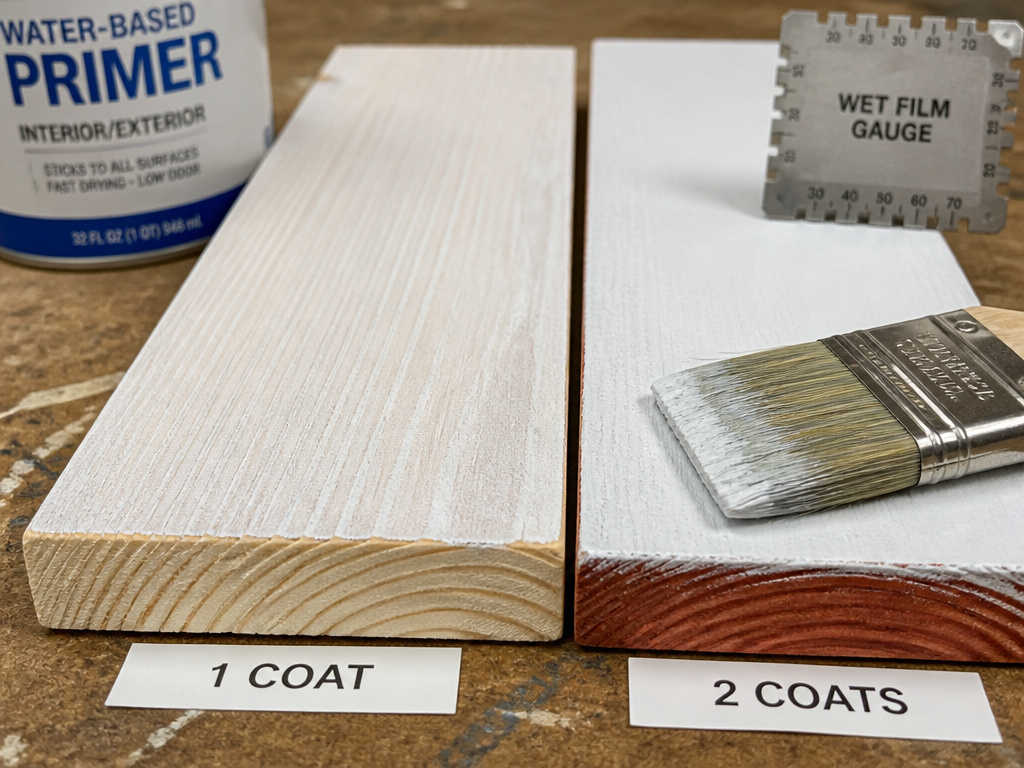
Cedar and redwood behave differently under primer, and treating them as one problem is how people end up with a pink fence. The Cal Poly study found cedar tannin blockable by water-based products matching the best solvent products at one coat. Redwood was not. Several water-based products only matched the best solvent products on redwood when applied as two coats.
That’s a useful fact in the primer category, though product pages rarely mention it.
Cedar Blocks in One Coat, Redwood Doesn’t
Cedar is the easy case. A water-based primer at 100 g/L or lower blocks cedar tannin at one coat, matching the best solvent products in the study. If you’re priming a cedar fence or a cedar-clad wall, the water-based route works.
Redwood needs two coats. That result is documented in the Cal Poly study, not a marketing claim. If you’re priming redwood and only apply one coat, the Cal Poly study found water-based primers needed two coats to match the best solvent products.
For primers for stained wood more broadly, the routing depends on whether the stain is tannin or an applied stain. Tannin means two coats on redwood for water-based primers in the Cal Poly study, while Dunn-Edwards says some stains may require a second coat and to test after 4 hours. An applied stain like a marker or a coffee ring means one coat of shellac or waterborne alkyd.
The tannin test in the study used 7 mil wet film on 12″x36″ cedar and redwood boards, dried at least 24 hours, then topcoated at 7 mils. That’s a heavier film than the 4.9 mil wet film Dunn-Edwards recommends for BLOCK-IT Premium on a wall. If you’re brushing a wall, follow the product’s film thickness, not the lab’s.
Shellac, Oil, and When to Skip Water-Based Entirely
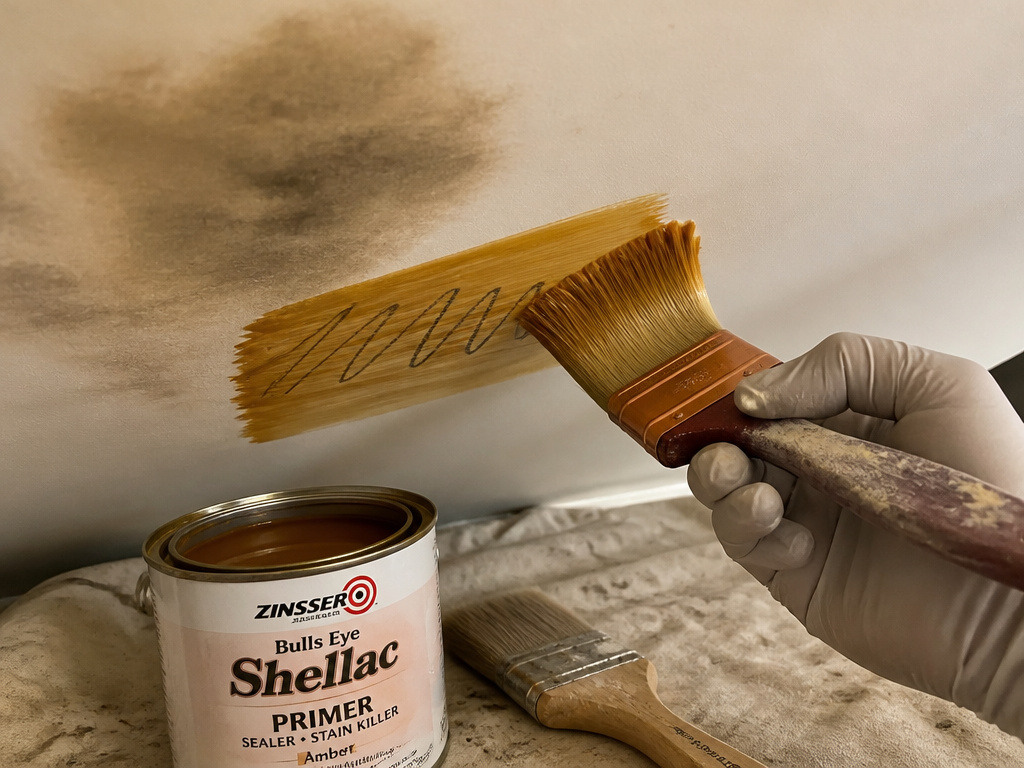
Shellac is the heavy hammer, and it earns its place on smoke, marker, and odors. I sealed a smoke-yellowed ceiling patch and a marker scribble with Zinsser B-I-N Shellac-Base Primer after two coats of regular wall paint had failed. One coat of shellac and it was done.
Two things nobody warns you about. The fumes are real. I opened every window in the house and still felt a bit loopy by the end. And cleanup needs denatured alcohol, which I learned the hard way after letting a brush sit for an afternoon. That brush is gone. Now I use a throwaway brush for shellac jobs and don’t feel guilty about it.
I won’t recommend shellac for a whole-room job unless the room is empty and you can ventilate it for a day. Spot priming a ceiling patch or a door frame? Shellac every time. Whole bedroom? Use a water-based stain blocker and save the shellac for the spots that need it.
For shellac-based primer pros and cons, the pattern is: dries in 20 minutes, blocks almost everything, smells like a chemistry lab, and needs solvent cleanup.
Oil-based primers still have a place. Oil-based primers are the right call on exterior bare wood and on some red inks where water-based products underperform. They also take longer to dry and smell worse than water-based, so the trade is real.
For odor-blocking primers specifically, shellac is the standard. Zinsser B-I-N Shellac-Base Primer seals smoke, nicotine, and pet urine odors, and the same coat blocks the stain. Two problems solved with one product.
Reach for shellac when:
- The stain is smoke, nicotine, or pet urine.
- A water-based primer already failed on the same spot.
- You need to topcoat within an hour.
- The room can be ventilated for a full day.
Why Do Water Stains Bleed Back Through Paint?
Water stains bled through two coats of regular wall paint on me, brown ring and all, until I used a stain-blocking primer. That’s the most common failure in the category.
Before you start: Scraping or sanding pre-1978 paint can release lead dust. Wear a NIOSH-approved N100 particulate filter mask and use a HEPA vacuum for cleanup. If the drywall is soft, bubbly, or crumbly, cut it out and patch before priming, because primer over wet paper will fail within a month.
Here’s the sequence that works:
- Find and fix the leak. Primer over an active leak is a waste of a Saturday.
- Let the drywall go bone dry, at least 24 hours after the leak stops.
- Scrape loose paint and any crumbly paper. Sand the edges smooth.
- Prime with a shellac or waterborne alkyd stain blocker. Zinsser B-I-N Shellac-Base Primer or Dunn-Edwards BLOCK-IT Premium (BIPR00) both work.
- Let the primer dry according to the product sheet. BLOCK-IT Premium wants overnight on water-sensitive stains. B-I-N Shellac-Base is recoatable in 45 minutes.
- Topcoat. If the stain bleeds through, Dunn-Edwards says to apply a second coat and re-test before topcoating the whole wall.
Common mistake: Priming a water stain with a basic latex wall paint and calling it done. The stain comes back within a day or two, usually as a faint tan shadow that gets darker each time you paint over it.
If you see fuzzy growth on the drywall, treat it first with a solution of one cup household bleach per gallon of water (no ammonia), then prime with a mold-blocking primer once the surface is dry. A plain water ring without growth is usually a mineral deposit, not mold.
Zinsser Smart Prime and B-I-N Advanced both note that a stain may appear in the drying primer film and that it’s locked in place, not bleeding, while Dunn-Edwards instructs to test a small area and apply a second coat if the stain bleeds through. Don’t panic and recoat early. Let the film cure and the topcoat will cover it.
Frequently Asked Questions
Does paint-and-primer-in-one actually block stains?
No. A combo product is thicker paint. It doesn’t block stains the way a dedicated primer does. I tried one over a brown water ring and it bled back through within about a day. It’s fine on a sound, previously painted wall where you’re just changing color.
Can I use a water-based primer on redwood?
Yes, but plan on two coats. The Cal Poly study found water-based primers at 100 g/L only matched the best solvent products on redwood when applied as two coats. One coat is not enough.
What’s the difference between a stain-blocking primer and a sealer?
Stain-blocking primer locks a stain into the film so it can’t bleed into the topcoat. A sealer is usually a clear coat that closes a porous surface like new drywall or bare wood. The two jobs overlap on bare wood, but they’re not interchangeable on a stain.
How cold is too cold to apply a stain-blocking primer?
It depends on the product. Benjamin Moore Max Block goes on above 40 °F. Miller 4700 stops at 45 °F. Dunn-Edwards BLOCK-IT Premium and the two Zinsser water-based products stop at 50 °F, Miller 4700 stops at 45 °F, and Benjamin Moore Max Block goes on above 40 °F. Zinsser B-I-N Shellac-Base goes on in freezing temperatures.
Do I need a mold-killing primer for a water stain?
Only if there’s visible mold. A water stain on drywall is usually a mineral deposit, not mold. If you see fuzzy growth, treat it first with a solution of one cup household bleach per gallon of water (no ammonia), then prime with a mold-blocking primer once the surface is dry.
Why did the stain show through the primer while it was drying?
Zinsser Smart Prime and B-I-N Advanced both say a stain may appear in the primer film as it dries and that it’s locked in place, not bleeding into the topcoat, while Dunn-Edwards instructs to test a small area and apply a second coat if the stain bleeds through. Let the film cure, then topcoat. If the stain bleeds through the topcoat, Dunn-Edwards says to apply a second coat and re-test before topcoating.
Before You Go
Before you prime an entire wall, brush a small test square of primer over the worst part of the stain. Let it dry for the full recoat window on the label, which varies by brand from 45 minutes to 14 days, then topcoat that square. If the stain bleeds through the topcoat, Dunn-Edwards says to apply a second coat and re-test before topcoating.
That test costs you the label’s recoat window, which varies by brand from 45 minutes to 14 days, and saves you a weekend. A stain that comes back through a full wall may mean applying a second primer coat and re-testing before topcoating, per Dunn-Edwards.
This all assumes the leak is fixed. If the leak is active, fix it first; the fact sheet does not support any primer holding over an active leak.
Try this today: find the worst stain in your house, brush a 6-inch square of the primer you already own over it, and see what happens after the label’s full dry time. Ten minutes. That’s the whole test.
