
Washable Paint for Interior Walls Guide: What Tests Miss
This post contains affiliate links. As an Amazon Associate, we earn from qualifying purchases.
Washable paint for interior walls is a coating that releases dirt during washing without losing film, and the claim is narrower than the label suggests: the ASTM D3450 washability test only covers coatings with CIE-Y reflectance of at least 60 percent, so deep colors sit outside it.
That 60 percent figure is a reflectance threshold. A tester needs to see the soil against the film well enough to score removal, and the threshold quietly excludes the saturated navy, the deep green, and the terracotta that half of us want on a feature wall.
What follows covers what the standards actually test, where each one stops applying, why washability and scrub resistance pull against each other, and how long a fresh wall needs before a sponge touches it.
Key Takeaways
- Wait a full week before washing a newly painted water-based wall; Dulux states water-based paint needs a full week under normal conditions to cure and develop full washability.
- Deep colors sit outside the tests. ASTM D3450 applies at CIE-Y 60 percent and above, and ISO 23169 applies only above Y 25.
- Match the cleaner to the finish. ASTM D3450 permits abrasive cleaners and says flat paint may need them; Dulux warns that rough abrasives polish the surface into highlights only repainting fixes.
- Washability and scrub resistance trade off. An Arkema paper presented at the 2016 American Coatings Conference notes that a latex with good stain removal often has poor scrub resistance.
- Prep beats price. Tinting the primer toward the topcoat color can shorten a dark-to-pale repaint.
What Does “Washable” Actually Mean on a Paint Label?
Washability is narrower than the word implies: it measures how easily washing lifts dirt off a cured film without damaging that film. Sherwin-Williams defines it exactly that way, and the definition is doing real work. A paint can be washable and still be a bad choice for a hallway.
Washability describes how easily washing lifts soil from a cured paint film without damaging that film. The ASTM D3450 method permits either an abrasive or a nonabrasive cleaner, and the scope of the standard covers only coatings with CIE-Y reflectance of at least 60 percent. Results do not necessarily correlate with every soilant type encountered in a home.
Two ASTM methods sit behind most of the claims you’ll read. The ASTM D3450 washability test method scores how completely a specific soilant comes off. ASTM D4828 goes at it with a household sponge and a liquid or powder cleanser, and it scores appearance change as well as soil removal.
That second half matters. A film that gives up the stain but dulls in the process has failed the practical test even though the mark is gone.
When you’re comparing a washable paint for interior walls guide, read the test method before the adjective. “Washable” on a label is a claim about a test, and every test has a scope.
Why Deep Colors Sit Outside Every Washability Standard
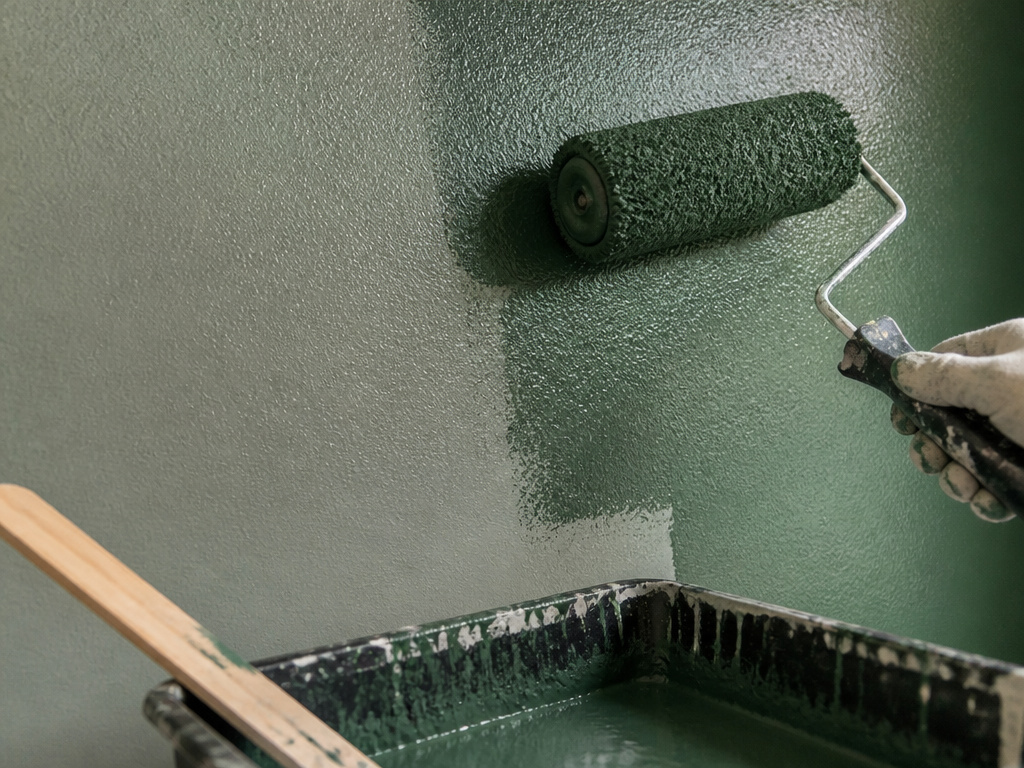
ISO 23169 draws its own line at Y greater than 25, and both thresholds exist for the same practical reason. Someone has to see the soil against the film to score how much of it came off. On a near-black wall that scoring gets hard, so the standards step aside rather than guess.
So the deep-green feature wall you want has no washability rating behind it. Not a weak one. No rating at all.
I found that out the expensive way going from a dark navy to a pale color. With a gray-tinted primer underneath, the repaint got shorter.
What changed the job was the layer under the topcoat. Ask the paint counter to tint the primer toward the topcoat color and the whole repaint gets shorter.
| Standard | What it measures | Where it stops applying |
|---|---|---|
| ASTM D3450 | Soilant removal by washing | Coatings below CIE-Y 60 |
| ASTM D4828 | Soil removal plus appearance change | Cured films only |
| ASTM D2486 | Erosion from repeated scrubbing | Method B is a ratio against a reference paint |
| ISO 23169 | Cleanability of interior coatings | Y of 25 or below |
ISO 23169 has a second limit that rarely gets mentioned. It only separates paints between 18 percent PVC and the critical pigment volume concentration, where PVC means pigment volume concentration, the ratio of pigment to binder in the dried film. Above that point, wet-scrub resistance is the only thing that tells two paints apart. Budget flat paints live above it.
Abrasive or Nonabrasive? Where the Sources Actually Disagree
Abrasion is the fight worth having, because the two most-cited sources on this point don’t agree with each other.
Where ASTM D3450 Lands
ASTM D3450 permits washing with an abrasive or a nonabrasive cleaner. Its significance section adds that semigloss finishes generally require only the nonabrasive type, while flat paints may require the abrasive type.
Where Dulux Lands
Dulux’s maintenance manual calls for a soft non-abrasive brush and a dilute solution of mild pH-neutral detergent in warm water. It warns that rough abrasives and stiff brushes polish the surface, creating highlights that only repainting can fix.
| Source | Position on abrasive cleaners | What it actually is |
|---|---|---|
| ASTM D3450 | Permits abrasive or nonabrasive; flat paint may need abrasive | A lab test method |
| Dulux manual | Soft non-abrasive brush only; abrasives polish the film | Maintenance advice for a real wall |
| Sherwin-Williams | Higher gloss cleans easier; porous paints let soil in | Product guidance, promotional |
The two positions sit closer together than they look. D3450 is a lab method asking whether a cleaner type can remove a soilant under controlled conditions. Dulux is telling a maintenance crew what happens to a real wall over years, which is the washable paint for interior walls guide question. Both can be true.
Here’s the split I’d draw. ASTM D3450 permits abrasive cleaners and says flat paint may need them, while Dulux warns that rough abrasives polish the surface into highlights only repainting fixes. The surface is already smooth, and polishing it just moves the damage around.
Where this goes sideways: Scrubbing a satin wall with a melamine sponge. The pad cuts the sheen flat in a patch, and under a window that patch reads as a dull bruise for the life of the coat.
For stubborn marks, Dulux allows isopropyl alcohol or methylated spirits on the affected area, followed by a rinse with clean water, and rules out other aggressive solvents. That’s the escalation path. Detergent first, solvent second, and never a solvent you picked because it was already under the sink.
The cleaners for painted walls question gets easier once you accept that order. ASTM D4828 scores appearance change alongside soil removal, which is why the practical washability of organic coatings method is the one to read if dulling worries you more than the stain.
Washability and Scrub Resistance Pull Against Each Other
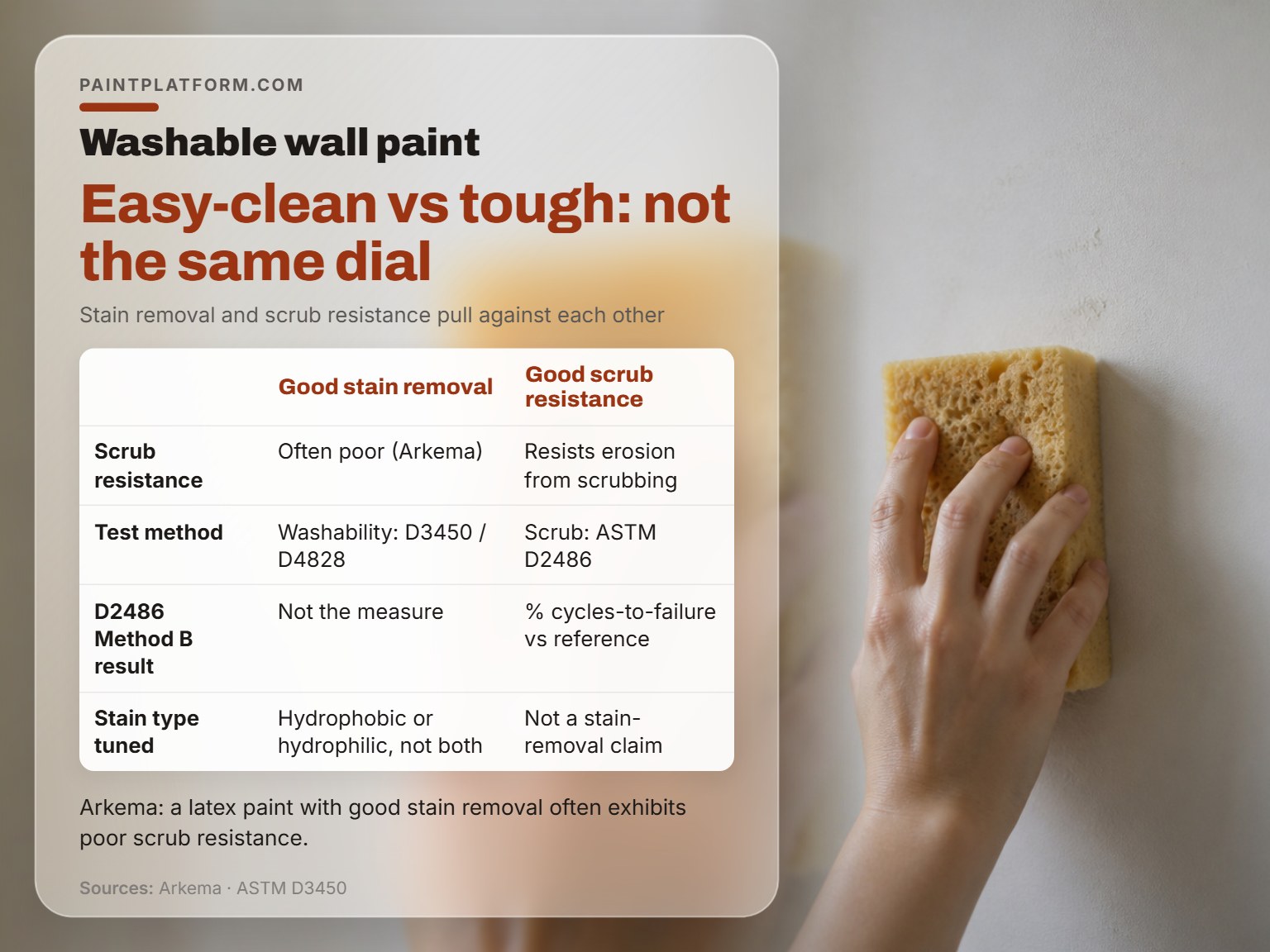
Stain removal and scrub resistance are separate properties, and the industry paper that says so most plainly is the Arkema one.
The authors, writing for the 2016 American Coatings Conference, put it this way: a latex paint with good stain removal often exhibits poor scrub resistance. The mechanism is mechanical erosion. If the film gives up its surface easily, it also gives up its surface when you scrub it repeatedly.
That’s the trade-off in one sentence. Easy-clean and tough are not the same dial.
ASTM D2486 measures the other side: the scrub resistance of wall paints, meaning the resistance to erosion caused by repeated scrubbing. Method B expresses the result as a percentage of cycles-to-failure against a concurrent reference paint, which exists because brush stiffness and tester condition made raw cycle counts hard to reproduce.
The acrylic polymers in interior wall paints paper adds a second split. A formulation tuned for hydrophobic stain washability loses hydrophilic stain removal, and the reverse. Even “stain resistant” is two different jobs wearing one word.
I used a washable matte in a hallway where a gear bag hits the wall most days. Scuffs came off with a damp sponge, and it hid patched dents better than the eggshell on the adjoining wall. Old flat paint is the version I’d skip for hard use. Modern washable matte behaves differently, and I spent a few years being wrong about that.
If scrub durability is what you actually need, look at scrubbable paint rather than the washability claim. Different test, different promise.
How Long Before You Can Wash a Fresh Wall?
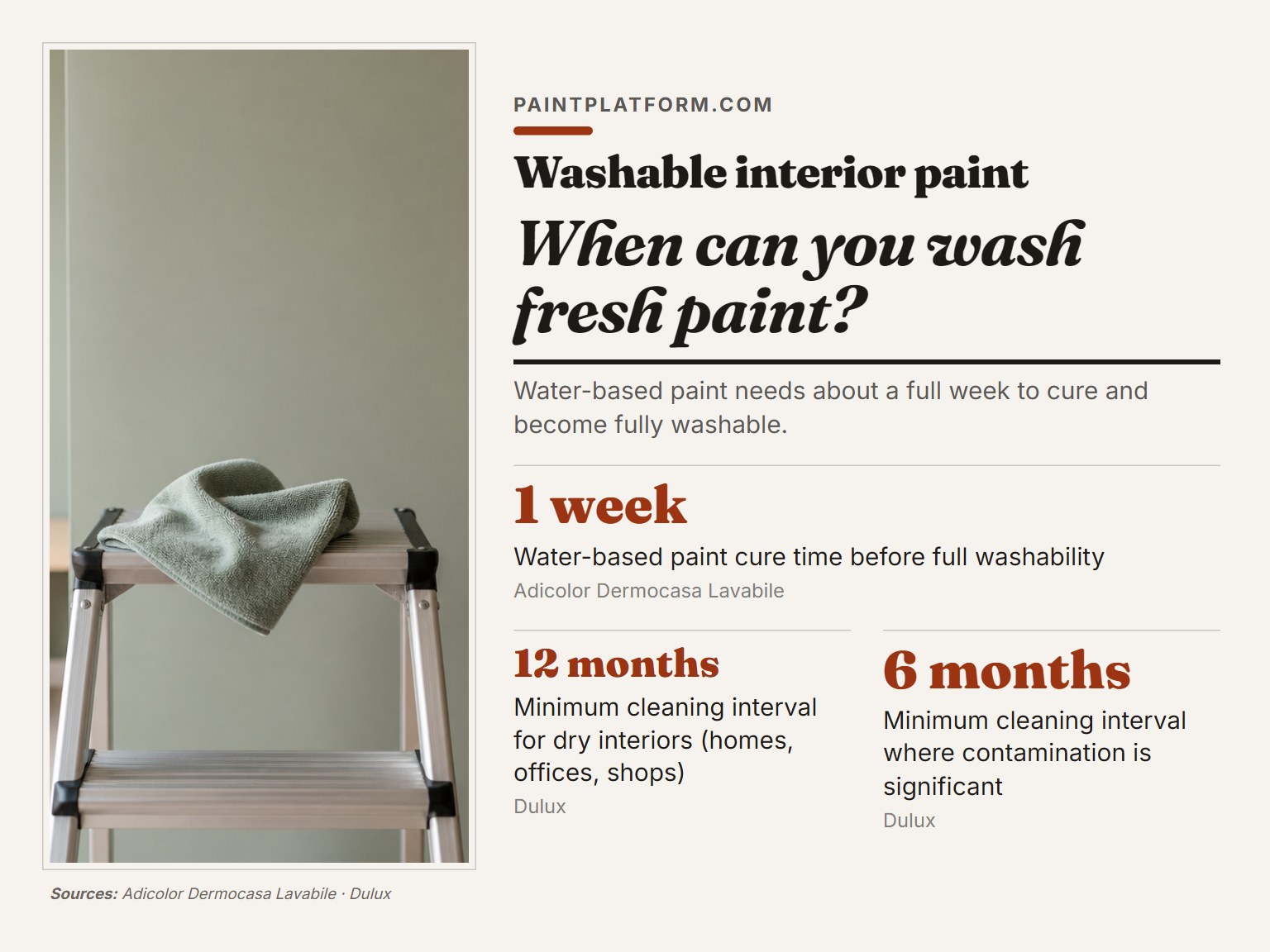
A full week, if the paint is water-based and you’re going by Dulux’s guidance. That’s the cure window, and it’s the number most people skip.
Water-based paints need a full week under normal climatic conditions to cure and develop full washability, per the Dulux maintenance manual. Wash a wall on day two and you’re working on a film that hasn’t finished forming.
No standard covers that window either. Every ASTM and ISO washability method tests cured films, so a failure inside the cure week isn’t a paint failure by any published definition.
Easy to miss: A wall that looks dry is not a wall that’s cured. Dry-to-touch happens in hours; full washability takes the week.
If you’re already past the week, how to clean painted walls safely covers the routine. Inside the week, the answer is a dry microfiber cloth and patience.
Dulux’s schedule sets a minimum cleaning interval of every 12 months for dry interior environments like homes, offices, and shops. It tightens to every 6 months where contamination is significant, such as around a swimming pool. That’s a scheduled wash, separate from spot-cleaning. Spot-clean marks when they appear and do the full wash on the calendar.
AS/NZS 2311:2017, published 3 March 2017, is worth knowing about here for a different reason. It’s a guide to painting buildings, not a specification, and it can form the basis of one without ever being nominated as the spec itself. If a contractor waves it at you as proof of a warranty standard, that’s a misread.
The Cleaning Sequence That Doesn’t Polish the Surface
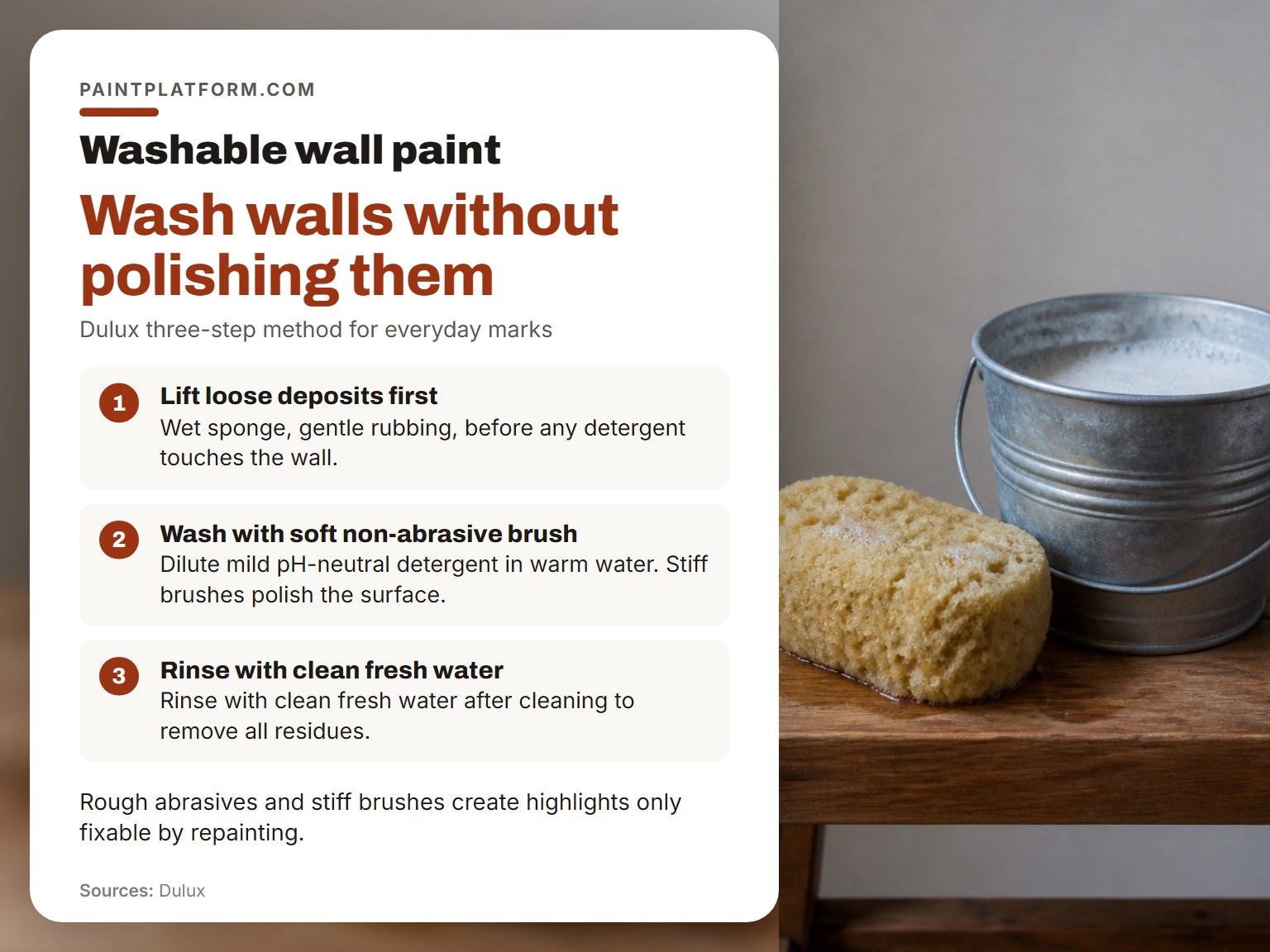
A damp sponge, a bucket of warm water, a drop of pH-neutral dish soap. That’s the entire kit Dulux recommends for everyday marks, and it’s already in your kitchen.
The Three-Step Wash
- Lift the loose stuff first. A wet sponge and gentle rubbing takes off dust and surface deposits before any detergent touches the wall. Skip it and that grit becomes an abrasive you’re pushing around the film.
- Wash with a soft non-abrasive brush and a dilute solution of mild pH-neutral detergent in warm water. A stiff brush or a scouring pad is exactly where polished highlights come from.
- Rinse with clean fresh water. Residue left on the film attracts soil, so an unrinsed wall gets dirty faster than one that was never washed at all.
Methylated spirits smells sharp and flashes off before you finish the pass, which is the tell that it’s working and the tell that you shouldn’t leave it sitting. Wipe, rinse, move on.
The places that need this most are the ones ASTM D2486 names: near doorways, near windows, and in work and play areas. So the high-traffic areas in your house are also the ones where a finish choice pays off most.
Skip this if: The mark is grease or oil. Detergent and water push those into a wider patch, and you’ll chase the smear across half the wall before you switch to isopropyl alcohol.
Matching Finish to Room Without Trusting the Chip
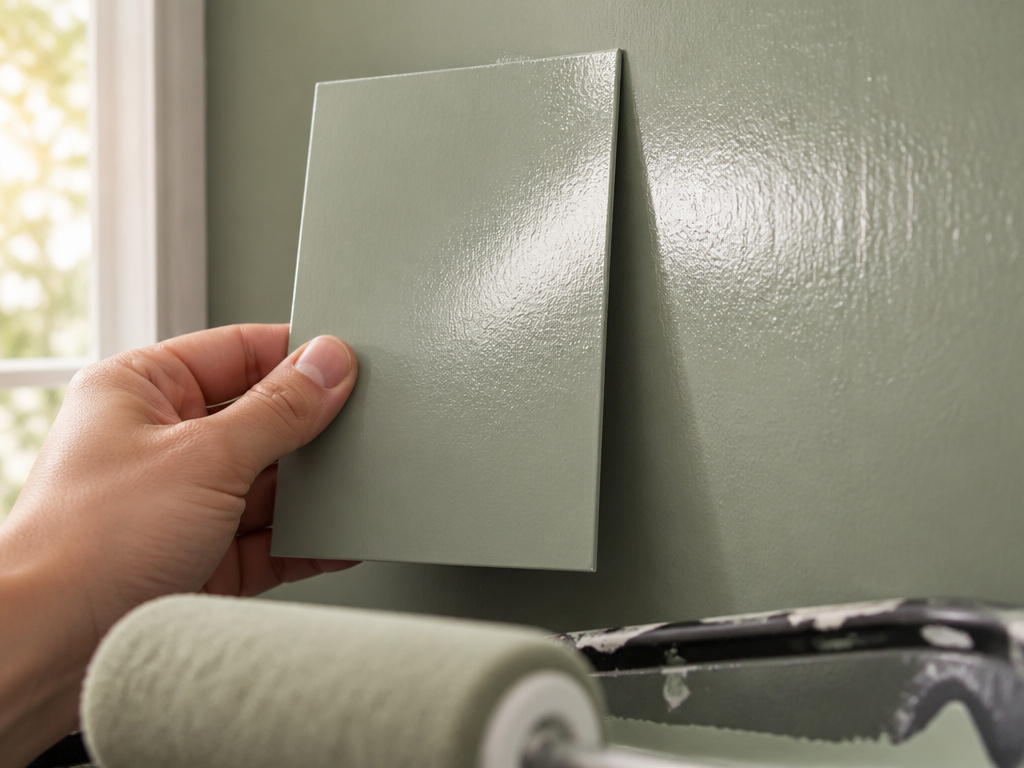
Sheen is the part of paint selection that photographs worst and matters most, and the chip in the store tells you almost nothing about it.
I picked satin off a small chip once. It looked soft and pretty under the store lights. On a full wall with a window opposite, it turned into a mirror for every roller mark, and the light raked across the surface at an angle that made each pass visible.
That’s the thing about sheen. It shows up at angles, never head-on, and a small chip can’t show you an angle.
Now I paint a sample board, tape it to the wall, and look at it morning and evening before committing. The morning look matters because that’s when the window light is hardest.
For a busy room, a washable matte handles marks and hides patching better than eggshell. For a bathroom or a kitchen splash zone, a higher sheen earns its place because Sherwin-Williams says higher gloss cleans more easily, though ASTM D3450 frames cleanability as a matter of cleaner type rather than a simple gloss ranking.
Kid rooms are their own case. A kid-friendly paint has to survive crayon and repeated wiping, and the finish matters more than the brand name on the can.
Where the Washable Label Earns Its Keep
Sherwin-Williams names two coatings, Emerald Interior and Duration Home, as washable products where contaminants sit on the surface and wash off without scrubbing. The distinction underneath that claim is porosity, and porosity is the whole game.
Low-quality, porous paints let contaminants penetrate the film, which is why scrubbing them harder makes things worse instead of better. You’re pushing soil deeper into a sponge.
Arkema reports that almost all interior paints now formulate below 50 g/L VOC, with some claiming zero VOC and odorless. So a washable claim isn’t a premium-only feature anymore, and paying for the top tier in a normal bedroom buys you very little.
Flat paint is the harder ask. Stain resistance gets more difficult to achieve in flat interior paints as pigment type and amount increase, which means the flatter and more heavily pigmented the finish, the more you’re demanding from it.
Adicolor’s Dermocasa Lavabile data sheet shows what a real spec looks like: ISO 11998 Class 3 for wet scrub resistance and cleanability, gloss at 60 degrees of 2.6, and an application window of 5°C to 28°C. Apply it outside the 5°C to 28°C range and the stated performance simply doesn’t apply.
If you want paint for washable walls, start with the finish, then the test method, then the brand. The wall paint you pick matters less than the layer under it and the week you give it to cure.
Frequently Asked Questions
Is washable paint worth it for a hallway?
Yes, with one condition. Hallways collect the scuffs ASTM D2486 points to near doorways and in work areas, and a washable matte wipes clean with a damp sponge. The condition is that you let it cure for a full week first, because washing inside that window damages a film that hasn’t finished forming.
Can I wash a wall painted two days ago?
Not safely. Dulux states water-based paint needs a full week to cure and develop full washability, and no ASTM or ISO method covers washing inside that window. A dry microfiber cloth handles dust in the meantime.
Does washable paint mean I never have to repaint?
No. Washability measures how easily soil comes off a cured film without damage, and repeated scrubbing erodes that film over time. ASTM D2486 exists precisely because walls erode with scrubbing, and a wall washed hard enough for long enough will eventually need a fresh coat.
What is the difference between washable and scrubbable paint?
They’re scored by different tests. Washability (ASTM D3450, ASTM D4828) measures soil removal and appearance change. Scrub resistance (ASTM D2486) measures resistance to erosion from repeated scrubbing. An Arkema paper presented in 2016 notes that a latex with good stain removal often has poor scrub resistance, so the two pull against each other.
Do I need a special cleaner for washable paint?
Dilute pH-neutral detergent in warm water covers almost everything, per Dulux. For stubborn marks, isopropyl alcohol or methylated spirits on the affected area, then a rinse with clean water. Dulux advises skipping rough abrasives on satin and above, while ASTM D3450 permits abrasive cleaners and says flat paint may need them; both sources rule out aggressive solvents other than recommended ones.
Why did my washable paint go shiny where I cleaned it?
You polished the film. Dulux warns that rough abrasives and stiff brushes gloss the surface and create highlights that only repainting can fix. It shows up at an angle first, usually under a window, and it doesn’t wash out.
The Bottom Line
Everything above assumes a normal room with a light-to-mid color and a paint that’s had a week to cure. Change any one of those and the advice shifts. Deep-tinted walls fall outside ASTM D3450 entirely, so no washability claim on that can is backed by the test.
Here’s the first thing I’d do this week. Buy a sample pot, paint a board, tape it to the wall, and look at it twice: once in the morning and once at night. Start smaller than you think.
Then spend your money on primer and a decent roller sleeve rather than the top-tier can. Fair warning, that’s the least fun place to spend it, and it’s the place that changes the result.
