
9 Best Paint For Fiberglass in 2026
This post contains affiliate links. As an Amazon Associate, we earn from qualifying purchases.
For a durable, glossy finish on fiberglass, Rust-Oleum Marine Topside Semi-Gloss White Boat Paint is our Best Overall pick. Its flexible oil-based formula levels smoothly and resists UV and weather damage. For a high-gloss yacht-quality finish, consider the TotalBoat Wet Edge Topside Marine Paint, or the Pettit EZ-Poxy Polyurethane Topside Paint for a smooth, professional look.
Painting fiberglass presents unique challenges: the surface is slick and non-porous, requiring proper adhesion and a finish that can withstand sun, salt, and physical wear. Choosing between a topside paint, an antifouling bottom paint, or a gelcoat repair kit depends entirely on your project—restoring a boat’s topsides, protecting its hull from barnacles, or repairing a scratch.
This guide is built from manufacturer specifications, expert round-ups, and patterns in owner feedback. We’ve organized nine distinct products by their specific strengths to help you match the right paint to your fiberglass project, saving you time and costly mistakes.
Top 9 Paints For Fiberglass in the Market

Certain content that appears on this site comes from Amazon. This content is provided "as is" and is subject to change or removal at any time.
The Best Paints For Fiberglass, Reviewed
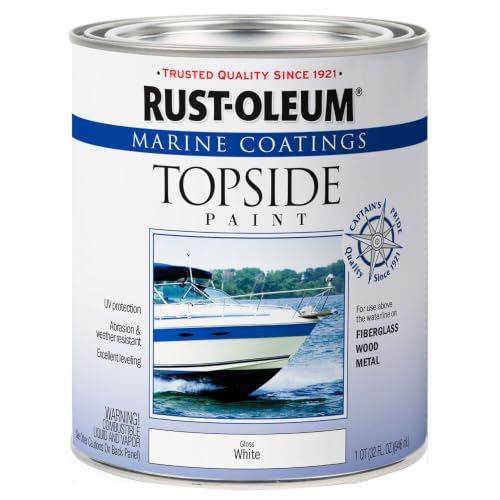
Rust-Oleum Marine Topside Semi-Gloss White Boat Paint
What We Like
- Flexible oil-based formula levels smoothly
- UV and weather resistant for long-lasting finish
- Superior gloss retention keeps surfaces elegant
- Dries to touch in 1-2 hours
Trade-offs
- Only for surfaces above the waterline
- Oil-based formula requires solvent cleanup
A quart of this paint covers up to 100 square feet, so it can handle a small boat deck or a fiberglass repair without needing a second can. The oil-based formula levels nicely, meaning brush strokes tend to settle out as it dries. That flexibility helps the coating resist cracking when the surface expands or contracts. The finish offers UV and weather resistance along with superior gloss retention, which helps maintain its appearance over time.
The main trade-off is that this paint is strictly for above-waterline use, it won’t handle constant immersion like an antifouling bottom paint would. If you need a product for both topsides and below the waterline, TotalBoat Wet Edge offers a polyurethane finish designed for topside use. For above-deck projects where durability and gloss matter most, this Rust-Oleum marine topside paint applies easily and provides a durable finish.
TotalBoat Wet Edge Topside Marine Paint

What We Like
- Scratch- and chemical-resistant finish
- Self-leveling for smooth application
- Works with roll & tip or spray
Trade-offs
- Above waterline use only
- Requires primer for metal surfaces
With 22 high-gloss colors and a self-leveling polyurethane formula that resists scratches, chemicals, and fading, this paint is built for boats and RVs that need to stay beautiful season after season. The one-part formula can be applied by roll and tip or spray, making it straightforward to use. It’s a topside finish for fiberglass, wood, and metal surfaces that sees sun and spray but not constant immersion.
If your boat stays moored for days, the 72-hour submersion limit means this paint is not for below the waterline. But for hulls, decks, trim, and even an RV exterior, Wet Edge resists fading, cracks, and peels. It delivers a high-gloss finish without mixing hardeners.
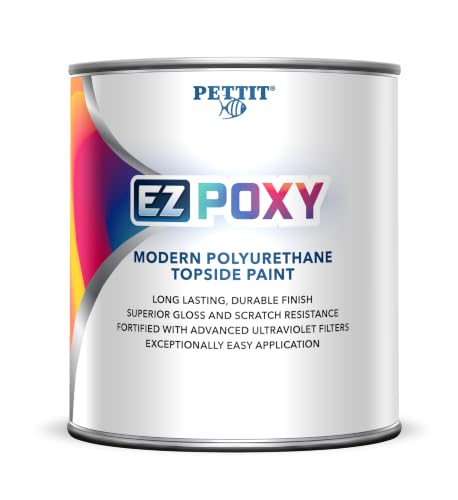
Pettit EZ-Poxy Polyurethane Topside Paint
What We Like
- One-part ease with yacht-quality finish
- UV filters preserve gloss and color
- Silicone-enhanced flow minimizes brush marks
- Scratch-resistant for dockside wear
Trade-offs
- Above-waterline use only, not for bottom
- Heavier quart can at 4 pounds
A silicone-enhanced formula that levels out brush marks and roller stipple means you can lay down a glossy, mirror-like finish without fighting the paint. That flow-and-leveling behavior is the reason this one-part polyurethane achieves results that look like a sprayed two-part system, but with far less cleanup and no mixing. It’s an excellent match for boat owners who want professional-grade appearance on topsides, cabins, or cockpit areas and are willing to invest in a premium product rather than a budget can.
This quart is heavy for its size and only covers above-waterline surfaces, so a full hull job may require multiple quarts and a separate bottom paint. Compared to Rust-Oleum Marine Topside, which is lighter at 2 pounds, the Pettit weighs 4 pounds per quart. For a showroom-quality finish on fiberglass, this is the one to reach for.
Product photos
Interlux Fiberglass Bottomkote NT Antifouling Paint
What We Like
- Designed specifically for fiberglass boat bottoms
- Antifouling protection for marine environments
- Large 1-gallon size covers multiple coats
- Trusted Interlux brand in boating supplies
Trade-offs
- Designed for below-waterline use only
- Blue color limits aesthetic options for topsides
Amazon labels this gallon of Interlux Fiberglass Bottomkote NT as ‘BEST IN CLASS’ for its category. So it’s a serious choice for boaters who want a dedicated antifouling paint. At 8 pounds, the can is noticeably heavier than a quart of Rust-Oleum Marine Topside paint (2 pounds), which reflects the larger volume and specialized formulation. If you’re looking for a product engineered specifically for fiberglass boat bottoms, this is the one to consider.
This paint is a specialized bottom paint, not a multi-surface topside coating like Rust-Oleum Marine Topside Semi-Gloss White, which works on fiberglass, wood, and metal above the waterline. Weighing 8 pounds per gallon, it’s also heavier than that quart-sized Rust-Oleum option (2 pounds), so plan for the extra weight when handling the can. For boat owners focused solely on keeping the underwater hull clean, that focus is exactly the point.
Product photos
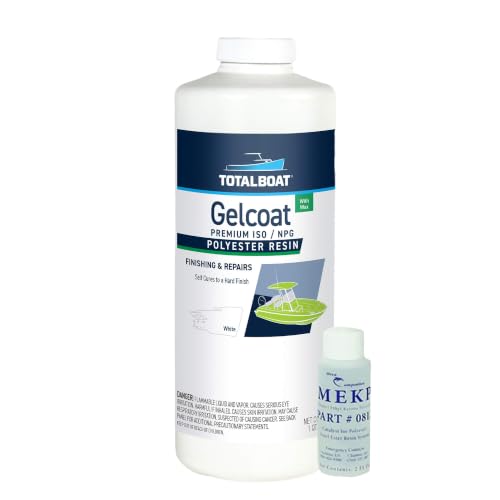
TotalBoat Marine Gelcoat for Fiberglass Repairs
What We Like
- Premium ISO/NPG formula for durability
- Non-sagging, high-viscosity for easy application
- Cures tack-free for sanding and polishing
- Tintable for custom color matching
Trade-offs
- Short 8-12 minute pot life at 77°F
- Requires separate MEKP catalyst and colorants
- Not for below-waterline or antifouling use
A premium ISO/NPG polyester gelcoat that cures tack-free thanks to added wax, this is built for restoring the factory gloss on fiberglass hulls and topsides. The non-sagging, high-viscosity formula lets you brush, roll or spray a thick coat that sands and polishes to a showroom finish. For anyone touching up gelcoat scratches, chips or faded areas, the wax additive ensures the surface dries tack-free without needing a separate barrier coat. It tints easily with polyester colorants, so matching your boat’s existing shade is straightforward. If you want a cosmetic repair that blends in and buffs out, this is the gelcoat to reach for.
You get only 8 to 12 minutes of working time at 77°F before the gelcoat kicks, so mix small batches and have your brush or spray gun ready before adding the MEKP catalyst. That short pot life is a fair trade for a thick, durable layer that matches original gelcoat on spot repairs, but it demands quick, deliberate application.
SENVEN Boat Paint Gloss White Marine Enamel

What We Like
- Abrasion-resistant polyurethane finish
- UV resistant with excellent gloss retention
- Applies by brush or spray
- Works on fiberglass, wood, metal, aluminum
Trade-offs
- Oil-based formula requires mineral spirits cleanup.
Covering up to 120 square feet, this oil-based enamel works for a weekend topside refresh on a jon boat, dinghy, or pontoon. The finish is described as abrasion-resistant and UV-resistant, with excellent gloss retention. For someone who wants a durable, good-looking coat, this delivers where it counts.
It is not rated for bottoms left in the water longer than 72 hours, so it belongs above the waterline or on a trailer-kept boat. That puts it in the same use zone as Rust-Oleum Marine Topside, based on the listed product descriptions. If your boat stays on a trailer and you need a durable enamel that holds up to weather, this is a practical route.
Product photos
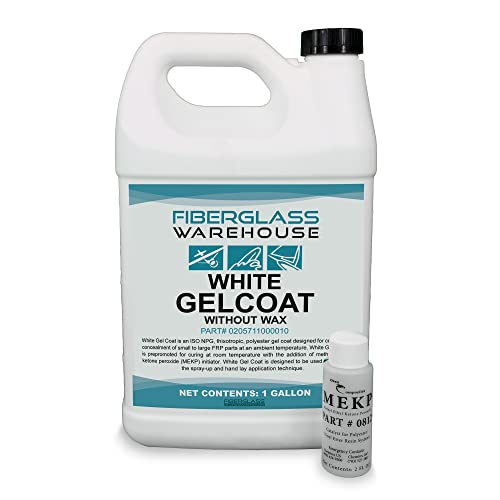
Fiberglass Warehouse Gel Coat With MEKP Catalyst
What We Like
- Includes MEKP catalyst for convenience
- High-viscosity formula minimizes sagging
- Compatible with polyester color pigments
- No sanding between layers required
Trade-offs
- Unwaxed formula needs waxed final layer for tack-free finish
- Requires separate purchase of polyester resin color pigments for color matching
A full gallon of ISO polyester gelcoat with a 2-ounce bottle of MEKP catalyst means you get everything needed to start a repair or coating job right out of the box. The high-viscosity formula resists sagging on vertical surfaces, which is a real help when you are brushing or rolling gelcoat onto a boat hull or a composite part for the first time. Because it is unwaxed, you can apply multiple layers without sanding between them, saving time and effort. This kit suits the beginner who wants a straightforward, forgiving material that still delivers the strength and flexibility of premium modified polyester resin.
Unwaxed gelcoat stays tacky unless you seal it with a waxed top layer, so you must buy a separate waxed gelcoat for the final coat. This 1-gallon kit includes a 2-ounce MEKP catalyst, making it a practical choice for repairs and composite coating. For a one-step finish on a fiberglass boat deck, a product such as Rust-Oleum Marine Topside paint would be simpler. But if you are rebuilding a gelcoat surface or fabricating composite parts, this kit provides the material for the job.
Fiberglass Supply Depot Black Gelcoat No Wax

What We Like
- Low styrene meets EPA MACT regulations
- Good water and blister resistance
- Exceptionally easy patch and repair
- Comes with hardener and measuring cup
Trade-offs
- Black color limits visibility for fairing work
- No wax means it stays tacky without a barrier coat
- Gelcoat requires catalyst mixing before use
A styrene level under 29% means this gelcoat meets current EPA MACT regulations, so you can work indoors or in a garage without overwhelming fumes. The NPG/isophthalic grafted polymer backbone is formulated for good water and blister resistance, which matters for repairs where moisture protection is a concern. This is the gelcoat to reach for when you want a durable finish that patches easily, especially if you need a strong, water-resistant layer.
This is a no-wax formula, so the surface stays tacky after curing unless you apply a topcoat or barrier layer. That makes it less convenient for a one-step job compared to a waxed gelcoat, which cures tack-free. But if you’re planning to paint over the gelcoat or use it as a repair layer, the low styrene and easy patch properties make the extra step worthwhile.
Product photos
Pettit Protect High Build Epoxy Primer

What We Like
- Prevents osmotic blistering in fiberglass hulls
- High-build formula reduces coats needed
- Creates durable moisture barrier
- Corrosion protection for underwater metals
Trade-offs
- Two-component system requires mixing before use
- Designed as primer, not a final finish coat
Pettit Protect High Build Epoxy Primer uses advanced two-component epoxy technology to reduce water absorption and prevent osmotic blistering in fiberglass hulls. That means fewer repairs down the line and a hull that stays sound in both freshwater and saltwater environments. Its high-solids formula delivers maximum film build with fewer coats than many competitive barrier systems, saving time during application. This is a professional-grade choice for new construction, restoration, or underwater repairs, trusted by marine pros and DIY owners alike.
This is a two-part system, so you must mix the epoxy and hardener before application, which adds a step compared to single-component primers. If you only need a quick topside refresh, a product such as Rust-Oleum Marine Topside Semi-Gloss White Boat Paint is simpler for above-waterline work. But for serious blister prevention and long-term hull protection, this heavy-duty barrier coat is worth the extra effort.
Product photos
How We Evaluated Paints For Fiberglass
This guide is based on manufacturer data, expert recommendations from marine restoration sources, and common themes in owner reviews. The focus is on what makes a paint successful on fiberglass: adhesion, durability, application ease, and intended use.
The four criteria that mattered most were surface compatibility, durability, application method, and finish quality. Surface compatibility means knowing whether the paint is for topsides, bottoms, or repairs. Durability covers resistance to UV, abrasion, and chemicals. Application method refers to whether you brush, roll, or spray. Finish quality involves gloss retention and self-leveling properties. A paint that excels on a wood boat may fail on fiberglass, so we prioritized products formulated for that substrate.
A research-led approach has limits: we cannot replicate real-world conditions like saltwater immersion or seasonal temperature swings. We rely on what the specifications state and what experienced owners consistently report, which gives you a reliable starting point for your own project.
What To Look For In Paints For Fiberglass
Choosing the right paint for fiberglass means understanding your project’s location on the boat, the finish you need, and how much prep you’re willing to do.
Key buying criteria: Identify if the paint is for above or below the waterline, check for UV and abrasion resistance, consider the application method, and decide between a one-part paint or a two-part epoxy or gelcoat system.
Above Waterline vs. Below Waterline
This is the most critical distinction. Topside paints like the Rust-Oleum Marine Topside are formulated for surfaces that spend most of their time out of the water. They resist UV rays, maintain gloss, and handle dockside scuffs. Bottom paints, such as the Interlux Fiberglass Bottomkote NT, are designed for submerged surfaces and contain antifouling biocides to prevent barnacle and algae growth. Using a topside paint on a boat bottom will lead to rapid failure.
Finish Type: Paint vs. Gelcoat
For large, visible areas like hull sides and decks, a marine paint (oil-based or polyurethane) provides a uniform, high-gloss finish. For small repairs, scratches, or restoring a specific area, a gelcoat like the TotalBoat Marine Gelcoat is a better match. Gelcoat is thicker, cures to a hard shell, and can be tinted to match the original fiberglass color. It requires mixing with a catalyst and has a short working time.
Application and Cleanup
One-part paints are easier for DIYers: they require no mixing and clean up with mineral spirits. Two-part systems (epoxies and gelcoats) offer superior durability but demand precise mixing and have shorter pot lives. Consider your comfort level with solvents like mineral spirits or acetone, and whether you plan to brush, roll, or spray. Self-leveling formulas like the TotalBoat Wet Edge reduce brush marks.
- Check the label for “fiberglass” or “FRP” compatibility.
- Confirm the paint is for the location (topside or bottom).
- Decide if you want a one-part paint for simplicity or a two-part system for maximum durability.
- Look for UV-resistant formulas if the surface will be in direct sunlight.
A general rule: if you are repainting a large topside area, choose a one-part marine enamel; for a small repair, use a gelcoat kit.
Paints For Fiberglass Compared
The table below compares our top picks across key features to help you decide which paint for fiberglass fits your project.
| Product | Surface | Coverage | Finish |
|---|---|---|---|
| Rust-Oleum Marine Topside Semi-Gloss White Boat Paint | Fiberglass, wood, metal | Up to 100 sq ft per quart | Semi-Gloss |
| TotalBoat Wet Edge Topside Marine Paint | Fiberglass, wood, metal, previously painted | 350-400 sq. ft./gallon | High-gloss |
| Pettit EZ-Poxy Polyurethane Topside Paint | Fiberglass, wood, metal | N/A | High-gloss |
| Interlux Fiberglass Bottomkote NT Antifouling Paint | N/A | N/A | N/A |
| TotalBoat Marine Gelcoat for Fiberglass Repairs | N/A | N/A | N/A |
| SENVEN Boat Paint Gloss White Marine Enamel | Fiberglass, wood, metal, aluminum | 100-120 sq ft | High-gloss |
| Fiberglass Warehouse Gel Coat With MEKP Catalyst | N/A | N/A | N/A |
| Fiberglass Supply Depot Black Gelcoat No Wax | N/A | N/A | N/A |
| Pettit Protect High Build Epoxy Primer | N/A | N/A | N/A |
Frequently Asked Questions
Can I paint directly over old gelcoat on fiberglass?
Yes, but you must prepare the surface first. Sand the old gelcoat with coarse grit paper to create a profile for adhesion, clean thoroughly, and apply a primer if the paint manufacturer recommends it. Skipping this step often leads to peeling.
What is the difference between topside paint and bottom paint?
Topside paint is designed for surfaces above the waterline. It resists UV rays and abrasion from docks and lines. Bottom paint is formulated for submerged surfaces and contains biocides to prevent marine growth like barnacles and algae. They are not interchangeable.
How do I get a smooth finish when painting fiberglass?
Use a self-leveling paint like the TotalBoat Wet Edge or the Pettit EZ-Poxy. Apply thin, even coats with a foam roller (the “roll and tip” method) or a sprayer. Work in a dust-free area and maintain a consistent temperature as recommended on the can.
Is marine paint the same as regular house paint?
No. Marine paint is formulated to withstand harsh conditions: constant UV exposure, saltwater, temperature swings, and physical abrasion. Regular house paint lacks these properties and will quickly fail on a boat or other outdoor fiberglass surface.
Can I use a gelcoat for a full hull repaint?
Gelcoat is better suited for small repairs and spot touch-ups. For a full hull repaint, a marine topside enamel or polyurethane paint is easier to apply evenly and will provide a more consistent, high-gloss finish. Large gelcoat applications require specialized spray equipment and skill.
The Bottom Line
For most boat owners restoring or repainting fiberglass topsides, the Rust-Oleum Marine Topside Semi-Gloss White Boat Paint is the best overall choice. It offers a durable, UV-resistant finish with easy application for DIYers. If you need a high-gloss, yacht-quality look, the TotalBoat Wet Edge or Pettit EZ-Poxy are excellent upgrades.
If your project is below the waterline, the Interlux Fiberglass Bottomkote NT provides essential antifouling protection. For small cosmetic repairs, the TotalBoat Marine Gelcoat kit is a reliable choice, and the SENVEN Boat Paint is a solid budget option for topside work.
The single most important factor is matching the paint to its intended location, above or below the waterline. Choose carefully there, and your fiberglass project will look great and last.
